Free Daily Podcast Summary
Microbial Mondays: Daily Summaries Delivered
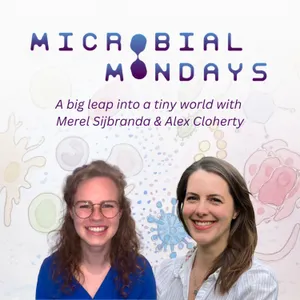
by Merel Sijbranda and Alex Cloherty
Microbes are constantly changing the world around us, in all sorts of seen & unseen ways. From outbreaks of the bubonic plague to outbreaks of SARS, from the yeast used in ancient beers to the yeast in your sourdough starter: microbes shape human experiences, history, & society. Join us in exploring this big microbial world!Microbial Mondays' hosts are scientists who share a passion for science communication. Alex Cloherty holds a PhD in Immunology from the University of Amsterdam, & Merel Sijbranda is completing her PhD in Immunology at the Karolinska Institute. Theme music by Jacky Deng.
Latest Episodes
The most recent episodes — sign up to get AI-powered summaries of each one.
- Jul 6, 202621 min
What does your microbiome have to do with allergies?
Genetics and food exposure in early life can impact if you develop allergies or not. But those aren't the only factors at play!This month we are continuing on the topic of allergies, and this time we will explore how our microbiome and exposure to microbes can impact our risk of developing allergies. We talk about how a diverse microbiome can reduce your risk of allergies and why, and what happens when your microbiome is less well-balanced. And to end - have you heard of the hygiene hypothesis? Well, it has an update... Listen in to find out more about the 'old friends' hypothesis!Key References:Tan J et al. Your Regulatory T Cells Are What You Eat: How Diet and Gut Microbiota Affect Regulatory T Cell Development. Front Nutr. 2022. https://doi.org/10.3389/fnut.2022.878382Gang Y et al. Risk and protective factors for food allergy: an in-depth analysis of dietary patterns and specific dietary components. Allergy Medicine 2025. https://doi.org/10.1016/j.allmed.2025.100076Kim CH & Baker JR. Regulation of allergies across the body by microbial metabolites. Exp Mol Med 2026. https://doi.org/10.1038/s12276-026-01642-1Rook GAW. The old friends hypothesis: evolution, immunoregulation and essential microbial inputs. Front Allergy 2023. https://doi.org/10.3389/falgy.2023.1220481Azad MB et al. Infant gut microbiota and the hygiene hypothesis of allergic disease: impact of household pets and siblings on microbiota composition and diversity. Allergy Asthma Clin Immunol 2013. https://doi.org/10.1186/1710-1492-9-15
- Jun 8, 202615 min
Why do some people get allergies, and others don’t?
Picture this: it’s a clear, bright morning in spring. You’re walking through the park with a friend, and the warm breeze floats delightfully over your skin, bringing with it the fragrant scent of local flowers in bloom, and the dewy smell of fresh grass. You smile, feeling a wave of contentment. “Don’t you love this time of year?” you ask your friend.He sneezes. “I hate it! It’s allergy season again!”Spring is a time that some people can enjoy the blooming life all around them, while others are a sneezing, stuffed up mess. Why is that? In this episode, we’ll try to answer this question. Du Toit G... LEAP Study Team. Randomized trial of peanut consumption in infants at risk for peanut allergy. N Engl J Med. 2015 Feb 26;372(9):803-13. doi: 10.1056/NEJMoa1414850. https://www.nejm.org/doi/full/10.1056/NEJMoa1414850FARE Blog: Celebrating the 10th Anniversary of the LEAP Study. https://www.foodallergy.org/fare-blog/celebrating-10th-anniversary-leap-study
- Apr 6, 202627 min
How HPV causes cancer, and how we can stop it in its tracks
In the last years, especially when the first HPV vaccine came out in 2006, we have heard a lot of commotion around this HPV vaccine and HPV’s link to cancer. In today’s episode, we share the story of how scientists discovered the link between HPV and cancer, and how the HPV vaccine works.
- Mar 2, 202623 min
Microbes in space!
In the last episode of Microbial Mondays, we covered what happens to our immune systems during space flight… but what about the microbes we bring with us? This month, join us in exploring how flying into space can impact microbial life from earth! Main publication discussed:Wilson et al., Space flight alters bacterial gene expression and virulence and reveals a role for global regulator Hfq, Proc. Natl. Acad. Sci. U.S.A. 104 (41) 16299-16304, https://doi.org/10.1073/pnas.0707155104 (2007).
- Feb 2, 202623 min
Your Immune System in Space
Humans have been heading into space to explore beyond earth for decades already. But when we head beyond our own atmosphere, what happens to our immune system? In this episode, we dive into astro-immunology: a sub-field of immunology that focuses on how our immune system responds to spaceflight. Let's dive in! Key reference: Winer D.A. et al. Astroimmunology: the effects of spaceflight and its associated stressors on the immune system. Nat Rev Immunol (2025). https://doi.org/10.1038/s41577-025-01226-6
- Jan 12, 202628 min
Permafrost Pandora’s Box
The summer of 2016 was warm in Siberia. So warm that the permafrost melted more than usual… releasing a dangerous microbe out onto the surface. In this episode, we dive into this historical example of an old microbe emerging from the permafrost, talk about how microbes can survive in the deep cold… and idee should be worried about what else might emerge.
- Dec 1, 202525 min
The Nobel Prize in Physiology or Medicine 2025 explained!
Have you ever wondered how our immune system finds the balance in attacking invading viruses and bacteria that try to enter our bodies, but not attacking our own body cells? The groundbreaking discoveries concerning this topic, called 'peripheral immune tolerance', by Mary E. Brunkow, Fred Ramsdell and Shimon Sakaguchi were awarded the Nobel Prize in Physiology or Medicine 2025! It tells us a lot about how the immune system functions in health and disease!In this episode, we dive into:the discoveries that led to winning this year's Nobel Prize, Mary E. Brunkow, Fred Ramsdell and Shimon Sakaguchi's journey to get to these discoveries,what impact these discoveries have had in the past, still have now, and will have in the future!This podcast episode was created based on the Popular Science Background and Scientific Background published on nobelprize.org . If you are interested in learning more, read here: https://www.nobelprize.org/prizes/medicine/2025/press-release/
- Oct 31, 202522 min
Microbial ghost towns: Life after death in the Necrobiome
Welcome to our Halloween special! Once your heart stops, what happens to all of the microbes that call your body home? Tonight, we explore the silent cities left behind when we die. Scientists call this the necrobiome: the community of microbes that thrive on and around decomposing bodies.In this episode we explore how microbes take over our bodies after death, the impact that decomposing bodies can have on the environment around them, and take a look at how microbial activity can even help forensic scientists estimate time of death.Let's dive into this spooky topic together! More Reading & Sources:Necrobiome framework for bridging decomposition ecology of autotrophically and heterotrophically derived organic matter, Benbow et al. 2018A conserved interdomain microbial network underpins cadaver decomposition despite environmental variables, Burcham et al. 2024Microbial community coalescence and nitrogen cycling in simulated mortality decomposition hotspots, Keenen et al. 2023BBC: Rewilding death: The plan to restore the necrobiome
About Microbial Mondays
Microbes are constantly changing the world around us, in all sorts of seen & unseen ways. From outbreaks of the bubonic plague to outbreaks of SARS, from the yeast used in ancient beers to the yeast in your sourdough starter: microbes shape human experiences, history, & society. Join us in exploring this big microbial world!Microbial Mondays' hosts are scientists who share a passion for science communication. Alex Cloherty holds a PhD in Immunology from the University of Amsterdam, & Merel Sijbranda is completing her PhD in Immunology at the Karolinska Institute. Theme music by Jacky Deng.
Customized Recaps
AI-powered recaps with compact key takeaways, quotes, and insights.
Straight to Your Inbox
Get key takeaways from Microbial Mondays in a 5-minute read.
Save Hours Every Week
Stay current on your favorite podcasts without falling behind.
Frequently Asked Questions
What is Podzilla's Microbial Mondays daily summary?
It's a free AI-powered email that summarizes new episodes of Microbial Mondays as soon as they're published. You get the key takeaways, notable quotes, and links & mentions — all in a quick read.
How does the Microbial Mondays podcast summary work?
When a new episode drops, our AI transcribes and analyzes it, then generates a personalized summary tailored to your interests and profession. It's delivered to your inbox every morning.
Is this an official Microbial Mondays product?
No. Podzilla is an independent service that summarizes publicly available podcast content. We're not affiliated with or endorsed by Merel Sijbranda and Alex Cloherty.
Can I get summaries of other podcasts too?
Absolutely! The free plan covers up to 3 podcasts. Upgrade to Pro for 15, or Premium for 50. Browse our full catalog at /podcasts.
How often does Microbial Mondays release new episodes?
Microbial Mondays publishes monthly. Our AI generates a summary within hours of each new episode.
What topics does Microbial Mondays cover?
Microbial Mondays covers topics including Science, Life Sciences. Our AI identifies the specific themes in each episode and highlights what matters most to you.
Start getting Microbial Mondays summaries tomorrow morning.
Free forever for up to 3 podcasts. No credit card required.
Free forever for up to 3 podcasts. No credit card required.