Free Daily Podcast Summary
Metabolic Mastery: Daily Summaries Delivered
by KORR Medical Technologies
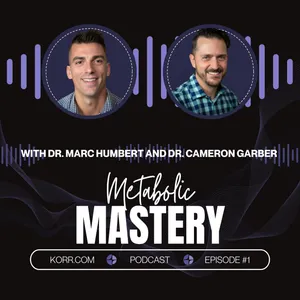
Metabolic Mastery, brought to you by KORR Medical Technologies, is the podcast about everything VO2 Max and beyond. Tips on testing, new research, and much more. Hosted by Dr. Marc Humbert and Dr. Cameron Garber Doctors of Physical Therapy (DPT)
Latest Episodes
The most recent episodes — sign up to get AI-powered summaries of each one.
- 4 days ago51 min
Ep. 79: Why Your “Bad Knee” May Not Be the Real Problem
Get A Demo: https://korr.com/contact/video-demo/“I have a bad knee.” “My back has never been the same since the accident.” In this episode of Metabolic Mastery, hosts Dr. Marc Humbert and Dr. Cameron Garber explain why your body doesn’t actually remember that old injury the way your brain does. They cover how tissues heal and adapt, how bracing and avoidance can reset your brain’s sense of “safe,” and why pain is an alarm system, not always a measure of tissue damage. They also explain the load vs. capacity framework and show how metabolic testing, strength testing, and smart zone 2 training help you rebuild what you can do, without blaming the activity.You Will Learn:Why most injured tissues heal within weeks, and why lingering pain often comes from disuse and avoidance rather than the original injuryHow your body communicates through electrical, chemical, and mechanical signals, and how those signals drive adaptation at any ageWhy bracing or slinging a joint can reset your brain’s “safe zone” and make normal movement feel threateningHow to think of pain as an alarm system and use it as a guide rail (the 0-2, 3-5, 6-7, and 8-10 ranges) instead of pushing through or avoiding itThe load vs. capacity concept and the “envelope of function,” and why going from zero to sixty leads to injuryWhy people blame running or pickleball for injuries that really come from not having “earned the right” to that much loadHow different tissues (muscle vs. tendon) adapt on different timelines, and why that matters for athletes and everyday peopleWhy zone 2 is a safe way to build a base, and how to progress from 99/1 toward an 80/20 intensity splitHow metabolic testing, dynamometry, DEXA, and a thorough history combine into a plan, and why graded exposure and a multimodal approach matter
- 1 weeks ago53 min
Ep 78: Dr. Gains (Michael Kamalu): Why Generic Workouts Fail: The Science of Personalized Training
Most fitness advice was written for the “average body,” and nobody is average from head to toe. In this episode of Metabolic Mastery, hosts Dr. Marc Humbert and Dr. Cameron Garber sit down with Michael Kamalu, founder of Dr. Gains, to explain why generic workouts fail and what truly personalized training looks like. Michael shares his path from a skinny eighth-grade basketball player with a string of injuries to Mayo Clinic Medical School, and how that led him to build tools and a facility around one idea: your training should match your anatomy, your metabolism, your goals, and your constraints. They cover how body proportions and even the number of lumbar vertebrae change how you should lift, why the “best” recovery tool depends on your goal, and how diagnostics like metabolic testing can feed a plan built for you. They also get into blood flow restriction training, rotational loading, and why muscles grow unevenly.You Will Learn:Why generic fitness advice is written for the “average body,” and how anatomical variations (like having four, five, or six lumbar vertebrae) change how you should squat and liftHow limb proportions affect the load your muscles actually feel, and why comparing lifts between two people can mislead youWhy the same recovery tool can help one goal and hurt another, such as a cold plunge after training helping strength but potentially blunting muscle growthHow metabolic testing, muscle function testing, and other diagnostics can combine into one personalized plan instead of ten disconnected opinionsWhy “perfect” training and recovery plans fail if they don’t fit your life, your timeline, and your constraintsHow blood flow restriction (BFR) training lets you build size, strength, and endurance with lighter weights, and why measuring arterial occlusion pressure mattersWhy rotational training is missing from most routines, and how it ties to rotator cuff health and injury preventionHow regional muscle activation works, and why varying your exercises prevents weak points and injuriesWhy muscles adapt faster than tendons and joint capsules, and how to train for long-term resilience instead of short-term gains
- 2 weeks ago1h 8m
Ep. 77: More Data Isn’t Better: Making Sense of Metabolic Test Results
Get A Demo: https://korr.com/contact/video-demo/Metabolic testing can feel overwhelming, but it starts with just four measurements.In this episode of Metabolic Mastery, hosts Dr. Marc Humbert and Dr. Cameron Garber walk through how the cardio coach turns oxygen, carbon dioxide, flow, and heart rate into a deep physiological picture.They sort that data into tiers of reliability, from directly measured values to estimates, and explain how to troubleshoot a test that looks “wrong.” Then they bring it back to simplicity: how to turn complex results into small, sustainable changes that fit a client’s real life, using frameworks like the aggregation of marginal gains and frequency, duration, then intensity.You Will Learn:The four core measurements behind every test (O2, CO2, flow, and heart rate) and how they produce dozens of outputsWhy a fixed-orifice differential pneumotach with no moving parts keeps flow measurement accurate without constant recalibrationThe tiers of data reliability: measured values, calculated values, values using known constants, estimates, thresholds, and normative comparisonsWhy a measured RMR beats predictive equations, which can be off by 200-400 calories either wayWhy “the numbers have to be wrong” is usually a setup, protocol, or client-prep issue, and the fasted, rested, unstimulated rule of thumb for reliable baselinesHow aerobic and anaerobic thresholds are frameworks applied to real physiological inflection points, not single measured valuesWhy a high VO2 max that is dropping can be a worse sign than a lower one that is climbing, using a real client exampleHow to turn complex data into a simple plan with the aggregation of marginal gains and the “90% confidence” test for any new habitWhy to build frequency first, then duration, then intensity, and how to meet each client where they are
- 3 weeks ago1h 14m
Ep. 76: Heart Rate Zones Explained: Why Zone 2 Means Different Things to Everyone
Get A Demo: https://korr.com/contact/video-demo/Heart rate zones might be the most misunderstood concept in fitness — and in this episode of Metabolic Mastery, hosts Dr. Marc Humbert and Dr. Cameron Garber take a deep dive into exactly why. From elite Olympic athletes using completely different zone systems to say the same thing, to the century-old misunderstanding behind "anaerobic threshold," they break down how heart rate zones are actually derived, why physiology is a continuum rather than an on/off switch, and how to use testing data (not guesswork or wearable estimates) to train for the adaptations that actually matter.You Will Learn:Why "zone 2" means something completely different depending on whether you're using a 3-zone, 4-zone, or 5-zone system — and why that causes so much confusion onlineThe real story behind "aerobic" and "anaerobic" thresholds, and why lactate is actually produced continuously, even aerobicallyWhy percentage-based zoning (like 220-minus-age or % of VO2 max) can lead to large individual errors compared to physiology-based zoningWhy wearable VO2 max estimates are a "prediction of a prediction" and can mislead you about your actual fitnessWhy zone 3 is often "the no-progress zone" — hard enough to require recovery, but not hard enough to drive real adaptationThe specific physiological adaptations happening in each zone: capillarization and mitochondrial density in zone 1-2, cardiac output improvements, and top-end power and mitochondrial efficiency in zones 4-5Why consistency (not intensity) is the real driver of long-term change, and how training every day — even lightly — beats sporadic hard effortsThe difference between performance and resilience, and why "surviving" a training program doesn't mean it was optimalHow to use RPE, pace, and power as anchors to your heart rate zones for better self-awareness and auto-regulation
- Oct 13, 20261h 35m
Ep. 75 - Dr. Craig Broeder: The Metabolic Cart Secrets: Why Most Devices Get It Wrong
Get A Demo: https://korr.com/contact/video-demo/Dr. Craig Broeder has spent 45 years at the top of exercise physiology and metabolic testing, training under legends like Jack Wilmore, David Costill, and George Brooks, running biopsy-heavy research trials, and leading elite performance projects for Red Bull's world-class athletes.In this episode of Metabolic Mastery, hosts Dr. Marc Humbert and Dr. Cameron Garber sit down with Dr. Broeder to unpack decades of hard-won lessons on what separates accurate metabolic testing from guesswork, from calibration pitfalls to genetic limits on VO2 max, and why so many popular fitness devices get it dangerously wrong.You Will Learn:How Dr. Broeder's path from professional musician to exercise physiologist began, and the mentors (Wilmore, Costill, Ivy, Coyle) who shaped his careerWhy mixing chamber, breath-by-breath, and mini mixing chamber metabolic systems each have unique strengths and blind spotsThe real-world calibration mistakes (temperature, humidity, drying lines) that silently corrupt test dataShocking accuracy findings from a published Cardio Coach validation study — including one popular consumer system with error rates up to 16.9%Inside the Heritage Project: what large-scale genetic research reveals about how much of your VO2 max improvement is really genetics vs. trainingBehind-the-scenes stories from Red Bull's altitude performance research with elite cyclists and runnersWhy knowing a client's history, goals, and psychological comfort with testing is just as important as the protocol itselfHow Dr. Broeder used metabolic testing to help a client recover from a severely underfed metabolism (800 to 1,290 calories) without weight-loss drugs
- Oct 6, 202653 min
Ep. 74 - Daniel Crumback: The Zoning Mistake: Why Your Heart Rate Zones May Be Wrong
Get Daniel's PTAP Course: https://strategichealthperformance.inspire360.com/p/ptap-foundationsGet A Demo: https://korr.com/contact/video-demo/Most people buying a metabolic analyzer have no idea how much data they're leaving on the table. In this episode of Metabolic Mastery, hosts Dr. Marc Humbert and Dr. Cameron Garber sit down with Daniel Crumback, KORR's Director of International Sales and a certified exercise physiologist, chartered physiotherapist, and strength and conditioning specialist with 30 years of testing experience, to break down how to get the absolute most out of your cardio coach.They cover why VO2 max alone only tells half the story, the hidden difference between metabolic and ventilatory zoning methods, the testing mistakes that quietly wreck your data, and why retesting (not just testing) is where the real transformation happens.You Will Learn:Why VO2 max is just "the sexy thing to sell", and what data actually drives real programming decisionsThe critical difference between metabolic (RER-based) and ventilatory (VE/VO2, VE/VCO2) zoning methods, and why they can produce zones 20-30 beats apartHow to identify a client's true physiological limiter (cardiovascular, respiratory, or metabolic) and zone accordinglyWhy "peak" and "max" aren't the same thing, and how missing a true max (RER of 1.15+) leaves critical zone-five data off the tableThe proper testing protocol: a 5-minute low-intensity warm-up, correctly sized increments, and tests lasting 9-12 minutesWhy RMR and VO2 max testing should never be done in isolation from each otherHow VO2 pulse and peak VO2/breathing frequency can reveal undiagnosed cardiac and respiratory issuesWhy retesting, not a one-and-done test, is what truly drives client retention and long-term resultsHow mismatched fat/carb utilization at rest vs. during exercise points directly to nutrition issues
- Sep 29, 20261h 12m
Ep. 73-Dr.Thomas George: The Doctor Who Lost 120 Pounds:Inside the Science of Adaptive Thermogenesis
Get A Demo: https://korr.com/contact/video-demo/Dr. Thomas George didn't set out to become an obesity medicine specialist — a traumatic brain injury and a 120-pound weight gain got him there. In this episode of Metabolic Mastery, Dr. Mark Humbert and Dr. Cameron Garber sit down with Dr. George, founder of Wellspring Weight and Wellness, to unpack the science and story behind sustainable weight management.Dr. George shares his own journey from competitive martial artist to 330 pounds and back, and how a neuroendocrinologist's diagnosis changed the way he sees — and treats — obesity. The conversation dives deep into adipocyte biology, why "it's not about the weight," the real data behind adaptive thermogenesis, and why so many patients on GLP-1 medications still hit frustrating plateaus.You Will Learn:Why obesity is best understood as a "disease of diseases" and what that means for treatmentHow the personal fat threshold and adipocyte hypertrophy drive metabolic dysfunctionWhat resting energy expenditure testing reveals about adaptive thermogenesis — and why its effects can persist up to six yearsWhy GLP-1/GIP medications don't fix metabolism on their own, and what's missing from many prescribing plansHow building metabolically healthy muscle protects against weight regain and sarcopeniaWhy exercise matters more for maintenance than for initial weight lossHow cultural food patterns (Mediterranean, Inuit, Hispanic heritage diets) inform sustainable eatingWhy calorie quality, density, and dosage matter more than any single "diet"Subscribe: https://www.youtube.com/@korrmed
- Sep 22, 202650 min
Ep. 72 - How to Warm Up Clients for Accurate VO2 Max & Metabolic Testing
Get A Demo: https://korr.com/contact/video-demo/Should every client do a warm-up before a VO2 max test? In this episode of Metabolic Mastery, Dr. Marc Humbert and Dr. Cameron Garber tackle a question that's surprisingly underexplored in the exercise science literature: how to properly warm up a client before metabolic testing.They break down the three main purposes of a warm-up — transition, familiarization, and priming — and introduce their practical R.E.A.D.Y. framework to help practitioners decide exactly how much (or how little) warm-up a given client needs. From elite athletes to deconditioned beginners, from ramp protocols to fat max testing, Marc and Cameron walk through real-world scenarios, mask familiarization tips, and how to use heart rate as a readiness indicator before you ever hit "start" on the test.You Will Learn:The three primary purposes of a warm-up: transition, familiarization, and primingWhy "it depends" is the right answer for whether a client needs a warm-upThe R.E.A.D.Y. framework: Reason, Estimate, Acclimate, Dose, and confirming they're readyHow to use heart rate stability as a signal that a client is ready to begin testingWhy building the warm-up into the protocol can save time without sacrificing data qualityTips for helping clients get comfortable with the mask and equipment before testing startsHow to document warm-up protocols in Cardio Coach software for consistent repeat testingWhen elite athletes need a separate warm-up vs. when to skip it for deconditioned clients
About Metabolic Mastery
Metabolic Mastery, brought to you by KORR Medical Technologies, is the podcast about everything VO2 Max and beyond. Tips on testing, new research, and much more. Hosted by Dr. Marc Humbert and Dr. Cameron Garber Doctors of Physical Therapy (DPT)
Customized Recaps
AI-powered recaps with compact key takeaways, quotes, and insights.
Straight to Your Inbox
Get key takeaways from Metabolic Mastery in a 5-minute read.
Save Hours Every Week
Stay current on your favorite podcasts without falling behind.
Frequently Asked Questions
What is Podzilla's Metabolic Mastery daily summary?
It's a free AI-powered email that summarizes new episodes of Metabolic Mastery as soon as they're published. You get the key takeaways, notable quotes, and links & mentions — all in a quick read.
How does the Metabolic Mastery podcast summary work?
When a new episode drops, our AI transcribes and analyzes it, then generates a personalized summary tailored to your interests and profession. It's delivered to your inbox every morning.
Is this an official Metabolic Mastery product?
No. Podzilla is an independent service that summarizes publicly available podcast content. We're not affiliated with or endorsed by KORR Medical Technologies.
Can I get summaries of other podcasts too?
Absolutely! The free plan covers up to 3 podcasts, any in the catalog. Basic raises that to 15, Pro to 40 and Max to 100. Browse our full catalog at /podcasts.
How often does Metabolic Mastery release new episodes?
Metabolic Mastery publishes weekly. Our AI generates a summary within hours of each new episode.
What topics does Metabolic Mastery cover?
Metabolic Mastery covers topics including Nutrition, Fitness, Health & Fitness. Our AI identifies the specific themes in each episode and highlights what matters most to you.
Start getting Metabolic Mastery summaries tomorrow morning.
Free forever for up to 3 podcasts. No credit card required.
Free forever for up to 3 podcasts. No credit card required.