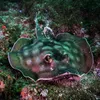
Hi friends! We're still taking a bit of a summer pause. We'll be back at the end of August—in the meanwhile, enjoy this listener favorite from our archives! ----- [originally aired September 19, 2024] There's a bit of a buzz out there, right now, but maybe you haven't noticed. It's in the water, it's in the air. It's electricity—and it's all around us, all the time, including in some places you might not have expected to find it. We humans, after all, are not super tuned in to this layer of reality. But many other creatures are—and scientists are starting to take note. My guest today is Dr. Sam England. Sam is a sensory ecologist at the Natural History Museum in Berlin, and one of a handful of scientists uncovering some shocking things about the role of electricity in the natural world. Here, Sam and I have a wide-ranging conversation about electroreception—which is the perception of electrical stimuli—and electric ecology—which is the study of the ecological roles of electricity. We talk about how an interest in electroreception first got started, and why it's recently resurged. We discuss aquatic electroreception versus aerial electroreception, active electroreception versus passive electroreception. We talk about how electroreception is actually kind of easy to evolve. Along the way, we consider electrolocation and, its analog in sound, echolocation. We touch on dolphins, sharks, echidnas, ticks, caterpillars, bees, and spiders. We zoom in on electrostatic pollination, and what is inarguably the coolest sounding anatomical structure known to biology: the ampullae of Lorenzini. I think you'll enjoy this one, friends. As Sam describes here, electroreception is one of those "alien senses"—it really challenges the imagination. And electric ecology is one of those frontiers in our understanding of the natural world. So without further ado, here's my chat with Dr. Sam England. Enjoy! A transcript of this episode is available here. Notes and links 3:00 – For many of the topics discussed in this episode, see this comprehensive recent review of electroreception and electric ecology by Dr. England and a colleague. 7:30 – A paper reviewing the (contested) phenomenon of electromagnetic hypersensitivity in humans. 9:30 – An encyclopedia article on electroreception in monotremes. 13:00 – An early study of electrolocation in "weakly electric" fish. 17:00 – A popular article about the discovery of electroreception in sharks. 20:30 – A 2013 study showing that bumblebees detect the electric fields around flowers. 23:30 – A recent review of electroreception and its evolution in fish. 25:00 – A study demonstrating electroreception in the Guiana dolphin. 34:00 – A recent <a href= "https://www.cell.com/current-biology/fulltext/S0960-9822(23)00772-8?_hsmi=263616874&_hsenc=p2ANqtz--faOOOSB
Podzilla Summary coming soon
Sign up to get notified when the full AI-powered summary is ready.
Free forever for up to 3 podcasts. No credit card required.
Listen to This Episode



Get summaries like this every morning.
Free AI-powered recaps of Many Minds and your other favorite podcasts, delivered to your inbox.
Free forever for up to 3 podcasts. No credit card required.