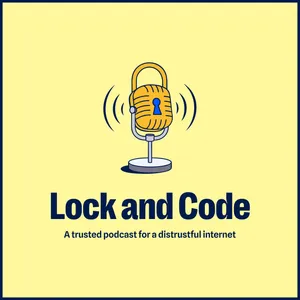
Free Daily Podcast Summary
Lock and Code: Daily Summaries Delivered
by Malwarebytes
Lock and Code tells the human stories within cybersecurity, privacy, and technology. Rogue robot vacuums, hacked farm tractors, and catastrophic software vulnerabilities—it’s all here.
Latest Episodes
The most recent episodes — sign up to get AI-powered summaries of each one.
- Yesterday39 min
The AI plot to scan and destroy books (feat. Emanuel Maiberg)
If you want AI to tell you a story, it will. If you want that story to sound like one of your favorite authors, it can. And if you’re one of the authors that AI can imitate, you might be a little upset at what feels like theft.In 2024, the authors Andrea Bartz, Charles Graeber, and Kirk Wallace Johnson sued Anthropic, the creator of Claude, alleging that the company had wrongfully digested millions of copyrighted works—including some of their very own—to train its AI models. The lawsuit grew to include more than 300,000 writers, and in September 2025, Anthropic agreed to pay $1.5 billion to settle the claims.That headline-worthy payout, however, would eventually be paired with more startling news.In January 2026, a district court judge unsealed thousands of documents related to the litigation. When The Washington Post investigated the documents, reporters found references to a secret project inside Anthropic called “Project Panama,” which Anthropic itself described as the company’s effort “to destructively scan all the books in the world.”Anthropic is not alone in this.On August 17, 404 Media co-founder and reporter Emanuel Maiberg revealed that Amazon is doing something similar inside a department it calls VGT3. By hiding an Apple AirTag in one book from a 1,000-book order, and then tracking the shipment across the country, 404 Media identified the book’s final destination to be a facility outside Las Vegas, where, according to employees, books are cut apart and scanned.Today, on the Lock and Code podcast with host David Ruiz, we speak with Maiberg about Amazon’s VGT3 operation and the likely commonplace practice of AI companies purchasing, scanning, and destroying books in an effort to build “frontier” models.“They’re buying a book, they’re scanning it, they’re mulching the book, and then the digital version of the book exists behind this wall where we don’t even know if they plan to sell it, right? It’s like they might keep it behind a wall, and the only way we see it come out again from behind that wall is in the form of an answer from a chatbot.”Tune in today.You can also find us on Apple Podcasts, Spotify, and whatever preferred podcast platform you use.For all our cybersecurity coverage, visit Malwarebytes Labs at malwarebytes.com/blog.Show notes and credits:Intro Music: “Spellbound” by Kevin MacLeod (incompetech.com)Licensed under Creative Commons: By Attribution 4.0 Licensehttp://creativecommons.org/licenses/by/4.0/Outro Music: “Good God” by Wowa (unminus.com)Listen up—Malwarebytes doesn't just talk cybersecurity, we provide it.Protect yourself from online attacks that threaten your identity, your files, your system, and your financial well-being with our exclusive offer for Malwarebytes Premium for Lock and Code listeners.
- 2 weeks ago39 min
Loyalty points fraud is funding hacker holidays (feat. Kim Sutherland)
Crooks are taking a holiday. They’re counting on you to fund it.For decades, cybercriminals have stolen roughly the same types of data. Biographical and personal details—like Social Security numbers, birthdates, addresses, and phone numbers—can be stolen to commit identity fraud. Credit card numbers, expiration dates, and CVC codes can be stolen to make fraudulent purchases. Usernames and passwords can, in the wrong hands, let a cybercriminal impersonate someone, steal sensitive photographs to later use for extortion, or abuse a reputation.All of these attack models seek to turn sensitive or important data into currency. But an emerging form of digital fraud is targeting data that, when used strategically, practically is currency: Loyalty points.Loyalty points programs are run by nearly every type of consumer-facing business today, from hotels to airlines to grocery stores to donut shops. As repeat customers accrue these points, they can exchange them for discounted prices on future purchases, cutting the costs of hotel stays, flights, rental cars, and even entire vacations.But the value stored within these loyalty points makes them a high target for cybercrime, said Kim Sutherland, Global Head of Fraud and Identity at LexisNexis® Risk Solutions.“Most loyalty currency is worth about one cent per point, and then there are premium programs that can be worth more than that,” Sutherland said, explaining that 100,000 airlines points, for example, can be worth $1,000 in the US. “Why criminals care so much about this is because most of us are not paying attention to our loyalty programs the same way we would our bank account.”But diligence is much needed here, Sutherland said, noting that one Chicago teacher only learned that 240,000 of his airlines points had been stolen because he received a basic confirmation email about their use. In another example, a man’s airline miles were stolen and fraudulently used to book rental cars in New York and Memphis.Today, on the Lock and Code podcast with host David Ruiz, we speak with Sutherland about loyalty points theft— how it happens, what companies are doing to protect customers, and what people can do to stay safe.“Some of us don’t even know how to access those points, right? Or we don’t even know we’re accumulating them, but the fraudsters do.”Tune in today.You can also find us on Apple Podcasts, Spotify, and whatever preferred podcast platform you use.For all our cybersecurity coverage, visit Malwarebytes Labs at malwarebytes.com/blog.Show notes and credits:Intro Music: “Spellbound” by Kevin MacLeod (incompetech.com)Licensed under Creative Commons: By Attribution 4.0 Licensehttp://creativecommons.org/licenses/by/4.0/Outro Music: “Good God” by Wowa (unminus.com)Listen up—Malwarebytes doesn't just talk cybersecurity, we provide it.Protect yourself from online attacks that threaten your identity, your files, your system, and your financial well-being with our exclusive offer for Malwarebytes Premium for Lock and Code listeners.
- 4 weeks ago36 min
What happens to your data when you die? (feat. Tamara Kneese)
You will die. Your data will not.The afterlife of our information is a recent phenomenon, and some of the companies with the most to sort through are still just figuring it out.As far back as 2007, Facebook was forced to reckon with mass grief when users asked the company to maintain the profile pages of the 32 victims killed by a school shooter at Virginia Tech that year. Those pages became de facto memorials for loved ones to fill with comments, and today, memorialization has become a full-fledged feature on both Facebook and Instagram. Platforms like YouTube, Pinterest, and LinkedIn—launched with likely zero strategy for a user’s death—now have procedures for next-of-kin to request that a deceased person’s account be deactivated.Now, think about all the other ways your data can linger after death.Every year, people accumulate more and digital stuff—email addresses, social media profiles, contact lists, domain names, subscription services, online banking accounts, and the phones, laptops, and tablets that hold it all—and every year, as that digital stuff accumulates, it compounds into ever more problems for someone else to sort out. Here, a small industry of digital estate planners have cropped up, helping families retrieve and preserve anything valuable, no matter how digital, from Spotify playlists, to poignant social media posts that mattered, to the photos stored on a phone.And where retrieval fails, artificial intelligence has offered an attempt at comfort. The chatbot service Replika launched in 2015 after its founder uploaded a dead friend’s text messages. HereAfter AI reportedly let users upload voice recordings to power a chatbot that sounded and spoke like the deceased. Film studios have pursued the same idea for entertainment, seeking to portray deceased actors in future films.Surprisingly, almost none of this activity is governed by law, said Tamara Kneese, author of the 2023 book “Death Glitch: How Techno-Solutionism Fails Us in This Life and Beyond.”“By and large, there is not a great legal mechanism for protecting the privacy rights of the dead,” said Kneese. “It may not be just that a grieving loved one decides to use a bunch of your data from all of your podcasts to create a chatbot to simulate interacting with you after you’re dead, but it may be that a company chooses, in some way, to use an aspect of your personality, of your demeanor, of your voice, of your likeness after your death without anyone really being aware.”Today, on the Lock and Code podcast with host David Ruiz, we speak with Kneese—Senior Research Scientist at Partnership on AI—about who owns a person’s data after they die, why every platform has invented its own private policy for the dead, and how the technology built to keep the dead close can vanish just as suddenly as they did.Or worse yet, as Kneese warned for those relying heavily on certain technologies in grief:“The company gets sold to someone else or disappears, goes bankrupt, and you no longer have that outlet or place for interaction when you’re mourning another time.”Tune in today.You can also find us on Apple Podcasts, Spotify, and whatever preferred podcast platform you use.For all our cybersecurity coverage, visit Malwarebytes Labs at malwarebytes.com/blog.Show notes and credits:Intro Music: “Spellbound” by Kevin MacLeod (incompetech.com)Licensed under Creative Commons: By Attribution 4.0 Licensehttp://creativecommons.org/licenses/by/4.0/Outro Music: “Good God” by Wowa (unminus.com)Further reading:Fartein Hauan Nilsen, “Caring for the Algorithm: Care, Love, and the Relational Personhood of Chatbots,” Somatosphere, February 26, 2026Fartein Hauan Nilsen, “Therapeutic ideology and AI personhood: an anthropological inquiry into AI companionship,” a chapter from “Handbook on Anthropology and Artificial Intelligence,” Edward El
- Aug 9, 202639 min
How to fake a data trail (and maybe lower prices) (feat. Chris Parr)
It may sound entirely bizarre but the prices you once paid for hotels, educational classes, or staplers could have all been higher because you used a Mac computer, lived in a certain zip code, or lacked an Office Depot in your neighborhood.No, really.In 2012, The Wall Street Journal reported that the travel booking site Orbitz showed Mac users pricier hotel options than PC users, because the company had determined that Mac users spend, on average, 30% more a night on hotels. That same year, The Wall Street Journal (once again) reported that Staples.com showed higher prices to visitors who lived farther away from a competitor like Office Depot. And in 2015, the reporting outfit ProPublica revealed that customers in certain zip codes were shown higher prices for college test prep courses offered by The Princeton Review.As that investigation found, if customers:“type some zip codes into the company’s website, they are offered The Princeton Review’s premier course for as little as $6,600. For other zip codes, the same course cost as much as $8,400. One unexpected effect of the company’s geographic approach to pricing is that Asians are almost twice as likely to be offered a higher price than non-Asians.”This is surveillance pricing put into action.Under surveillance pricing, companies collect as much data as possible about consumers so that they can alter the literal prices those consumers pay for the exact same goods as everyone else. It is reportedly what caused some customers to see higher prices for televisions in the Target app when those customers were physically located in a Target parking lot. It is also allegedly why Home Depot customers in wealthy neighborhoods oddly paid less. And it is what Delta Airlines walked away from after public backlash.The near-omnipresence of surveillance pricing is also why so many videos can be found online today that claim that minor alterations to a person’s data trail—like changing an IP address using a VPN or shopping for airline tickets on a public library’s computer—can lead to lower prices online.The proof behind these claims, however, is harder to test.Thankfully, one person has already tried.Video journalist Chris Parr, known on YouTube as Chris the Producer, ran a wild experiment into whether he could “stress-test” surveillance pricing. Far beyond changing his IP address or making online purchases from different locations, Parr started from scratch. By first registering an LLC in the state of Wyoming, Parr granted that LLC both a credit card and a phone, effectively creating a brand new consumer persona to be tracked. But creating a realistic data trail for his LLC would require a little extra help—help that Parr received from an actor he hired for the part.Today, on the Lock and Code podcast with host David Ruiz, we speak with Parr about his experiment into surveillance pricing, including a high-wire drone act to purchase a White Castle Crave Case in the air space above his home state’s wealthiest neighborhood:“To the data collectors, they don’t know that this phone is floating in the air, like 200 feet in the air. They just see a geolocation on it.”Tune in today.You can also find us on Apple Podcasts, Spotify, and whatever preferred podcast platform you use.For all our cybersecurity coverage, visit Malwarebytes Labs at malwarebytes.com/blog.Show notes and credits:Intro Music: “Spellbound” by Kevin MacLeod (incompetech.com)Licensed under Creative Commons: By Attribution 4.0 License<
- Jul 26, 202624 min
What's your data worth on the dark web?
Twenty years ago, a British mathematician named Clive Humby popularized a phrase that came to describe data’s relationship with the entire global economy: “Data is the new oil.”Pithy as the phrase sounds, it is undeniably true.Data steers decisions at businesses of every size. Data created entirely new industries built around its capture. And, for a select number of companies, data has produced billions—if not trillions—of dollars in value.So how is it that, on the dark web, your stolen identity can be purchased for just 95 cents?That’s what a Malwarebytes researcher found last month after spending 48 hours inside the dark web to investigate cybercrime. Across a variety of forums and directories, he found subscription plans for malware that steals information once implanted on a device. He found guides for deploying social engineering scams. He found people selling their services to build fake websites that trick people into handing over their usernames and passwords. And he found one of the dark web’s most traded commodities—personal data, packaged together about individual people, to help a cybercriminal commit identity fraud.These packages are called “fullz.” For victims in the United States, a fullz contains a full name, Social Security Number, date of birth, address, and other personal details. That is enough, on its own, for a cybercriminal to potentially open a bogus line of credit, file a fake tax return, access financial accounts, or obtain medical services under someone else’s name.As we wrote on Malwarebytes Labs:“For less than the cost of a cup of coffee, a cybercriminal can buy enough information to devastate someone’s financial life.”It’s the kind of risk that could scare anyone, especially considering the scale behind it. In just the first six months of 2026, Malwarebytes found more than 7,500 compromised data sets on the dark web containing more than 8.4 billion records.And yet, even today, cybersecurity professionals still get ask why anyone should bother protecting their data.The public, understandably, are exhausted. With data breaches happening every week—if not every day—caring about cybersecurity starts to feel pointless. With young people unable to build financial security, they start believing that they have nothing worth stealing. And with Big Tech already collecting our every movement, behavior, click, and concern, people understandably feel powerless to fight any kind of data abuse, corporate or criminal.So today’s episode approaches the question from a different direction. This isn’t about why you should protect yourself—plenty of company websites will tell you that, and most of them rely on fear. This is about why hackers want your data in the first place.Today, on the Lock and Code podcast, host David Ruiz explains how cybercriminals turn a single repeated password into account takeover, how a screenshot of your house from Google Maps became a tool in extortion emails, and why the most benign information about you—an address, an age, one public photo—is often the most useful data a stranger can buy.Tune in today.You can also find us on Apple Podcasts, Spotify, and whatever preferred podcast platform you use.For all our cybersecurity coverage, visit Malwarebytes Labs at malwarebytes.com/blog.Show notes and credits:Intro Music: “Spellbound” by Kevin MacLeod (incompetech.com)Licensed under Creative Commons: By Attribution 4.0 Licensehttp://creativecommons.org/licenses/by/4.0/Outro Music: “Good God” by Wowa (unminus.com)Listen up—Malwarebytes doesn't just talk cybersecurity, we provide it.Protect yourself from online attacks that threaten your identity, your files, your system, and your financial well-being with our exclusive offer for Malwarebytes Premium for Lock and Code listeners.
- Jul 12, 202639 min
Trusting your kids online isn't enough
There is a lot going on right now regarding the safety of kids online.In the United States, the majority of state legislatures have passed age verification laws requiring a variety of websites to more rigorously verify the age of their visitors. In the United Kingdom, Canada, Norway, Spain, and Germany, lawmakers are considering bans on social media access for anyone under the age of 16—Australia passed its ban in 2025. In schools across the world, smartphones have been removed from classrooms, hallways, and cafeterias. And online, some of the most popular apps and video games with children, such as Discord and Roblox, have implemented default restrictions on what young users can find and who they reach.But all this activity comes after rising crises at home, as an increasing number of behavioral researchers connect increased social media use with increased rates of depression, isolation, and suicidal thoughts. So, until real, societal change takes place, what is a concerned parent to do?That’s what we’re trying to answer today.Today, on the Lock and Code podcast with host David Ruiz, we bring back Anna Brading, editor-in-chief of Malwarebytes Labs and director of content and, perhaps most importantly, mother of three. With a long career in cybersecurity—and an equally long time spent reading, writing, and assigning some of the cybersecurity world’s most pressing headlines—Brading has a unique perspective on what is most dangerous to her children online.Brading’s list of priorities is long, and includes improper image use, “online nastiness,” and Roblox, but she has a few rules and guidelines to help. She sets a one-hour-a-day video game limit on the weekends, restricts YouTube to a communal and monitored activity, and requests that no one share photos of her children online without her express permission. Importantly, she also reminds parents to trust their guts.“If the norm now is mental health issues or online grooming or non-consensual porn or constant comparison, then I’m okay without my kids fitting in. I would say be radical, buck the trend, don’t do what everybody else is doing. Say no to things you don’t feel comfortable with.”Tune in today.You can also find us on Apple Podcasts, Spotify, and whatever preferred podcast platform you use.For all our cybersecurity coverage, visit Malwarebytes Labs at malwarebytes.com/blog.Show notes and credits:Intro Music: “Spellbound” by Kevin MacLeod (incompetech.com)Licensed under Creative Commons: By Attribution 4.0 Licensehttp://creativecommons.org/licenses/by/4.0/Outro Music: “Good God” by Wowa (unminus.com)Listen up—Malwarebytes doesn't just talk cybersecurity, we provide it.Protect yourself from online attacks that threaten your identity, your files, your system, and your financial well-being with our exclusive offer for Malwarebytes Premium for Lock and Code listeners.
- Jun 28, 202641 min
This pay gap is programmed (feat. Veena Dubal)
Pay is personal for plenty of Americans, but a new distribution model that consumes vast quantities of worker data is turning pay into something else: personalized.For an increasing number of workers in America, the money they can expect to be paid on any given day, week, or month is unknown to them. They could work the same number of hours as they did the shift before. They could help the same number of customers. They could do everything, as nearly similar as possible, and still be paid less than another worker in the exact same position, or even themselves just last week.The mechanism behind this pay disparity is called algorithmic wage discrimination and while the term may be new, it’s inner workings could sound quite familiar.Algorithmic wage discrimination describes the zig-zag pay that is meted out to contract workers by big companies like Uber and Amazon. Whereas many workers in the world rely on salaries, or commissions, or self-determined contract rates, workers at Uber are different.In the same way that Uber decides what you pay for a ride to the airport, Uber also decides what a driver makes. And the calculus behind that decision is opaque. Location, traffic, the time of day, and the number of drivers on the road all play some role, but not a complete one. And in the same way that Uber incentivizes you with a flash sale or a price so high that you maybe walk a couple blocks in a different direction to get a lower price, Uber incentivizes drivers with bonuses and challenges, keeping them on the road perhaps longer than they intended.The end result, then, isn’t just unpredictable pay—it’s potentially an attempt to predict and control behavior.For her 2023 paper, titled “On Algorithmic Wage Discrimination,” professor of law Veena Dubal spoke with many Uber drives who compared this system to “casino culture,” in that the pay is unpredictable but the potential for a jackpot—or, just a good payment on one ride—is enough to convince drivers to stick around, night after night, hour after hour.As one driver told Dubal:“It’s like gambling! The house always wins.”Today, on the Lock and Code podcast with host David Ruiz, we speak with Dubal—professor of law at the UC Irvine School of Law—about how algorithmic wage discrimination works, what data it consumes to function, and the threat it poses as it creeps from gig work into many more industries.Tune in today.You can also find us on Apple Podcasts, Spotify, and whatever preferred podcast platform you use.For all our cybersecurity coverage, visit Malwarebytes Labs at malwarebytes.com/blog.Show notes and credits:Intro Music: “Spellbound” by Kevin MacLeod (incompetech.com)Licensed under Creative Commons: By Attribution 4.0 Licensehttp://creativecommons.org/licenses/by/4.0/Outro Music: “Good God” by Wowa (unminus.com)Listen up—Malwarebytes doesn't just talk cybersecurity, we provide it.Protect yourself from online attacks that threaten your identity, your files, your system, and your financial well-being with our exclusive offer for Malwarebytes Premium for Lock and Code listeners.
- Jun 14, 202621 min
Deepfake porn sites are going offline (re-air) (feat. David Chiu)
If you weren’t taking deepfakes seriously before, it’s too late now to ignore them.According to new research from Malwarebytes, one in three people who use AI every day said it’s okay to generate pornography of people without their consent.Nearly 10 years ago, “deepfake” technology provided hobbyists and film editors with artificial intelligence (AI) tools to swap the face of one person onto the body of another. In its infancy, this technology brought silly film experiments like swapping Tom Cruise in Mission Impossible with Keanu Reeves. Today, this same technology produces something far more harmful—fake nude images of teenagers.On the Lock and Code podcast today with host David Ruiz, we are re-visiting an interview from 2024, in which we spoke with a lawyer named David Chiu about his lawsuit against 16 deepfake nude generation websites.The websites named in that lawsuit often needed just one image of a person to generate fake pornography. And while nearly everyone has at least one image of themselves online, even if they had hundreds, the path towards deletion is somewhat understood—start by deactivating and deleting popular social media accounts. But for teenagers today, raised mostly online, and who share images directly with friends and boyfriends and girlfriends and exes, it’s likely impossible to remove every visual trace of themselves. Also, they shouldn’t have to face this problem alone.The Lock and Code podcast frequently discusses structural problems that require individual management. You have to skirt corporate data collection. You have to find the automated license plate readers in your hometown. You have to review every single message you get with a certain antagonism, to guard yourself against scams.So, it’s rare to encounter a solution that benefits more than one person.Chiu serves as the City Attorney for San Francisco, which means his department can file a lawsuit on behalf of not just the people of San Francisco, but also California, and that’s what his team did in going after the deepfake websites.Since then, Chiu’s department has shut down 10 deepfake nude websites, and it received a settlement agreement from a company called Briver LLC to no longer operate any website that creates nonconsensual deepfake pornography.And, as California goes, so goes the nation.In May of last year, the Take It Down Act became effective as law in the United States, which criminalizes “revenge porn” and AI-generated nonconsensual intimate imagery. The law is not perfect but so far it is being used as intended. Last month, two men in the US were among the first to be charged with violating the Take It Down act for allegedly creating deepfake nudes that, according to the AP, “included both celebrities as well as private women, including recent high school graduates.”Today, we revisit our conversation with San Francisco City Attorney David Chiu about the important fight against deepfake porn and the clear threat that his department found against the public.“At least one of these websites specifically promotes the non-consensual nature of this. So, and I’ll just quote, ‘Imagine wasting time taking her out on dates when you can just use website X to get her nudes.'”Tune in today.You can also find us on Apple Podcasts, Spotify, and whatever preferred podcast platform you use.For all our cybersecurity coverage, visit Malwarebytes Labs at malwarebytes.com/blog.Show notes and credits:Intro Music: “Spellbound” by Kevin MacLeod (incompetech.com)Licensed under Creative Commons: By Attribution 4.0 Licensehttp://creativecommons.org/licenses/by/4.0/Outro Music: “Good God” by Wowa (unminus.com)Listen up—Malwarebytes doesn't just talk cybersecurity, we provid
Get Lock and Code summaries in your inbox
Free AI-powered daily recaps. Key takeaways, quotes, and mentions — in a 5-minute read.
Get Free Summaries →Free forever for up to 3 podcasts. No credit card required.
You Might Also Like
Listeners also like.

The Dark Web Diaries
Explores cybersecurity topics, hacker motivations, and weekly cyber news to demystify online safety and the dark web.

Taylor Lorenz’s Power User
Examines how technology and internet culture reshape society, fame, and free speech through weekly deep dives and policy discussions.

Decoder with Nilay Patel
Conversations with innovators and policymakers exploring the impact of technology and business on the future.

Cyber Hack
A true-crime podcast examining notorious cybercriminal groups and their global hacking sprees, from bank heists to ransomware attacks.
dot com: The Hacking
A journalist investigates the rise of cyberattacks in the post-Cold War era, exploring who is behind them and their global impact.

Cyberside Chats: Cybersecurity Insights from the Experts
Cybersecurity experts discuss emerging threats, defense strategies, and AI's role in protecting organizations.
Hacked
Stories of hacking, tech scams, and digital mysteries explored by two hosts diving into how systems are built and broken.

Security Now (Audio)
A weekly deep dive into cybersecurity news, hacking trends, and digital defense strategies for professionals and individuals.

Darknet Diaries
True stories of hacking, cybercrime, and data breaches from the dark side of the Internet.
Decoded | Unlock The Secrets of Human Behavior, Emotion and Motivation
Explores subconscious patterns behind human behavior and provides tools to rewire destructive cycles and live with intention.
Uncanny Valley | WIRED
A weekly look at Silicon Valley’s tech, power, and influence through interviews and insider reporting from WIRED journalists.

The Kim Komando Show
A weekly show offering tech news, gadget reviews, and digital privacy advice with expert tips and listener call-ins.
About Lock and Code
Lock and Code tells the human stories within cybersecurity, privacy, and technology. Rogue robot vacuums, hacked farm tractors, and catastrophic software vulnerabilities—it’s all here.
Customized Recaps
AI-powered recaps with compact key takeaways, quotes, and insights.
Straight to Your Inbox
Get key takeaways from Lock and Code in a 5-minute read.
Save Hours Every Week
Stay current on your favorite podcasts without falling behind.
Frequently Asked Questions
What is Podzilla's Lock and Code daily summary?
It's a free AI-powered email that summarizes new episodes of Lock and Code as soon as they're published. You get the key takeaways, notable quotes, and links & mentions — all in a quick read.
How does the Lock and Code podcast summary work?
When a new episode drops, our AI transcribes and analyzes it, then generates a personalized summary tailored to your interests and profession. It's delivered to your inbox every morning.
Is this an official Lock and Code product?
No. Podzilla is an independent service that summarizes publicly available podcast content. We're not affiliated with or endorsed by Malwarebytes.
Can I get summaries of other podcasts too?
Absolutely! The free plan covers up to 3 podcasts. Upgrade to Pro for 15, or Premium for 50. Browse our full catalog at /podcasts.
What topics does Lock and Code cover?
Lock and Code covers topics including News, Technology. Our AI identifies the specific themes in each episode and highlights what matters most to you.
Start getting Lock and Code summaries tomorrow morning.
Free forever for up to 3 podcasts. No credit card required.
Free forever for up to 3 podcasts. No credit card required.