Free Daily Podcast Summary
Let's Talk Energy: Daily Summaries Delivered
by Rystad Energy
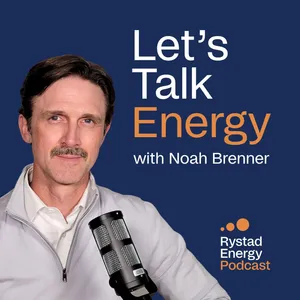
Let’s Talk Energy is a podcast from Rystad Energy that delivers timely, expert-led insights into the global energy landscape. Hosted by Noah Brenner, who has covered the evolution of energy for more than 20 years, each episode features in-depth conversations with Rystad Energy experts, as well as the occasional special guest.Together, we explore the most important developments shaping the energy world, from oil production and power demand to market-moving geopolitics. Whether you're an industry veteran or simply curious about energy and its impact to our world, you'll find clear and thoughtful discussions. Have a question, a topic suggestion, or want to chat with us?Email podcast@rystadenergy.com and visit our website <a target="_blank" rel="noopener noreferrer nofollow" classname="text-underline" href="h
Latest Episodes
The most recent episodes — sign up to get AI-powered summaries of each one.
- 6 days ago33 min
Inside HSBC’s bet on the “mega transition”, with Natalie Blyth, HSBC
Let’s talk energy to find out how the financial sector is looking at the energy transition and where bankers see the best transition bets.The whole idea of an energy transition has become a topic of debate, with some arguing that the world is simply adding more types of energy – and not moving away any from as concerns about affordability and security take priority. But while governments have been rethinking their support for technologies like green hydrogen or carbon capture and storage, those technologies that can stand on their own economics, such as wind, solar and batteries, have accelerated despite – or perhaps because of – the energy shocks caused by wars in the Middle East and Ukraine.So what’s the state of the energy transition from a bank’s perspective and where does it go next?Related Analysis:Data centers and electrification test the limits of power delivery (available to non-clients)Energy Macro Renewables & Power Condensed Report 2026 (clients only)US executive order targets Chinese grid hardware, but battery storage serving AI data centers is more exposed (available to non-clients)Fuel cell investment by data centers set to grow tenfold, reaching $30 billion by 2030 (available to non-clients)MENA's power transition: Conflict and the long game (clients only)Related Episodes:Energy insecurity is changing the case for renewables, with Vegard VollsetThe data center power crunch: “Physics is going to win”Will power-hungry data centers overwhelm the grid?Is trade key to cutting global emissions? With Jon Erik Remme and Patrick KingLet’s Talk Energy is a Rystad Energy Production. Produced by Elliot Busby & Både Og. Executive producers: Noah Brenner, Elliot Busby, Evodie Fleury-Greaker & Erik Means. Follow us on: LinkedIn YouTube Instagram X
- 2 weeks ago37 min
Venezuela’s oil and gas recovery: How far can it go? With Radhika Bansal and Rob Cordray
Let’s talk energy and revisit the promise and peril of investing in Venezuela. Venezuela holds the largest hydrocarbon reserves in the world and was once a top global producer, but years of mismanagement left its oil and gas industry in disarray. Now, renewed international interest following geopolitical and regulatory changes has operators, service companies, and investors re-engaging at a pace not seen in years.Production is already climbing past 1.2 million barrels per day, but the real story isn't new drilling – it's fixing what's already there. From reactivating idle rigs to untangling the commercial frameworks that could finally unlock the country's massive Orinoco Belt and offshore gas resources, this episode maps out exactly what a credible path back to relevance looks like, and how fast it could realistically happen.In this episode, we'll look at:· How much oil could Venezuela realistically produce in the next few years, and is a widely cited target like 1.5 million barrels per day conservative, or genuinely ambitious given the country's track record?· Why might the single most valuable investment dollar in Venezuela right now go toward unglamorous fixes – compressors, workovers, pump replacements – rather than drilling new wells in the Orinoco Belt?· What specific commercial and regulatory protections do international investors need in place before committing billions of dollars to multi-decade Venezuelan oil and gas projects?Related Analysis:· Loran vital to gas and LNG future for Shell, Trinidad & Tobago and Venezuela (clients only)· Venezuela's upstream revival: Turning policy momentum into production growth (available to non-clients)· Venezuela upstream reopening broadens as new operators enter the market (clients only)· Venezuela’s oil sector comeback accelerated by majors and newcomers (available to non-clients)· Venezuela’s upstream revival hinges on closing the ambition-to-execution gap (clients only)· Can Venezuela replicate Canada’s oil sands success? (clients only)Related Episodes:· What’s next for Venezuela? Oil production, global markets and foreign investment, with Jorge León· A glimpse into energy in 2026, with Jarand Rystad· Non-OPEC+ oil growth finds its engine in South America, with Radhika BansalLet’s Talk Energy is a Rystad Energy Production. Produced by Elliot Busby & Både Og.
- 3 weeks ago14 min
Inside Abu Dhabi's multi-billion dollar bet on gas in the Americas, with XRG’s Bill Lambert
Let's talk energy and get an inside look at the ambitious plans by Abu Dhabi National Oil Company (ADNOC) to expand its natural gas business in the Americas. XRG, Adnoc’s foreign investment arm, has been taking stakes in high-profile gas developments globally as it seeks to create a global gas portfolio, Bill Lambert, Senior Director for Business Development in the Americas at XRG explains, including stakes in upstream assets and LNG liquefaction projects. Recently, the company has set its sights on the Americas, where it is seeking to build a flexible portfolio that includes assets in Argentina, Venezuela and the US, with goals for further growth. Lambert discusses how XRG’s long-term investment horizon shapes its acquisition strategy and what an ideal gas portfolio in the Americas might look like five years down the road.Related Analysis:Argentina LNG gathers pace with Eni and XRG upstream entry – Client PortalMideast war puts Vaca Muerta's million-barrel promise in the spotlightAbsheron FID expands XRG's Caspian stake, but top-five gas goal rides on LNG – Client PortalVenezuela’s oil sector comeback accelerated by majors and newcomersUS shale E&Ps test buyer interest as elevated prices spur next M&A growth phase – Client PortalRelated Episodes:Why the Permian Basin won't replace lost Middle East oilCheap no more: How rising demand is reshaping US natural gasThe next US shale hotspot: Western Haynesville, with Matthew BernsteinLet’s Talk Energy is a Rystad Energy Production. Produced by Elliot Busby & Både Og. Executive producers: Noah Brenner, Elliot Busby, Evodie Fleury-Greaker & Erik Means. Follow us on: LinkedIn YouTube Instagram X
- Sep 23, 202631 min
The data center power crunch: “Physics is going to win” — Robert Gaudette, CEO, NRG
Let’s Talk Energy and get an inside look at how US power producers are responding to surging electricity demand.US power demand had been growing slowly for the last few decades but now electrification, re-industrialization and large-load data centers is pushing demand growth up dramatically, straining markets, the grid and the pocket books of consumers and putting producers at the center of some of the hottest issues in this year’s mid-term election.CORRECTION: At 9:20 minutes - NRG estimates that its Bring Your Own Power (BYOP) activity will result in $500 million in annual earnings by 2029.Related Analysis:Data Center Report – 2026 (clients only)Data centers and electrification test the limits of power delivery (available to non-clients)PJM needs 8.4 GW of accredited UCAP in next auction to shore up reliability (clients only)The big chill and the bigger bill: ERCOT hits historical power price spreads (clients only)Gas Turbine Report H2 2026 (available to non-clients)Related Episodes:How data centers and natural disasters are pushing the grid to its limitsHow AI is reshaping the way we build, run and secure the gridWill power-hungry data centers overwhelm the grid?Let’s Talk Energy is a Rystad Energy Production. Produced by Elliot Busby & Både Og. Executive producers: Noah Brenner, Elliot Busby, Evodie Fleury-Greaker & Erik Means. Follow us on: LinkedIn YouTube Instagram X
- Sep 9, 202638 min
How data centers and natural disasters are pushing the grid to its limits
Let’s Talk Energy and look at the growing stresses to power grids from the growing amount and severity of extreme weather and wildfires alongside rapidly rising demand from data centers. Keeping the lights on during natural disasters has never been more important as lifesaving services – and life in general- require more power and computing capacity than ever before. And that task is getting more difficult.From 2018 to 2024, the number of major outage events each year - power cuts affecting 30,000 customers or 15% of customers in a specific US county - increased by about 40% to more than 6,500 annually, according to a March study from the US Oak Ridge National Laboratory, and the average duration of these outages rose 23% to just under 12 hours.Now grids are being asked to add a massive wave of new data centers. Globally, data center power demand grew 50% from 2023 to 2025 and is expected to almost double to just under 250 GW by 2030, according to Rystad Energy forecasts, putting unprecedented strain on the power system.· Can grids cope with the simultaneous stresses of increasing natural disasters and rapid demand growth from data centers?· How should big tech, utilities and regulators manage data center demand as well as supply from onsite generation during these types of events?· What is the outlook for improving the way grids function during weather-related stress, perhaps even leveraging the same AI that is adding to the stress in the first place?Related Analysis:Europe, US and India make up 60% of global grid investments next decade (clients only)Data Center Report – 2026 (clients only)How AI is reshaping the way we build, run and secure the grid, with Microsoft's Per Christian Honningsvaag: Let's Talk Energy Q&A (available to non-clients)Data centers and electrification test the limits of power delivery (available to non-clients)China's data center capacity set to top 60 GW by 2030, driving a doubling of power demand (available to non-clients)
- Aug 26, 202639 min
Why the Permian Basin won’t replace lost Middle East oil, with Jai Singh and Matthew Bernstein
Let’s Talk Energy and kick off our first episode back from our summer break with a look at the Permian Basin. The production trajectory in the Permian has been one of the single most important variables to understanding global oil supply – if not the entire oil industry – for much of the past decade. Permian production more than tripled since the start of the US tight oil revolution around 2014 and now sits above 6.6 million barrels of oil per day -almost half of US oil output – and well over 25 billion cubic feet per day of natural gas.In the process, hundreds of companies sprang up, rapidly drilled, merged, drilled a bit slower and merged again as they sought to win over investors whose demands shifted from rapid growth to cash returns.But the days of jaw-dropping production gains are over, and companies aren’t inclined to ramp up activity to fill the hole in global supply left by the blockade of the Strait of Hormuz.In this episode, we’ll look at:How much affordable oil is left in the Permian and how long might operators be able to keep up current rates of production?Which companies control the highest number of choice locations, and do they have enough to earn the confidence of investors keen to know if their cash returns are sustainable?And what are the implications of the rising volumes of natural gas that are trading at much higher prices than they did in the past?Related Analysis:Permian Deep Dive Report (clients only)The price of passage: How Hormuz recovery determines Brent’s future (clients only)ExxonMobil’s Permian efficiency gains pay off with bumper quarter (clients only)Sustained oil price signal needed to trigger shale supply response (clients only)E&Ps pay premium for contiguous Delaware NM acreage in lease sale (clients only)US shale braces for next consolidation wave as smaller players seek scale (available to non-clients)Related Episodes:How data center growth is slowing the US shale comebackHow the worst oil crisis ever recorded could end in energy abundanceCheap no more: How rising demand is reshaping US natural gasThe next US shale hotspot: Western Haynesville, with Matthew BernsteinLet’s Talk Energy is a Rystad Energy Production. Produced by Elliot Busby & Både Og. Executive producers: Noah Brenner, Elliot Busby, Evodie Fleury-Greaker & Erik Means. Follow us on: LinkedIn <a target="_bl
- Jul 8, 20261 min
Host note: Back in August and future plans
We're on summer break and back with new episodes in late August 2026.That’s a wrap on the first half of 2026 and our 44th episode. Over the past 10 months, Let’s Talk Energy has surpassed 1 million views on YouTube, tallied more than 70,000 hours of watch time and totaled over 25,000 downloads across Spotify and Apple Podcasts. Thank you for spending your time with us We’re taking a summer break from early July to recharge. While we’re away, the full archive is there for the road trip, the beach or the river float. We’ll return in late August with new episodes dropping every two to four weeks while our regular producers are on family leave. We’ll be back to our regular weekly schedule in 2027. We’ve got a strong lineup taking shape for the fall, including some high-profile guests from major energy producers, supply chain giants and, of course, Rystad’s own expert voices. We’ll also have another dispatch from the sidelines of the Rystad Energy EMEA Summit in London in October. Got a question or a topic you’d like us to tackle when we’re back? Email us at podcast@rystadenergy.com. Have a great summer and see you again in late August! Related Episodes: A few recent episodes worth catching up on while we’re away: How AI is reshaping the way we build, run and secure the grid, with Microsoft's Per Christian Honningsvaag How a decade of underinvestment is reshaping the global hunt for oil, with APA Corporation’s Tracey Henderson Why the world's cheapest oil is now its riskiest investment, with Olga Savenkova and Schreiner Parker How data center growth is slowing the US shale comeback, with Ryan Hassler and Roe Patterson Let’s Talk Energy is a Rystad Energy Production. Produced by Elliot Busby & Både Og. Executive producers: Noah Brenner, Elliot Busby, Evodie Fleury-Greaker & Erik Means. Follow us on: LinkedIn YouTube Instagram X
- Jul 1, 202642 min
How AI is reshaping the way we build, run and secure the grid, with Microsoft's Per Christian Honningsvaag
[Summer break] Let's Talk Energy will return with new episodes in late August 2026.Let’s Talk Energy and try to understand how AI might be used to future proof the grid and what bumps we could encounter along the way.Regulators and utilities worldwide are sounding the alarm about the impact of data centers on the stability of the electricity grid. But the same compute that is straining our power system can also improve efficiency and access diverse sources of power more easily. That efficiency, however, could result in more complex and critical decisions relying on AI, rather than on human judgment, potentially inviting questions about safety and cybersecurity.Can AI alleviate the need for more physical grid infrastructure and defray some of the expense needed to make the system fit for the future?How can a growing role for AI in grid management improve reliability, and how should we think about the threats from digital hiccups or malicious cyberattacks on our critical infrastructure?And how is Microsoft looking at the potential for its own data centers to at least support – if not enhance – the way grids function today?Related Analysis: Rystad Energy launches Spektra: the next-generation market intelligence platform, shaped by the clients who use it (available to non-clients) Fuel cell investment by data centers set to grow tenfold, reaching $30 billion by 2030 (available to non-clients) Powering the AI era: A special report from Reuters Insights and Rystad Energy (available to non-clients) Grid Equipment Report - First Edition (clients only) As gas turbine orders surge 75%, new market entrants eye growing AI demand (clients only) Fuel cell investment by data centers set to grow tenfold, reaching $30 billion by 2030 (available to non-clients) Data centers offer chance to boost green power consumption in China (clients only) China's data center capacity set to top 60 GW by 2030, driving a doubling of power demand (available to non-clients) Related Episodes: The AI arms race has a critical minerals problem, with Michael Walshe and Jeff Dickerson Will power-hungry data centers overwhelm the grid? Shell’s Peter Wood on AI, future energy scenarios and trade turning points. Let’s Talk Energy is a Rystad Energy Production. Produced by Elliot Busby & Både Og. Executive producers: Noah Brenner, Elliot Busby, Evodie Fleury-Greaker &am
Get Let's Talk Energy summaries in your inbox
Free AI-powered daily recaps. Key takeaways, quotes, and mentions — in a 5-minute read.
Get Free Summaries →Free forever for up to 3 podcasts. No credit card required.
You Might Also Like
Listeners also like.

Interchange Recharged
Explores clean tech, green finance, and energy policy driving the global shift to renewable power.

Energy Gang
A podcast that breaks down clean energy technology, policy, and market trends shaping the global energy transition.

Energy Policy Now
Experts discuss current energy policy challenges and their societal and environmental impacts.
The Clean Energy Weekly Brief
PodcastAI

Resources Radio
Experts discuss climate change, energy, ecosystems, and environmental policy research in accessible weekly episodes.
Catalyst with Shayle Kann
Shayle Kann interviews experts on energy technologies, markets, and policies shaping decarbonization.

Clean Power Hour
Experts discuss clean energy innovations and strategies to accelerate the transition to renewable power and decarbonize the economy.

De Week van Energeia
Een wekelijkse update over ontwikkelingen in de Nederlandse energiesector, samengevat in ongeveer vijfentwintig minuten.

Intelligence Squared: Business
Discusses the future of capitalism and major economic trends with business leaders, authors, and economists.

American Power
A geopolitical podcast examining the hidden systems—military, energy, and politics—driving global conflicts and decisions.

Here's Why
Explains global news and geopolitical shifts with clear, concise analysis on topics like nuclear security, AI, and market dynamics.

The Investor's Podcast (We Study Billionaires) - The Investor’s Podcast Network
Analyzes the investment strategies of billionaire investors and explores lessons from legendary financiers on wealth, wisdom, and life.
About Let's Talk Energy
Let’s Talk Energy is a podcast from Rystad Energy that delivers timely, expert-led insights into the global energy landscape. Hosted by Noah Brenner, who has covered the evolution of energy for more than 20 years, each episode features in-depth conversations with Rystad Energy experts, as well as the occasional special guest.Together, we explore the most important developments shaping the energy world, from oil production and power demand to market-moving geopolitics. Whether you're an industry veteran or simply curious about energy and its impact to our world, you'll find clear and thoughtful discussions. Have a question, a topic suggestion, or want to chat with us?Email podcast@rystadenergy.com and visit our website <a target="_blank" rel="noopener noreferrer nofollow" classname="text-underline" href="h
Customized Recaps
AI-powered recaps with compact key takeaways, quotes, and insights.
Straight to Your Inbox
Get key takeaways from Let's Talk Energy in a 5-minute read.
Save Hours Every Week
Stay current on your favorite podcasts without falling behind.
Frequently Asked Questions
What is Podzilla's Let's Talk Energy daily summary?
It's a free AI-powered email that summarizes new episodes of Let's Talk Energy as soon as they're published. You get the key takeaways, notable quotes, and links & mentions — all in a quick read.
How does the Let's Talk Energy podcast summary work?
When a new episode drops, our AI transcribes and analyzes it, then generates a personalized summary tailored to your interests and profession. It's delivered to your inbox every morning.
Is this an official Let's Talk Energy product?
No. Podzilla is an independent service that summarizes publicly available podcast content. We're not affiliated with or endorsed by Rystad Energy.
Can I get summaries of other podcasts too?
Absolutely! The free plan covers up to 3 podcasts, any in the catalog. Basic raises that to 15, Pro to 40 and Max to 100. Browse our full catalog at /podcasts.
How often does Let's Talk Energy release new episodes?
Let's Talk Energy publishes weekly. Our AI generates a summary within hours of each new episode.
What topics does Let's Talk Energy cover?
Let's Talk Energy covers topics including Business. Our AI identifies the specific themes in each episode and highlights what matters most to you.
Start getting Let's Talk Energy summaries tomorrow morning.
Free forever for up to 3 podcasts. No credit card required.
Free forever for up to 3 podcasts. No credit card required.