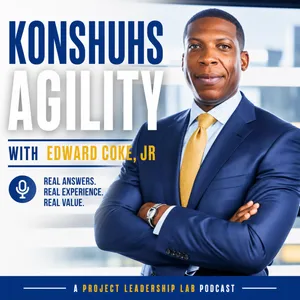
Free Daily Podcast Summary
Konshuhs Agility-Project Manager Coach & Agile Coach, Trainer, Mentor & Author: Daily Summaries Delivered
by Edward Coke
Are you ready to elevate your project management game? Welcome to a dynamic podcast designed to disrupt traditional thinking and revolutionize your approach to project management. Blending the powerful frameworks, methodologies, and mindsets of the PMBOK, Agile, Scrum, and Kanban, infused with a strong focus on personal development, this podcast delivers real-world strategies and transformative insights. Hosted by a seasoned professional holding PMP, CAPM, and CSM certifications and boasting over a decade of hands-on experience, each episode provides actionable advice to sharpen your leadership, enhance communication skills, and master stakeholder engagement. Whether you're managing cross-functional teams, seeking continuous improvement, or navigating complex projects, you'll gain practical tips and cutting-edge methodologies to excel in today's fast-paced landscape. Join us weekly for engaging discussions and the inspiration you need to become the except
Latest Episodes
The most recent episodes — sign up to get AI-powered summaries of each one.
- 2 weeks ago21 min
How to Handle Office Politics Without Playing The GAME
You Can Manage the Project and Still Lose the PoliticsWhat happens when you're delivering results, taking initiative, and doing everything you believe a good project manager should do, yet your leadership is still being questioned?Welcome to one of the most difficult realities of project leadership: organizational politics.Project management certifications teach us how to manage scope, schedules, budgets, risks, and stakeholders. But they can't fully prepare us for every unspoken expectation, relationship dynamic, leadership disagreement, or political challenge we'll encounter.And sometimes, those challenges can have a greater impact on your career than the project itself.In this episode of Konshuhs Agility, I'm sharing personal experiences that changed how I understand organizational politics, professional accountability, and the responsibility that comes with leadership.I've experienced situations where understanding organizational politics protected my career. I've also experienced situations where failing to recognize what was happening came at a professional cost.This conversation isn't about blaming managers, criticizing organizations, or learning to manipulate workplace relationships.It's about developing the judgment, self-awareness, and organizational understanding necessary to lead effectively.Three Leadership Principles You'll DiscoverPrinciple 1: Know When You're Protecting the Project and When You're Protecting YourselfWhen someone questions your leadership, challenges your decisions, or communicates in a way you don't appreciate, your response matters.Learn how to separate legitimate project risks from personal frustrations, communicate with intention, and avoid turning manageable disagreements into unnecessary leadership battles.The lesson: Being right about what happened doesn't automatically mean you've chosen the right response.Principle 2: Political Awareness Isn't the Same as Playing PoliticsSometimes you enter an organization, position, or project without realizing you're walking into existing relationships, expectations, and unresolved disagreements.Explore why organizational history matters, how to recognize decision-making influence, and why building relationships before you need support can change your leadership effectiveness.The lesson: You don't have to participate in office politics to understand the political environment surrounding your work.Principle 3: You Can Manage the Project and Still Lose the PoliticsYou can deliver results, accept feedback, and continuously improve while still struggling to understand how your leadership is being evaluated.Discover why performance expectations must be clarified, how to evaluate organizational fit, and why your professional development includes understanding when to adjust your approach and when an environment may no longer support your success.The lesson: Your results matter, but leadership requires more than execution.Practical Leadership TakeawaysAfter listening to this episode, you'll be better prepared to:Separate facts from personal feelings before escalating concerns.Clarify whether a conversation is about project risk, leadership decisions, expectations, or behavior.Use RAID logs, meeting recaps, and decision logs to maintain professional accountability.Understand organizational history before accepting additional responsibilities.Build meaningful stakeholder relationships before problems arise.Clarify performance expectations, decision-making authority, and leadership support.Recognize when taking initiative may create responsibilities you aren't fully equipped or authorized to own.Evaluate whether you're experiencing a normal learning curve or a persistent organizational mismatch.Take Your Leadership Beyond CertificationsAre you ready to move beyond certifications and become the leader your team deserves?The Project Management Lab exists to help project managers replace uncertainty with confidence, strengthen their leadership judgment, and develop the practical skills needed to navigate real-world challenges.Explore The Project Management Lab:https://pxl.to/edwardcokejrJoin the ConversationHave you ever found yourself spending more time managing organizational politics than managing the actual project?What did that experience teach you about leadership, communication, or knowing when to step back?I'd love to hear your perspective.Remember: You can be right about the project and sti
- 3 weeks ago18 min
Executive Communication Skills Every Project Manager Needs
Three words from an executive. No instructions. No template. No clearly defined assignment.What do you do next?You can build another dashboard, create a status report, or schedule another meeting. But what if none of those things actually solves the problem your executive is trying to communicate?Here's something many project managers discover as they advance in their careers: The higher you go in leadership, the less likely someone is to tell you exactly what to do next.In this episode of The Konshuhs Agility Project, ED explores how to interpret executive language, recognize the problems behind broad requests, and develop the judgment necessary to lead when the assignment isn't clearly defined.Through personal experiences working with senior leaders, ED shares why executive communication requires more than listening to instructions. It requires curiosity, business understanding, critical thinking, and the ability to recognize patterns in leadership feedback.Because the goal isn't just to become someone who can follow an assignment. It's to become someone leadership can trust to help define it.WHAT WE'LL DISCUSSPrinciple 1 | Hear the Problem Behind the WordsWhen an executive says, "I need visibility," are they asking for a dashboard, or are they asking you to help eliminate surprises?Learn why understanding the problem before building the solution is one of the most important skills a project manager can develop.Principle 2 | Bring Thinking and Curiosity QuestionsAre your questions helping you understand how your executive thinks, or are you asking them to do the thinking for you?Discover how to ask better questions, bring hypotheses into conversations, and demonstrate judgment without pretending you have all the answers.Principle 3 | Pay Attention to What They Keep Teaching YouNot every correction means you made a mistake.Learn how executive feedback reveals decision-making preferences, business priorities, and expectations that can help you build stronger working relationships.KEY TAKEAWAYSUnderstand what executives actually mean when they ask for visibility, structure, or better communication.Recognize the difference between completing an assignment and understanding the problem behind it.Ask curiosity-driven questions that clarify expectations without handing the entire assignment back to leadership.Learn to recognize patterns in executive feedback and communication preferences.Build credibility and trust through consistent thinking, judgment, and follow-through.A QUESTION TO REFLECT ONWhen leadership gives you the destination but not the direction, can they trust you to help build the road?Think about your last conversation with a senior leader.Were you listening for instructions, or were you listening for the problem they needed you to solve?That distinction can change the way you lead.CONTINUE YOUR LEADERSHIP JOURNEYReady to move beyond certifications and become the leader your team deserves?The Project Management Lab exists to help project managers replace uncertainty with confidence.Explore practical resources, leadership insights, and professional development opportunities designed to help you become the project manager and leader you want to become.The Project Management Lab: [Insert website or resource link]WATCH & CONNECT WITH EDPrefer to watch the conversation?🎥 Watch this episode on YouTube: https://youtu.be/IGvXg5-Y8HA📺 Subscribe to the YouTube channel: https://www.youtube.com/@edwardcokejrExplore more conversations on project management, executive communication, leadership development, professional confidence, and the personal growth required to become the leader you're capable of becoming.Keep learning. Keep experimenting. Keep building. One brick at a time.Sets and reps beat talent when talent doesn't do the reps.ED | The Konshuhs Agility Project
- Oct 19, 202618 min
Why Do You Keep Your Word to Everyone But Yourself? | The Scoreboard Principle
Why is it so easy to keep your promises to everyone else but so difficult to keep the commitments you make to yourself?When your employer needs something done, you find a way. When your team needs help, you make time. When someone is depending on you, you figure it out.But what happens when the person depending on you is YOU?The book you promised to write. The business you promised to build. The personal goals you keep postponing.Why do those commitments suddenly become negotiable?Here's something we don't talk about enough: We can become so committed to not disappointing other people that we become comfortable repeatedly disappointing ourselves.In this episode of The Scoreboard Principle, ED explores the relationship between personal accountability, self-trust, leadership, identity, and the promises we make to ourselves.Through personal reflection, real-world leadership experiences, and practical strategies, we'll examine why capable professionals can confidently execute someone else's vision while struggling to give their own dreams that same commitment.Because sometimes the challenge isn't a lack of time, motivation, or ability. It's recognizing that your word to yourself deserves the same consideration as your word to everyone else.WHAT WE'LL DISCUSSPRINCIPLE 1 | Your Priorities Are Revealed by the Commitments You Consistently HonorWhy being dependable doesn't mean being available to everyone, and how the sacrifices nobody asked us to make can quietly delay our personal ambitions.PRINCIPLE 2 | You May Be Operating From Two Different IdentitiesWhy you trust yourself to deliver at work but continue questioning whether you're ready to become the author, entrepreneur, speaker, or leader you envision.PRINCIPLE 3 | Every Commitment You Negotiate With Yourself Has a CostHow repeatedly postponing personal commitments can undermine your confidence, and why rebuilding self-trust begins with creating evidence through action.THE FINAL REFLECTIONIf everyone else can depend on your word, when are you going to give yourself that same privilege?And more importantly, what's one commitment you've made to yourself that you're finally ready to honor?Your future deserves more than another promise. It deserves someone who follows through.THE PROJECT MANAGEMENT LABReady to invest in your leadership, confidence, and professional development?Explore coaching, mentorship, and resources designed to help you grow beyond certifications and become the leader you're capable of being.👉 https://pxl.to/edwardcokejrJOIN THE CONVERSATIONWhat's ONE commitment you've been postponing that you're finally ready to honor?If this episode challenged your thinking, follow The Scoreboard Principle, share it with someone who needs this conversation, and leave a review.One brick at a time.Sets and reps beat talent when talent doesn't do the reps.
- Oct 17, 202628 min
What If They Never See It? | Stop Checking, Start Showing Up
What if they never see it?The work. The sacrifice. The early mornings. The person you've spent years becoming.What if the people you've been hoping would recognize your growth never acknowledge it? Would you still keep building?In this episode, ED explores why we continue seeking validation from people who doubted us, even after we've made progress.Through three stages of growth, Crawl, Walk, and Run, we examine why moving forward and letting go aren't always the same thing, and why proving someone wrong can become powerful motivation without being sustainable motivation.Because sometimes the people who doubted you have moved on, while you're still trying to win an argument they're no longer having.WHAT WE'LL DISCUSSCRAWL: When we're looking for permission instead of advice.WALK: Why we keep checking the rearview mirror for recognition.RUN: When proving them wrong becomes our motivation.Why something can be effective without being sustainable.How to move from "I'll show you" to "I'll show up."What it really means to become visible.WATCH ON YOUTUBEPrefer to watch the conversation?Watch this episode on YouTube: https://youtu.be/-Um1QrQ-GFk
- Oct 7, 202618 min
Can AI Really Prepare You for the CAPM Exam?
Can AI help you prepare for the CAPM exam, or can it make you feel more prepared than you actually are?Today, you can ask ChatGPT, Gemini, Claude, or another AI tool to explain almost anything. You can generate unlimited practice questions, create study plans, build scenarios, and have AI challenge your answers.So, do you still need a CAPM trainer, study group, course, books, or other resources?I started thinking about this after someone asked whether they should use Gemini to prepare for the CAPM before spending money on exam prep.My answer was simple:Yes, use AI. But don't confuse access to information with preparation.That's especially important for aspiring project managers who believe they're starting from zero.The person who asked the question told me they had no project management experience, but they had spent about 10 years working in operations and were currently a team lead.That changed the conversation.You may have never held the title of Project Manager, but that doesn't mean you've never managed deadlines, coordinated people, communicated with stakeholders, solved problems, prioritized work, or improved processes.And even if you have years of project management experience, there's another lesson I've learned personally:Knowing project management and knowing how to prepare for a PMI certification exam are two different things.In this episode of Konshuhs Agility, I unpack five principles for using AI, trainers, practice questions, the CAPM Exam Content Outline, and your own reasoning to build a stronger approach to CAPM preparation.In this episode, we'll explore:• Why access to information isn't the same as preparation• How your existing experience may translate into project management• Why studying in isolation can make CAPM preparation harder• How to use the CAPM Exam Content Outline to organize your preparation• Why AI should be your study partner, not your source of truth• How to use AI to challenge your reasoning instead of simply giving you answers• Why practice exam scores don't tell the entire story• How getting the right answer for the wrong reason can hide gaps in your understanding• What an experienced trainer can see that a percentage cannot• Why you may never feel completely ready to take the CAPM exam• How to recognize when preparation needs to become executionThe five principles:1. Stop Studying in IsolationA course can give you content. The Exam Content Outline gives you direction. A trainer provides guidance and feedback. A community provides perspective and accountability. AI provides on-demand reinforcement.They don't have to compete. They solve different problems.2. Let the Exam Content Outline Drive Your PreparationDon't build your study plan around the resources you purchased.Build your resources around what the exam requires you to know.The course is a resource. The book is a resource. YouTube is a resource. AI is a resource.The Exam Content Outline tells you where you're going.3. Use AI as a Study Partner, Not Your Source of TruthDon't simply ask AI to teach you everything you need to pass the CAPM.Give AI what you need to learn and make it help you understand it.Ask it to create scenarios. Make your answer before asking for the solution. Explain your reasoning. Then ask AI to challenge your thinking.AI should accelerate your preparation, not determine your preparation.4. Train Your Thinking, Not Your MemoryA practice exam can tell you what you selected.An exceptional trainer can help you determine why you selected it.On exam day, you don't need to remember the answer you selected during practice. You need to recreate the thinking that helped you arrive at the best answer.Sometimes you can answer a question incorrectly while your reasoning shows you're getting closer.And sometimes you can get the question right for the wrong reason.5. You May Never Feel Completely ReadyEventually, preparation has to become execution.There can come a point when you're no longer studying because you're unprepared. You're studying because another practice exam feels safer than taking the real one.Don't mistake fear for evidence that you're unprepared.But don't ignore legitimate gaps either.That's where feedback, preparation, readiness criteria, and experienced guidance become incredibly valuable.Before you buy another course, generate another 100 AI questions, or spend another month study
- Oct 5, 202621 min
The Performance: What Are You Still Trying to Prove?
Are you burned out because you have too much work, or because you're carrying the work AND the performance?Sometimes the pressure we feel at work isn't coming from anyone else. Nobody told us we weren't capable. Nobody said we didn't belong. Yet somewhere along the way, we created an audience in our heads and started performing for them.I know because I caught myself doing it.In this episode of Konshuhs Agility, I unpack The Performance, a Scoreboard Principle about leadership, confidence, burnout, and the pressure high performers can place on themselves to constantly prove their value.After stepping into a new role, I was asked to review a struggling project and determine whether I could help. Instead of reviewing the schedule, assessing my existing commitments, and making an informed decision, I immediately said yes.Why?Because somewhere underneath the confidence was something else: I wanted to prove that I belonged.That realization led me to three leadership principles I'm still learning today.In this episode, we'll explore:• Why capability and capacity are not the same thing• How competence can become part of the costume• Why experienced leaders evaluate whether they should, not simply whether they can• How to recognize when leadership requires you to step onto the stage and when it's time to step aside• Why speaking more doesn't necessarily mean you're leading more• How always being the problem solver can turn you into the bottleneck• Why asking before answering can develop stronger problem-solvers• How to lead without constantly needing to prove your valueThe three principles:1. Competence Can Become Part of the CostumeBeing capable is an asset. Feeling obligated to constantly demonstrate your capability can become a trap.2. Know When You're on the StageLeadership isn't about making yourself smaller. It's learning when the moment needs your voice, your expertise, your questions, or your silence.3. Don't Confuse Leading With SolvingSometimes leadership requires you to make the call. Other times, your responsibility is to help the people around you develop the answer.The goal isn't to stop performing.The goal is to become intentional about your performance.Step up when the moment requires you. Step aside when someone else needs the opportunity to lead.And ask yourself:If you knew without question that you belonged in the room, what would you stop trying to prove?📘 The Project Management LabResources for project managers ready to move beyond certifications and replace uncertainty with confidence:https://pxl.to/edwardcokejr🎥 Watch the video version on YouTube:https://youtu.be/ozcpQsdaxhsIf you're ready to move beyond certifications and become the leader your team deserves, The Project Management Lab exists to help project managers replace uncertainty with confidence.Keep learning. Keep experimenting. Keep building one brick at a time.Steps and reps beat talent when talent doesn't do the reps.
- Aug 12, 202622 min
The Project Management Translation Guide Series| The Hidden Meaning Behind “Socialize This” at Work
What does an experienced project manager actually mean when they say, “I’ll socialize this information”?They are not simply promising to send another email or add more people to a distribution list.Socializing project information is a communication strategy designed to create shared understanding, support decisions, clarify expectations, and establish accountability.In this episode, my goal is to translate one of the most common phrases used in project management and corporate environments.Through practical examples involving meeting recaps, UAT delays, budget risks, executive updates, and action items, you will learn how experienced project managers communicate information differently based on what each audience needs to know, decide, or do.If you’re ready to move beyond certifications and become the leader your team deserves, The Project Management Lab exists to help project managers replace uncertainty with confidence. Explore the resources available here: https://pxl.to/edwardcokejrWhat We’ll Discuss👉 What “socialize this” really means in project management👉 Why forwarding an attachment is not the same as communicating👉 How shared information quietly creates accountability👉 Why executives and delivery teams need different versions of the same message👉 How meeting recaps protect decisions, responsibilities, and deadlines👉 When to use terms such as awareness, alignment, documentation, and complianceWhat You’ll Learn👉 How to explain why project information matters👉 How to identify what an audience needs to know, decide, or do👉 How to tailor one project update for different stakeholder groups👉 How to document actions, owners, deadlines, and impacts clearly👉 How to create a response window for questions and corrections👉 How to turn project communication into documented accountability👉 How to prevent “I didn’t know” from becoming a project excuseKey takeawaySending information is an activity. Socializing information is a communication strategy.Communication is not complete when you press send. It is complete when the right people understand what the information means and what needs to happen next.If you’re ready to move beyond certifications and become the leader your team deserves, explore the resources from The Project Management Lab. They are designed to help you replace uncertainty with confidence and continue becoming the project manager you want to become.https://pxl.to/edwardcokejr
- Aug 10, 202622 min
The Scoreboard Principle| Sometimes You’re Starting Against Someone Else’s Scoreboard
Have you ever entered a new role and realized you were not being evaluated against the job description? You were being evaluated against the habits, relationships, and expectations created by the person who came before you.If you’re ready to move beyond certifications and become the leader your team deserves, The Project Management Lab provides resources to help you replace uncertainty with confidence. Explore the resources linked in the episode notes and continue becoming the project manager you know you can be.Sometimes you do not enter an organization with a blank scoreboard. You inherit old promises, outdated processes, damaged relationships, invisible expectations, and responsibilities that may never have formally belonged to your role.In this episode, I will explain why understanding the scoreboard you inherited matters more than blaming the people who created it. I will explore how experienced project managers can earn trust, establish healthy ownership boundaries, and receive difficult feedback without allowing someone else’s perception to become their identity.What you’ll learn:Why new leaders inherit expectations they did not createWhy experience is portable but trust is notHow temporary assistance becomes permanent ownershipHow to study organizational history before changing established processesHow to separate valuable feedback from damaging labelsWhy someone else’s scoreboard should inform you without defining youWe’ll discuss:Conducting an expectation audit in a new organizationAsking for the history behind unusual processesBuilding trust through small, consistent promisesReturning accountability after a crisisConverting personal labels into observable behaviorsLooking for patterns before accepting someone’s evaluation as truthYou may not be responsible for the score you inherited, but you are responsible for what happens while you are in the game. Study the first half, learn from it, and start putting your own points on the board.If this episode reminded you of a project manager or leader who inherited expectations they did not create, share it with them. Subscribe to The Project Management Lab and explore the resources below to continue developing your confidence, leadership, and professional identity.
Get Konshuhs Agility-Project Manager Coach & Agile Coach, Trainer, Mentor & Author summaries in your inbox
Free AI-powered daily recaps. Key takeaways, quotes, and mentions — in a 5-minute read.
Get Free Summaries →Free forever for up to 3 podcasts. No credit card required.
You Might Also Like
Listeners also like.

Certified - Project Management Professional (PMP) Audio Course
Audio lessons covering project management concepts for PMP certification preparation.

The Knowledge Project
Explores the mental models and decision-making strategies of high-performing individuals across disciplines.

Amplify Speakers Podcast
Discusses mindset, leadership, and resilience with top speakers, athletes, and change-makers about their personal journeys and impact.

Coaching Inc with Tom Krol
Teaches coaches and consultants how to generate consistent leads and increase income using proven, efficient marketing strategies.
The Learning Leader Show With Ryan Hawk
Conversations with top leaders across industries exploring how continuous learning drives success.
Think Fast Talk Smart: Communication Techniques
Communication techniques from Stanford lecturer Matt Abrahams and experts to improve clarity, confidence, and impact in professional settings.

Coaching for Leaders
Practical leadership advice from experienced experts and proven leaders to help professionals grow through career transitions.

Secrets of the Career Game
Kendall Berg - That Career Coach

The CUSP Podcast
Dr Tom Hitchcock
Strategy Meets Reality Podcast
Mike Jones
Consulting Success Podcast
Strategies for building a profitable, scalable consulting business, from client acquisition to team management and marketing that works.

The Uncommon Career: Job Search & Career Coaching for Mid-career Women
Helps mid-career women improve their job search by refining personal branding, communication, and negotiation strategies.
About Konshuhs Agility-Project Manager Coach & Agile Coach, Trainer, Mentor & Author
Are you ready to elevate your project management game? Welcome to a dynamic podcast designed to disrupt traditional thinking and revolutionize your approach to project management. Blending the powerful frameworks, methodologies, and mindsets of the PMBOK, Agile, Scrum, and Kanban, infused with a strong focus on personal development, this podcast delivers real-world strategies and transformative insights. Hosted by a seasoned professional holding PMP, CAPM, and CSM certifications and boasting over a decade of hands-on experience, each episode provides actionable advice to sharpen your leadership, enhance communication skills, and master stakeholder engagement. Whether you're managing cross-functional teams, seeking continuous improvement, or navigating complex projects, you'll gain practical tips and cutting-edge methodologies to excel in today's fast-paced landscape. Join us weekly for engaging discussions and the inspiration you need to become the except
Customized Recaps
AI-powered recaps with compact key takeaways, quotes, and insights.
Straight to Your Inbox
Get key takeaways from Konshuhs Agility-Project Manager Coach & Agile Coach, Trainer, Mentor & Author in a 5-minute read.
Save Hours Every Week
Stay current on your favorite podcasts without falling behind.
Frequently Asked Questions
What is Podzilla's Konshuhs Agility-Project Manager Coach & Agile Coach, Trainer, Mentor & Author daily summary?
It's a free AI-powered email that summarizes new episodes of Konshuhs Agility-Project Manager Coach & Agile Coach, Trainer, Mentor & Author as soon as they're published. You get the key takeaways, notable quotes, and links & mentions — all in a quick read.
How does the Konshuhs Agility-Project Manager Coach & Agile Coach, Trainer, Mentor & Author podcast summary work?
When a new episode drops, our AI transcribes and analyzes it, then generates a personalized summary tailored to your interests and profession. It's delivered to your inbox every morning.
Is this an official Konshuhs Agility-Project Manager Coach & Agile Coach, Trainer, Mentor & Author product?
No. Podzilla is an independent service that summarizes publicly available podcast content. We're not affiliated with or endorsed by Edward Coke.
Can I get summaries of other podcasts too?
Absolutely! The free plan covers up to 3 podcasts, any in the catalog. Basic raises that to 15, Pro to 40 and Max to 100. Browse our full catalog at /podcasts.
What topics does Konshuhs Agility-Project Manager Coach & Agile Coach, Trainer, Mentor & Author cover?
Konshuhs Agility-Project Manager Coach & Agile Coach, Trainer, Mentor & Author covers topics including Education, Business, Careers. Our AI identifies the specific themes in each episode and highlights what matters most to you.
Start getting Konshuhs Agility-Project Manager Coach & Agile Coach, Trainer, Mentor & Author summaries tomorrow morning.
Free forever for up to 3 podcasts. No credit card required.
Free forever for up to 3 podcasts. No credit card required.