Free Daily Podcast Summary
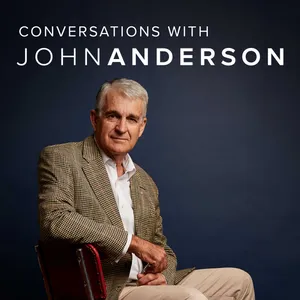
John Anderson: Conversations: Daily Summaries Delivered
by John Anderson
Former Deputy Prime Minister of Australia
Latest Episodes
The most recent episodes — sign up to get AI-powered summaries of each one.
- 1 weeks ago1h 5m
"I Refuse To Be The Canary In The Coal Mine" | David Harris
Join John in conversation with David Harris as they explore the roots and modern resurgence of antisemitism. They discuss the defining characteristics of antisemitism, its historical evolution, and how contemporary political dynamics shape global attitudes toward the Jewish community and Israel.The conversation examines the blurring lines between antizionism and antisemitism, alongside the changing social climate in Western democracies following the December 2025 terrorist attack at Bondi Beach. Harris calls for principled, bipartisan leadership and a unified societal stance that rejects prejudice and protects fellow citizens.David Harris is an international Jewish advocate and the current Executive Vice Chair of the Institute for the Study of Global Antisemitism and Policy (ISGAP). He served as CEO of the American Jewish Committee (AJC) from 1990 to 2022. He is the author of Anti-Semitism: What Everyone Needs To Know.
- 2 weeks ago1h 3m
Why the West Is Turning Against It's Elites | Frank Furedi
John sits down with sociologist and author Frank Furedi to discuss why millions of people across the West are turning against the political establishment, the rise of populism, the collapse of trust in traditional institutions, and the growing divide between ordinary citizens and the elites who govern them.From immigration and multiculturalism to education, free speech, national identity and the future of democracy, Furedi argues that populism is not simply a threat to the political order — it is a response to people feeling ignored by it. The conversation explores what has been lost, why citizenship matters, and whether Western democracies can rebuild a shared culture strong enough to survive.Frank Furedi is Emeritus Professor of Sociology at the University of Kent and the author of 26 books, including most recently In Defence of Populism. His work has focused on cultural developments in Western societies, including the culture of fear, education, identity, national sovereignty and the changing relationship between citizens and political institutions. He is a regular commentator on radio and television and has contributed extensively to media outlets across the UK and internationally.A long-time friend of the program, Frank was one of John’s earliest Conversations guests, first appearing on the show in April 2018.
- 3 weeks ago1h 6m
What The Left Gets Wrong About Denmark | Alex Vanopslagh
In this interview, sitting Danish politician Alex Vanopslagh explains how Denmark became a great and prosperous nation. Contrary to the platitudes from members of the left like Bernie Sanders, who have argued that Denmark is a socialist success story, Alex argues that liberty and individual responsibility have made it great.He also explains how Denmark's Protestant emphasis on individual conscience and responsibility, combined with its high social trust, has put the country in a unique position to deal with issues like mass migration and the rise of political Islam. This has helped Denmark to avoid the pattern seen across much of the West, where right-wing populist parties have surged.Already leader of his party, the Liberal Alliance, at 34-years-old, Alex encourages young people everywhere to take ownership of their own lives and to be contributors to their community and country.Alex’s new book Den usynlige ånd (The Invisible Spirit) comes out on the 28th of August.Alex Vanopslagh is a Danish politician and leader of the Liberal Alliance, a classical liberal, free-market party in the Folketing. He has served as party leader since 2019, taking the role at just 27, and has become one of the most prominent voices on the Danish right — making the case that Denmark's prosperity rests on economic freedom and civic responsibility, not socialism. Born in France and raised in Denmark, he studied political science at the University of Southern Denmark before rising through Liberal Alliance's youth wing to lead the party itself.
- Aug 21, 202631 min
After Charlie Kirk: The Death Of Civil Discourse | Robert George
Robert P. George joins John Anderson at the ARC conference in London for a conversation that traces natural law back through Cicero and Aristotle to Martin Luther King's Letter from Birmingham Jail. He also discusses his friendship with utilitarian philosopher Peter Singer on the personhood of the unborn as evidence that serious disagreement and real friendship aren't incompatible.The conversation turns to what happens when that capacity disappears: the tribalism of social media and siloed media ecosystems, and the assassination of Charlie Kirk, which George calls a tragedy not just for Kirk's family but for civic life in the West. He warns that the U.S. may be "one more assassination away from a civil war," and argues that the way back runs through intellectual humility — a willingness to recognise one's own fallibility and to see one's opponent as a fellow citizen rather than an enemy to be destroyed.Robert P. George is an American legal scholar, political philosopher, and public intellectual. He serves as the sixth McCormick Professor of Jurisprudence and Director of the James Madison Program in American Ideals and Institutions at Princeton University.
- Aug 14, 202639 min
“The Politics Of Gaslighting”: Why Britain Won't Face Its Own Decline | Konstantin Kisin
Konstantin Kisin argues that Britain is poor and getting poorer, and that almost nobody knows it. He points to polling showing most Britons believe they are as rich as Switzerland, Singapore or Australia, when on a per capita basis Britain sits far down the table and is close to being overtaken by Poland. Konstantin also examines the grooming gangs scandal, which he describes as organised crime run through kinship networks, and rejects outright the idea that Britain can accommodate two legal systems. Konstantin Kisin is a writer, social commentator, comedian, and co-host of the free speech podcast Triggernometry. He is a regular on British and American TV and radio shows including Question Time, Good Morning Britain, BBC Breakfast, Daily Politics, LBC Cross Question, The Joe Rogan Experience, and many others. He is also the author of An Immigrant's Love Letter to the West.
- Aug 10, 202639 min
What The Census Gets Wrong About Religion | Mark McCrindle and Dorian von Freyhold
John Anderson sits down with social researcher Mark McCrindle and measurement researcher Dorian von Freyhold to examine whether Australia’s Census is giving an accurate picture of the country’s religious identity. They explore how changes to the wording and structure of the religion question may influence responses, why “no religion” does not necessarily mean atheism, and what their research suggests about the true scale of secularisation in Australia.The conversation also looks beyond the Census to the broader cultural picture: the changing relationship younger Australians have with Christianity, the difference between religious affiliation and active belief, the enduring influence of Christian institutions and values, and the growing search for meaning in an increasingly fragmented society.Mark McCrindle is an Australian social researcher, demographer, author and founder of McCrindle, a research and communications agency specialising in social trends, generational change and demographic analysis. He has spent two decades researching how Australian society is changing and is the author of five books. McCrindle is also widely known for coining the term “Generation Alpha” and regularly contributes to public debate on demographic, cultural and generational trends.Dr Dorian von Freyhold is a researcher and strategist specialising in consumer psychology, data science, survey design and business analytics. He holds a PhD from the University of Queensland, where he also lectured in business analytics, consumer psychology and marketing research. Von Freyhold has applied experimental and behavioural research methods across consulting, polling and commercial analytics, and is Managing Partner at Compass Polling. His recent research includes a 5,000-person experiment examining how the wording and structure of the Australian Census religion question can influence responses.
- Aug 7, 20261h 4m
The End of an Empire: Britain's Self-Inflicted Fall From Glory | David Starkey
Dr. David Starkey sits down with John Anderson to discuss the breakdown of Britain, arguing the crisis is not merely a run of bad prime ministers but a system deliberately broken. He contends that from 1997 the Blair government reinvented British governance on a continental model, displacing the supremacy of Parliament with human rights law, supreme courts and an alien legal architecture.Starkey warns that the sovereignty of the British people has been quietly inverted, and that the country is only now waking up to the consequences. He points to the 440 quangos accounting for roughly a third of state expenditure, a £100 million bat tunnel, and judges who now determine wage rates and fuel policy. Yet for all Starkey's pessimism, he implores Britons to recall their duty and find the courage to fight for a civilisation that is worth preserving.Dr. David Starkey CBE is a British historian, broadcaster and commentator, best known for his work on the English monarchy. Starkey was presented with the Norton Medlicott Medal for Services to History by Britain's Historical Association. He is Honorary Fellow of Fitzwilliam College, Cambridge, and the author of historical non-fiction including Elizabeth: The Struggle for the Throne and Monarchy: The History of England and Her Rulers from the Tudors to the Windsors.
- Jul 31, 20261h 3m
How China Is Using Iran | Michael Doran
Geopolitical expert Michael Doran argues that Middle East stability depends on the U.S. winning its long war with Iran. He warns the “rabid dog” regime remains a paused but persistent danger.Doran also unpacks how China is using the Middle East as a laboratory to test how America defends against missiles and drones before any move on Taiwan. He warns that anti-ship ballistic missiles supplied to Iran and the Houthis exist for one purpose: sinking American aircraft carriers.Michael Doran is a Senior Fellow at the Hudson Institute and director of its Center for Peace and Security in the Middle East. A former George W. Bush administration National Security Council director, he is the author of Ike's Gamble and a leading voice on Iran, Israel and U.S. strategy.
Get John Anderson: Conversations summaries in your inbox
Free AI-powered daily recaps. Key takeaways, quotes, and mentions — in a 5-minute read.
Get Free Summaries →Free forever for up to 3 podcasts. No credit card required.
You Might Also Like
Listeners also like.

One Decision
Former intelligence leaders and journalists examine high-stakes decisions that shaped global events.

Conversations with Tyler
Discussions with intellectuals and experts on ideas, culture, and global issues.
Political Thinking with Nick Robinson
In-depth conversations with political figures and influencers about their lives and the experiences that shaped their worldviews.

Danny Jones Podcast
Danny explores ways to become smarter.

The Signal Sitdown
Examines how Washington policymakers make decisions and why government often fails to serve public interests.

The Andrew Klavan Show
A conservative commentator uses satire and interviews to critique progressive cultural norms and politics.

Conversations with Coleman
Explores complex topics like politics, philosophy, and culture through candid, in-depth conversations with intellectuals and thinkers.

Intelligence Squared
Live debates and in-depth discussions on pressing global issues featuring leading experts and thinkers.

The Rest Is Politics
Two former political insiders analyze current events in the UK and abroad, offering candid debate and behind-the-scenes insights.

Monetary Matters with Jack Farley
Expert interviews exploring macroeconomics, financial markets, and monetary policy.

Any Questions? and Any Answers?
Experts answer public questions on current issues, followed by audience responses.

Radical with Amol Rajan
Amol Rajan interviews global radicals, pioneers, and innovators shaping the future on issues like AI, climate, and politics.
Customized Recaps
AI-powered recaps with compact key takeaways, quotes, and insights.
Straight to Your Inbox
Get key takeaways from John Anderson: Conversations in a 5-minute read.
Save Hours Every Week
Stay current on your favorite podcasts without falling behind.
Frequently Asked Questions
What is Podzilla's John Anderson: Conversations daily summary?
It's a free AI-powered email that summarizes new episodes of John Anderson: Conversations as soon as they're published. You get the key takeaways, notable quotes, and links & mentions — all in a quick read.
How does the John Anderson: Conversations podcast summary work?
When a new episode drops, our AI transcribes and analyzes it, then generates a personalized summary tailored to your interests and profession. It's delivered to your inbox every morning.
Is this an official John Anderson: Conversations product?
No. Podzilla is an independent service that summarizes publicly available podcast content. We're not affiliated with or endorsed by John Anderson.
Can I get summaries of other podcasts too?
Absolutely! The free plan covers up to 3 podcasts. Upgrade to Pro for 15, or Premium for 50. Browse our full catalog at /podcasts.
What topics does John Anderson: Conversations cover?
John Anderson: Conversations covers topics including News, Politics. Our AI identifies the specific themes in each episode and highlights what matters most to you.
Start getting John Anderson: Conversations summaries tomorrow morning.
Free forever for up to 3 podcasts. No credit card required.
Free forever for up to 3 podcasts. No credit card required.