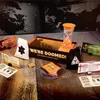
Summer started off with a bang in the Strange household—one of our kiddos pulled some epically bad behavior and, as a result, lost screentime privileges for two weeks! The one upshot of this arrangement is that he was B-O-R-E-D and willing to indulge in more boardgames than usual. Our new family favorite? A cheery little card game called WE’RE DOOMED!Why WE’RE DOOMED! Is So CompellingWE’RE DOOMED! imagines that the world is ending in 15 minutes, and only those who get a seat on an escape rocket will survive. The trick is, the rocket isn’t finished yet. The main choice on each turn is whether to contribute to the (shared) rocket project, or to perform actions which make it more likely that you, yourself, will get a seat on said rocket. Along the way there are fun complications like opportunities to steal or even “nuke” other players (thus eliminating them from the game.) Since the game is timed, all of this is all done with much shouting and rushing.I’ve played WE’RE DOOMED! a few dozen times now and have only succeeded in getting on the rocket once. Generally, everyone dies, but a few times we’ve managed to pull together and build a big enough rocket for all the (still-living) players. Heretic Hereafter is a reader-supported publication. To receive new posts and support my work, consider becoming a free or paid subscriber.This game is the right level of fun, challenging, and silly. But the secret, nerdy reason that I like it? It’s a perfect illustration of the “tragedy of the commons.”Our Most Common Problem?The tragedy of the commons is an idea borrowed from economics describing a situation in which a group shares a common, scarce resource. Any one individual can try to hoard this resource for themselves at a cost to the community. Think overfishing, deforestation, or climate change. Once you understand the tragedy of the commons, you start to see it everywhere: it’s corporations putting short-term profits ahead of long-term financial stability (the financial crisis), it’s countries wanting to industrialize (and pollute) to gain an economic edge in the short-term while contributing to climate crisis in the long-term. What makes the tragedy of the commons so interesting is that it taps into that eternal tension between the individual and the community. What is fair? Who gets to decide? And should I take my “fair share,” or do I try to get one over on everyone else?The term “tragedy of the commons” was popularized by the economist Garrett Hardin, who wrote (of overgrazed “commons” or communal land):“Therein is the tragedy. Each man is locked into a system that compels him to increase his herd without limit – in a world that is limited. Ruin is the destination toward which all men rush, each pursuing his own best interest in a society that believes in the freedom of the commons. Freedom in a commons brings ruin to all.”— Garrett Hardin, The Tragedy of the CommonsHardin’s view, it seems, is that all people are inherently selfish and that we are, in fact, doomed to ruin all shared resources. The only solutions, in his estimation, are privatization and top-down government management. But is that actually the case?Crabbing LessonsWe were on a big group camping trip this weekend, playing WE’RE DOOMED! in the evening and crabbing by day, which provided an interesting view into the tragedy of the commons.When you crab in Washington, you must buy a $35 license. You’re limited to a certain number of crabs per day, of certain species, and you may not collect crabs that are too small, molting, or the wrong gender. This is top-down government regulation meant to prevent over-harvesting of crabs, enforced by park rangers.Due to a broken boat, we were mostly limited to crabbing off the dock this year. We were not the only ones doing so—the space was fairly crowded with a diverse group of people: immigrants speaking a variety of languages, experienced crabbers, newbie tourists, a precocious 12-year-old crustacean expert, and a very nice guy wearing a very obnoxious Trump t-shirt. The crabs were pretty scarce this year. Following Hardin’s logic, you’d expect that competition would be fierce and the strangers wouldn’t be very friendly towards each other. But you’d be wrong.While my crew only managed to catch 6 crabs over 2 days, we were given many more by folks who were doing better than us. Folks who preferred bigger crabs, or Dungeness versus Rock Crab, were giving us crustaceans left and right. Folks shared tools and tips and repeatedly helped each other. A sort of gift economy developed on the dock, partly enabled by those government limits. Ronald Reagan Was WrongIf you grew up like I did, learning that Reaganism was next to godliness, yo
Podzilla Summary coming soon
Sign up to get notified when the full AI-powered summary is ready.
Free forever for up to 3 podcasts. No credit card required.
Listen to This Episode




Get summaries like this every morning.
Free AI-powered recaps of Heretic Hereafter Podcast and your other favorite podcasts, delivered to your inbox.
Free forever for up to 3 podcasts. No credit card required.