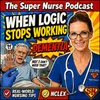
When Logic Stops Working: Dementia Communication for Real-World Nursing
👉 Watch the video @SuperNurseAI Dementia care can be confusing because the patient’s words and behaviors may not seem logical from the outside. But for the patient, the fear, frustration, confusion, or resistance often feels very real. This episode explains why nurses need to stop relying on reasoning and start focusing on emotional safety. A key concept in this episode is that dementia affects more than memory. It can damage judgment, sequencing, impulse control, communication, recognition, and the ability to connect cause and effect. That means a patient may not understand why they need medication, why they cannot leave, why they are in the hospital, or why a nurse is trying to help. We also talk about why correcting a dementia patient often backfires. Telling them “That’s not true,” “You already asked me that,” or “You need to calm down” may feel factual to the nurse, but it can feel threatening or humiliating to the patient. Instead of improving cooperation, correction can increase agitation, fear, and resistance. The better approach is connection over correction. Nurses should validate the emotion underneath the behavior, use short simple phrases, offer reassurance, and redirect the patient toward something safe. The goal is not to win an argument — the goal is to reduce distress and protect dignity. This episode also covers real-world nursing tips for dementia communication, including using calm body language, approaching from the front, lowering stimulation, offering simple choices, maintaining routine, and avoiding overwhelming explanations. These strategies matter on the floor and on NCLEX because dementia questions often test safety, communication, psychosocial integrity, and prioritization. The biggest takeaway: when logic stops working, nurses do not push harder with facts. They slow down, connect emotionally, protect safety, and respond to the patient’s reality with calm, dignity, and clinical judgment. Timestamps for 23:24 Podcast 00:00 – When logic stops working in dementia care Why dementia communication requires a different nursing approach. 01:10 – Dementia is more than memory loss How dementia affects reasoning, judgment, sequencing, recognition, and emotional control. 02:20 – Why patients may resist care A patient may refuse medication, hygiene, food, or safety instructions because their brain cannot process the situation clearly. 03:30 – Why arguing makes it worse Correcting the facts can increase fear, shame, agitation, and mistrust. 04:40 – Connection over correction The goal is not to prove the patient wrong — it is to help them feel safe. 05:50 – Validate the emotion, not the confusion Respond to fear, sadness, frustration, or worry instead of arguing with the patient’s words. 07:00 – What not to say to a dementia patient Avoid phrases like “calm down,” “you already said that,” or “that’s not true.” 08:10 – Simple phrases work better Use short, calm, reassuring sentences the patient can process. 09:20 – Body language matters Approach slowly, stay at eye level, keep your tone soft, and avoid looking rushed or irritated. 10:30 – Redirection in real-world nursing How nurses gently shift attention away from unsafe or distressing thoughts. 11:45 – Agitation is communication Restlessness, refusal, yelling, or pulling away may be signs of fear, pain, hunger, toileting needs, or overstimulation. 13:00 – Check for physical causes first Assess for pain, infection, hypoxia, urinary retention, constipation, dehydration, medication effects, and delirium. 14:20 – Dementia vs delirium reminder Sudden confusion is never something to brush off as “just dementia.” 15:35 – Creating a low-stimulation environment Reduce noise, bright lights, clutter, unnecessary staff traffic, and competing instructions. 16:45 – Offer simple choices Give one or two safe options instead of open-ended questions or long explanations. 17:55 – Routine and familiarity Why consistent schedules, familiar objects, and repeated reassurance can decrease distress. 19:05 – Safety without confrontation How to protect patients from falls, wandering, pulling lines, and unsafe decisions without escalating the situation. 20:15 – Family education Help families understand that dementia behaviors are brain-based, not intentional defiance. 21:25 – NCLEX nursin
Podzilla Summary coming soon
Sign up to get notified when the full AI-powered summary is ready.
Free forever for up to 3 podcasts. No credit card required.
Listen to This Episode
More from The Super Nurse Podcast

The Head Injury That Looks Fine: TBI, Increased ICP & Nursing Red Flags
Confused Patient? How Nurses Decode the 3 Ds at the Bedside.

Seizure Aftercare for Nurses: What to Do When the Shaking Stops

Alzheimer’s vs Dementia: Connection Over Correction in Real-World Nursing
Get summaries like this every morning.
Free AI-powered recaps of The Super Nurse Podcast and your other favorite podcasts, delivered to your inbox.
Free forever for up to 3 podcasts. No credit card required.