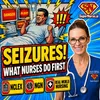
Seizure at the Bedside: What Nurses Do First When Seconds Matter
👉 Watch the video here on Super Nurse - You Tube! In this episode, we take a real-world look at what happens when a quiet shift suddenly turns into a seizure emergency. A patient begins actively convulsing in a tonic-clonic seizure, and the nurse has to act quickly, calmly, and in the correct order. This is exactly the kind of seizure nursing priority scenario that shows up on NCLEX and NGN case studies. The first priority is not medication. It is safety and timing. Nurses should stay with the patient, call for help, and note the exact seizure start time because duration drives the next clinical decisions. The nurse should lower the bed, protect the patient from injury, pad or secure the side rails when available, and move hard objects away from the patient. Airway protection is one of the biggest seizure nursing priorities. The patient should be turned onto their side when safe to help secretions drain and reduce aspiration risk. Tight clothing around the neck should be loosened, oxygen and suction should be ready at the bedside, and the nurse should never place anything in the patient’s mouth — no fingers, no tongue depressors, and no bite blocks. Once the patient is physically protected, the team shifts toward medical management and identifying the cause. Nurses should anticipate a point-of-care glucose check, electrolyte labs, toxicology screening if appropriate, and possible EEG monitoring. Fast-acting benzodiazepines such as lorazepam or diazepam may be ordered to stop ongoing seizure activity. The episode also explains status epilepticus, a major NCLEX red flag. If a seizure lasts longer than 5 minutes, or if the patient has repeated seizures without regaining consciousness, this becomes a medical emergency. At that point, the priority shifts toward IV access, benzodiazepines, 100% oxygen, advanced airway support, possible intubation, and neurocritical care. The key takeaway: seizure nursing care is about sequence. Stay with the patient, time the seizure, protect them from trauma, support the airway, prepare oxygen and suction, never put anything in the mouth, check glucose, anticipate meds, and escalate fast if the seizure crosses the 5-minute status epilepticus threshold. This is real-world nursing, and it is exactly the kind of priority thinking that helps students pass NCLEX and protect patients at the bedside. Timestamps 00:00 – A seizure at the bedside A quiet shift can change in seconds when your patient suddenly begins convulsing. 01:10 – Why seizure priorities matter for NCLEX Seizure questions test whether nurses know the correct order: safety, airway, timing, support, and escalation. 02:20 – Prodrome and aura: early warning signs Some patients may feel unusual symptoms before a seizure, giving nurses a chance to prepare the environment. 03:30 – First action: stay with the patient Do not leave the patient alone. Call for help and stay at the bedside to protect them. 04:35 – Time the seizure immediately The exact start time matters because seizure duration determines when care escalates to status epilepticus. 05:40 – Protect the patient from injury Lower the bed, clear hard objects, protect the head, and reduce the risk of trauma during convulsions. 06:55 – Side-lying position and airway safety Turn the patient to the side when safe so secretions can drain and aspiration risk is reduced. 08:05 – What NOT to do during a seizure Never restrain the patient and never put anything in the mouth — no fingers, no tongue depressors, and no bite blocks. 09:15 – Oxygen and suction at the bedside Prepare oxygen and suction so the airway can be supported as soon as it is safe to intervene. 10:25 – Checking glucose and possible triggers Nurses should anticipate blood glucose checks, electrolytes, toxicology labs, and other tests to identify the cause. 11:45 – Seizure medications nurses should anticipate Benzodiazepines like lorazepam or diazepam may be ordered to stop ongoing seizure activity. 13:00 – Respiratory risk with benzodiazepines Seizure medications can depress breathing, so airway support and oxygenation are critical. 14:15 – Status epilepticus: the 5-minute emergency A seizure lasting longer than 5 minutes or repeated seizures without recovery is a medical emergency. 15:35 – When care escalates to advanced airway support Status epilepticus may require IV access, 100% oxygen, intubation, anesthetic drips, and neurocritical care. <stro
Podzilla Summary coming soon
Sign up to get notified when the full AI-powered summary is ready.
Free forever for up to 3 podcasts. No credit card required.
Listen to This Episode
More from The Super Nurse Podcast

The Head Injury That Looks Fine: TBI, Increased ICP & Nursing Red Flags
Confused Patient? How Nurses Decode the 3 Ds at the Bedside.
When Logic Stops Working: Dementia Communication for Real-World Nursing
Seizure Aftercare for Nurses: What to Do When the Shaking Stops
Get summaries like this every morning.
Free AI-powered recaps of The Super Nurse Podcast and your other favorite podcasts, delivered to your inbox.
Free forever for up to 3 podcasts. No credit card required.