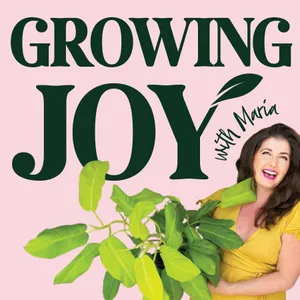
Free Daily Podcast Summary
Growing Joy with Plants - Wellness Rooted in Nature, Houseplants, Gardening and Plant Care: Daily Summaries Delivered
by Maria Failla- Happy Plant Lady and Author of Growing Joy: The Plant Lover's Guide to Cultivating Happiness
Looking for free, natural ways to decrease stress and increase joy and calm in your life? The answer might be simpler than you think: houseplants, gardening and nature. On Growing Joy with Plants, learn alongside Happy Plant Lady, Maria Failla, to care for plants, engage with nature, and use them to manage your overwhelm, anxiety and experience happiness and calm you thought was only available on vacation. Plant care is self care.
Latest Episodes
The most recent episodes — sign up to get AI-powered summaries of each one.
- 5 days ago1h 2m
Motherhood, Seasons of Life and Changing Plant Passions
Did you know that Becca from Becca De La Plants and I delivered our babies 24 hours and 3 minutes apart?! We didn't plan that. We've been friends for almost 10 years now, and the first time we hung out, she was planning her wedding. Since then, we've gotten married, moved, built businesses, and now she's had her second baby, and I've had my first! For some reason, we keep landing in the same season of life at the same time. So I asked her to come talk with me about it. About two hard pregnancies, about the identity shift nobody warns you about properly, and about what plants have been quietly teaching us the whole time. Come join our conversation! In this episode, we learn:[02:14] Meet Becca De La Plants[06:53] The TikTok comment that flagged her cholestasis![08:22] Where social media saves you, and where it wrecks you[10:22] Running my business from bed through a sick first trimester[11:43] What prenatal depression took from Becca’s toddler's first years[13:41] The beliefs we absorb about how pregnancy is supposed to feel[14:51] Joey Santore’s Concrete Botany[15:55] Espoma Organic[17:57] Why I wouldn't let myself attach to this pregnancy after two losses[20:42] How one Five Guys order sent me to the ER with gallstones[24:22] How a hard pregnancy made the newborn phase feel blissful![25:53] Becca's HG lifting the day she delivered and finally being able to eat[28:47] Why snap-back culture makes no sense when you barely gained weight[29:49] The identity shift of becoming a mom![35:46] How thinking in seasons gives you permission to be fully present[37:37] Is "don't lose yourself" actually good advice?[38:21] My HOT take: why you should have your kids later[42:01] What slow-germinating seeds taught me about timing[42:59] What it's like being last to have a kid when you've always gone first[46:19] Second-baby calm vs. logging every single diaper in the app[47:53] Sibling age gaps, and watching your own sister dynamic play out in your kids[49:49] Childcare, pumping, and holding the next year with an open hand[51:50] Why first-time moms should be allowed to be weird (the mammal side of postpartum)[54:18] Do I let Growing Joy expand beyond plants?[57:22] Why evolving your content is the only way to keep it honest[58:50] A six-month check-in with Becca! Mentioned in our conversation:Growing Joy 240: How to Move with Houseplants with Becca De La Plants, Ep 240Huckleberry App: Baby Tracker & Sleep ExpertsUnderstanding Natural LightGreen Up Your Workspace For all of my and Becca's motherhood hot takes,check out the full show notes and blog! Follow Becca:PodcastBookInstagramFacebookYouTubeTikTok Thank you to our episode sponsors:Quarto: Concrete Botany by Joey SantoreGrab your copy of Concrete Botany at quarto.com, wherever books are sold or through your local bookstore.Espoma OrganicVisit espoma.com to find your local Espoma dealer or check my Amazon storefront.
- 1 weeks ago47 min
Indoor Citrus Trees: Light, Water, and Fruiting Tips: Best of Growing Joy Replay
Have you ever wandered through the citrus section of a nursery, inhaling the sweet scent of Meyer lemons and key limes, and thought “Oh my, I want one”? As someone who impulse purchased a struggling lime tree years ago—which I named Limey, by the way—growing citrus indoors is possible with the right care and conditions. Citrus plants can be great houseplants if you set them up for success, and they present a unique opportunity to engage all five senses! In this episode, I invited my long-lost dear friend Danny Trejo from Via Citrus to share with you everything you need to know to cultivate your own indoor citrus plant, from choosing the right variety to proper care for growth and fruiting. In this episode, we learn:[00:00] What citrus varieties has Maria grown over the years? [11:59] What is Danny's background with citrus?[19:39] What citrus varieties does Danny recommend for beginners?[21:20] Other citrus varieties Via Citrus are growing[24:13] What conditions do citrus plants need to thrive indoors?[28:01] Grow light specifications for citrus (a crash course)[31:28] Why you should have a proper watering schedule[34:09] Soil care and drainage hole for your citrus[35:52] How often should you fertilize citrus?[37:11] How to prepare your citrus in the winter[38:37] When is the best time to prune your citrus plants?[41:40] How to increase humidity for citrus in the winter[42:53] What are some common citrus troubleshooting tips?[44:08] Can you grow citrus from seeds?[45:28] What is grafting?[49:53] How to ensure that your plant's buds develop into fruit[51:52] What exciting new sustainable pot line is Danny creating?[55:06] Where can you find Danny on social media? (use code ‘GROWINGJOY' for 10% discount!) Mentioned in our conversation:Growing Joy Ep 206 The History Of Italian Gardens And Italian Citrus With Helena AttleeGrowing Joy Ep 203 How To Bring Your Plants Indoors For The WinterYouTube video Limey’s Grand Adventure // Flying My Lime Tree To FloridaHelena Attlee’s book, The Land Where Lemons Grow: The Story of Italy and Its Citrus FruitWe The WildSoltech Aspect Lights CollectionEspoma Organic Citrus ToneEspoma Organic Citrus Food Set your indoor citrus plant up for success with Danny's expert tips!Check out the full show notes and blog here! Follow Danny:WebsiteInstagramRepotsFacebookEmail Follow Maria and Growing Joy:Order my book: Growing Joy: The Plant Lover's Guide to Cultivating Happiness (and Plants) by Maria Failla, Illustrated by Samantha LeungJoin the Bloom and Grow Garden Party Community Platform & App AKA the plantiest and kindest corner of the internet! Get your FREE 2-week trial here!Take the Plant Parent Personality Quiz (Get the perfect plants, projects a
- 1 weeks ago1h 0m
Listen to This Before You Buy a Greenhouse!
Have you fallen down the greenhouse rabbit hole yet, plant friends? If you've had plants for more than a year, you're probably like me, who's started Googling "how to put a greenhouse in my backyard" already. And I learned that a greenhouse isn't a big plant shelf but a structure, and it's probably the largest single purchase you'll make as a plant parent. I'm in Zone 10b in Florida and I still haven't built mine. So I asked Leslie Halleck, a favorite podcast guest, a long-time friend, and someone who has a master's in greenhouse production and a new book called Home Greenhouse Revival, what to figure out first. And I think she also holds the guest record for most appearances on the show! Let's dive in! In this episode, we learn:[02:06] Meet Leslie Halleck[02:33] Moving her whole life and business from Texas to Oregon[03:29] Why the Pacific Northwest is a ‘horticultural mecca’ for gardeners[04:42] Lelie’s new 6-acre property (what she calls folia forest farm)[06:49] What does her "pocket farming" look like?[09:03] Why are greenhouses trending?[12:51] What is the biggest greenhouse mistake?[14:13] Why cooling a greenhouse is so much harder than heating one[15:29] Manukora Honey[17:47] Hoop house vs. glass house[18:47] What are the elements that make up a greenhouse?[21:21] Greenhouse framing materials and glazing![22:43] Is there a beginner-friendly greenhouse?[25:04] What Leslie thinks about thrifted/DIY vintage window greenhouses[27:41] How to pick the right greenhouse size?[29:48] Greenhouses as the expensive part of a cheap hobby[30:33] Using multiple greenhouses to zone temperature and humidity[32:47] What about a half-empty greenhouse?[33:26] What is AOI (angle of incidence)? How roof pitch and sun angle affect how much light gets in[35:49] Inside the plant profiles (PPFD, DLI, photoperiod, fertilizer PPM, and VPD)[39:21] How does pest management in a greenhouse work?[43:33] Leslie's dream greenhouse for her new property (and why she's leaning Venlo)[48:23] How greenhouse pricing and options have changed and where to find good manufacturers[50:26] Why you want someone local who knows your climate and orientation[51:29] Starting small without setting yourself up to fail (and reviving a greenhouse that already flopped)[54:10] Where to find Leslie, the book, her gardener's round tables, and her UCLA courses! Mentioned in our conversation:By Leslie Halleck:Home Greenhouse RevivalPlant ParentingGardening Under LightsThe Gardener's RoundtableEpisodes:331: What is Forest Bathing: Exploring Forest Therapy with ANFT250: The Business of Horticulture with Leslie Halleck222: Humidity and Houseplants with Leslie Halleck208: DIY Houseplant First Aid Kit with Leslie Halleck204: How to Identify Houseplant Disease with Leslie Halleck173: Seed Starting Basics with Joe Lamp'lPrime Video: Clarkson's Farm For Leslie's expert greenhouse advice,check out the full show notes and blog here! Follow Leslie:WebsiteShop<a href="https://www.facebook
- 2 weeks ago44 min
The Secret Language of Flowers Every Plant Lover Should Know
How can we use flowers to further connect with nature and with the world? My mom once photocopied an entire flower dictionary for me from the thick pages of The Language of Flowers. I loved that she did it, but then I never really used it because it was too dense and there were a lot of meanings nobody says out loud anymore. But then I’ve thought deeply about it. I've grown dahlias my whole life. I have four hibiscus in my front lawn now. What if those choices were saying something? So I sat down with Mary Kelava, a former florist and author of A Bouquet of Words, to finally learn the language of flowers as a gardener. Come learn with me! In this episode, we learn: [01:27] Meet Mary Kelava! [02:12] How she became a florist and a flower language expert [03:41] Two types of flower books you’re bound to read! [06:08] My mom’s photocopied dictionary part of ‘The Language of Flowers’ [07:41] Where does the language of flowers come from? [10:21] How did the Victorian era understand the language of flowers? [11:38] What the flowers you're drawn to might be telling you [12:46] Why color, personal memory, and fragrance matter as much as the meaning [15:03] Espoma Organic [16:54] Leslie Halleck's new book, Home Greenhouse Revival [18:30] Kate Middleton's wedding bouquet, Queen Elizabeth's funeral flowers, and a Lego hibiscus [20:16] Do flower colors carry meanings of their own, or is it just color psychology? [21:46] What zinnias mean, and how to handle flowers bred in every color [22:58] What the research for her book ‘A Bouquet of Words’ looked like [23:57] Do flower meanings hold up across cultures? [25:35] How to start learning the language of flowers easily [27:02] How to build a themed garden with meaning using easy-to-grow flowers [28:29] Planning a flower memorial garden for a pet [31:01] How to write notes that go with the bouquet [32:29] Bringing this to the florist (or to the $6.99 Trader Joe's flowers) [34:46] Bouquet recipes for housewarmings, Christmas, and new babies [36:26] What are some birth month and zodiac flowers? [37:02] Get well flowers, and giving hydrangea to someone who's persevered [37:50] Why Mary assigns a signature flower to her closest friends [38:34] What flowers to give someone in grief? [40:49] Where to find Mary and A Bouquet of Words! Mentioned in our conversation: A Bouquet of Words by Mary Kelava Language of Flowers by Vanessa Diffenbaugh Episode 339: How to Grow Sweet Peas, The World's Most Nostalgic Flower with Marryn Mathis To grow flowers that have meaning to you, check out the full show notes and blog for Mary's recommendations! Follow Mary: WebsiteInstagramBlogs Thank you to our episode sponsors: Espoma Organic Visit espoma.com to find your local Espoma dealer or check my Amazon storefront. Quarto: Home Greenhouse Revival by Leslie F. Halleck Home Greenhouse Revival is available for pre-order now at quarto.com and launches in September. Pre-order your copy wherever books are sold or through your local bookstore. Follow Maria and Growing Joy: Order my book: Growing Joy: The Plant Lover's Guide to Cultivating Happiness (and Plants)</
- 3 weeks ago51 min
Elevate Your Interior Decor with Plants: A Plant Design Crash Course
What if the fewer the plants, the bigger the impact? Right now my house is a construction zone, and my plants are on their own. I have an eight-week-old baby, a '70s house we gutted mid-pregnancy, and a carpeted garage. So yes, a few plants have died. But something else is happening too! My taste is changing. I'm letting go of a lot of little plants, and I want one big beautiful plant for my bathroom instead. In fact, my friend Samantha Hermann of @houseplusplant and I are both in a transitional season of life. She’s moving into a house she designed around her plants... and cutting her collection from 300 to about 100. Here's what she taught me. Let's dive in! In this episode, we learn: [01:42] Grab a mini course for whatever your plants need right now with the Growing Joy Academy! [02:57] Welcome back, Samantha of @houseplusplant [04:05] How much did her plants influence her home design aesthetic? [06:07] Instagram vs. reality: where do plant people actually keep their plants? [07:36] Cutting her collection from 300 plants down to 100 (intentional vs. collector) [10:11] Why she's only keeping big statement plants now [12:03] The guilt of letting a plant go [15:23] Manukora Honey [19:22] What is she most excited about in the new house? [22:20] Renovating a 1970s house while I’m pregnant! [24:33] Collecting pieces with a story instead of getting them off Amazon [25:29] What are some plant styling rules for a calm home? [28:21] Treating a statement plant as art! [30:19] What makes a plant grouping actually work? [32:33] Does the rule of threes work for plants? [33:54] Why there's always a hoya in her groupings [36:49] Blooming houseplants that don't get enough credit! [37:49] The custom window shelves she's sad to take down [40:00] How to build grow lights into your house (outlets, dimmers, timers, and hiding cords) [42:16] Why spreading plants throughout your home makes you enjoy them more [45:20] What makes her book House + Plant different and QR codes to her DIYs [47:28] Pre-orders, the October 6th release, and where to find Samantha! Mentioned in our conversation: Growing Joy Academy House Plus Plant Equals Home by Samantha Hermann Beautiful Views Shelves Soltech Highland™ LED Track Light System (Use Bloom15 for 15% off) SANSI LED Grow Lights Collection for Indoor Plants Episode 235: How to Care for a Lot of Plants (AKA Have a Large Plant Collection) with Samantha of @houseplusplant For Samantha's amazing tips on how to do more with fewer plants, check out the full show notes and blog here! Follow Samantha: WebsiteInstagramYouTubeTikTokFacebook Thank you to our episode sponsor: Manukora Go to manukora.com/bloom to get up to 31% off the starter kit that includes their 850+ Manukora honey jar, 5 honey travel sticks, a wooden spoon, and a guidebook, PLUS $25 worth of free gifts! Follow Maria and Growing Joy: Order my book: Growing Joy:
- Aug 20, 20261h 11m
Wedding Flowers 101: How to Choose Blooms That Last: Best of Growing Joy Replay
When I got engaged, I figured choosing wedding flowers would be the easy part. I'm a plant person, right? Wrong. Wedding florals are an entire world of their own, and I was lucky to have a florist who walked me through all of it and built the floral landscape of my dreams. That florist is Corina of The Botaniste, and in this Best of Growing Joy episode, she's sharing the wedding flower crash course I wish I'd had from day one. We get into how to choose blooms that actually hold up and don't wilt (spoiler: several of my first picks were a hard no), why conditioning matters more than expensive stems, how to work with seasonal availability instead of fighting it, and how to lean on greenery to stretch your budget. Corina also covers the trends she's seeing, how to talk to a florist even if you don't know a single flower name, and how to repurpose arrangements so they outlast the ceremony. And if a wedding isn't in your future, don't skip this one because it all applies to backyard bouquets and dinner party tables too! In this episode, we learn: [02:22] Introducing Corina [04:16] What to expect of the last episode of My Botanically Inspired Wedding Series [09:29] Corina shares her experiences planning wedding florals with couples [10:33] Why Pinterest is every bride’s best friend AND worst enemy [11:52] How Corina became a plant lady and how she started The Botaniste [17:29] Corina’s biggest influences in floral styling [18:18] What are current and upcoming trends for wedding flowers? [19:46] What elements are there in a tablescape? [22:28] Is there a difference between wedding flowers and event flowers? [26:14] Maria shares her decision-making process with her wedding florals [28:02] How flowers elevate any event [29:26] How to preserve your wedding flowers [31:00] What are the best and the worst flowers to have at your wedding? [34:01] Which flower is an alternative to peonies? [35:54] New rose varieties to try in your wedding flowers [39:27] How to condition cut flowers [41:23] How to keep cut hydrangeas from wilting [42:58] Where to get the best organic indoor and outdoor gardening products [44:12] Planning to grow from seeds this coming garden season? [48:15] How to work with florists and where to start with your wedding flower planning [52:33] Building a trusting relationship with your wedding florist [55:08] Corina’s advice for couples planning to DIY their wedding [58:51] Maria’s garland and greenery vision [01:00:40] How to style a wedding with greenery [01:03:38] Incorporating bud vases in your wedding [01:07:55] Adding statement greenery to your wedding venue and reception [01:12:49] What you should know about greenery [01:14:38] Corina’s ultimate tip for wedding planners and contractors [01:15:15] Corina’s current favorite flowers and combinations [01:17:00] What Maria loved about blushing bride protea [01:18:08] Where you can hire Corina as your florist [01:20:25] Maria’s Wedding Series reflections Mentioned in our conversation: Check out Corina's video on how to arrange a big bridal bouquet! Lush Magnolia Flower Preservation artist DIY Wedding Copper Arbor blog BAGR Episode: 3 Plant Inspired DIY Wedding Ideas that Live on After the Big Day BAGR Episode: 26 Ways to Incorporate Plants Into Your Wedding BAGR Blog: 26 Ways to Incorporate Plants Into Your Wedding What flower would you love to have in your wedding bouquet? Check out the full show notes and blog for the blooms that actually hold up on your wedding day! Follow Corina: Website Instagram Facebook <a href="https://www.yelp.com/biz/t
- Aug 18, 202647 min
How to Tell Time with Your Garden (And Not a Watch)
Is it possible to tell time with your garden? Apparently, birds and plants can tell us what time of day it is! When we recorded this episode, I was in my third trimester, so sometimes I would be up at 2 AM whether I liked it or not. Which was how I found out that the birds in my Florida backyard start up around 4! For a while, I'd check my phone to see how close we were to sunrise. Now I learned to listen. That's the idea behind The Fullness of Time by Cathy Haynes. It's a book I read about how to tell time without a clock, instead using birdsong, blooms, shadows, and stars. It touched the gardener in my soul, and I knew I needed to have Cathy on the podcast to talk about all of the different ways our ancestors kept time in their gardens and in nature. Come learn with me! In this episode, we learn: [02:07] Meet Cathy Haynes! [03:12] What is The Fullness of Time book about? [04:05] The evening primrose in her London backyard that started all of this! [05:55] How does gardening change your sense of time? [07:17] How did ordinary people tell time before clocks? [09:26] Cock crow, midnight spirits, and what each part of the day means! [11:42] Reading a clock vs. actually sensing time [12:20] What is the ornithological clock (how to tell time through birds)? [15:24] Espoma Organic [17:00] Learning to pick out the individual singers in the dawn chorus [17:36] Merlin app to learn birdsong [18:38] What third-trimester insomnia taught me about the 4 AM birds [21:53] What is this Linnaeus’s flower clock? [23:55] Did the Bern Botanical Garden get a living flower clock to work? [26:30] Daisies, chicory, and the timekeeping plants hiding in pavement cracks [28:40] Which time-telling plants can you add to your own garden? [30:59] Why mature sunflowers stop following the sun and just face east [33:26] How did our ancestors use shadows to tell time? [35:21] Ancient scratch sundials on churches and Icelandic hills! [37:37] Light pollution and how to adapt to the sun in a city [39:32] Can you tell the time by the stars? [41:42] What are some simple ways to get started with your time garden? [44:52] Where to find Cathy and The Fullness of Time! Mentioned in our conversation: The Fullness of Time: Marking the Day by Birdsong, Blooms, Shadows, and Stars by Cathy Haynes Merlin Bird ID Collins Bird Guide App A Botanical Timekeeper - The Flower Clock Growing Joy Episode 186: The History of Houseplants with Jane Perrone Interested in tracking time with your local birds and flowers, check out the full show notes and blog here! Follow Cathy: WebsiteInstagram Thank you to our episode sponsor: Espoma Organic Visit espoma.com to find your local Espoma dealer or check my Amazon storefront. Follow Maria and Growing Joy: Order my book: Growing Joy: The Plant Lover's Guide to Cultivating Happiness (and Plants)by Maria Failla, Illustrated by Samantha Leung Take the Plant Parent Personality Quiz (Get the perfect plants, projects and educational resources for YOUR Lifestyle) Support Growing Joy with Maria by becoming a Plant Friend on Patreon! Instagram: <a href="http://www.instagram.com/growi
- Aug 11, 202656 min
How to Propagate Pothos and Other Vining Indoor Plants
We're going back to basics today on how to propagate pothos, plant friends! It's one of the simplest things you can do as a plant parent. And pothos is probably the easiest plant to propagate, which is exactly why it's where you should start. I just want you to do it right the first time because one success is what turns this into a lifelong habit. So I brought propagation expert Lindsay Sisti back on the podcast to walk through pothos propagation from the very beginning. Join us as we talk beginner-friendly propagation tips, how to root pothos cuttings in water, light and watering, and why making that first cut actually helps your plant grow. Let's prop! In this episode, we learn: [02:51] Meet Lindsay Sisti and her challenge for you! [04:24] Why pothos is the best plant to learn propagation on [06:00] Why your pothos cutting speeds up your other props [07:02] Plant anatomy 101: What do you need to know before you cut? [09:11] Why you should leave the leaves on your cuttings [10:19] Internodes vs. nodes (aka plant knuckles) [13:31] Node cuttings vs. tip cuttings, and what "sterilized shears" really means [15:30] Manukora Honey [17:16] Espoma Organic [19:54] What is a petiole and why will a single pothos leaf never root? [21:22] Leaf removal and water setup! [23:12] Why cutting back a balding pothos makes it bushier (apical dominance explained) [26:57] Do pothos cuttings need to callus first? [27:55] What rooting hormone actually does, and the tradeoff of changing your water [30:36] The different methods of propagating different types of vining plants like pothos [31:44] Sphagnum, fluval stratum, and perlite (why water still wins for pothos) [35:02] Can you root bare nodes with no leaves? Plus prop box basics [37:40] Does cinnamon work as a rooting hormone? [38:56] Why the thrift store is the best place to find propagation vessels [40:15] Root length sweet spot! [41:25] Potting up: indoor mix, extra perlite, and starting small [47:03] Why light matters while rooting [48:19] Propagation walls and test tube shelves [51:30] Thrifted candelabras, champagne racks, and DIY propagation stations [53:27] Where to find Lindsay, her book, and all of her propagation resources! Mentioned in our conversation: Growing Joy 129: How to Root Bare Nodes or "Wet Sticks" Growing Joy 350: Propagation Tips For Plant Parents That Actually Work: Prop Boxes, Ikea Grow Cabinets and How to Avoid Mold Damage Growing Joy 309: How to Propagate an Alocasia Corm Growing Joy 289: How to Propagate Plants in Fluval Stratum The Ultimate Guide to Houseplant Propagation by Lindsay Sisti Clonex Rooting Gel For Lindsay's different propagation methods, check out the full show notes and blog here! Follow Lindsay: WebsiteInstagramYouTubeTikTok Thank you to our episode sponsors: Manukora Go to manukora.com/bloom to get up to 31% off the starter kit that includes their 850+ Manukora honey jar, 5 honey travel sticks, a wooden spoon, and a guidebook, PLUS $25 worth of free gifts! Espoma Organic Visit <a href="https://www.espoma.com/" target="_blank" rel="noopener n
Get Growing Joy with Plants - Wellness Rooted in Nature, Houseplants, Gardening and Plant Care summaries in your inbox
Free AI-powered daily recaps. Key takeaways, quotes, and mentions — in a 5-minute read.
Get Free Summaries →Free forever for up to 3 podcasts. No credit card required.
You Might Also Like
Listeners also like.
Learn Cut Flower Growing | Lessons From a Seasoned Flower Farmer
A seasoned flower farmer shares practical advice and insights on growing and selling cut flowers, from planting to harvest.
The Beginner's Garden with Jill McSheehy
A practical guide for new gardeners, breaking down gardening basics and terminology to help beginners grow confidently.

Growing Cut Flowers
Two flower growers share practical tips, expert interviews, and personal experiences to help you cultivate stunning cut flowers.
The Beet: A Podcast For Plant Lovers
Explores gardening from basics to advanced techniques, featuring expert insights and innovations in plant science and agriculture.
Gardening with the RHS
Seasonal gardening advice from RHS experts, covering planting, design, pest control, and flower show insights for all skill levels.
The Plant Report- Every Plant Has A Story
Explores the botanical world through stories about plants, herbal medicine, heirloom seeds, and human connections to plant life.

The joe gardener Show - Organic Gardening - Vegetable Gardening - Expert Garden Advice From Joe Lamp'l
Joe Lamp'l shares practical, organic gardening advice focused on growing food and sustainable practices for gardeners of all skill levels.
Black in the Garden
Explores the intersection of Black culture and gardening through conversations about plants, identity, and community.
MARGARET ROACH A WAY TO GARDEN
A WAY TO GARDEN explores horticulture through the perspective and experience of Margaret Roach.

Joyce Meyer Enjoying Everyday Life Radio Podcast
Joyce Meyer

BBC Gardeners’ World Magazine Podcast
Expert gardening advice, seasonal tips, and global garden travels from BBC Gardeners’ World Magazine.

Healthy Living with Yoga Anita | inspiring wellness body, mind, soul
Explores holistic health and mindfulness through conversations with wellness experts and practitioners.
About Growing Joy with Plants - Wellness Rooted in Nature, Houseplants, Gardening and Plant Care
Looking for free, natural ways to decrease stress and increase joy and calm in your life? The answer might be simpler than you think: houseplants, gardening and nature. On Growing Joy with Plants, learn alongside Happy Plant Lady, Maria Failla, to care for plants, engage with nature, and use them to manage your overwhelm, anxiety and experience happiness and calm you thought was only available on vacation. Plant care is self care.
Customized Recaps
AI-powered recaps with compact key takeaways, quotes, and insights.
Straight to Your Inbox
Get key takeaways from Growing Joy with Plants - Wellness Rooted in Nature, Houseplants, Gardening and Plant Care in a 5-minute read.
Save Hours Every Week
Stay current on your favorite podcasts without falling behind.
Frequently Asked Questions
What is Podzilla's Growing Joy with Plants - Wellness Rooted in Nature, Houseplants, Gardening and Plant Care daily summary?
It's a free AI-powered email that summarizes new episodes of Growing Joy with Plants - Wellness Rooted in Nature, Houseplants, Gardening and Plant Care as soon as they're published. You get the key takeaways, notable quotes, and links & mentions — all in a quick read.
How does the Growing Joy with Plants - Wellness Rooted in Nature, Houseplants, Gardening and Plant Care podcast summary work?
When a new episode drops, our AI transcribes and analyzes it, then generates a personalized summary tailored to your interests and profession. It's delivered to your inbox every morning.
Is this an official Growing Joy with Plants - Wellness Rooted in Nature, Houseplants, Gardening and Plant Care product?
No. Podzilla is an independent service that summarizes publicly available podcast content. We're not affiliated with or endorsed by Maria Failla- Happy Plant Lady and Author of Growing Joy: The Plant Lover's Guide to Cultivating Happiness.
Can I get summaries of other podcasts too?
Absolutely! The free plan covers up to 3 podcasts. Upgrade to Pro for 15, or Premium for 50. Browse our full catalog at /podcasts.
How often does Growing Joy with Plants - Wellness Rooted in Nature, Houseplants, Gardening and Plant Care release new episodes?
Growing Joy with Plants - Wellness Rooted in Nature, Houseplants, Gardening and Plant Care publishes 2x weekly. Our AI generates a summary within hours of each new episode.
What topics does Growing Joy with Plants - Wellness Rooted in Nature, Houseplants, Gardening and Plant Care cover?
Growing Joy with Plants - Wellness Rooted in Nature, Houseplants, Gardening and Plant Care covers topics including Leisure, Education, Garden, Health & Fitness, Home & Garden. Our AI identifies the specific themes in each episode and highlights what matters most to you.
Start getting Growing Joy with Plants - Wellness Rooted in Nature, Houseplants, Gardening and Plant Care summaries tomorrow morning.
Free forever for up to 3 podcasts. No credit card required.
Free forever for up to 3 podcasts. No credit card required.