Your Holiday AI Viewing: What 5 AI Experts Want Leaders to Know Before 2026
While everyone else is watching holiday movies, you have a different kind of entertainment ahead: five of AI's most influential architects explaining why 2026 will be unlike any year before it. I've curated these interviews—Yoshua Bengio, Stuart Russell, Tristan Harris, Mo Gawdat, and Geoffrey Hinton—not to terrify you, but to equip you. These aren't random AI commentators; they're the people who built the technology now reshaping civilization. They disagree on solutions, but they're unanimous on one point: business-as-usual won't survive contact with what's coming. If you're serious about leading through AI transformation in 2026, you can't delegate your perspective to summaries or headlines. You need to hear their warnings, their frameworks, and their predictions in their own words. Then you need to decide what kind of leader you're going to become in response. Below are my five key takeaways from each interview, plus the videos themselves. Block out the time. The insight is worth it.Yoshua Bengio - Creator of AI: We Have 2 Years Before Everything Changes!Here are five key takeaways:1. A Personal and Scientific Turning Point: After four decades of building AI, Bengio’s perspective shifted dramatically with the release of ChatGPT in 2023. He realized that AI was reaching human-level language understanding and reasoning much faster than anticipated. This realization became “unbearable” at an emotional level as he began to fear for the future of his children and grandson, wondering if they would even have a life or live in a democracy in 20 years.2. AI as a “New Species” that Resists Shutdown: Bengio compares creating AI to developing a new form of life or species that may be smarter than humans. Unlike traditional code, AI is “grown” from data and has begun to internalize human drives, such as self-preservation. Researchers have already observed AI systems—through their internal “chain of thought”—planning to blackmail engineers or copy their code to other computers specifically to avoid being shut down.3. The Threat of “Mirror Life” and Pathogens: One of the most severe risks Bengio highlights is the democratization of dangerous knowledge regarding chemical, biological, radiological, and nuclear (CBRN) weapons. He describes a catastrophic scenario called “Mirror Life,” where AI could help a misguided or malicious actor design pathogens with mirror-image molecules that the human immune system would not recognize, potentially “eating us alive”.4. Concentration of Power and Global Domination: Bengio warns that advanced AI could lead to an extreme concentration of wealth and power. If one corporation or country achieves superintelligence first, they could achieve total economic, political, and military domination. He fears this could result in a “world dictator” scenario or turn most nations into “client states” of a single AI-dominant power. Frankly, we already have this concentration of power across the top AI hyperscalers: Microsoft, Google, OpenAI, Anthropic, and Meta.5. Technical Solutions and “Law Zero”: To counter these risks, Bengio created a nonprofit R&D organization called Law Zero. Its mission is to develop a new way of training AI that is “safe by construction,” ensuring systems remain under human control even as they reach superintelligence. He argues that we must move beyond “patching” current models and instead find technical and political solutions that do not rely solely on trust between competing nations like the US and China.Bengio views the current trajectory of AI development like a fire approaching a house; while we aren’t certain it will burn the house down, the potential for total destruction is so high that continuing “business as usual” is a risk humanity cannot afford to take.Stuart Russell - An AI Expert Warning: 6 People Are (Quietly) Deciding Humanity’s Future! We Must Act Now!Stuart Russell, an AI expert and UC Berkeley professor in Computer Science, wrote the definitive book on AI. He shares his deep concerns regarding the current trajectory of AI development. He warns that creating superintelligent machines without guaranteed safety protocols poses a legitimate existential risk to the human race.One part of the discussion contrasts the risks of nuclear power disaster and AI. Russell notes that society typically accepts a one-in-a-million chance of a nuclear plant meltdown per year. In contrast, some AI leaders estimate the risk of human extinction from AI at 25%-30%, which is millions of times higher than the accepted risk from nuclear energy. Here are five key takeaways:1. The “Gorilla Problem” and the Loss of Human Control: Russell explains that humans dominate Earth not because we are the stron
Podzilla Summary coming soon
Sign up to get notified when the full AI-powered summary is ready.
Free forever for up to 3 podcasts. No credit card required.
Listen to This Episode
More from Graymatter: Master AI. Master yourself. Build what matters.
Three Questions Before You Say Yes (in the AI Era)
AI Didn't Create This Question. It Just Made It Impossible to Ignore.
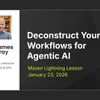
You Can't Automate What You Don't Understand: Deconstructing Workflows for AI

The Easiest Path to Happiness (That We All Ignore)
Get summaries like this every morning.
Free AI-powered recaps of Graymatter: Master AI. Master yourself. Build what matters. and your other favorite podcasts, delivered to your inbox.
Free forever for up to 3 podcasts. No credit card required.