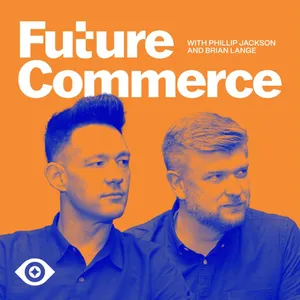
Free Daily Podcast Summary
Future Commerce: Daily Summaries Delivered
by Phillip Jackson, Brian Lange
Future Commerce is the culture magazine for Commerce. Hosts Phillip Jackson and Brian Lange help brand and digital marketing leaders see around the next corner by exploring the intersection of Culture and Commerce. Each week, they explore the cultural implications of what it means to sell or buy products and how commerce and media impact the culture and the world around us, through unique insights and engaging interviews with a dash of futurism.
Latest Episodes
The most recent episodes — sign up to get AI-powered summaries of each one.
- 4 days ago43 min
Separating Real Signals from the Noise
The in-house research team has hollowed out, and the LLMs picking up the slack are only delivering their best guesses. Merciv, the agentic brain behind Future Commerce’s Signal Reports, has set out to deliver auditable, defensible, and unified reporting solutions — and it’s redefining what brands are capable of achieving in-house in the process. Phillip and Alicia welcome Merciv co-founder and CEO Shaia Erlbaum to the show to talk about how brands can read signals in real time, and verify their relevancy. Shaia argues that data itself is commoditizing, but verification is not. The most honest consumer signal lives too deep for surveys to reach, which is why our Signal Reports are looking deeper than stated behaviors and are telling completely new kinds of retail and culture stories.The Toothpaste Doesn't Lie Key takeaways:Insights teams keep shrinking while the C-suite depends on them more than ever.Surveys capture posturing. Forums, reviews, and comment sections capture behavior.Data is commoditizing. Proprietary brand knowledge is the durable moat.The first Signal Report, a collaboration between Future Commerce and Merciv, maps where GLP-1s removed cultural friction – and where friction migrated to."Almost everyone answering a survey question about how many times they brush their teeth in a day will say twice. But if you actually look at those sales figures, they simply don't sell enough toothpaste." — Shaia Erlbaum"These models aren't built to tell you, 'Hey, I don't know.'" — Shaia Erlbaum"There's a world where data's already becoming a commodity… a lot of the real advantage is less rooted in which model's more intelligent, but more so in to what degree can we actually verify the information we're coming across." — Shaia Erlbaum"The office of the CMO is becoming more of an individual contributor role." — Phillip JacksonIn-Show Mentions:Merciv: merciv.com"Frictionless Wellness: GLP-1s and What Comes After the Age of Autonomy" – the first Future Commerce Signal Report, powered by Merciv.LORE, our newest book on who really writes your brand's story. Get it in the Future Commerce shop.Associated Links:Read the first Signal Report, Frictionless Wellness: GLP-1s and What Comes After the Age of AutonomyInsiders 204: The Ozempic Effect: How GLP-1s Rewrote the Gospel of Self-LoveEpisode 435: Predictions 2026: Prepare for the Age of AutonomyEpisode 367: AI Agents Are Here. "Brands" Might Be In Danger.Episode 447: The Agent Has Left the BuildingCheck out Future Commerce on YouTubeCheck out Future Commerce Plus for exclusive content and save on merch and printSubscribe to Insiders and The Senses to read more about what we are witnessing in the commerce worldListen to our other episodes of Future CommerceHave any questions or comments about the show? Let us know on futurecommerce.com, or reach out to us on Twitter, Facebook, Instagram, or LinkedIn. We love hea
- 1 weeks ago22 min
Cartographies of Meaning
Nikita Walia and Elliot Vredenburg of U.N.N.A.M.E.D. Studios took to the VISIONS stage at MoMA last year to enlighten a room of retail executives and brand marketers about the realities of worldbuilding. Their theory: a brand’s final form is decided by the public—and the strategist's job is to navigate that story, not control it. And they use Mercator, Buckminster Fuller, Guy Debord, free public Wi-Fi, and an acne sticker to back up their claims.Mapping Meaning Isn’t About Being RightKey takeaways:Branding isn't worldbuilding because worldbuilding just imposes another set of rulesA three-hundred-page brand book is obsolete the day it ships, and rebrands every five to ten years are theater for stakeholdersThe public decides a brand's final form, not the guidelines deckRegenerative brands are always rebranding[00:00:25] "Counter to what you've heard today, branding is not, in fact, worldbuilding." — Nikita Walia[00:04:34] "This is sameness being sold to us as a form of consistency." — Nikita Walia[00:15:45] "It's not about being right. It's about being useful, and useful in motion." — Elliot Vredenburg[00:17:09] "A regenerative brand doesn't need to rebrand every five to ten years because it's always rebranding." — Elliot VredenburgIn-Show Mentions:The Mercator projection (1569) and Buckminster Fuller's Dymaxion MapSuperstudio, The Continuous MonumentGuy Debord and psychogeographyLinkNYCBurberry, Daniel Lee, Demna's Balenciaga, Pierpaolo PiccioliStarfaceAssociated Links:Read Alicia Esposito's companion essay, The New Meaning of Brand Building: Cartographies of MeaningWatch the original session at VISIONS Summit: Cartographies of MeaningHear Dami Lee's VISIONS session, The Stories Behind Our SpacesListen to Building Culturally Intelligent Brands with Dr. Anastasia Kārkliņa GabrielRevisit The Anti-Blands, Existential Brands, and the New DadaismRead Surface Culture: When Brands Mistake Wallpaper for AuthenticityCheck out Future Commerce on YouTubeCheck out Future Commerce Plus for exclusive content and save on merch and printSubscribe to Insiders and The Senses to read more about what we are witnessing in the commerce worldListen to our other episodes of Future CommerceHave any questions or comments about the show? Let us know on futurecommerce.com, or reach out to us on Twitter, Facebook, Instagram, or LinkedIn. We love hearing from our listeners! Hosted by Simplecast, an AdsWizz company. See pcm.adswizz.com for information about our collection and use of personal data for advertising.
- 1 weeks ago1 min
*TEASER* The Oreogate Lady Is NOT Real!
Can anyone tell the staged from the real anymore? On today’s After Dark: We’re growing increasingly certain that everything is fake now. Amazon drones delivering your package to the deep end of your backyard pool? Curiosity bait. A bunch of Kindergarten moms actually keeping up in a group thread? A Suno commercial. That behind-the-scenes footage? AI-generated – but you watched it, didn’t you? PLUS: The minds of Nathan Fielder and Lance Oppenheim have converged to craft what’s anticipated to be one of the most compelling documentaries we’ve ever seen.This episode is exclusive to Future Commerce Plus members. Subscribe to listen at www.futurecommerce.com/plus. Hosted by Simplecast, an AdsWizz company. See pcm.adswizz.com for information about our collection and use of personal data for advertising.
- 2 weeks ago39 min
Retail Media In Your Ears: Inside Dollar General's 21,000-Store Audio Network
The next big advertising opportunity is here. The audio systems in Dollar General’s 21,000 stores connect shoppers with advertisers and drive loyalty. Austin Leonard, VP and GM of Dollar General Media Network (DGMN), sits down with Phillip and Alicia to explain why the retailer has doubled down on audio and the role that non-endemic advertisers play in his long-term vision. “The Cocktail Party Effect” Key takeaways: In-store audio is getting programmatic optimization so DG’s sponsors can serve ads at the best time of day and in the best-suited markets. Non-endemic only works in-store if it clears the near-endemic bar: shopper relevance. Dollar General’s 21,000 stores across suburban, urban, and rural markets are often the only stores in town, making its ad inventory a community utility. The Yellow Glasses Project pairs brand partners with the DG Literacy Foundation via iHeartRadio. [00:18:10] Phillip: "This is the power that I think audio has that nothing else has; it can catch your attention even when you're focused on something else." [00:32:40] Austin Leonard: "I call that the last mile of eCommerce for the last mile of America." [00:36:15] Austin Leonard: "The next era of retail media is really about accountability and also telling our story for our unique audiences." In-Show Mentions: Find Austin Leonard on LinkedIn More about DG Media Network Yellow Glasses Project iHeartMedia, DG Literacy Foundation partnership featuring Bobby Bones Listen to Future Commerce’s episode with Collin Colburn of IAB Associated Links: More retail media coverage on Future Commerce retail media hub Read: Insiders 237: “Vertical Dramas” and the New Era of Commerce Media Listen: LIVE from Shoptalk Spring: Retail Media Confessions, Hype Cycles, and the Creator Reckoning Read: Ad Infinitum: Retail Media is The Final Boss VISIONS Summit at MoMA, New York City: Join us on November 3 Watch: Future Commerce on YouTube Join Future Commerce Plus for exclusive content and save on merch and print Subscribe to Insiders and The Senses to read more about what we are witnessing in the commerce world Listen to our other episodes of Future Commerce Have any questions or comments about the show? Let us know on futurecommerce.com, or reach out to us on Twitter, Facebook, Instagram, or LinkedIn. We love hearing from our listeners! Hosted by Simplecast, an AdsWizz company. See pcm.adswizz.com for information about our collection and use of personal data for advertising.
- 3 weeks ago27 min
2026 Signals We’re Tracking: Commerce Evolves (Again), the Monoculture is Back, and Celebrity Prevails?
Phillip sits solo to unpack conflicting economic signals: Shopify's monster quarter against a Census report showing eCommerce eating share while retail overall slows. What does this mean for brick-and-mortar? Although stores still make up most retail sales, their mission and value have shifted. The good has become secondary to the experience of acquiring it. Plus, he breaks down why the monoculture returned in a summer of shared events, and what's on the FC docket through November 3rd. The Monoculture Isn’t Dead, It’s On Substack Key takeaways: Commerce is growing (online sales grew at nearly twice retail’s pace in 2025), but it’s growing by disappearing into everything else. The product itself is secondary to the experience of purchasing it. The monoculture isn't dead; it’s been revived by sport, tours, and global events. "There is a monoculture now of people writing about the summer of the monoculture on their Substack." "You're not just communicating your vision anymore to the human capital within your business; you now have to communicate vision to machines and put it into machine language. Because increasingly, we are automating more and more of our vision, and it's going on autopilot." In-Show Mentions: See our Celebrity Brands Hub before the Signal Report launches Spotify Summer Trends Report Get your early bird ticket for VISIONS Summit: NYC Associated Links: Check out Future Commerce on YouTube Check out Future Commerce Plus for exclusive content and save on merch and print Subscribe to Insiders and The Senses to read more about what we are witnessing in the commerce world Listen to our other episodes of Future Commerce Have any questions or comments about the show? Let us know on futurecommerce.com, or reach out to us on Twitter, Facebook, Instagram, or LinkedIn. We love hearing from our listeners! Hosted by Simplecast, an AdsWizz company. See pcm.adswizz.com for information about our collection and use of personal data for advertising.
- Aug 19, 202651 min
Shopify Earnings Go Wild, and American Retail is OVER.
Phillip and Alicia open the back-to-school season with a modern dichotomy: NRF data shows shoppers playing chicken, while Shopify posts a quarter where agentic traffic tripled. PLUS: After a summer abroad in London, Phillip reflects on behaviors unique to U.S. shoppers. Get ‘Em While They’re Young Key takeaways: Retailers are manufacturing visible human effort as a hedge against frictionless AI commerce. Play is a form of consumption. Browsing kids are already converting. Back-to-school splits into two camps: early movers and deal holdouts. Shopify's agentic traffic tripled as answer engines are becoming a back-to-school search surface. U.S. share of wallet favors experience, forcing a fusion of retail and hospitality. [00:17:11] Alicia: "When you create these spaces that are conducive to young people, you're kind of creating this magnet moment that ultimately motivates them to shop." [00:28:18] Phillip: "What’s really wild about the mini brands thing is…we all complain about shrinkflation, then also buy the mini of something, which is a premiumization of a per-unit cost…We are irrational by nature, and brands would do well to play at both ends of the spectrum." [00:40:17] Alicia: "[Søstrene Grene] almost feels like it's more high-touch because it's kind of imperfect." Associated Links: Check out Future Commerce on YouTube Check out Future Commerce Plus for exclusive content and save on merch and print Subscribe to Insiders and The Senses to read more about what we are witnessing in the commerce world Listen to our other episodes of Future Commerce Have any questions or comments about the show? Let us know on futurecommerce.com, or reach out to us on Twitter, Facebook, Instagram, or LinkedIn. We love hearing from our listeners! Hosted by Simplecast, an AdsWizz company. See pcm.adswizz.com for information about our collection and use of personal data for advertising.
- Aug 12, 202628 min
Enter Through the Gift Shop: Inside MoMA's Retail Journey
MoMA welcomes three million people to its Midtown campus in a good year. But the beloved cultural institution now has the power to reach multiples of that through a hoodie, a Lego set, and a chicken-shaped cutting board. Chief Retail Officer, Jesse Goldstine, joins the show to explain how MoMA inverted the museum retail model, how every product in the store thoughtfully ties back to MoMA’s art, and where the design institution draws the line between rolling out AI partnerships while protecting human craft. Until the AI Overlords Say Otherwise Key takeaways: Museums historically have defaulted to funneling visitors through the gift shop last. MoMA inverted the formula, shifting the museum’s point-of-entry to retail channels. Cutting SKUs in SoHo raised productivity per SKU and clarified brand identity. Licensing starts and ends with one question: why MoMA? Discovery and gifting resist automation in ways basic replenishment does not. [00:24:04] Jesse: "The DNA of our business is rooted in decisions made by humans in our curatorial department…I will continue to defer to them and put my faith in them until our AI overlords tell me that I need to behave differently." [00:26:43] Jesse: "There's something really special about our brand that... will sort of inoculate it against some sort of automated sock repurchase every six months." In-Show Mentions: Join us at VISIONS: NYC at MoMa on November 3! MoMA Design Stores MoMA licensing partners: LEGO, Mattel Creations, Uniqlo, Champion Associated Links: More on the intersection of art, culture, and commerce: Insiders #186 Check out Future Commerce on YouTube Check out Future Commerce Plus for exclusive content and save on merch and print Subscribe to Insiders and The Senses to read more about what we are witnessing in the commerce world Listen to our other episodes of Future Commerce Have any questions or comments about the show? Let us know on futurecommerce.com, or reach out to us on Twitter, Facebook, Instagram, or LinkedIn. We love hearing from our listeners! Hosted by Simplecast, an AdsWizz company. See pcm.adswizz.com for information about our collection and use of personal data for advertising.
- Aug 5, 202643 min
Commerce Media's Day Two: The Agentic Shelf and the Measurement Reckoning
Retail media is now a $100 billion industry. Collin Colburn, VP of Commerce and Retail Media at the IAB, says we’ve entered commerce media's "day two" – the era where operational integration, interoperable measurement, and the arrival of the agentic shelf matter more than launching another network. We unpack why brands started calling retail media a tax, why Collin says we should blow attribution up, and whether an ad-supported agent can stay trustworthy. Welcome to Day Two Key takeaways: Optimization and integration replace growth-at-all-costs expansion. Brands call retail media a “tax,” sensing the industry's referee is now incrementality. Agent-referred shoppers convert higher and return less. In-store media's ceiling is customer experience, not inventory: frequency caps beat non-endemic dollars. [14:05] "Agentic commerce isn't changing what consumers buy or want to buy today. It's changing their pathway to purchase." — Collin Colburn [19:35] “The coming reckoning is in the measurement space.” –– Collin Colburn [20:45] "Attribution was built for: an ad is served, it's clicked on or seen, the customer goes to the website, and they purchase. That model does not work well in this new era." — Collin Colburn [25:15] "AI feels objective to me for the most part… it's like your omnipotent friend that you never had. And when ads get introduced, it begs the question of, am I still gonna trust that agent?" — Collin Colburn In-Show Mentions: Commerce Media Has Hit “Day Two.” Now What? EMarketer: IAB’s Collin Colburn on the Future of Commerce Media More about IAB Associated Links: VISIONS Summit, Nov 3 at MoMA Check out Future Commerce on YouTube Check out Future Commerce Plus for exclusive content and save on merch and print Subscribe to Insiders and The Senses to read more about what we are witnessing in the commerce world Listen to our other episodes of Future Commerce Have any questions or comments about the show? Let us know on futurecommerce.com, or reach out to us on Twitter, Facebook, Instagram, or LinkedIn. We love hearing from our listeners! Hosted by Simplecast, an AdsWizz company. See pcm.adswizz.com for information about our collection and use of personal data for advertising.
Get Future Commerce summaries in your inbox
Free AI-powered daily recaps. Key takeaways, quotes, and mentions — in a 5-minute read.
Get Free Summaries →Free forever for up to 3 podcasts. No credit card required.
You Might Also Like
Listeners also like.
Omni Talk Retail
A retail industry podcast offering news, analysis, and expert insights on e-commerce, technology, marketing, and consumer behavior trends.
The Business of Fashion Podcast
The Business of Fashion
What Future with Joshua Topolsky
Explores modern culture through reflective monologues and eclectic conversations with thinkers, experts, and outliers.
Butternomics the Business of Culture
Explores how culture shapes business through interviews with entrepreneurs and tastemakers redefining brand strategy.
Right About Now - Legendary Business Advice
Real talk from business founders and entrepreneurs about building companies, lessons learned, and what actually works in real-world ventures.

Possible NOW
Explores the future of marketing, culture, and technology through conversations with innovators shaping bold new possibilities.
DTC POD: How The Best Brands Are Built
Explores how direct-to-consumer brands are built, from startup to growth, through interviews with founders, marketers, and industry experts.
Prof G Markets
Daily market news and analysis on earnings, geopolitics, Big Tech, and AI without the jargon.

Intelligence Squared: Business
Discusses the future of capitalism and major economic trends with business leaders, authors, and economists.

Tomorrow, Today
Explores the societal and personal impacts of emerging technologies through conversations with experts and cultural thinkers.

The AI XR Podcast.
Industry insiders interview top founders and executives on AI, spatial computing, VR/AR, and synthetic media.
Conversations with Tyler
Discussions with intellectuals and experts on ideas, culture, and global issues.
About Future Commerce
Future Commerce is the culture magazine for Commerce. Hosts Phillip Jackson and Brian Lange help brand and digital marketing leaders see around the next corner by exploring the intersection of Culture and Commerce. Each week, they explore the cultural implications of what it means to sell or buy products and how commerce and media impact the culture and the world around us, through unique insights and engaging interviews with a dash of futurism.
Customized Recaps
AI-powered recaps with compact key takeaways, quotes, and insights.
Straight to Your Inbox
Get key takeaways from Future Commerce in a 5-minute read.
Save Hours Every Week
Stay current on your favorite podcasts without falling behind.
Frequently Asked Questions
What is Podzilla's Future Commerce daily summary?
It's a free AI-powered email that summarizes new episodes of Future Commerce as soon as they're published. You get the key takeaways, notable quotes, and links & mentions — all in a quick read.
How does the Future Commerce podcast summary work?
When a new episode drops, our AI transcribes and analyzes it, then generates a personalized summary tailored to your interests and profession. It's delivered to your inbox every morning.
Is this an official Future Commerce product?
No. Podzilla is an independent service that summarizes publicly available podcast content. We're not affiliated with or endorsed by Phillip Jackson, Brian Lange.
Can I get summaries of other podcasts too?
Absolutely! The free plan covers up to 3 podcasts. Upgrade to Pro for 15, or Premium for 50. Browse our full catalog at /podcasts.
How often does Future Commerce release new episodes?
Future Commerce publishes 2x weekly. Our AI generates a summary within hours of each new episode.
What topics does Future Commerce cover?
Future Commerce covers topics including Business, Marketing, Entrepreneurship, Philosophy, Culture, Society & Culture. Our AI identifies the specific themes in each episode and highlights what matters most to you.
Start getting Future Commerce summaries tomorrow morning.
Free forever for up to 3 podcasts. No credit card required.
Free forever for up to 3 podcasts. No credit card required.