Free Daily Podcast Summary
From Models to Medicine: Daily Summaries Delivered
by KAMI Think Tank
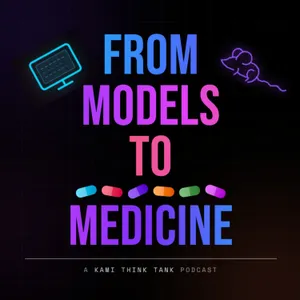
At KAMI Think Tank, we love cutting through the AI hype to showcase where the technology actually stands and how to use it meaningfully within the life sciences. Now, we're bringing that same clarity with our community to a brand new podcast: From Models to Medicine. Every week, we sit down with a real practitioner in the life sciences, whether they're working in the lab, leading innovation at a biotech, or building tools to better serve scientists. We discuss how they cut through the hype of AI and practically leverage the tool in their scientific workflows.
Latest Episodes
The most recent episodes — sign up to get AI-powered summaries of each one.
- 1 weeks ago36 min
Episode 25: The 200-Page Protocol Problem AI Is Finally Solving
In this episode of From Models to Medicine, we sit down with Angie Schwab, CEO and founder of Trialynx, who has spent 20 years watching clinical trials run over budget, over timeline, and over complexity for one reason: nobody got rid of the copy-paste. Angie makes a sharp distinction that most people in the AI conversation are blurring. That automation and AI are not the same thing, and deploying generative AI on top of unstructured workflows without fixing the foundation first is how you get polished-looking documents that still require someone to fact-check every line.We get into how Trialynx compresses months of protocol documentation into 30 days, why a single source of truth changes everything downstream, and where Angie draws a hard line on what AI should never touch. The episode closes on a genuinely provocative idea: AI pseudo-clinical trials that run molecules through synthetic models of human biology before a single patient is enrolled.
- 3 weeks ago27 min
Episode 24: Beyond Correlation - Teaching AI the Rules of Biology
This week, we sit down with Jean-Baptiste Morlot of Deep Life, who makes the case that the drug discovery field has been asking the wrong thing of its AI models. Correlation-based machine learning can find patterns, but it can't tell you why a cell is sick or what it would take to make it healthy again. Jean-Baptiste walks us through how single-cell sequencing unlocked the data volume needed to train something far more ambitious: a causal world model of cellular biology that learns the underlying rules of disease rather than memorizing them.We get into how Deep Life's TwinCell platform works, why most virtual cell benchmarks are quietly inflated by popularity bias, and what it means to build an interpretable AI that a biologist can trust.
- Sep 2, 202630 min
Episode 23: When Biologists Start Thinking Like Engineers
This week, we sit down with Katie Lennon, CSO of Exthymic, who makes a case most bench scientists aren't ready to hear: biology isn't just a discovery discipline anymore. It's engineering. Katie walks us through what it actually looks like to build biology, hardware, and software concurrently, why that requires a shared language across disciplines, and what gets lost when teams hand off instead of collaborate.We also get into the unglamorous side of AI in the lab. More data documentation, peer-checking metadata before an experiment is marked complete, and knowing exactly where LLMs quietly get things wrong. Katie also shares a surprisingly effective strategy for getting scientists over their fear of AI tools. Companies mentioned in the show: https://exthymic.com/https://oni.bio/https://www.potato.ai/https://ollie.ai/-------------------Sign up for KAMI Think Tank's Maven course here! Classes start in less than 10 days!!
- Aug 26, 202645 min
Episode 22: The Model Was Never Built for Her
In this episode of From Models to Medicine, we sit down with Mark Amouzgar, co-founder and CEO of March Health. Mark opens with a striking stat: general-purpose AI models are only about 60% accurate in women's health. Sounding confident isn't the same as being clinically safe, and in this episode he breaks down exactly why generic AI was never built for this.We get into how March Health built a gender-aware digital twin, what it takes to wrap a model in real clinical logic, and why the average endometriosis patient sees eight different doctors before getting an accurate diagnosis. It's a candid conversation about a problem that doesn't get nearly enough attention.-------------------------Sign up for KAMI Think Tank's Maven course here!
- Aug 19, 202634 min
Episode 21: Glass Box Wins - What Pharma Actually Trusts in AI
In this episode of From Models to Medicine, we sit down with Lavanya Anandan, Head of External Innovation, West Coast at CSL, whose path from bench scientist to Merck Group platform builder to UCSF Innovation Venture startup advisor gives her a rare view of where AI in drug discovery is delivering versus where it's mostly promise. She makes a sharp case that the companies winning in AI-bio aren't necessarily the ones with the best models, and the reason why might surprise you.We get into what big pharma wants from an AI partner, why women's health data scarcity is quietly producing some of the most rigorous AI in biology, and what an unexpected finding in mRNA research tells us about where this whole field might be heading. Articles mentioned in show: https://endpoints.news/can-ai-do-scientific-research-billions-chase-hopes-of-superintelligence/Maven course: https://maven.com/kamithinktank/ai-literacy-for-life-sciences-healthcare
- Aug 12, 202641 min
Episode 20: The Build vs. Buy Question Every Pharma Leader is Wrestling With
We chat with Karl Moritz, CEO of Reliant AI, now part of Cohere, whose career took him from NLP research to McKinsey to building AI infrastructure for drug development. Karl reminds us that clinical trial success rates have been stuck years, and the golden age of AI-powered target discovery isn't fixing it.Karl lays out a sharp framework; own the science, rent the AI plumbing, and explains why building your own data ingestion pipeline is as misguided as writing your own operating system. He's also candid about what general-purpose LLMs are actually good for, where purpose-built enterprise tools earn their keep, and why the audit trail question will separate serious AI vendors from everyone else. If you're a pharma or biotech leader trying to make sense of the build vs. buy debate right now, this one is worth your time.
- Aug 5, 202633 min
Episode 19: Flow Cytometry, Biomarkers, and the AI Patterns Nobody Is Verifying
For this episode, we sit down with Banishree Saha, Global Biomarkers Lead at Takeda, who has worked in fields such as academic liver biology to translational biomarker work, over the course of her 20-year career. She walks us through what biomarkers really are, how flow cytometry went from single-color panels to capturing 40 proteins simultaneously, and why that explosion in data has made systems thinking the only way forward.Banishree talks about AI's strengths and weaknesses, and makes the case that the scientists most at risk from AI aren't the ones who know too much biology. But are the ones who don't know enough to catch when the model is wrong.
- Jul 29, 202640 min
Episode 18: Why Does mRNA Keep Breaking AI Models?
In this episode, we sit down with Chris Nelson, an mRNA scientist at nCode Bio whose career has taken him from building blood transfusion matching tests now used by the NHS, to cancer genomics at Personalis, to the frontier of mRNA sequence design. Chris breaks down why the untranslated regions of mRNA might actually change how we dose therapeutics, reduce side effects, and engineer cells inside the body entirely.Then we talk about why AI has conquered protein folding but keeps hitting a wall with mRNA. Chris walks us through the data problem, the cost problem, and the modeling choices nCode Bio is making that go against the grain of what most of the field is building. He's also candid about where the big model providers are letting biology down and which scrappy research groups he thinks are quietly building the tools that will actually matter.
Get From Models to Medicine summaries in your inbox
Free AI-powered daily recaps. Key takeaways, quotes, and mentions — in a 5-minute read.
Get Free Summaries →Free forever for up to 3 podcasts. No credit card required.
You Might Also Like
Listeners also like.

OpenAI Podcast
Conversations with OpenAI researchers and builders exploring how frontier AI models are developed and used in practice.

Latent Space: The AI Engineer Podcast
Explores AI engineering breakthroughs in foundation models, code generation, and AI agents through interviews with researchers and developers.

How I AI
A practical guide to using AI tools in work and life, featuring guests who share specific, actionable techniques and workflows.
Everyday AI Podcast – An AI and ChatGPT Podcast
Covers practical uses of AI tools like ChatGPT and Midjourney to help people work more efficiently and advance their careers.
Me, Myself, and AI
Leaders from top companies share real-world strategies for turning artificial intelligence into measurable business results.

This Week in AI
Four AI experts analyze the latest news and trends in artificial intelligence each week.

AI Breakdown
Explores the latest advancements, ethical issues, and real-world impacts of artificial intelligence across industries.

Machine Learning Street Talk (MLST)
Discussions with leading AI researchers and thinkers exploring machine learning, cognitive science, and philosophy of mind without hype.
Data Science With Sam
Experts discuss data science, artificial intelligence, actuarial science, and scientific research in an academic and industry-focused forum.
"The Cognitive Revolution"
Explores the transformative impact of artificial intelligence through interviews with innovators shaping its future.

AI For Humans: Weekly AI News, Tools & Trends
A weekly breakdown of major AI news, tools, and breakthroughs for both newcomers and seasoned enthusiasts.

A Beginner's Guide to AI
Explores artificial intelligence through interviews and clear explanations for beginners and the curious.
About From Models to Medicine
At KAMI Think Tank, we love cutting through the AI hype to showcase where the technology actually stands and how to use it meaningfully within the life sciences. Now, we're bringing that same clarity with our community to a brand new podcast: From Models to Medicine. Every week, we sit down with a real practitioner in the life sciences, whether they're working in the lab, leading innovation at a biotech, or building tools to better serve scientists. We discuss how they cut through the hype of AI and practically leverage the tool in their scientific workflows.
Customized Recaps
AI-powered recaps with compact key takeaways, quotes, and insights.
Straight to Your Inbox
Get key takeaways from From Models to Medicine in a 5-minute read.
Save Hours Every Week
Stay current on your favorite podcasts without falling behind.
Frequently Asked Questions
What is Podzilla's From Models to Medicine daily summary?
It's a free AI-powered email that summarizes new episodes of From Models to Medicine as soon as they're published. You get the key takeaways, notable quotes, and links & mentions — all in a quick read.
How does the From Models to Medicine podcast summary work?
When a new episode drops, our AI transcribes and analyzes it, then generates a personalized summary tailored to your interests and profession. It's delivered to your inbox every morning.
Is this an official From Models to Medicine product?
No. Podzilla is an independent service that summarizes publicly available podcast content. We're not affiliated with or endorsed by KAMI Think Tank.
Can I get summaries of other podcasts too?
Absolutely! The free plan covers up to 3 podcasts. Upgrade to Pro for 15, or Premium for 50. Browse our full catalog at /podcasts.
How often does From Models to Medicine release new episodes?
From Models to Medicine publishes weekly. Our AI generates a summary within hours of each new episode.
What topics does From Models to Medicine cover?
From Models to Medicine covers topics including Science, Life Sciences. Our AI identifies the specific themes in each episode and highlights what matters most to you.
Start getting From Models to Medicine summaries tomorrow morning.
Free forever for up to 3 podcasts. No credit card required.
Free forever for up to 3 podcasts. No credit card required.