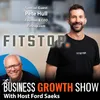
S1Ep297 Business Systems That Turn a Great Idea Into a Global Brand with Pete Hull
Business systems are what separate a great idea from a business that can grow beyond its founder. A concept may work brilliantly in one location with the right people, the right customers, and the founder closely involved. The bigger test comes when that same experience has to work in another location, another market, or another country. That challenge becomes even more significant when the customer experience depends heavily on people. Processes can be documented, technology can be standardized, and performance can be measured, but culture, service, and human connection are harder to replicate. Pete Hull has experienced that challenge firsthand. As Founder and CEO of Fitstop, he has helped grow a fitness concept that began in his parents' garage in Australia into a global brand with more than 170 locations across Australia, New Zealand, Singapore, and the United States. Fitstop's growth provides a useful example of how business systems can support expansion without removing the human elements that made the original concept successful. It also demonstrates why sustainable growth requires more than simply duplicating what worked once. Turn What Works Into a Repeatable System Pete's path to entrepreneurship began long before Fitstop became an international franchise. After two knee reconstructions ended his pursuit of becoming a professional motocross athlete, he moved into coaching and became deeply interested in strength and conditioning, human performance, and helping people make measurable progress. Eventually, Pete began considering how he could take the benefits of one-on-one coaching and create something that could serve more people. The challenge was not simply putting more people into the same workout. He wanted to preserve the progressive nature of athletic training while creating a model that could work in a group environment. That distinction matters in almost every industry. Scaling effectively requires identifying what actually produces the result for the customer and building business systems around those elements. For Fitstop, that meant developing a centralized training methodology rather than allowing every location or coach to independently decide what the customer experience should look like. Studios operate from the same underlying programming, while individual owners and coaches can still bring their personalities and energy to the local community. Pete described the balance simply: "Your vibe attracts your tribe." That balance between standardization and personalization is one of the more difficult parts of building a multi-location business. Too much variation can weaken the brand. Too much standardization can make the experience feel disconnected from the local market. Strong business systems establish the non-negotiables while creating room for people to deliver those standards authentically. Build Systems Around the Customer Experience Operational consistency matters, but consistency alone does not create customer loyalty. A business also needs to understand what keeps customers engaged and what ultimately produces the outcome they came for. Pete's approach starts with the member experience. He explained that the fundamental responsibility of a gym, personal trainer, or fitness business is to serve its members by helping them achieve their goals. Fitstop's systems were built around that objective rather than around simply getting people through a workout. The company's group training model deliberately creates interaction among members. People train together, support one another, push each other, and celebrate progress together. Pete describes the formula as combining the science of strength and conditioning with "the art of human connection." That connection becomes part of the business model rather than something the company hopes will happen organically. Fitstop also tracks progress and gives members milestones to pursue. Members advance through statuses based on participation, testing is incorporated into programming, results can be logged in the company's app, and achievements are celebrated inside the studio. Those systems do more than encourage participation. They create opportunities for customers to recognize their own progress. Progress can be one of the most powerful forms of customer retention. When customers can see evidence that the product or service is helping them move toward something they value, they have a compelling reason to continue. <p
Podzilla Summary coming soon
Sign up to get notified when the full AI-powered summary is ready.
Free forever for up to 3 podcasts. No credit card required.
Listen to This Episode
More from FORDIFY LIVE: The Business Growth Show with Ford Saeks
S1Ep299 Building a Business Through Responsible Growth with Don Varady

S1Ep298 Why Franchise Success Starts with Relationships with Brad Fishman
S1Ep296 Hiring a Keynote Speaker Who Delivers Real Value with Katrina Mitchell
S1Ep295 Building a Smarter Growth Pipeline with John Dobelbower
Get summaries like this every morning.
Free AI-powered recaps of FORDIFY LIVE: The Business Growth Show with Ford Saeks and your other favorite podcasts, delivered to your inbox.
Free forever for up to 3 podcasts. No credit card required.