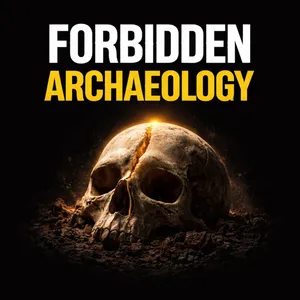
Free Daily Podcast Summary
Forbidden Archaeology: Daily Summaries Delivered
by Forbidden Knowledge Network
Forbidden Archaeology explores lost civilizations, ancient catastrophes, forgotten cultures, and discoveries that challenge conventional views of humanity's past. From Gobekli Tepe and Baalbek to Atlantis theories, submerged ruins, and prehistoric mysteries, each episode investigates evidence, sites, and debates that suggest civilization may be older and more complex than traditionally believed. Through immersive storytelling, discover the mysteries hidden in humanity's distant past.Unlock bonus content:https://www.patreon.com/theforbiddenknowledgenetwork
Latest Episodes
The most recent episodes — sign up to get AI-powered summaries of each one.
- 1 weeks ago27 min
The Archaeology of Halloween: Ancient Sacred Sites and Rituals of the Dead
At Tlachtga, the Hill of Ward in County Meath, excavators uncovered overlapping enclosures, animal-bone deposits, human remains, hearths, possible metalworking evidence, medieval activity, and the burial of a child in an enclosure ditch. The hill is associated in later Irish tradition with the fires of Samhain, but its excavated evidence spans many centuries and several distinct monuments.This episode follows the published excavation record from Tlachtga alongside the seasonal-sun observation at Tara’s Mound of the Hostages. It separates trench evidence, radiocarbon results, later literary testimony, and museum-recorded Halloween customs to ask a difficult question: can any excavated phase at these hills be securely connected to the Samhain fire tradition?The evidence includes ancient monuments, burials, burned deposits, a documented autumn sunrise observation, and later folklore records. It also includes major chronological gaps between prehistoric construction, early medieval activity, seventeenth-century testimony, and recent Halloween customs. The final judgment remains open.This podcast uses artificial intelligence in its research, writing, production, and narration. Episodes are editorially reviewed before publication.#ForbiddenArchaeology #Samhain #Tlachtga #HillOfWard #MoundOfTheHostagesYES OR NO: Does current evidence securely connect Tlachtga to an ancient Samhain fire rite??????
- 2 weeks ago25 min
The Lovelock Cave Archaeology: What Was Actually Found Beneath the Legend?
Lovelock Cave above Nevada’s Humboldt Sink entered the archaeological record after commercial guano mining disturbed part of an extraordinarily rich Indigenous deposit. Beginning in 1912, Llewellyn L. Loud, and later Loud with Mark R. Harrington, documented basketry, nets, sandals, cordage, tools, food remains, burials, and remarkable duck decoys made for wetland hunting.The cave later became associated with claims of red-haired giants and Northern Paiute conflict traditions. This episode follows the surviving excavation plan, numbered lots, the 1929 monograph, museum catalog records, radiocarbon determinations, Sarah Winnemucca Hopkins’s 1883 text, and later cultural-history documentation to distinguish what each source actually says.What can a disturbed but extraordinary archaeological site establish about Indigenous life in the Great Basin? And does its documented history substantiate the giant-remains claim?This podcast uses artificial intelligence in its research, writing, production, and narration. Episodes are editorially reviewed before publication.#ForbiddenArchaeology #LovelockCave #NorthernPaiuteHistory #SaidukaSaiDukaATraditions #BatGuanoYES OR NO: Does the documented Lovelock Cave record verify giant human remains??????
- Oct 6, 202628 min
The Stone Boxes of Egypt: Why Are Massive Granite Containers Found Underground?
Beneath the desert at Saqqara, near Memphis, underground galleries hold immense stone coffers long associated with the burials of sacred Apis bulls. Auguste Mariette entered the Greater Underground in November 1851 after tracing a buried avenue of sphinxes toward the lost Serapeum. He recorded twenty-four coffers there: twenty-two of granite and two of compact limestone. Their scale, hard stone, heavy lids, and carefully worked surfaces have made them central to claims that ancient Egypt possessed an unrecognized manufacturing technology.The strongest alternative interpretation comes from tool-and-die maker Christopher Dunn, who argues that reported flatness, squareness, and parallelism on some coffers indicate advanced machining beyond the usual account of ancient stoneworking. The strongest conventional interpretation is that the galleries formed part of a long-lived funerary complex for Apis bulls associated with Ptah at Memphis, supported by stelae, royal inscriptions, gallery phases, funerary finds, and the broader history of the cult.But the record is incomplete. Mariette found a site already disturbed in antiquity, his original excavation journal is reported lost, and no independently published surface-metrology survey has confirmed or rejected Dunn’s measurements across the coffers. The religious purpose of the Serapeum is strongly supported. The exact methods used to make, move, and lower every massive coffer remain less fully documented.This podcast uses artificial intelligence in its research, writing, production, and narration. Episodes are editorially reviewed before publication.#ForbiddenArchaeology #SerapeumOfSaqqara #ApisBullSarcophagi #AugusteMariette #SaqqaraYES OR NO: Do the Serapeum coffers challenge the accepted account of ancient Egyptian engineering???????
- Sep 29, 202624 min
The Serapeum of Saqqara: Who Made the Giant Granite Boxes Beneath Egypt?
Beneath the Saqqara necropolis, west of ancient Memphis, underground galleries contain some of Egypt’s most imposing stone objects: immense hard-stone coffers resting in chambers cut into bedrock. Since Auguste Mariette’s nineteenth-century excavation, the Serapeum has been identified as a burial complex for sacred Apis bulls associated with Ptah. Stelae, royal inscriptions on particular coffers, changing gallery plans, and records of bull burials provide substantial support for that interpretation.The coffers also raise an enduring engineering question. Engineer Christopher Dunn has argued that local observations of flatness, squareness, and finely finished hard-stone surfaces indicate manufacturing abilities beyond those usually proposed for ancient Egypt. His published account describes limited inspections of portions of two coffers with machinist’s tools. No comprehensive, independently reviewable survey of all accessible surfaces, coffers, and tool marks was verified in the source record.This episode follows the site’s changing burial landscape, Mariette’s excavation along the sphinx avenue, the chamber-five stela recorded above its ancient closing wall, the inscribed coffers studied by Battiscombe Gunn, and the later dispute over precision. The evidence strongly supports an Egyptian Apis-burial context. The complete manufacturing sequence for particular coffers remains open to investigation.This podcast uses artificial intelligence in its research, writing, production, and narration. Episodes are editorially reviewed before publication.#ForbiddenArchaeology #SerapeumOfSaqqara #ApisBullBurials #GraniteSarcophagi #AugusteMarietteYES OR NO: Do the surviving records support an Egyptian Apis-burial purpose for the giant coffers??????
- Sep 22, 202626 min
The Unfinished Obelisk: What Do the Tool Marks Reveal About Ancient Egypt?
In Aswan’s granite quarry landscape, an immense obelisk remains attached to the bedrock from which it was shaped. When Reginald Engelbach’s clearance exposed the full monument in 1921–1922, he measured an intended length of approximately 41.75 metres and calculated a finished weight of 1,168 English tons. It would have exceeded every surviving erected Egyptian obelisk, but it was never detached, transported, or raised.Its abandonment preserved evidence normally erased from completed monuments: rounded quarry trenches, repeated scalloped depressions, black and red layout lines, overlapping outlines, fissures, localized test features, later modifications, and battered hard-stone pounders. This episode follows the ancient adjustments recorded in the granite, Engelbach’s difficult clearance, the complicated provenance of the pounders, modern experiments, and the claim that the marks may indicate a lost technology.The evidence strongly supports hard-stone impact quarrying in the principal trench. Yet the monument was abandoned before its final undercutting, transport, and erection could leave evidence at this site. Do the surviving marks record a practical project defeated by flawed stone, or an ambition that exceeded the available system?This podcast uses artificial intelligence in its research, writing, production, and narration. Episodes are editorially reviewed before publication.#ForbiddenArchaeology #AncientEngineeringMysteryEvidenceLedForbiddenArc #UnfinishedObelisk #AswanGraniteQuarries #AncientEgyptianToolMarksYES OR NO: Do the Unfinished Obelisk’s principal trench marks require unknown machinery??????
- Sep 14, 202627 min
The Stone Circles Older Than Stonehenge
In 1992, archaeologists excavating a low ring of sandstone slabs in Egypt’s Western Desert documented a structure only about four metres across. It stood at Nabta Playa, a basin roughly one hundred kilometres west of Abu Simbel that once filled seasonally with water. The stones were surrounded by wells, settlements, cattle burials, tumuli, stelae, megalithic lines, and buried stone deposits. Some researchers, including J. McKim Malville and colleagues, argued that paired openings in the circle approximately marked the summer-solstice sunrise and north, making it a possible early seasonal calendar.That claim is often placed beside two other monuments older than Stonehenge’s famous stone settings: the tenth-millennium BCE round and oval pillar buildings of Göbekli Tepe in southeastern Türkiye, and the multi-phase Neolithic menhir enclosure at Almendres in Portugal. Together, they show that communities without writing, metal tools, or states could build durable ceremonial and communal spaces far earlier than popular history once assumed.But the evidence does not establish one lost civilization or a chain of ancient observatories. Göbekli Tepe was also an occupied settlement. Nabta’s circle is contextually dated rather than directly dated, and its broad openings limit precision. Almendres was restored after many stones had fallen. The unresolved question is whether these monuments were built chiefly to track the heavens, or whether sky directions were one part of places shaped by gathering, survival, animals, memory, and ceremony.This podcast uses artificial intelligence in its research, writing, production, and narration. Episodes are editorially reviewed before publication.#ForbiddenArchaeology #PrehistoricArchaeologyEarlyMonumentalArchitectur #GBekliTepe #NabtaPlaya #AlmendresCromlechYES OR NO: Do these older monuments challenge the usual story of how monumental building began???????
- Sep 8, 202627 min
The Dragon Man Skull: A Possible Human Lineage Hidden in China
In 2018, an exceptionally complete archaic human skull entered scientific study after decades in private custody. The Harbin cranium, now held by Hebei GEO University in China, was reportedly found during bridge construction near Harbin in 1933 and hidden in an abandoned well. But that family history is not independently documented, and even researchers involved in the case later questioned parts of it.The skull itself is real, ancient, and difficult to classify. It has a braincase of about 1,420 milliliters, massive brow ridges, broad facial bones, almost square eye sockets, and one unusually large surviving molar. In 2021, researchers proposed a new species name for it: Homo longi, or Dragon Man. Their anatomical analysis suggested an East Asian lineage unexpectedly close to Homo sapiens.Other specialists saw a different possibility. The skull’s molar and its similarities to the protein-identified Denisovan jaw from Xiahe, Tibet, suggested that Dragon Man might be the long-missing skull of the Denisovans, an archaic population first identified through DNA from tiny fossils in Siberia.In 2025, proteins from the skull and mitochondrial DNA recovered from dental calculus on its tooth both showed Denisovan affinity. The evidence now strongly connects Harbin to that lineage. But its original burial layer is lost, its discovery story remains uncertain, and scientists still disagree about whether Homo longi should remain a separate species name or become the formal anatomical name for Denisovans.This podcast uses artificial intelligence in its research, writing, production, and narration. Episodes are editorially reviewed before publication.#ForbiddenArchaeology #ForbiddenArchaeologyHumanOriginsPaleoanthropolog #DragonManSkull #HomoLongi #DenisovansYES OR NO: Does the Dragon Man skull challenge the accepted picture of human evolution in Asia???????
- Sep 1, 202624 min
The Cerutti Mastodon Site: Were Humans in California 130,000 Years Ago?
In November 1992, fossil monitor Richard Cerutti spotted bones exposed by highway construction along State Route 54 near the boundary of San Diego and National City, California. The animal proved to be a mastodon. But as the San Diego Natural History Museum team excavated, the deposit appeared unusual: major limb bones were sharply broken, some fragile elements survived, five large cobbles lay in fine sediment, stone fragments refitted, and one tusk stood nearly vertical.More than two decades later, uranium-thorium modeling of mastodon bone produced a preferred age estimate of about 130,700 years. In a 2017 Nature paper, Steven Holen, Thomas Deméré, Daniel Fisher and colleagues argued that an unidentified member of Homo had used the cobbles as hammerstones and anvils to break fresh mastodon bones, perhaps for marrow or bone-tool material.The claim remains deeply contested. Critics point to construction disturbance, possible geological and biological site-formation processes, the difficulty of identifying human action from broken bone and battered stone, and the absence of human remains, hearths, conventional stone tools, or comparable sites from the following one hundred thousand years. Defenders answer that mineral coatings show important fractures are ancient, that the sediment does not easily explain the large cobbles, and that later microscopy found bone residues concentrated on worn cobble surfaces.The mastodon is old. The unresolved question is whether anyone picked up the stones beside it.This podcast uses artificial intelligence in its research, writing, production, and narration. Episodes are editorially reviewed before publication.#ForbiddenArchaeology #ControversialArchaeologyAnomalousPrehistoryEarly #CeruttiMastodon #EarlyHumansAmericas #Topic130000YearsAgoYES OR NO: Do you believe Cerutti challenges the accepted timeline of peopling in the Americas???????
Get Forbidden Archaeology summaries in your inbox
Free AI-powered daily recaps. Key takeaways, quotes, and mentions — in a 5-minute read.
Get Free Summaries →Free forever for up to 3 podcasts. No credit card required.
You Might Also Like
Listeners also like.

Ancient Aliens
Explores the theory that extraterrestrial beings have visited Earth throughout history, examining ancient evidence and modern sightings.
The Ancients
Explores ancient history through expert interviews, covering topics from Neolithic Britain to the fall of Rome.

HistoryExtra podcast
Historical conversations with leading experts explore gripping stories from the past.

New Books in Ancient History
New Books Network
Ancient Civilisations
Explores the history, people, and achievements of ancient civilizations through narrative storytelling.

History's Great Mysteries
Explores unexplained historical events and invites listeners to ponder possible theories behind enduring mysteries.

The Ancient Tradition
Explores evidence of a primordial religious tradition across ancient myths, symbols, rituals, and sacred texts worldwide.

Expanded Perspectives
Explores ancient history, alternative theories, cryptozoology, UFOs, and paranormal mysteries through research and expert interviews.

Astonishing Legends
Explores unexplained mysteries and paranormal phenomena through investigations and interviews with experts.

Blurry Creatures
Explores biblical perspectives on UFOs, cryptids, the Nephilim, and supernatural phenomena through theology and witness testimony.

Our Fake History
Explores the blurred line between historical events and the myths surrounding them.

Mystic Sciences Theater
Dramatized explorations of historical mysteries, unexplained phenomena, and legendary events through immersive storytelling.
About Forbidden Archaeology
Forbidden Archaeology explores lost civilizations, ancient catastrophes, forgotten cultures, and discoveries that challenge conventional views of humanity's past. From Gobekli Tepe and Baalbek to Atlantis theories, submerged ruins, and prehistoric mysteries, each episode investigates evidence, sites, and debates that suggest civilization may be older and more complex than traditionally believed. Through immersive storytelling, discover the mysteries hidden in humanity's distant past.Unlock bonus content:https://www.patreon.com/theforbiddenknowledgenetwork
Customized Recaps
AI-powered recaps with compact key takeaways, quotes, and insights.
Straight to Your Inbox
Get key takeaways from Forbidden Archaeology in a 5-minute read.
Save Hours Every Week
Stay current on your favorite podcasts without falling behind.
Frequently Asked Questions
What is Podzilla's Forbidden Archaeology daily summary?
It's a free AI-powered email that summarizes new episodes of Forbidden Archaeology as soon as they're published. You get the key takeaways, notable quotes, and links & mentions — all in a quick read.
How does the Forbidden Archaeology podcast summary work?
When a new episode drops, our AI transcribes and analyzes it, then generates a personalized summary tailored to your interests and profession. It's delivered to your inbox every morning.
Is this an official Forbidden Archaeology product?
No. Podzilla is an independent service that summarizes publicly available podcast content. We're not affiliated with or endorsed by Forbidden Knowledge Network.
Can I get summaries of other podcasts too?
Absolutely! The free plan covers up to 3 podcasts, any in the catalog. Basic raises that to 15, Pro to 40 and Max to 100. Browse our full catalog at /podcasts.
How often does Forbidden Archaeology release new episodes?
Forbidden Archaeology publishes weekly. Our AI generates a summary within hours of each new episode.
What topics does Forbidden Archaeology cover?
Forbidden Archaeology covers topics including Science, History. Our AI identifies the specific themes in each episode and highlights what matters most to you.
Start getting Forbidden Archaeology summaries tomorrow morning.
Free forever for up to 3 podcasts. No credit card required.
Free forever for up to 3 podcasts. No credit card required.