Free Daily Podcast Summary
Our Fake History: Daily Summaries Delivered
by PodcastOne
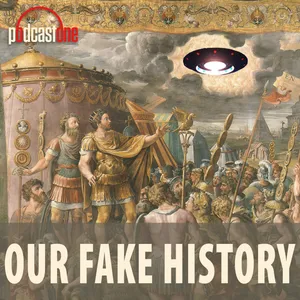
A podcast about myths we think are history and history that might be hidden in myths! Awesome stories that really (maybe) happened!
Latest Episodes
The most recent episodes — sign up to get AI-powered summaries of each one.
- 5 days ago37 min
Bonus Episode - Fakelore, Fan Fiction, and Local Giants
In this bonus episode Sebastian takes questions about the recent shows on Paul Bunyon and the Children's Crusade. The host takes some time to further unpack the idea of fakelore and draw some distinctions between "authentic" lore and the creations of money writers. Sebastian also compares the differences between folklore and urban legends. Finally, Sebastian shares a few giant stories from the Lake Huron region and talks about some contemporary online creators playing fast and loose with the Children's Crusade myth. Tune-in and find out how Atlantis, Giant's Tomb, and newspaper sages all play a role in the story.See Privacy Policy at https://art19.com/privacy and California Privacy Notice at https://art19.com/privacy#do-not-sell-my-info.
- 1 weeks ago1h 22m
Episode #257 - Was There a Children's Crusade?
In the year 1212 something strange happened in Western Europe, but none of the contemporary historic sources can agree on exactly what it was. Later historians would claim that a religious movement made up of children under twelve sprang up in rural France. After gathering together thousands of pre-teen followers this crusade set out to liberate the holy land. However, we're told that this so-called Children's Crusade ended in disaster. According to some sources, the children were attacked, starved, murdered, or sold en-masse into slavery. But is any of that true? Was there really a Children's Crusade? If there was, should we believe the horror stories about this unusual movement? Tune-in and find out how "mythistory," a Woodstock Nation, and The Old Man of the Mountain all play a role in the story.Hear more Staring Contest HereBuy OFH Merch HereSee Privacy Policy at https://art19.com/privacy and California Privacy Notice at https://art19.com/privacy#do-not-sell-my-info.
- 3 weeks ago1h 18m
Episode #256 - Is Paul Bunyan Fakelore?
Season 12 begins with the trip to the Northwoods! For over a century Paul Bunyan has been America's best loved lumberjack hero. Statues honoring the gigantic woodsman dot the mid-west. His smiling face has been used to sell everything from building materials to loaves of bread. But, in the 1950's one of America's leading folklorists declared that Paul Bunyan was a prime example of something he called "fakelore." These were tales invented by authors that mimicked stories that came out of oral traditions. He accused Paul Bunyan of being a corporate mascot masquerading as an authentic American myth. Have these accusations stood the test of time? Is Paul Bunyan a fake myth? Tune-in and find out how lumberjack improv teams, mythical Quebec potholes, and the best man in Ottawa all play a role in the story!Listen to more Staring Contest HereSee Privacy Policy at https://art19.com/privacy and California Privacy Notice at https://art19.com/privacy#do-not-sell-my-info.
- Aug 18, 20261h 14m
OFH Throwback - Episode #149 - Who Was the Real Stagger Lee?
In this throwback episode Sebastian takes you to an episode that is one of his personal favorites. Is it "secretly" one of the best episode of OFH? The character of Stagger Lee has been one of America’s most enduring folk heroes. There have been over 400 songs written about the swaggering, gun-toting, bad man. He has gone by many names: Stacks Lee, Stagolee, Staxs O’Lee. Sometimes he is presented as a malevolent villain, others a heroic defender of the oppressed. No matter the telling Stagger Lee is always a badass. Is this figure just a piece of fiction dreamt up by blues musicians and perpetuated by their rock’n’roll progeny? Or was there a real man behind the murderous myth? Tune-in and find out how Biggie Smalls, 19th century fightin’ words, and a milk white stetson hat all play a role in the story.See Privacy Policy at https://art19.com/privacy and California Privacy Notice at https://art19.com/privacy#do-not-sell-my-info.
- Aug 13, 20264 min
"You're Dead to Me" from the BBC
With a new star-studded film adaptation of The Odyssey bringing Homer's world back to the big screen, it’s the perfect time to share a teaser clip from our friends at You're Dead To Me. It's the BBC comedy podcast that takes history seriously, bringing together experts and comedians to explore the people, stories and ideas that shaped our world. If you like what you hear you can find full episodes of You're Dead to Me wherever you get your podcasts.See Privacy Policy at https://art19.com/privacy and California Privacy Notice at https://art19.com/privacy#do-not-sell-my-info.
- Aug 11, 20261h 30m
OFH Throwback - Episode #117 - What Went Down On Easter Island? (Part II)
In this throwback episode Sebastian takes you to the conclusion of one of the podcast's most discussed series. The island of Rapa Nui, or Easter Island, has been called “the clearest example of a society that destroyed itself.” For years it was taken for granted that the people of Rapa Nui had depleted their natural resources in pursuit of bigger and better stone statues called Moai. However, recent scholarship has called into to question the widely known story of ecological collapse. Were the people of Rapa Nui really the authors of their own destruction, or has this narrative been unfairly exaggerated? Tune-in and found out how Birdmen, traumatized skeletons, and a stolen friend all play a role in the story.See Privacy Policy at https://art19.com/privacy and California Privacy Notice at https://art19.com/privacy#do-not-sell-my-info.
- Aug 4, 20261h 21m
OFH Throwback - Episode #116 - What Went Down on Easter Island? (Part I)
In this Throwback Episode Sebastian revisits one of the best loved series from Season 6. Easter Island, or Rapa Nui as the indigenous islanders call it, may be the most misunderstood place on planet Earth. For centuries outsiders have tried to unravel what they perceived to be the islands many mysteries. How did stone age people manage to get to such a remote island? How did these people build the island’s remarkable statues? What caused this unique society to collapse? Recent research has completely upended many previous assumptions about this storied island. Was the mysterious collapse even a collapse at all? Tune in an find out how awesome canoes, ancestor mana, and OFH’s favourite ocean current all play a role in the story. See Privacy Policy at https://art19.com/privacy and California Privacy Notice at https://art19.com/privacy#do-not-sell-my-info.
- Jul 28, 20261h 17m
OFH Throwback - Episode #145 - Real Gryphons?
In this Throwback Episode Sebastian revisits one of his favourite episodes from Season 7 and brings in some new critiques that did not make it into the original show! The legendary hybrid creature known as the gryphon was said to have the body of a lion and the head and wings of an eagle. Despite this fantastical descriptions the ancient Greeks and Romans truly seemed to have believed that gryphons were real animals. It was thought that gryphons lived in arid steppes and deserts of central Asia where they guarded stashes of gold. Stories of gryphons made their way to Mediterranean by way of the nomadic Scythian people, who hunted for gold in the gryphon’s homeland. Stanford Professor Adrienne Mayor thinks she may have solved the mystery of this puzzling creature. Could the gryphon stories be an early form of paleontology? Tune-in and find out how giant hoaxes, paleo-art, and one eyed gold hunters all play a role in the story.Read Mark Witton's blog HereSee Privacy Policy at https://art19.com/privacy and California Privacy Notice at https://art19.com/privacy#do-not-sell-my-info.
Get Our Fake History summaries in your inbox
Free AI-powered daily recaps. Key takeaways, quotes, and mentions — in a 5-minute read.
Get Free Summaries →Free forever for up to 3 podcasts. No credit card required.
You Might Also Like
Listeners also like.

American History Tellers
Pivotal moments in American history are explored through narrative storytelling, revealing their impact on the nation and modern life.

History Unplugged Podcast
Features interviews with history authors and answers to listener questions on a wide range of historical topics.

HistoryExtra podcast
Covers global history from ancient to modern times through expert interviews on events, figures, and eras.
Everything Is Fake
Explores how fakery in modern life is often rewarded and why people remain indifferent to it.
History on Trial
Examines famous American trials to reveal how legal battles reflected and shaped cultural forces of their time.

HISTORY This Week
A weekly look at pivotal historical events and the people behind them, famous or forgotten, who shaped the world.

Ridiculous History
Explores bizarre and absurd stories from human history with a mix of humor and historical insight.
Mythology
A scripted audio drama that reimagines ancient myths while exploring their historical roots and cultural significance.

Real Cool History for Kids
Engaging true stories from history told from a biblical perspective to spark curiosity in kids and families.
Mythology & Fiction Explained
Explores myths and fictional stories from around the world, breaking down their origins and meanings.
Lore
Dark historical tales blending folklore, mystery, and real events to reveal the eerie side of the past.

Very Special Episodes
True stories of ordinary people in bizarre, life-changing situations, each episode unfolding like a movie-worthy tale.
About Our Fake History
A podcast about myths we think are history and history that might be hidden in myths! Awesome stories that really (maybe) happened!
Customized Recaps
AI-powered recaps with compact key takeaways, quotes, and insights.
Straight to Your Inbox
Get key takeaways from Our Fake History in a 5-minute read.
Save Hours Every Week
Stay current on your favorite podcasts without falling behind.
Frequently Asked Questions
What is Podzilla's Our Fake History daily summary?
It's a free AI-powered email that summarizes new episodes of Our Fake History as soon as they're published. You get the key takeaways, notable quotes, and links & mentions — all in a quick read.
How does the Our Fake History podcast summary work?
When a new episode drops, our AI transcribes and analyzes it, then generates a personalized summary tailored to your interests and profession. It's delivered to your inbox every morning.
Is this an official Our Fake History product?
No. Podzilla is an independent service that summarizes publicly available podcast content. We're not affiliated with or endorsed by PodcastOne.
Can I get summaries of other podcasts too?
Absolutely! The free plan covers up to 3 podcasts. Upgrade to Pro for 15, or Premium for 50. Browse our full catalog at /podcasts.
How often does Our Fake History release new episodes?
Our Fake History publishes weekly. Our AI generates a summary within hours of each new episode.
What topics does Our Fake History cover?
Our Fake History covers topics including History, Education, Culture, Society & Culture. Our AI identifies the specific themes in each episode and highlights what matters most to you.
Start getting Our Fake History summaries tomorrow morning.
Free forever for up to 3 podcasts. No credit card required.
Free forever for up to 3 podcasts. No credit card required.