Free Daily Podcast Summary
For the Living and the Dead. Traces of the Holocaust: Daily Summaries Delivered
by EHRI
Get key takeaways, quotes, and insights from For the Living and the Dead. Traces of the Holocaust in a 5-minute read. Delivered straight to your inbox.
Latest Episodes
The most recent episodes — sign up to get AI-powered summaries of each one.
- Dec 12, 202429 min
Uncovering Hidden (Hi)stories
The final episode of the third series of the EHRI podcast takes a step back to look at micro-archives in a more general sense. In keeping with our theme, however, we also focus on an object that teaches us more about the Holocaust. An object that represents both the richness of sources that can be found in micro-archives and the challenges that those working with them face. Our object of focus is a black and white photograph, depicting a group of prisoners dressed in the distinctive str...
- Nov 28, 202429 min
The Writings of a Wandering Poet
In this podcast episode, we learn about a remarkable manuscript that survived the Holocaust and was later discovered to be the work of one of the most interesting modern creators of Hebrew literature in the 20th century: David Vogel. The manuscript is made up of pages upon pages of miniscule, uniform handwriting and was hidden by Vogel in the back garden of the boarding house in Hauteville, France where he was staying before his arrest by the Gestapo in 1944. Vogel was murdered in Auschwitz c...
- Nov 14, 202433 min
The Lost letter
In this episode, a lost letter tells the extraordinary story of Tommy Benford Junior, a baby boy born in Paris in 1939 and saved by the incredible bravery of a Dutch woman called Truus Wijsmuller. To look at, the letter is simple, and formally written, but it contains a father's desperate plea to save his son. Tommy Benford Junior was born in Paris in 1939. His father was an accomplished American jazz drummer, and his mother, Sophia Mezzaro, was a dancer, singer and pianist from Vien...
- Oct 31, 202434 min
A Place of Paradise
In this episode, the object of our focus is a black and white photograph that offers a harrowing glimpse into the narrow survival of Nazi camp prisoners. Two of the survivors in this image would later travel to the ‘paradise’ of Windermere, in the Lake District in England, on 14 August 1945. The image contains a stark contrast; the jubilant gestures of greeting from the gaggle of young survivors sits in juxtaposition with the cargo train they are loaded onto, a vehicle normally used for trans...
- Oct 17, 202434 min
The Stamp of Samuilo Demajo
In this episode, we focus on a stamp, printed on the inside jacket of a book donated to the National Library of Serbia in 1941. The stamp is remarkable not least because it belonged to a prominent Belgrade lawyer named Samuilo Demajo, whose family was murdered in May 1942 in a Dušegupka, a truck re-equipped as a mobile gas van. Though Demajo's life was abruptly ended, his legacy lives on in this and the approximately 200 other books that he donated in an effort to rebuild the public lib...
- Oct 3, 202434 min
A Message from Malawi
The object of our attention in this episode is a well-travelled letter of 21 pages, received in 1997 by Professor Albert Lichtblau, in response for an appeal for "unpublished biographical memoirs" of Holocaust survivors he had posted on behalf of the Institute for Jewish History of Austria as well as the Leo Baeck Institute in New York. The letter was written by Norbert Abeles, an Austrian living in Malawi, and its arrival prompted an exchange of further letters between Malawi and Austria, u...
- Dec 14, 202328 min
Gita's Notes for Survival
In this podcast episode, released during Hanukka 2023, we talk with Ofer Lifshitz about a tiny memory booklet, as small as a young girl’s fist, that belonged to a teenage girl named Gita Rubanenko. Gita was born in 1929 and lived with her parents and sister in a town called Kovno in Lithuania. Kovno, also known as Kaunas, was before the war the capital and largest city of Lithuania. In 1939, Kovno had a vibrant Jewish community with approximately 32,000 people, about one-fourth of the c...
- Nov 30, 202324 min
A Paper Heart for Wanda
In this podcast episode, the object of our attention is a delicate paper heart, a small work of art, crafted by Elisabeth Salomon. You can enfold the 'heart', like a flower, and on each petal, you will find the name of the woman or girl (sometimes a boy or man) who made it, maybe a date or place, and endearing messages of gratitude. Elizábeth was not the only woman who crafted this paper heart. There are many paper "hearts", all with their own uniqueness, in the Swedish Holocaust Museum, that...
Get For the Living and the Dead. Traces of the Holocaust summaries in your inbox
Free AI-powered daily recaps. Key takeaways, quotes, and mentions — in a 5-minute read.
Get Free Summaries →Free forever for up to 3 podcasts. No credit card required.
You Might Also Like
Listeners also like.
Deutsche Geister
DIE ZEIT
Adventures with Dead Jews
Tablet Magazine

Documentaries
BBC

WHAT WAS HER NAME
Miah Huber

Jewish History Nerds
Unpacked
Joods (over) leven
JMW | Ronit Palache
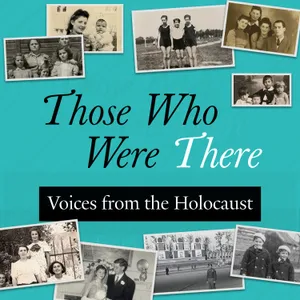
Those Who Were There: Voices from the Holocaust
Fortunoff Video Archive for Holocaust Testimonies
Israel Story
Israel Story
History: darkness and light
Matthew Frank Stevens

Jewish History Soundbites
Yehuda Geberer
Haunting
iHeartPodcasts and Glass Podcasts
Dark History: Where The Darkness See’s The Light
Rob Bradley
About For the Living and the Dead. Traces of the Holocaust
In each episode of For the Living and the Dead, a Holocaust researcher talks about an object, now often in a museum, that tells a very personal story about the Holocaust. The first season of the EHRI Podcast has six episodes and features a teddy bear, mica-flakes, a postcard, gramophone discs, a magazine cover and the typewriter. The unique stories come from all over Europe – the Holocaust being a continent-wide phenomenon – ranging from Belgium to Ukraine, from Romania to Italy.This podcast season of six episodes is released every other week, starting 29 September 2022. In 2023, another season will follow.Music accreditation: Blue Dot Sessions, https://app.sessions.blue/ Tracks - Opening and closing: Stillness. Incidental, Gathering Stasis, Pencil Marks, Uncertain Ground, Marble Transit and Snowmelt. License Creative Commons Atttribution-NonCommercial 4.0 International (BB BY-NC 4.0).
Customized Recaps
AI-powered recaps with compact key takeaways, quotes, and insights.
Straight to Your Inbox
Get key takeaways from For the Living and the Dead. Traces of the Holocaust in a 5-minute read.
Save Hours Every Week
Stay current on your favorite podcasts without falling behind.
Frequently Asked Questions
What is Podzilla's For the Living and the Dead. Traces of the Holocaust daily summary?
It's a free AI-powered email that summarizes new episodes of For the Living and the Dead. Traces of the Holocaust as soon as they're published. You get the key takeaways, notable quotes, and links & mentions — all in a quick read.
How does the For the Living and the Dead. Traces of the Holocaust podcast summary work?
When a new episode drops, our AI transcribes and analyzes it, then generates a personalized summary tailored to your interests and profession. It's delivered to your inbox every morning.
Is this an official For the Living and the Dead. Traces of the Holocaust product?
No. Podzilla is an independent service that summarizes publicly available podcast content. We're not affiliated with or endorsed by EHRI.
Can I get summaries of other podcasts too?
Absolutely! The free plan covers up to 3 podcasts. Upgrade to Pro for 15, or Premium for 50. Browse our full catalog at /podcasts.
How often does For the Living and the Dead. Traces of the Holocaust release new episodes?
For the Living and the Dead. Traces of the Holocaust publishes biweekly. Our AI generates a summary within hours of each new episode.
What topics does For the Living and the Dead. Traces of the Holocaust cover?
For the Living and the Dead. Traces of the Holocaust covers topics including Science, History, Culture, Society & Culture, Social Sciences. Our AI identifies the specific themes in each episode and highlights what matters most to you.
Start getting For the Living and the Dead. Traces of the Holocaust summaries tomorrow morning.
Free forever for up to 3 podcasts. No credit card required.
Free forever for up to 3 podcasts. No credit card required.