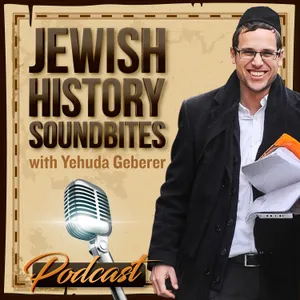
Free Daily Podcast Summary
Jewish History Soundbites: Daily Summaries Delivered
by Yehuda Geberer
Listen to noted Tour Guide, Lecturer and Yad Vashem Researcher of Jewish History Yehuda Geberer bring the world of pre-war Eastern Europe alive. Join in to meet the great personages, institutions and episodes of a riveting past.
Latest Episodes
The most recent episodes — sign up to get AI-powered summaries of each one.
- Yesterday59 min
Tragedy on the Beach: The Altalena Part II
With the Altalena’s arrival at Kfar Vitkin, the situation escalated rather rapidly. The Israeli government was keen on asserting its authority, maintaining one state and one army, while the Irgun was insisting that the weapons aboard the ship be allocated according to its demands. Following an ultimatum from the IDF, a skirmish broke out which led to several tragic deaths. The Altalena then sailed for Tel Aviv, where the final showdown took place the next day. With the Irgun refusing to surrender, the government of the State of Israel decided to take the ship by force. The resulting battle led to death, injury and the shelling of the Altalena. Civil war was averted, but scars and animosity remained. Was there another way this could have ended? Who fired the first shot? Could the violence have been averted had the Irgun submitted to the State’s authority? Subscribe to Jewish History Soundbites Podcast on: PodBean: https://jsoundbites.podbean.com/ or your favorite podcast platform Follow us on LinkedIn, Twitter or Instagram at @Jsoundbites For sponsorship opportunities about your favorite topics of Jewish history or feedback contact Yehuda at: yehuda@yehudageberer.com
- 1 weeks ago52 min
A Ship, An Army & A State: The Altalena Part I
With the resurfacing of the Altalena weapons ship of the Irgun, the controversies and story of its tragic ending have resurfaced as well. In this first part of a two part series on the Altalena story, the background of the Irgun’s position in the early days of the State of Israel is clarified, along with the background to the purpose and goals of the Altalena ship. What was the relationship between the Irgun and the new State of Israel? What was on the Altalena and who was it for? What took place during the first few weeks of the State’s existence that dramatically changed the fate of the Altalena? Who was to fight the War of Independence for the State of Israel - the newly founded IDF or prestate private politicized militias? Subscribe to Jewish History Soundbites Podcast on: PodBean: https://jsoundbites.podbean.com/ or your favorite podcast platform Follow us on LinkedIn, Twitter or Instagram at @Jsoundbites For sponsorship opportunities about your favorite topics of Jewish history or feedback contact Yehuda at: yehuda@yehudageberer.com
- 2 weeks ago50 min
Chassidic Historiography: Tribute to Rabbi Dr. Yitzchak Alfasi
One of the most prolific researchers and writers of Chassidic history, Yitzchak Alfasi amassed an enourmous amount of valuable historic material related to the Chassidic movement, that without his prodigious efforts would have been lost to posterity. Among many others, his invaluable three volume Encyclopedia of Chassidic Personalities is one of the most impressive works of chassidic history ever compiled. When taking a broader view of chassidic historiography, Alfasi fits right in the middle of the dynamic field of researching chassidic history. With its roots in the prewar research of eminent historians such as Shimon Dubnow, and continuing today with new methodologies and sources enriching our knowledge of the chassidic movement, the field of chassidic history research is better than it has ever been before. Subscribe to Jewish History Soundbites Podcast on: PodBean: https://jsoundbites.podbean.com/ or your favorite podcast platform Follow us on LinkedIn, Twitter or Instagram at @Jsoundbites For sponsorship opportunities about your favorite topics of Jewish history or feedback contact Yehuda at: yehuda@yehudageberer.com
- 3 weeks ago57 min
Where Have You Gone Mussar Movement?
What happened to the Mussar Movement following its near decimation in the Holocaust? Were there attempts to reestablish it? Were those attempts successful? If not, why not? If yes, how can that limited success be measured? How broad in scope was the success of the Mussar Movement even prior to its destruction in the Holocaust? A Mussar Movement history episode in honor of Elul. Subscribe to Jewish History Soundbites Podcast on: PodBean: https://jsoundbites.podbean.com/ or your favorite podcast platform Follow us on LinkedIn, Twitter or Instagram at @Jsoundbites For sponsorship opportunities about your favorite topics of Jewish history or feedback contact Yehuda at: yehuda@yehudageberer.com
- 4 weeks ago57 min
Tourbites: Summary of Summer Jewish History Trips
Coming off a rich and diverse series of Jewish history tours throughout Europe, Jewish History Soundbites presents a summary of these journeys throughout our storied past across the length and breadth of Europe. Classic sort of tours included Poland & Lithuania in Eastern Europe, to Prague, Bratislava & Vienna in Central Europe. Another one was an in depth exploration of the rich Jewish history in northern Italy - Venice, Padua, Stra, Mantua, Cento, Bologna, Trieste and so much more. Presented here for the benefit and enjoyment of listeners of Jewish History Soundbites, insights and stories from each and every one of these fascinating locations and narratives from the many stops of our collective Jewish journey. Subscribe to Jewish History Soundbites Podcast on: PodBean: https://jsoundbites.podbean.com/ or your favorite podcast platform Follow us on LinkedIn, Twitter or Instagram at @Jsoundbites For sponsorship opportunities about your favorite topics of Jewish history or feedback contact Yehuda at: yehuda@yehudageberer.com
- Aug 15, 202620 min
[RERELEASE] Pre war Torah leaders on Vacation (replay)
The great Rabbis had their favored vacation spots in the Prewar era. Where were they? What went on there? An inside look at the relaxing times and locations known as the "Dachas". Subscribe To Our Podcast on: PodBean: https://jsoundbites.podbean.com/ Follow us on Twitter or Instagram at @Jsoundbites You can email Yehuda at yehuda@yehudageberer.com
- Aug 8, 202646 min
[Rerelease] Great American Jewish Cities #17: The Catskills (replay)
The Mountains, the Catskills, the Borscht Belt, upstate, the country. Monticello, Liberty, Woodridge, Swan Lake, Woodbourne, Fallsburg. A place of many names with one thing in common: a place rich in Jewish history and lore. As a summer destination, the Catskills would be home to countless bungalow colonies as city Jews organized their communities for a mountain air getaway. Generations of children attended the many summer camps that dotted Sullivan County. Camps included Mesivta, Agudah, Munk, HILI, Kol Rinah, Torah Vodaath, Ohr Shraga, Sternberg and many more including the Betar Jewish self defense camp where Vladimir Jabotinsky died in 1940. It was also famously known as the Borscht Belt, and the legendary hotels/resorts/country clubs like Grossinger's, Kutscher's and the Concord made their mark as vacation sites. Most Jewish comedians of the time commenced their careers there. In addition to the summer crowd, the Catskills were home to many year round Jewish communities over the years. These towns built shuls, mikvas, hired Rabbis and even Jewish owned farms burgeoned for a time. This included Yeshivas as well such as the Mountaindale Yeshiva of Rav Yehuda Davis and the famous Yeshiva of South Fallsburg. Subscribe to Jewish History Soundbites Podcast on: PodBean: https://jsoundbites.podbean.com/ or your favorite podcast platform Follow us on LinkedIn, Twitter or Instagram at @Jsoundbites For sponsorship opportunities about your favorite topics of Jewish history or feedback contact Yehuda at: yehuda@yehudageberer.com
- Aug 1, 202629 min
[Rerelease] From Abbey Road to Mt. Zion: The Jewish Music Revolution Part II (replay)
Aside from the Rabbi's Sons discussed in Part 1 of this miniseries, the 1960's saw the first music groups in Ohr Chadash, Pirchei and the London School of Jewish Song. From Israel came Chaim Banet and Jo Amar, the latter a pioneer of Morroccan Jewish music. No less important than the performers, the production, composition and arrangements were handled by architects of Jewish music Suki & Ding, Sheya Mendlowitz, Yisroel Lamm and later Moshe Laufer, Mona Rosenblum and Yossi Green. The 1970's saw the new sounds of Diaspora Yeshiva Band and Dudu Fisher, bringing Jewish music to ever wider audiences. Abie Rottenberg commenced his illustrious career this decade with Dveykus and the soon to be crowned king of Jewish music Mordechai Ben David burst on to the scene as well. Capitalizing on their earlier involvement with Pirchei-JEP, Rivie Schwebel and Ali Scharf collaborated once again with a series of albums of Schwebel, Scharf & Levine. Check out the story of Yerachmiel Begun and the Miami Boys Choir on this popular episode of Jewish History Soundbites: https://jsoundbites.podbean.com/e/great-american-jewish-cities-14-miami/ Subscribe to Jewish History Soundbites Podcast on: PodBean: https://jsoundbites.podbean.com/ or your favorite podcast platform Follow us on LinkedIn, Twitter or Instagram at @Jsoundbites For sponsorship opportunities about your favorite topics of Jewish history or feedback contact Yehuda at: yehuda@yehudageberer.com
Get Jewish History Soundbites summaries in your inbox
Free AI-powered daily recaps. Key takeaways, quotes, and mentions — in a 5-minute read.
Get Free Summaries →Free forever for up to 3 podcasts. No credit card required.
You Might Also Like
Listeners also like.

The Jewish History Podcast - With Rabbi Yaakov Wolbe
A podcast featuring Rabbi Yaakov Wolbe's lectures on Jewish history.

Adventures with Dead Jews
Explores bizarre and darkly humorous stories from Jewish history to examine society's obsession with dead Jews.

Ask Haviv Anything
A history podcast shaped by listener questions, covering wars, identity, and cultural topics with a mix of serious and light discussion.

Call Me Back - with Dan Senor
Discusses challenges and dilemmas facing Israelis and Jews worldwide.

Tablet Studios
Explores Jewish identity, tradition, and culture through diverse podcasts offering insight for contemporary Jewish life.

History Unplugged Podcast
Features interviews with history authors and answers to listener questions on a wide range of historical topics.

Those Who Were There: Voices from the Holocaust
Holocaust survivors and witnesses share personal accounts from the Fortunoff Video Archive at Yale University.

Forum Borealis
In-depth interviews with authors and thinkers on unconventional topics in history, science, philosophy, and politics.

WW2 Pod: We Have Ways of Making You Talk
A comedian and historian explore World War II through detailed analysis, personal stories, and dark humor.

Reading Hannah Arendt with Roger Berkowitz
Close readings of Hannah Arendt’s works paired with interviews exploring her ideas on politics, thought, and the human condition.

Travel with Rick Steves
Explores global travel, cultures, and human connections with expert insights and listener stories.

The History of WWII Podcast
A detailed narrative exploration of World War II, covering its events, battles, and key figures.
About Jewish History Soundbites
Listen to noted Tour Guide, Lecturer and Yad Vashem Researcher of Jewish History Yehuda Geberer bring the world of pre-war Eastern Europe alive. Join in to meet the great personages, institutions and episodes of a riveting past.
Customized Recaps
AI-powered recaps with compact key takeaways, quotes, and insights.
Straight to Your Inbox
Get key takeaways from Jewish History Soundbites in a 5-minute read.
Save Hours Every Week
Stay current on your favorite podcasts without falling behind.
Frequently Asked Questions
What is Podzilla's Jewish History Soundbites daily summary?
It's a free AI-powered email that summarizes new episodes of Jewish History Soundbites as soon as they're published. You get the key takeaways, notable quotes, and links & mentions — all in a quick read.
How does the Jewish History Soundbites podcast summary work?
When a new episode drops, our AI transcribes and analyzes it, then generates a personalized summary tailored to your interests and profession. It's delivered to your inbox every morning.
Is this an official Jewish History Soundbites product?
No. Podzilla is an independent service that summarizes publicly available podcast content. We're not affiliated with or endorsed by Yehuda Geberer.
Can I get summaries of other podcasts too?
Absolutely! The free plan covers up to 3 podcasts. Upgrade to Pro for 15, or Premium for 50. Browse our full catalog at /podcasts.
How often does Jewish History Soundbites release new episodes?
Jewish History Soundbites publishes weekly. Our AI generates a summary within hours of each new episode.
What topics does Jewish History Soundbites cover?
Jewish History Soundbites covers topics including History, Religion & Spirituality, Spirituality, Judaism. Our AI identifies the specific themes in each episode and highlights what matters most to you.
Start getting Jewish History Soundbites summaries tomorrow morning.
Free forever for up to 3 podcasts. No credit card required.
Free forever for up to 3 podcasts. No credit card required.