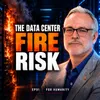
The Data Center Fire Risk Nobody's Asking About
Gary spent 50+ years in public safety — police officer, then two decades in the fire service as an EMT and wildland firefighter, then a 911 center director and emergency manager, then six years running Apple’s global public safety business. Last December, he and his wife co-founded a data center opposition group in Round Rock, Texas, after learning a ninth data center was headed for their town. A few months later, the Sabey Data Center a few miles from his house caught fire. He pulled the fire report and the hazardous materials records himself, through open records requests. What he found is the subject of this episode.The numbers nobody’s citingGary rattles these off from memory, because he’s spent the last several months compiling them:* An Amazon data center in Ohio logged 84 fires between 2021 and 2025. The same facility has, in some cases, delayed fire department entry by up to an hour over security protocols — with an active fire burning.* A Chesterfield County, Virginia facility had 4 to 7 fires in a single year, all lithium battery failures.* A data center in France lost multiple buildings on one campus to fire.* The Round Rock fire in March 2024 — lead-acid batteries, not even the more volatile lithium-ion kind — took 14 pieces of fire apparatus, a specialized hazmat team, and 44 firefighters just under five hours to control. Damage estimates have climbed from an initial $2 million to closer to $11 million.That last one is the one Gary knows best, because it happened in his backyard. The smoke — carcinogens, heavy metals — drifted into an immediately adjacent residential neighborhood on a foggy, low-wind morning, so it banked down and stayed low instead of dispersing. Firefighting runoff went into a storm drain that feeds a creek tributary. No public notification was issued. No media alert went out. “This was held very, very quietly by the city,” Gary says.Why it’s so hard to actually put outThe Round Rock fire involved lead-acid batteries. Most new capacity is lithium-ion, which is a different problem entirely. Lithium cells fail through thermal runaway: one cell overheats — from a manufacturing defect, overcharging, water intrusion, physical damage, even a coding error or a deliberate cyberattack — and it heats the cells next to it, which heat the cells next to those. In a sealed building, the vented gases can build up to the point of explosion. And extinguishing the visible flame doesn’t mean the reaction has stopped: crews see fires “go out” and reignite hours later because the heat inside the module never actually dropped.Then there’s the water math. A data center fire can take 1 to 2 million gallons of water to extinguish. Round Rock has a municipal hydrant system that can supply that. Most of the towns where data centers are actually being sited — rural Texas, rural Pennsylvania, the four-hours-outside-New-Orleans sites Gary references — don’t. A rural water tender truck carries 2,000 to 3,000 gallons. Getting a million gallons to a fire with a 2,000-gallon truck means roughly 500 round trips between the water source and the fire. That’s the arithmetic a volunteer fire department is looking at when a facility the size of a small city catches fire in their jurisdiction.The standard that exists — and isn’t being enforcedUL 9540 is the regulation for how battery energy storage systems should be built and separated to contain a fire if one starts. UL 9540A is the test standard that verifies compliance. It was updated in March 2026. Round Rock, which only adopted the 2024 International Fire Code in December, hasn’t incorporated the update yet — and Gary is careful to note this isn’t a Round Rock-specific failure. Most jurisdictions are in the same position, and many rural counties in Texas can’t even have a fire marshal until they hit a population of 250,000. Out of 254 counties, most never will.Layered on top of outdated code: NDAs. Data center operators frequently won’t share emergency plans, building layouts, or battery composition with the fire departments that would have to respond to their fires. “If there’s something they want to hide that badly,” Gary says, “then maybe they should take their business elsewhere.”Why this might be the argument that actually landsGary’s read, after four appearances before Texas House and Senate committees in the past two months: noise and water complaints get pre-empted. Developers show up to a town a year before residents hear anything, work the local elected officials, and have counterarguments ready by the time anyone objects publicly. Fire risk is new enough that it hasn’t been pre-argued yet — which is part of why his first committee testimony picked up tens of thousands of views after Alec Baldwin reposted it, despite Gary having no public platform of his own.It als
Podzilla Summary coming soon
Sign up to get notified when the full AI-powered summary is ready.
Free forever for up to 3 podcasts. No credit card required.
Listen to This Episode
More from For Humanity: An AI Risk Podcast
The AI Kill Switch That Still Doesn't Exist

The Volunteer Fire Department's Plan Is To Watch It Burn

The fear inside the AI labs is real, and it keeps getting harder to ignore

The AI Buildout Has a Physical Speed Limit
Get summaries like this every morning.
Free AI-powered recaps of For Humanity: An AI Risk Podcast and your other favorite podcasts, delivered to your inbox.
Free forever for up to 3 podcasts. No credit card required.