Free Daily Podcast Summary
Face-Off: The U.S. vs China: Daily Summaries Delivered
by Airwave Media
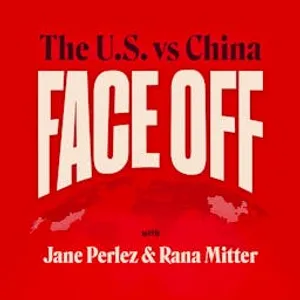
FACE-OFF: US vs CHINA is an inside look at the turbulent relationship between the world's two superpowers, the two men in charge, and the vital issues that affect us all. FACE-OFF is hosted by Pulitzer Prize-winning journalist Jane Perlez, former New York Times Beijing bureau chief and current fellow at the Harvard Kennedy School’s Belfer Center. In each episode Professor Rana Mitter, recently of the University of Oxford and now professor of modern China at the Harvard Kennedy School, chats with Jane on what’s at stake.
Latest Episodes
The most recent episodes — sign up to get AI-powered summaries of each one.
- 1 weeks ago39 min
Ukraine’s Lost Deterrent
It is one of the great broken promises of the post-Cold War era. When the Soviet Union collapsed, Ukraine found itself in possession of the world’s third-largest nuclear arsenal. In 1994, Ukraine gave up those weapons in exchange for assurances that its sovereignty would be protected. Jane Perlez was there reporting on the nuclear dismantling in Kyiv that winter of 1994. Decades later, Vladimir Putin has threatened to unleash nuclear weapons on Ukraine. In this episode, Jane Perlez interviews former Ukrainian foreign minister Dmytro Kuleba. Kuleba explains that Russia could have invaded Ukraine in 2022 whether or not Ukraine had nuclear weapons, but he believes strongly that the Americans should have done more to support his nation. “That's always the problem: Ukrainians pay with blood and tears for every intellectual failure of their Western colleagues.” Amid the world’s shifting balance of power, Kuleba weighs in: what could Ukraine have done? Reading Recommendations: Inheriting the Bomb by Mariana Budjeryn. Fabulous archival and on the ground research. A first rate political scientist looks at the disarmament of Ukraine, including the pressures from Washington. Face-Off is produced and reported by Jane Perlez. Our production team is Nina Porzucki, Louise Morris, and Frank Zhou. Sound design and mixing by John Myers and Rowhome Productions. This project is made possible by the Belfer Center at the Harvard Kennedy School and the Managing the Atom Project. Our special guest is Professor Matthew Bunn, Faculty Chair of the Managing the Atom Project (@matthew-bunn.bsky.social). Face Off is produced in partnership with Rowhome Productions. Rowhome's Creative Director is Alex Lewis. John Myers is Rowhome's Executive Producer. Episode Art Image Credit: James Hill for the New York Times. Image Caption: A missile scientist stands inside the Pivdenmash rocket factory 250 miles southeast of Kyiv in 1994. Learn more about your ad choices. Visit megaphone.fm/adchoices
- 2 weeks ago38 min
The Age of Arms Control
There was a time when the nuclear powers did more than posture. During the era of arms control, the White House, Kremlin, and State Department built frameworks to slow the arms race and reduce the chance of catastrophe. The process was imperfect and often fragile. In this episode, Jane Perlez interviews New START Treaty chief negotiator Rose Gottemoeller. Gottemoeller takes us behind the scenes to dissect how a nuclear treaty comes together: the negotiations, the personalities, the yelling from the White House, and the U.S.-Russian nuclear facility ground inspections spelled out in painstaking detail. “Both sides really try to make sure that the other side doesn't see what they're not supposed to see,” Gottemoeller tells us. Now, as the last nuclear treaties expire, we must ask: is there still a path forward on arms control? Reading Recommendations: Negotiating the New START Treaty by Rose Gottemoeller: The American negotiator for the last arms control treaty tells her story. Insider, juicy stuff. Detente and Confrontation by Raymond Garthoff: Published in 1985, highly regarded account of the and fall of detente in the 1970s and early 80s. Face-Off is produced and reported by Jane Perlez. Our production team is Nina Porzucki, Louise Morris, and Frank Zhou. Sound design and mixing by John Myers and Rowhome Productions. This project is made possible by the Belfer Center at the Harvard Kennedy School and the Managing the Atom Project. Our special guest is Professor Matthew Bunn, Faculty Chair of the Managing the Atom Project (@matthew-bunn.bsky.social). Face Off is produced in partnership with Rowhome Productions. Rowhome's Creative Director is Alex Lewis. John Myers is Rowhome's Executive Producer. Episode Art Image Credit: AP Photo/JH. Image Caption: A young donor receives a button from Dr. Louise Reiss after giving his baby teeth to the strontium research project in St. Louis, Missouri on Jan. 15, 1962. The button announces: “I Gave My Tooth to Science.” Learn more about your ad choices. Visit megaphone.fm/adchoices
- 3 weeks ago40 min
Thirteen Days on the Brink
Jane Perlez reports on the thirteen most dangerous days in human history, when the world came closer to nuclear annihilation than ever before or since: the Cuban Missile Crisis. In October 1962, a Soviet submarine trapped under the Atlantic with a nuclear-tipped torpedo faced orders so ambiguous they could spell the end of civilization. Above the surface, American President John F. Kennedy learned of Soviet missiles in Cuba and had to decide: invade, bomb, or negotiate? With historian Fredrik Logevall, Pulitzer Prize winner and foremost biographer of President Kennedy, Perlez explores how a young president and a Soviet leader, both haunted by war, chose empathy over escalation. Logevall explains how Kennedy's willingness to see through Khrushchev's eyes—to understand his rival's motives—became key to resolution. The secret agreement to withdraw Soviet missiles from Cuba for American missiles from Turkey allowed both sides to claim victory and step back from the abyss. But the crisis revealed dangers that still haunt us: the fragility of communication, the weight of incomplete information, and how quickly human judgment can fail under pressure. Sixty-four years later, as nuclear weapons proliferate and leaders lose touch with the visceral fear that defined 1962, the question remains: would we be as lucky next time? Reading Recommendations: Abyss by Max Hastings. This is the latest on the Cuban Missile Crisis by one of the finest contemporary historians. The Underwater Cuban Missile Crisis at 60 by the National Security Archive. This is nail-biting original research by the Washington-based National Security Archive on what happened aboard the Soviet submarine carrying a nuclear-tipped torpedo at the height of the crisis. Face-Off is produced and reported by Jane Perlez. Our production team is Nina Porzucki, Louise Morris, and Frank Zhou. Sound design and mixing by John Myers and Rowhome Productions. This project is made possible by the Belfer Center at the Harvard Kennedy School and the Managing the Atom Project. Our special guest is Professor Matthew Bunn, Faculty Chair of the Managing the Atom Project (@matthew-bunn.bsky.social). Face Off is produced in partnership with Rowhome Productions. Rowhome's Creative Director is Alex Lewis. John Myers is Rowhome's Executive Producer. Episode Art Image Credit: Associated Press Photo. Image Caption: President John F. Kennedy makes a national television speech October 22, 1962, from Washington, announcing a naval blockade of Cuba until Soviet missiles are removed. Learn more about your ad choices. Visit megaphone.fm/adchoices
- 4 weeks ago50 min
The Race to Build the Bomb
The nuclear age began in fear, secrecy, and scientific ambition. The bomb created in a moment of wartime urgency became the foundation of a new global order defined by terror and deterrence. The story is familiar, but its implications have never left us. In episode two of the series, Jane Perlez interviews nuclear historian Alex Wellerstein about the origins of the bomb and the Americans’ race to build a weapon before Hitler. Wellerstein explains how the White House first learned about a terrifying source of energy and the top-secret decision-making that culminated in Los Alamos and the creation of the first atom bomb used on Hiroshima, Japan in 1945. Jane Perlez also travels to Hiroshima with Associate Producer Frank Zhou to interview an atomic bomb survivor and retrace her steps through the decimated city in the hours after the blast. Decades later, we must ask: will we let it happen again? Reading Recommendations: Hiroshima by John Hersey. The gruesome, influential reportage by the famed New Yorker writer about Hiroshima eight months after the bombing. Fallout by Lesley M.M. Blume. The riveting behind-the-scenes story of how John Hersey got his Hiroshima story. 90 Seconds to Midnight by Charlotte Decroes Jacobs. A biography of Setsuko Nakamura Thurlow, a schoolgirl who survived Hiroshima. The Most Awful Responsibility: Truman and the Secret Struggle for Control of the Atomic Age by Alex Wellerstein. When he gave the go-ahead to bomb, Truman thought Hiroshima was mainly a military base. He was mistaken. Face-Off is produced and reported by Jane Perlez. Our production team is Nina Porzucki, Louise Morris, and Frank Zhou. Sound design and mixing by John Myers and Rowhome Productions. This project is made possible by the Belfer Center at the Harvard Kennedy School and the Managing the Atom Project. Our special guest is Professor Matthew Bunn, Faculty Chair of the Managing the Atom Project (@matthew-bunn.bsky.social). Face Off is produced in partnership with Rowhome Productions. Rowhome's Creative Director is Alex Lewis. John Myers is Rowhome's Executive Producer. Episode Art Image Credit: U.S. Department of Energy (or predecessor organization) employee. Image Caption: Leslie Groves (left), military head of the Manhattan Project, with Professor Robert Oppenheimer (right). Learn more about your ad choices. Visit megaphone.fm/adchoices
- Oct 6, 202654 min
The New Nuclear Age
For the first time in half a century, the world is drifting into a nuclear era with fewer constraints and more danger. The old arms control architecture is gone. The United States is modernizing its arsenal, Russia is making explicit nuclear threats, and China is expanding rapidly and in secret. Each development is destabilizing on its own. Together, they make a world in which the nuclear threat risks escalating faster than diplomacy can contain it. In episode one of the series, Jane Perlez and New York Times White House and National Security Correspondent David Sanger lay out the stakes. How did we get to a world with crumbling nuclear guardrails? And what might happen next? Sanger explains why nuclear weapons are back: how the Biden White House scrambled to respond to Vladimir Putin’s threats to use the nuclear option against Ukraine, what the war in Iran and North Korea’s arsenal signal to nuclear-curious nations waiting in the wings, and whether it is ever possible to wage a “limited nuclear war.” They also discuss how AI and cyberwarfare will transform the future of our arsenals. As nuclear weapons return to the public eye, we must ask: is the world inching toward another nuclear conflict? Reading Recommendations: New Cold Wars by David Sanger on the current global tensions. At The Brink by William Hennigan. A brilliant series of articles by the New York Times opinion writer on the state of nuclear weapons. Nukesletter, an email newsletter written by noted international expert on nuclear weapons, Ankit Panda. Subscribe here to receive future issues. Face-Off is produced and reported by Jane Perlez. Our production team is Nina Porzucki, Louise Morris, and Frank Zhou. Sound design and mixing by John Myers and Rowhome Productions. This project is made possible by the Belfer Center at the Harvard Kennedy School and the Managing the Atom Project. Our special guest is Professor Matthew Bunn, Faculty Chair of the Managing the Atom Project (@matthew-bunn.bsky.social). Face-Off is produced in partnership with Rowhome Productions. Rowhome's Creative Director is Alex Lewis. John Myers is Rowhome's Executive Producer. Episode Art Image Credit: U.S. Department of Energy. Image Caption: Overseas Operation Ivy, at a height of approximately 12,000 feet, 50 miles from the detonation site. Learn more about your ad choices. Visit megaphone.fm/adchoices
- Sep 22, 20264 min
Introducing Face-Off: Nuclear Anarchy?
The nuclear age began in secrecy and scientific ambition. The story is familiar, but its implications have never left us. Face-Off: Nuclear Anarchy is an 8-part series tracing the arc of nuclear danger. A bomb created in a moment of wartime urgency became the foundation of a global order defined by terror and deterrence. But what happens when that global order breaks down? This season, we take you back inside the Manhattan Project and a decimated Hiroshima in the hours after the blast. We retrace the Cuban Missile Crisis and the abandonment of the New START treaty with a Pulitzer Prize-winning historian and the State Department decision-makers in the room. We follow China’s rapid expansion, Russia’s threats, Ukraine’s lost deterrent, and the outliers challenging the world’s nuclear order. In each episode, Pulitzer-winning journalist Jane Perlez interviews leading participants in the nuclear conversation: David Sanger, Tong Zhao, Rose Gottemoeller, Alex Wellerstein and more. Plus, Harvard Kennedy School Professor Matthew Bunn joins for a wrap-up segment to put everything in context. Episodes out every Tuesday in October & November 2026. Listen wherever you get your podcasts. This project is made possible by the Belfer Center at the Harvard Kennedy School and the Managing the Atom Project. Our special guest is Professor Matthew Bunn, Faculty Chair of the Managing the Atom Project (@matthew-bunn.bsky.social). Face-Off is produced and reported by Jane Perlez. Our production team is Nina Porzucki, Louise Morris, and Frank Zhou. Sound design and mixing by John Myers and Rowhome Productions. Learn more about your ad choices. Visit megaphone.fm/adchoices
- Aug 28, 20261 min
Introducing Asian Innovation for Social Good
While we're busy working on a new season of Face-Off, we thought our audience might be interested in learning about a new series called Asian Innovation for Social Good, produced by our friends at Foreign Policy. Across Asia, philanthropy is expanding from traditional grant-making into a more active role as catalytic capital, taking on risk that commercial investment avoids and public funding cannot yet reach. Climate, global health, and inclusive development now draw partnerships that cross borders and sectors, financing early-stage innovation where the returns are uncertain and the time horizons are long. The Philanthropy Asia Summit is where those alliances take shape, and this four-part series, recorded at the sixth edition in Singapore, follows host Rob Sachs into the rooms where funders, operators, and policy leaders are testing what collaborative giving can achieve. Each episode examines the role philanthropy plays when the maps drawn for an earlier era no longer fit the terrain, and what becomes possible when ambition meets disciplined execution. Find the show wherever you listen to podcasts. Learn more about your ad choices. Visit megaphone.fm/adchoices
- May 26, 202627 min
Introducing Foreign Policy's The Hidden Economics of Remarkable Women
We’re hard at work on Season 4 of Face-Off. And we have some great episodes in the works, but while we’re in production I wanted to share an episode from a different podcast that I thought you might enjoy…. When people discuss environmental solutions, they often mention its impact on our lives. This can include ensuring parts of the planet remain inhabitable in the face of extreme temperatures, maintaining biodiversity, and preventing the oxidation of our oceans. But there’s another case to be made: Investing in our planet makes sense economically. Conservation can deliver high returns on investment. According to the International Monetary Fund, every dollar spent on conservation and other green projects may yield up to seven dollars within five years. This is because of jobs created, food systems improved, and a reduction in greenhouse gases, among other outcomes. On this episode of The Hidden Economics of Remarkable Women, we speak with Jody Allen, a philanthropist, businesswoman, and conservationist. She cares deeply about protecting wildlife and our planet. Allen is also the owner of the Seattle Seahawks. Host Zainab Salbi, who co-founded Daughters for Earth with Allen, talks with Allen about the interplay between philanthropy and conservation. We also speak with two African wildlife conservations: Dr. Shivani Bhalla, founder of Ewaso Lions in Kenya, and Dr. Moreangels Mbizah, founder of Wildlife Conservation Action in Zimbabwe. They share what community-led conservation strategies look like and what they have seen work best to decrease human-wildlife conflict. The Hidden Economics of Remarkable Women is a podcast from Foreign Policy, supported this season by Daughters for Earth. Guests Interviewed: Jody Allen, Founder of Daughters for Earth Dr. Shivani Bhalla, Founder of Ewaso Lions Dr. Moreangels Mbizah, Founder of Wildlife Conservation Action Follow and listen to more episodes of The Hidden Economics of Remarkable Women: https://play.megaphone.fm/jzrwm69essm3zpacrrjmua Learn more about your ad choices. Visit megaphone.fm/adchoices
Get Face-Off: The U.S. vs China summaries in your inbox
Free AI-powered daily recaps. Key takeaways, quotes, and mentions — in a 5-minute read.
Get Free Summaries →Free forever for up to 3 podcasts. No credit card required.
You Might Also Like
Listeners also like.
The Bomb
A historical narrative of nuclear weapons' impact, focusing on key figures, espionage, and Cold War crises.

One Decision
Former intelligence leaders and journalists examine high-stakes decisions that shaped global events.

Unclear and Present Danger
Analyzes 1990s post-Cold War thrillers to understand America’s shifting global identity after the fall of the Soviet Union.

The Truth of the Matter
Breaks down complex global policy issues through informed, balanced discussions without spin or sensationalism.
Sources & Methods
A weekly deep dive into national security news with NPR correspondents and interviews with military, intelligence, and diplomatic leaders.
Are We Doomed?
Explores real and exaggerated existential threats like climate change, AI, and pandemics through expert interviews and narrative storytelling.
NatSec Matters
Former national security officials interview top leaders on critical security challenges and U.S. policy responses.

American Power
A geopolitical podcast examining the hidden systems—military, energy, and politics—driving global conflicts and decisions.

State of Play
Geopolitical analysis with CSIS experts on shifting global power and international relations.

The Coming Storm
A journalist investigates the roots and rise of American conspiracy theories, from Cold War paranoia to modern claims of a Deep State.

In the Room with Peter Bergen
Peter Bergen examines global news stories through interviews with experts and firsthand reporting on national security, technology, and conflict.

Here's Why
Explains global news and geopolitical shifts with clear, concise analysis on topics like nuclear security, AI, and market dynamics.
About Face-Off: The U.S. vs China
FACE-OFF: US vs CHINA is an inside look at the turbulent relationship between the world's two superpowers, the two men in charge, and the vital issues that affect us all. FACE-OFF is hosted by Pulitzer Prize-winning journalist Jane Perlez, former New York Times Beijing bureau chief and current fellow at the Harvard Kennedy School’s Belfer Center. In each episode Professor Rana Mitter, recently of the University of Oxford and now professor of modern China at the Harvard Kennedy School, chats with Jane on what’s at stake.
Customized Recaps
AI-powered recaps with compact key takeaways, quotes, and insights.
Straight to Your Inbox
Get key takeaways from Face-Off: The U.S. vs China in a 5-minute read.
Save Hours Every Week
Stay current on your favorite podcasts without falling behind.
Frequently Asked Questions
What is Podzilla's Face-Off: The U.S. vs China daily summary?
It's a free AI-powered email that summarizes new episodes of Face-Off: The U.S. vs China as soon as they're published. You get the key takeaways, notable quotes, and links & mentions — all in a quick read.
How does the Face-Off: The U.S. vs China podcast summary work?
When a new episode drops, our AI transcribes and analyzes it, then generates a personalized summary tailored to your interests and profession. It's delivered to your inbox every morning.
Is this an official Face-Off: The U.S. vs China product?
No. Podzilla is an independent service that summarizes publicly available podcast content. We're not affiliated with or endorsed by Airwave Media.
Can I get summaries of other podcasts too?
Absolutely! The free plan covers up to 3 podcasts, any in the catalog. Basic raises that to 15, Pro to 40 and Max to 100. Browse our full catalog at /podcasts.
How often does Face-Off: The U.S. vs China release new episodes?
Face-Off: The U.S. vs China publishes weekly. Our AI generates a summary within hours of each new episode.
What topics does Face-Off: The U.S. vs China cover?
Face-Off: The U.S. vs China covers topics including News. Our AI identifies the specific themes in each episode and highlights what matters most to you.
Start getting Face-Off: The U.S. vs China summaries tomorrow morning.
Free forever for up to 3 podcasts. No credit card required.
Free forever for up to 3 podcasts. No credit card required.