Free Daily Podcast Summary
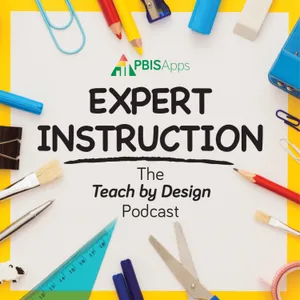
Expert Instruction: The Teach by Design Podcast: Daily Summaries Delivered
by PBISApps
Expert Instruction is the PBISApps Teach by Design podcast where we talk to experts from the educational field - researchers, practitioners, community members - about their work. Each episode connects with that month’s Teach by Design article, taking you deeper into your own exploration of the topic. Expert Instruction gives you a fly-on-the-wall perspective to hear how the research can work in your school, too. Visit PBISApps: www.pbisapps.org
Latest Episodes
The most recent episodes — sign up to get AI-powered summaries of each one.
- 3 weeks ago39 min
Ep. 64: Mythbusters — “It’s just a meeting. Everyone knows how to do that.”
We’re continuing our Mythbuster series by taking on an assumption that sounds simple enough: “It’s just a meeting. Everyone knows how to do that.” Joining us are two experts whose work with the Team-Initiated Problem Solving (TIPS) framework offers a closer look at what it actually takes to turn team meetings into productive decision-making processes:Dr. Asha Yadav is a researcher with Educational and Community Supports at the University of Oregon whose work with TIPS examines how school teams use data and structured problem solving to make decisions and improve outcomes.Sarah Falcon works with Educational and Community Supports and the TIPS project, supporting teams in using evidence-based meeting practices to move from identifying areas of need to developing and following through on action plans.In this episode, we explore what separates simply having a meeting from having an effective one. Asha and Sarah share what they’ve learned from studying team meetings, including some of the steps teams commonly miss: setting measurable goals, assigning responsibilities and timelines, following up on action plans, and making sure teams trust the data they’re using. We also discuss the importance of periodically examining data through an equity lens and share practical ways teams can strengthen their meetings, build accountability, and turn conversations into meaningful action.Don’t forget to check out the TIPS website and click “Submit Inquiry” at the bottom of the page to learn more about participating in their upcoming study! For more information about the resources shared in this episode, check out the following links:Teach by Design: Motive, Motivate, Motivation: Why Are My Students Doing That?!Teach by Design: 4 Ways to Jumpstart Your Goals This YearTIPS Meeting Minutes
- Aug 17, 202642 min
Ep. 62: Improving Outcomes with PBIS
We’re kicking off a new season of Expert Instruction and our yearlong exploration of the impact of PBIS. Joining us are four regional partners from the Center on PBIS:Brian Meyer is the co-executive director of the Midwest PBIS Network. From general education to higher education, residential care, to state departments down to the local level, Brian has worked with them all. As a partner with the Center on PBIS, he coordinates technical assistance offered to state education agencies, the National Leadership Forum, the workgroup on Juvenile Justice and Alternative School settings, and internal evaluation supports. Kelly Perales is the co-executive director of the Midwest PBIS Network and an implementer partner with the Center on PBIS. She provides professional development and technical assistance for state and local leaders in the implementation and scale up of PBIS. Kelly has also led local, regional and state-level implementers in the Interconnected Systems Framework, focusing on the integration of mental health and education systems.Dr.Brandi Simonsen is a professor of special education in the Neag School of Education at the University of Connecticut. She is also the Co-Director of the Center on PBIS and a member of the MTSS Leadership Collaborative. In her research, Brandi focuses on supporting educators' implementation of PBIS/MTSS across a continuum of settings. Dr. Jessica Swain-Bradway is the executive director for Northwest PBIS Network – an organization providing professional development and support around PBIS and MTSS. In her work, Jessica focuses on equipping teachers with strategies for instruction, relationship-building, and designing effective learning environments. In this episode, we explore how PBIS can influence far more than student behavior. Our guests share how the framework supports priorities such as attendance, academics, mental health, school climate, staff well-being, and family engagement. We also discuss how relationships, local capacity, and a shared commitment to safer, more predictable, equitable, and nurturing learning environments help sustain PBIS implementation over time.
- Jun 16, 202621 min
Ep. 61: 2025-26 Year in Review
Over the 2025–26 season of Expert Instruction, we explored how data help schools make better decisions for students. In this year-end reflection episode, Megan Cave and Danielle Triplett look back on the conversations, lessons, and stories that shaped the season. Together, they revisit favorite moments from guests across the PBIS community and reflect on what they learned about prevention, relationships, systems, and data-based decision making.
- May 19, 202641 min
Ep. 60: Mythbusters - Districts Use Your Data as a Gotcha
We're coming to you LIVE from the NWPBIS Conference in Tacoma, WA to explore another PBIS myth. Joining us today are Becky Gawenit and Charisse Elliott.Becky is from Battle Ground Public School District in Battle Ground, WA. She's been a part of that district for the last 18 years as either a school psychologist or as a district MTSS coach. Charisse is a behavior program associate with Salem-Keizer Public Schools in Salem, OR. In her role, she works as an advocate for what teachers, students, and families need by focusing on systems to create supportive, inclusive learning environments. In this installment of our Mythbusters series, we discuss whether districts use the data you submit as a gotcha. We talk about how data work best when they inform the decisions you make, but when you submit those same data to the district, they seem work as a punishment. Charisse and Becky help us understand that finding the middle ground involves trusting relationships, honest coaching, and a culture prioritizing improvement over accountability.
- May 6, 202635 min
Ep. 59: Rethinking Fidelity — Making Behavior Support Plans Work in Real Classrooms
We continue our exploration of Tier 3 support by focusing on an important and often misunderstood part of behavior support plans: measuring fidelity. Joining us today is Rose Iovannone.• Rose is a research professor at the University of South Florida and a Board Certified Behavior Analyst (BCBA). She also serves as director of the University of South Florida Interdisciplinary Center for Evaluation and Intervention, where she supports individuals with complex needs from early childhood through young adulthood. In addition to her research, Rose works closely with educators through training and professional development to support practical, real-world implementation of behavior support systems. In this episode, Rose helps us reframe fidelity as a way to evaluate whether a behavior support plan is actually feasible, effective, and aligned with classroom realities, rather than a measure of teacher performance. She also gives us actionable ideas for how teams can build buy-in, start small, and integrate fidelity into their ongoing problem-solving process.For more information about the resources shared in this episode, check out the following links:• Expert Instruction Ep. 58: Tier 3 Supports in General Education Classrooms• Teach by Design: The Fit Check Your Behavior Plan Needs• Prevent–Teach–Reinforce (PTR) Model• Technical Adequacy Tool for Evaluation (TATE)
- Mar 17, 202644 min
Ep. 58: Tier 3 Supports in General Education Classrooms
We continue our exploration of Tier 3 support by focusing on the way systems make it possible to get students the level of support they really need. Joining us today are Mara Lynaugh and Jess Olson. Mara is a member of our PBISApps training team. She brings to the team over 25 years of experience in public education as a special education teacher and a Student Services coach where she supported schools to implement multi-tiered systems and practices focused on meeting students’ social, emotional, behavioral, and mental health needs. Her passion for helping educators, students, families, and community partners create learning environments where every student achieves their goals. Jess is a Board Certified Behavior Analyst (BCBA) and doctoral student in Special Education at the University of Utah. Her work centers on helping schools implement function-based, individualized behavior support with strong alignment to PBIS and a clear focus on teacher implementation fidelity. Before this, Jess spent several years as a district BCBA, partnering with educators and school teams across general and special education to design behavior support plans, coach implementation, and build sustainable routines that fit the realities of busy classrooms. Tune in to hear Jess tell the story about how she and her colleagues implemented a system of support that allowed the three of them to manage their work in a district of 60,000 students spread across 92 schools. It’s an approach that resulted in fewer students referred to special education for their behavior and more students getting the support they needed right within their general education classrooms. For more information about the resources shared in this episode, check out the following links: Expert Instruction Ep. 57: Mythbusters — Functional Behavioral Assessment is Only for Special EducationAdditional resources from Jess’ story including powepoint presentations, meeting templates, data review questions, and moreBasic FBA Training
- Feb 17, 202638 min
Ep. 57: Mythbusters - Functional Behavioral Assessment is Only for Special Education
When targeted interventions don't improve the behavior you hope to see, what's the next step? Today's guest might tell you to check the function of that behavior. Today, we're talking with Dr. Chris Borgmeier and exploring the myth: Functional behavioral assessment (FBA) is a process only meant for special education.Chris is a Professor and the Doctoral Program Director in the College of Education at Portland State University. He is co-author of the Basic FBA to BIP training series and developed the Basic FBA to BIP e-learning series. His research focuses on using multi-tiered systems of support (MTSS) to support students with challenging behavior. He has been a trainer and consultant for MTSS for Behavior implementation across the North America and internationally.During our conversation, we talk about where this myth comes from and how schools can use the elements of FBA to make function-based thinking a schoolwide practice.For more information about the resources shared in this episode, check out the following links:ABC TrackerPractice Brief: When to Use Functional Behavioral Assessment? Best Practice vs. Legal Guidance
- Jan 20, 202646 min
Ep. 56: Support for Staff Implementing Tier 2 Supports
When we talk about Tier 2 support, we usually talk about the support we offer students. Today, we're talking about the ways we support the adults in our building to implement Tier 2 with fidelity...and maybe even a little enthusiasm. Back with us again are our colleagues Dr. Billie Jo Rodriguez and Noah Van Horn.Billie Jo is an Associate Teaching Professor and the School Psychology director of clinical training at the University of Oregon, a nationally certified school psychologist, and a doctoral board-certified behavior analyst. She has over 20 years of experience supporting students with diverse needs and helping schools implement increasingly intensive function-based supports. Noah is a nationally certified school psychologist and PBIS coach for Springfield Public Schools in Springfield, OR. He is also a trainer and PBIS coach for the NWPBIS Network. In addition to his work leading district initiatives to support PBIS, he is a lead trainer for district professional development on topics ranging from Tier 1 practices to more intensive, individualized support.For more information about the resources shared in this episode, check out the following links:Expert Instruction - Ep. 54: Mythbusters - Student Behavior is More Significant Now Than EverTiered Fidelity InventoryOverview of Tier 2 SupportCooking with Fidelity: How Smart Adaptations Improve Tier 2 OutcomesTier 2: A District-Level Systems Guide
Get Expert Instruction: The Teach by Design Podcast summaries in your inbox
Free AI-powered daily recaps. Key takeaways, quotes, and mentions — in a 5-minute read.
Get Free Summaries →Free forever for up to 3 podcasts. No credit card required.
You Might Also Like
Listeners also like.
Servant Leadership Institute Podcast
Servant Leadership Institute
Good Inside with Dr. Becky
A clinical psychologist provides practical guidance for handling common parenting challenges and improving parent-child relationships.

Think UDL
Think UDL

UI Breakfast: UI/UX Design and Product Strategy
Discussions with UI/UX and product strategy experts on applying practical insights to design and SaaS businesses.

Expert Intelligence with Paul Estes
Explores the intersection of human expertise and AI in shaping the future of work through interviews with industry leaders and innovators.
Building Champions for Life
Examines how elite performers in sports, business, and education develop character and mindset for lasting success.
Inspired Nonprofit Leadership
Practical advice and inspiration for nonprofit leaders to grow their skills and impact.

The Middle School Mary Poppins Podcast
Practical strategies for supporting kids ages 10–15 through the challenges of early adolescence.

Dissecting High Performance In Tennis
A deep dive into the coaching philosophies and methods that shape elite tennis players’ development and performance.
The Grading Podcast
Two educators examine traditional and alternative grading methods to improve student learning outcomes.
Stanford Psychology Podcast
Students interview psychologists about recent research and its real-world applications.
SLP Nerdcast
Discusses clinical topics and best practices for speech-language pathologists seeking continuing education.
About Expert Instruction: The Teach by Design Podcast
Expert Instruction is the PBISApps Teach by Design podcast where we talk to experts from the educational field - researchers, practitioners, community members - about their work. Each episode connects with that month’s Teach by Design article, taking you deeper into your own exploration of the topic. Expert Instruction gives you a fly-on-the-wall perspective to hear how the research can work in your school, too. Visit PBISApps: www.pbisapps.org
Customized Recaps
AI-powered recaps with compact key takeaways, quotes, and insights.
Straight to Your Inbox
Get key takeaways from Expert Instruction: The Teach by Design Podcast in a 5-minute read.
Save Hours Every Week
Stay current on your favorite podcasts without falling behind.
Frequently Asked Questions
What is Podzilla's Expert Instruction: The Teach by Design Podcast daily summary?
It's a free AI-powered email that summarizes new episodes of Expert Instruction: The Teach by Design Podcast as soon as they're published. You get the key takeaways, notable quotes, and links & mentions — all in a quick read.
How does the Expert Instruction: The Teach by Design Podcast podcast summary work?
When a new episode drops, our AI transcribes and analyzes it, then generates a personalized summary tailored to your interests and profession. It's delivered to your inbox every morning.
Is this an official Expert Instruction: The Teach by Design Podcast product?
No. Podzilla is an independent service that summarizes publicly available podcast content. We're not affiliated with or endorsed by PBISApps.
Can I get summaries of other podcasts too?
Absolutely! The free plan covers up to 3 podcasts, any in the catalog. Basic raises that to 15, Pro to 40 and Max to 100. Browse our full catalog at /podcasts.
How often does Expert Instruction: The Teach by Design Podcast release new episodes?
Expert Instruction: The Teach by Design Podcast publishes monthly. Our AI generates a summary within hours of each new episode.
What topics does Expert Instruction: The Teach by Design Podcast cover?
Expert Instruction: The Teach by Design Podcast covers topics including Education, How To, Parenting, Kids & Family, Family. Our AI identifies the specific themes in each episode and highlights what matters most to you.
Start getting Expert Instruction: The Teach by Design Podcast summaries tomorrow morning.
Free forever for up to 3 podcasts. No credit card required.
Free forever for up to 3 podcasts. No credit card required.