Free Daily Podcast Summary
Energy Changemakers Podcast: Daily Summaries Delivered
by Energy Changemakers
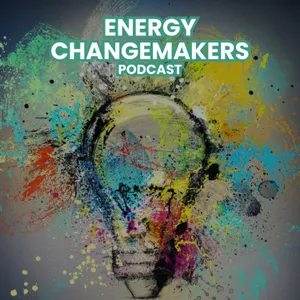
As the energy grid faces unprecedented changes, local energy solutions are increasingly needed. Hosted by Elisa Wood, an experienced energy journalist, The Energy Changemakers Podcast brings you into the heart of these transformations. Each episode features in-depth discussions with industry leaders pioneering the move toward a decentralized grid. From technological innovations to policy changes — discover actionable insights to help your company leverage emerging opportunities. Join us at The Energy Changemakers Podcast and be part of the conversation that shapes our energy future.
Latest Episodes
The most recent episodes — sign up to get AI-powered summaries of each one.
- 3 days ago42 min
The Grid Isn’t Ready for Robots on Wheels
Autonomous vehicles are more than cars without drivers. They’re “robots on wheels” — and they will need enormous amounts of electricity at the grid edge.In this episode of the Energy Changemakers Podcast, host Elisa Wood talks with Mike Calise, CEO of EV charging company Tellus Power, about why the rise of autonomous fleets could make microgrids and distributed energy a strategic necessity.Calise sees two massive transformations colliding: the electrification and automation of transportation, and a power system already confronting soaring demand from AI and data centers. Microgrids could help bridge the two by generating and managing electricity close to where autonomous vehicles operate — while bidirectional charging allows the batteries inside those vehicles to become grid assets rather than simply new loads.The conversation explores a real-world example at Oakland Unified School District, where 74 electric school buses can act as dispatchable batteries, returning energy to buildings or the grid when the buses are sitting idle. It also looks ahead to robotaxis, delivery vehicles, drones and other forms of “physical AI” — and what it will take to power them as they scale.Calise calls it a collision between the multi-trillion-dollar energy and transportation industries. At the center of that collision may be one of distributed energy’s biggest opportunities yet: using microgrids, storage and vehicle-to-grid technology to power the machines emerging at the edge.
- 2 weeks ago41 min
The Case for Electric Cooperatives in the Microgrid Era
What if the model to solve many of our biggest electricity problems already exists—we've just never used it to its full capacity? In this episode, Keith Taylor, a UC Davis institutional economist, makes the case that America's 800-plus co-ops are a form of "latent community capacity" hiding in plain sight. Keith proposes federating cooperatives so that they compete in the microgrid era, and what a Lake Tahoe utility crisis reveals about who really gets served when data centers come knocking. It's a hopeful, practical conversation about doing "policy from below."Look beyond the market and the state. Drawing on Nobel laureate Elinor Ostrom's insight that "there are no panaceas," Keith argues we systematically overlook the civic economy — a third leg of the stool alongside the market and government — where cooperatives operate on logics of service at cost rather than profit.We already have energy democracy. The U.S. has more than 800 electric cooperatives serving roughly 42 million Americans, generating about $42 billion a year in revenue. Of those members, some 8,000 serve as elected board directors — a political economy of its own that's ready to be leveraged, not built from scratch.Co-ops are often more efficient, not less. Investor-owned utilities serve about 30 households per mile of line; the average co-op serves about 7 — yet co-ops deliver comparable rates. In the 1930s, IOUs claimed lines would cost $2,000/mile; co-ops innovated the cost down to under $650/mile. Keith sees the same pattern today in broadband, where a South Carolina co-op (Carolina Connect) is stringing fiber for ~$15,000/mile against incumbent telco estimates of $200,000–$300,000/mile.Small doesn't mean weak — they federate. Individual co-ops stay locally controlled but pool into federations for financing (CoBank, the National Rural Utilities Cooperative Finance Corporation, and USDA's Rural Utilities Service together hold over $300 billion in assets), insurance (Federated Insurance), and white-label marketing (Touchstone). Keith's vision: a "microgrid federation" that makes co-ops a trusted vendor for communities building distributed energy.The Tahoe warning. A pocket of ~50,000 Californians around Lake Tahoe is served by the Nevada grid — and as Nevada's data-center demand grows, that region may be dropped in about 18 months, facing spot-market rates and rolling blackouts. It's a concrete example of customers losing out to data centers, and of why platforming alternative institutional models matters.Policy parity works. Co-ops have lagged on renewables largely because of incentive structures — they were historically excluded from renewable subsidies and often exempt from state renewable portfolio standards. When the Inflation Reduction Act's "direct pay" provision finally gave them parity with IOUs, co-ops rapidly expanded their renewable and distributed-energy portfolios.Start local, start now. Keith's call to action is bottom-up: engage your co-op's board and member-relations staff, join a member advisory committee, or run for the board. Where there's no co-op, look to public utility districts, community choice aggregators, or form a new association. As Ostrom put it: "We can, so we must."
- Aug 19, 202643 min
The Wild, Weird & Wonderful History of Solar
Most people in solar assume the industry started with the trade-show boom of 2006–2007. It didn't. It started decades earlier, in the logged-over hills of Humboldt County, California, where back-to-the-land hippies were hacking a self-sufficient life out of the wilderness — powering their homes off car batteries, micro-hydro, and windmills just so they could keep the lights on and play a little music.Host Elisa Wood sits down with filmmakers Jeff Spies and Jason Vetterli, whose two-hour documentary Solar Roots: The Pioneers of PV traces how an expensive military, space, and petrochemical technology found its way into the hands of ordinary people — and, in doing so, became a real industry. It's a story of catalog salesmen, off-grid homesteaders, cannabis-funded land deals, conservative ranchers won over one panel at a time, and a scrappy magazine that connected them all. Along the way, Jeff and Jason make the case for why solar has already won the price war, why the remaining fight is cultural, and why this history had to be captured now, while its pioneers are still here to tell it.
- Aug 5, 202642 min
How Customers Are Reshaping the Grid
From homeowners to businesses to AI data centers, customers are investing in distributed energy for their own reasons — and collectively rewiring how the entire electric system evolves. Recorded live to open The Great Transformation conference in Bend, Oregon, host Elisa Wood sits down with three people who aren’t just watching this shift — they’re shaping it: Cameron Brooks of Think Microgrid, Greg Castle of Schneider Electric, and Mike Grenier of Elexity.The panel digs into the data center power boom (a reported 114 GW of behind-the-meter generation in the pipeline — roughly 20% of U.S. peak load), why falling battery prices are flipping "two yeses out of ten" into "eight," the "Frankenstein microgrid" phenomenon, and how flexible interconnection deals in New Jersey and the Google–Voltus capacity agreement point toward a grid that’s built from the outside in. It’s a candid, optimistic conversation about ownership, resilience, and scaling what already works.
- Jul 22, 202633 min
Resilience as a Team Sport
Wildfires, record heat, and a grid under more strain than ever have turned “resilience” from a buzzword into one of the fastest-growing categories in energy technology. Host Elisa Wood talks with Julia Hamm — who spent nearly 20 years growing the Smart Electric Power Alliance (SEPA) before becoming a partner at The Ad Hoc Group — about how resilience became its own market, the AI cameras and wildfire-spread software utilities are deploying today, why microgrids are still an emerging (not mainstream) resilience play, and why the length of the utility sales cycle remains startups' biggest obstacle. They also discuss why Julia launched the Power Resilience Forum to keep this conversation from being crowded out by the AI and data-center load-growth story dominating the industry right now.
- Jul 8, 202646 min
Plug-In Solar Explained: Answers to your top questions
Plug-in solar — widely known as “balcony solar” — is one of the fastest-growing entry points into clean energy, and it is finally gaining a legal foothold in the United States. In this episode, host Elisa Wood talks with Stephan Scherer, co-founder and CEO of CraftStrom, who spent roughly a decade in the European plug-in solar market before bringing the technology to the U.S.The conversation unpacks what plug-in solar actually is, how small systems can offset a meaningful chunk of a household's electricity bill for a fraction of rooftop-solar costs, and why the technology sidesteps the interconnection agreements and “soft costs” that make traditional residential solar expensive. Scherer addresses the two big safety debates head-on — line-worker protection and grid export — and explains the certifications, anti-islanding shutoffs, and “zero-export” approaches that underpin safe deployment.They also explore the technical breakthroughs that made plug-in solar practical (lightweight bendable panels, integrated Wi-Fi monitoring, simplified installation), the economics and payback math, the addition of plug-in batteries and virtual power plants, and the wave of state laws — now five enacted — reshaping access for homeowners and renters alike.
- Jun 17, 202633 min
Coming Together for Energy's Great Transformation
The grid is straining under AI-driven demand, aging infrastructure, and climate-fueled weather events — and Robert W. Cross believes the answers already exist. The harder question is whether the industry can come together to deploy them. In this episode, host Elisa Wood talks with Cross, founder of Cross Consulting and principal at the cleantech design studio Outfit, about why distributed energy may be the relief valve utilities need, why storytelling is the industry's most underrated tool, and what he's building at The Great Transformation 2026, a curated, single-track summit in Bend, Oregon (July 8–10).They dig into the collision between an "irresistible force" — distributed energy resources — and the "immovable object" of the legacy utility model, the gap between feasibility and bankability, and why Cross is intentionally designing his event to create constructive professional conflict. It's a candid conversation about scale, finance, policy whiplash, and the case for getting builders, bankers, regulators, and dreamers into the same room.Learn more and subscribe to the free newsletter at energychangemakers.com.
- Jun 10, 202640 min
How Utilities Can Do Less and Make More Money
Electricity prices are rising, data centers are struggling to connect, and consumers are feeling the pinch — yet utilities keep reporting record earnings. What's going wrong, and how do we fix it? In this episode, Elisa Wood speaks with Michael Lee, former CEO of Octopus Energy US and founder of Distributed Grid, about the structural flaw at the heart of the American utility model: an incentive system that rewards building infrastructure regardless of whether it is needed.Lee argues that this cost-of-service model — largely unchanged for a century — is driving an inflationary spiral in electricity rates and blocking the distributed energy resources that could make the grid more affordable and resilient. But his argument is not simply that utilities are bad actors. It is that utilities are rational actors operating under the wrong rules. Change the rules — and the business model — and utilities could earn more revenue by coordinating a decentralized grid than by building poles and wires.Lee lays out a detailed roadmap: from reframing utilities as "network coordinators" to paying them for outcomes (reliability, affordability, speed to power) rather than capital deployed. He also confronts the political and social complexities — utility shareholders who depend on dividends, governors who fear blackouts, and a public that has never had to think about how electricity works. The conversation is both an indictment of the status quo and a genuine blueprint for a better grid.
Get Energy Changemakers Podcast summaries in your inbox
Free AI-powered daily recaps. Key takeaways, quotes, and mentions — in a 5-minute read.
Get Free Summaries →Free forever for up to 3 podcasts. No credit card required.
You Might Also Like
Listeners also like.
Catalyst with Shayle Kann
Shayle Kann interviews experts on energy decarbonization, technology, and investment trends shaping the future of clean energy.
Stepchange
Ben Shwab Eidelson and Anay Shah

The Restless Ones
Executives at the intersection of technology and business discuss innovation, leadership, and driving change in fast-evolving industries.
De Week van Energeia
Een wekelijkse update over ontwikkelingen in de Nederlandse energiesector, samengevat in ongeveer vijfentwintig minuten.

Intelligence Squared: Business
Discusses the future of capitalism and major economic trends with business leaders, authors, and economists.
Unf*cking the Future
A scientist explores environmental crises and practical solutions to secure a sustainable future.
Power: Limits and Prospects for Human Survival
Explores how humanity's pursuit and misuse of power drives ecological and social crises, and why rethinking power is key to survival.
Why Is This Happening? The Chris Hayes Podcast
A journalist explores pressing global issues with writers and experts to understand the forces shaping our world.

The State of Energy
A podcast exploring the uses and benefits of propane for homes, businesses, farms, and vehicle fleets.
A Changed Mind | Mindset That Matters
Explores mindset, personal growth, and global issues through neuroscience, spirituality, and practical strategies for lasting change.
What's Your Problem?
Jacob Goldstein interviews innovators solving major technological challenges to improve the future.

Makes Sense - with Dr. JC Doornick
Explores everyday mysteries and thought-provoking questions about human behavior and reality.
About Energy Changemakers Podcast
As the energy grid faces unprecedented changes, local energy solutions are increasingly needed. Hosted by Elisa Wood, an experienced energy journalist, The Energy Changemakers Podcast brings you into the heart of these transformations. Each episode features in-depth discussions with industry leaders pioneering the move toward a decentralized grid. From technological innovations to policy changes — discover actionable insights to help your company leverage emerging opportunities. Join us at The Energy Changemakers Podcast and be part of the conversation that shapes our energy future.
Customized Recaps
AI-powered recaps with compact key takeaways, quotes, and insights.
Straight to Your Inbox
Get key takeaways from Energy Changemakers Podcast in a 5-minute read.
Save Hours Every Week
Stay current on your favorite podcasts without falling behind.
Frequently Asked Questions
What is Podzilla's Energy Changemakers Podcast daily summary?
It's a free AI-powered email that summarizes new episodes of Energy Changemakers Podcast as soon as they're published. You get the key takeaways, notable quotes, and links & mentions — all in a quick read.
How does the Energy Changemakers Podcast podcast summary work?
When a new episode drops, our AI transcribes and analyzes it, then generates a personalized summary tailored to your interests and profession. It's delivered to your inbox every morning.
Is this an official Energy Changemakers Podcast product?
No. Podzilla is an independent service that summarizes publicly available podcast content. We're not affiliated with or endorsed by Energy Changemakers.
Can I get summaries of other podcasts too?
Absolutely! The free plan covers up to 3 podcasts. Upgrade to Pro for 15, or Premium for 50. Browse our full catalog at /podcasts.
How often does Energy Changemakers Podcast release new episodes?
Energy Changemakers Podcast publishes biweekly. Our AI generates a summary within hours of each new episode.
What topics does Energy Changemakers Podcast cover?
Energy Changemakers Podcast covers topics including News. Our AI identifies the specific themes in each episode and highlights what matters most to you.
Start getting Energy Changemakers Podcast summaries tomorrow morning.
Free forever for up to 3 podcasts. No credit card required.
Free forever for up to 3 podcasts. No credit card required.