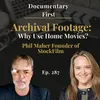
What can a few seconds of a stranger's home movie do for your documentary?Archival footage does not have to come from the National Archives or a big footage house. Home movies, the 8mm and Super 8 reels families shot from the 1930s through the 1980s, show ordinary life the way it actually looked: the clothes, the cars, the Christmases. For a documentary filmmaker, home movie footage carries a texture and an emotion that narration cannot supply, and it does it in a few seconds.In Episode 287, Christian sits down with Phil Maher, founder of Stockfilm, a home movie archive with over 200,000 clips. A software engineer by training, Phil started in 2015 by digitizing his grandfather's 8mm reels of his father's big Irish Catholic family in Chicago. He kept collecting reels from families and built a library of archival footage that filmmakers can search and license. Stockfilm keeps every scratch and flaw on purpose, and it keeps the physical reel after every scan.Phil walks through how a reel becomes a licensable 4K clip: cleaning, splicing, scanning, and dating footage with no label by reading the cars and clothes in the frame. He explains vinegar syndrome and why one decaying reel can damage the reels stored beside it. Christian and Phil take on footage houses that charge for public domain Signal Corps film, talk about what decades of home movies reveal about how people smoked, danced and smiled for the camera, and draw a firm line on AI. Stockfilm uses it to search and catalog the archive, never to change a frame. As Phil puts it, "We can prove every frame that we have, because we have it." Christian also shares 1947 home movies of Carentan, Normandy, shot by the father of Yves Marchais, whose story is at the center of her film in production, Heroes of Carentan.The conversation turns to physical film versus cloud storage, and Christian brings up the Nine PBS case. In March 2026, the St. Louis public television station lost access to more than 50 terabytes of its archive, 70 years of its history, when its cloud storage vendor cut off access and appeared to go out of business. As of August 2026, a Denver judge had ruled that the station owns the data and set up a court-supervised process to retrieve it. It backs up Phil's point that the cloud can go away, because you do not really own it.In this episode, you'll learn:Why home movies give a documentary emotion that narration can'tHow one family's 8mm reels became a searchable archiveHow an unlabeled reel gets dated from cars, clothing and AIWhat vinegar syndrome is, and why it spreads between reelsWhy you should keep the physical reel after digitizing itWhy paying for Signal Corps footage can mean paying for something freeWhere AI belongs in archival work, and why AI recreations should be labeledWhy physical media belongs in a real backup planCHAPTERS0:00 A Grandfather's 8mm Became Stockfilm9:28 Racing to Save Fading Film13:18 How Do You Date Unlabeled Reels?18:38 What Is Vinegar Syndrome?20:56 Is Public Domain Footage Free?23:36 Why Home Movies Move Audiences27:18 Smoking, Dancing, Forgetting to Smile32:34 AI in Documentary Filmmaking35:02 Cloud or Physical Media?39:08 Donating Your Family Archive42:44 Dawson City: Frozen TimeFREQUENTLY ASKED QUESTIONSWhy use home movies as archival footage in a documentary?Home movies capture ordinary life the way it actually looked, scratches and all. Stockfilm founder Phil Maher says filmmakers turn to them when they want texture and emotion, something real that doesn't need narration to explain it. In his words, "A few seconds of just showing someone a place and time can really just get people into that spot and really create that moment that connects with the audience."Where can I find free archival footage for a documentary?Much U.S. government footage, including World War II Signal Corps film, is free through the National Archives and the Library of Congress. Christian Taylor points out that commercial footage houses often charge download and license fees for that same public domain material. Doing the research yourself takes longer, but it can save an independent film real money.How do you date old home movie footage with no label?Start with the clues inside th
Podzilla Summary coming soon
Sign up to get notified when the full AI-powered summary is ready.
Free forever for up to 3 podcasts. No credit card required.
Listen to This Episode
More from Documentary First
Ep. 286 l RKO, Stax, and Music Rights: How Does a Catalog Become a Movie?
Ep. 285 l How to Make a Documentary With No Film School: 5 Lessons

Why Can't Your Documentary Find an Audience? l Deep Dive on Ep. 284
Ep. 284 I How to Fund a Documentary Without the Industry
Get summaries like this every morning.
Free AI-powered recaps of Documentary First and your other favorite podcasts, delivered to your inbox.
Free forever for up to 3 podcasts. No credit card required.