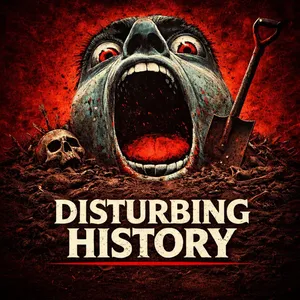
Free Daily Podcast Summary
Disturbing History: Daily Summaries Delivered
by Disturbing History-True Stories
Disturbing History is a dark history podcast uncovering the strange, sinister, and little-known stories the past tried to bury. Each week, we explore unsolved mysteries, secret societies, forgotten crimes, eerie folklore, lost civilizations, historical conspiracies, and disturbing events that never made it into your high school textbook. Hosted by author, investigator, and storyteller Brian King-Sharp, Disturbing History dives deep into: Unsolved historical mysteries Secret societies and hidden power structures Dark folklore and urban legends Lost colonies and vanished civilizations True crime cases buried by time Historical conspiracies and cover-ups Paranormal events rooted in real history Through immersive storytelling and investigative research, we uncover the shadowy corners of the past — the uncomfortable truths, forgotten tragedies, and disturbing secrets that shaped our world. If you’re fascinated by
Latest Episodes
The most recent episodes — sign up to get AI-powered summaries of each one.
- 2 days ago1h 2m
The 1970's
The 1970s opened in conflict.On April 30, 1970, President Richard Nixon announced the expansion of U.S. military operations into Cambodia.Days later, four students were killed by the Ohio National Guard at Kent State. On May 8, construction workers attacked antiwar demonstrators in what became known as the Hard Hat Riot, one of the defining images of a country bitterly divided over Vietnam, protest, and generational change.In the third installment of Disturbing History’s series on the American decades, Brian turns to the 1970s—the decade when the young people everyone had spent years worrying about finally began inheriting the country.The voting age dropped to eighteen with the 26th Amendment. The military draft ended. American prisoners of war came home. Smallpox was pushed toward eradication. The microprocessor arrived, environmental protections expanded, and Voyager carried a golden record filled with sounds and greetings from Earth toward the stars.Then Brian turns the photograph over.The decade exposed extraordinary abuses of government power. The burglary of an FBI office in Media, Pennsylvania helped reveal domestic surveillance programs. Congressional investigations uncovered CIA and FBI misconduct, while the Church Committee documented intelligence programs including NSA access to international telegram traffic.The Pentagon Papers further exposed how successive administrations had privately understood the Vietnam War very differently from the way it was often presented publicly. The episode also examines the disasters, scandals, panics, and strange cultural moments that defined the decade: Buffalo Creek, the Teton Dam collapse, deadly aviation failures, the Browns Ferry nuclear fire, the Legionnaires’ outbreak, the 1976 swine flu vaccination campaign, the Chowchilla school-bus kidnapping, fears surrounding youth culture, the rise of deprogramming, the Dungeons & Dragons panic, the Amityville story, the Howard Hughes autobiography hoax, and Chicago’s infamous Disco Demolition Night.And running beneath it all is the same question this series keeps returning to: Was the generation coming up really destroying America—or was an older generation simply watching the country change? By the end of the 1970s, the first baby boomers were entering their thirties and raising children of their own. Those children would grow up with seat belts, car seats, lower lead exposure, computers, and a very different America.And eventually, they too would grow old enough to complain about the generation coming behind them.Email BrianJoin Our FREE NewsletterGet Brian's Books Leave Us A VoicemailVisit Our WebsiteHave a forgotten historical mystery, disturbing event, unsolved crime, or hidden conspiracy you think deserves investigation?Send your suggestions to brian@paranormalworldproductions.com.Disturbing History is a dark history podcast exploring unsolved mysteries, secret societies, historical conspiracies, lost civilizations, and the shadowy stories buried beneath the surface of the past.Follow the show and enable automatic downloads so you never miss a deep dive into history’s most unsettling secrets.Because sometimes the truth is darker than fiction.
- 4 days ago1h 0m
The Bystander Effect
On March 27, 1964, The New York Times published a story that would become one of the most famous examples of human indifference ever told. According to the report, 38 people in Queens watched as 28-year-old Kitty Genovese was stalked and attacked for more than half an hour, and not one of them called police or came to help.The story spread across the country and eventually helped inspire decades of research into what became known as the bystander effect. But much of the story was wrong.In this episode of Disturbing History, Brian goes back to the night of March 13, 1964, and separates the legend from what the evidence actually shows.Kitty Genovese was a 28-year-old bar manager living in Kew Gardens with her partner, Mary Ann Zielonko. She was attacked outside her apartment building, but the idea that dozens of people simply watched and did nothing does not match the record. One neighbor shouted and frightened the attacker away. Another, Sophia Farrar, went downstairs, found Kitty, and stayed with her until the ambulance arrived.So where did the number 38 come from? How many people actually witnessed the attack? And how did a complicated crime become a lasting story about an uncaring crowd?The episode also explores the psychology that grew out of the case, including John Darley and Bibb Latané’s famous seizure and smoke-filled-room experiments, diffusion of responsibility, audience inhibition, and the tendency to look to other people before deciding whether something is really an emergency. Then the science takes another turn.Later studies found that the bystander effect is far from universal. In real emergencies, people often do help. A major 2019 study of 219 public conflicts caught on security cameras found that someone intervened in roughly nine out of ten incidents. So why do some crowds freeze while others act?This episode examines the history, the science, and the myth surrounding Kitty Genovese—and what decades of research really tell us about how ordinary people behave when someone needs help.Email BrianJoin Our FREE NewsletterGet Brian's Books Leave Us A VoicemailVisit Our WebsiteHave a forgotten historical mystery, disturbing event, unsolved crime, or hidden conspiracy you think deserves investigation?Send your suggestions to brian@paranormalworldproductions.com.Disturbing History is a dark history podcast exploring unsolved mysteries, secret societies, historical conspiracies, lost civilizations, and the shadowy stories buried beneath the surface of the past.Follow the show and enable automatic downloads so you never miss a deep dive into history’s most unsettling secrets.Because sometimes the truth is darker than fiction.
- 1 weeks ago1h 2m
The 1960's
Everybody knows the line: “Don’t trust anyone over thirty.” It became shorthand for an entire generation, even though the man who said it was a 24-year-old Berkeley graduate student who would turn thirty just months after the decade ended.In the second installment of Disturbing History’s series on the American decades, Brian turns to the 1960s—a decade remembered for rebellion, protest, Vietnam, assassinations, the counterculture, and the moon landing. But, as with the 1950s, the familiar photograph only tells part of the story.The decade brought enormous change: poverty declined, college enrollment surged, Medicare became law, the birth control pill transformed American life, and hundreds of millions watched humanity reach the moon.Then the photograph gets turned over. There are hydrogen bombs accidentally dropped over North Carolina and Spain, a nuclear explosion in space, a Soviet launch disaster hidden for decades, and a submarine officer whose refusal to authorize a nuclear torpedo may have helped prevent catastrophe.There is Frances Kelsey standing against thalidomide, Rachel Carson challenging the chemical industry, Ralph Nader being followed by General Motors investigators, and a polluted river becoming a symbol of an environmental crisis.The episode also revisits some of the decade’s most enduring stories: the supposed thirty-eight witnesses to the murder of Kitty Genovese, the mythical baby boom after the New York blackout, the disputed Gulf of Tonkin incident, Project 100,000, the collapse of the Haight-Ashbury counterculture, Apollo 1, Soyuz 1, and the speech prepared in case the first astronauts on the moon never came home.Behind all of it were dangers that received far less attention: staggering highway deaths, Vietnam, and a 1968 influenza pandemic that killed tens of thousands of Americans while much of the country barely stopped to notice.The episode closes by asking six questions: What do we remember? What did we forget? What did we fear? What was actually killing us? What wasn’t the government telling us? And what did the decade hand forward?The answer ends inside a glass jar on December 1, 1969, as 366 blue capsules containing every possible birthday were drawn on live television to decide which young American men would be called to war first.The 1960s changed America. The disturbing part is how much of the story we remember incorrectly.Disturbing History is a Paranormal World Productions podcast hosted, researched, and produced by Brian King-Sharp.Email BrianJoin Our FREE NewsletterGet Brian's Books Leave Us A VoicemailVisit Our WebsiteHave a forgotten historical mystery, disturbing event, unsolved crime, or hidden conspiracy you think deserves investigation?Send your suggestions to brian@paranormalworldproductions.com.Disturbing History is a dark history podcast exploring unsolved mysteries, secret societies, historical conspiracies, lost civilizations, and the shadowy stories buried beneath the surface of the past.Follow the show and enable automatic downloads so you never miss a deep dive into history’s most unsettling secrets.Because sometimes the truth is darker than fiction.
- 1 weeks ago51 min
Nightmare In The National Forest
A warning before you press play: this episode contains descriptions of extreme violence and what was done to several victims, including after death.In early January 2008, police searching a dumpster and nearby van north of Atlanta found blood-soaked clothing, weapons, restraints, and evidence connected to missing hiker Meredith Emerson. The man cleaning that van was Gary Michael Hilton.What followed exposed a 75-day killing spree across national forests in Georgia, North Carolina, and Florida. This episode of Disturbing History examines Hilton's life, the murders of Meredith Emerson, John and Irene Bryant, and Cheryl Dunlap, and the evidence that finally brought him down.It also looks at several other unsolved disappearances and murders where his name has surfaced over the years, while separating proven facts from speculation.Hilton was ultimately sentenced to death in Florida and multiple life sentences elsewhere.Years later, he publicly confessed to killing Cheryl Dunlap after previously denying prosecutors could prove the case.Disturbing History is a Paranormal World Productions podcast, hosted, researched, and produced by Brian King-Sharp.Email BrianJoin Our FREE NewsletterGet Brian's Books Leave Us A VoicemailVisit Our WebsiteHave a forgotten historical mystery, disturbing event, unsolved crime, or hidden conspiracy you think deserves investigation?Send your suggestions to brian@paranormalworldproductions.com.Disturbing History is a dark history podcast exploring unsolved mysteries, secret societies, historical conspiracies, lost civilizations, and the shadowy stories buried beneath the surface of the past.Follow the show and enable automatic downloads so you never miss a deep dive into history’s most unsettling secrets.Because sometimes the truth is darker than fiction.
- 2 weeks ago56 min
The 1950's
Everybody carries a version of the 1950s around in their head, and the strange thing is that a surprising amount of it is true. For millions of American families, one paycheck really could support a house, a car, and children. Homeownership climbed from roughly 44 percent before World War II to about 62 percent by 1960.Television went from a novelty to a fixture in nearly nine out of ten homes, Elvis Presley drew an audience of roughly 60 million people on The Ed Sullivan Show, and when the polio vaccine was declared safe and effective in 1955, church bells rang across the country.For a large group of mostly white, married, union-wage families, the 1950s delivered a level of prosperity and security their parents could scarcely have imagined. That part of the picture is real.But this episode turns the photograph over. In the first installment of The Good Old Lie, Disturbing History looks at what existed alongside that prosperity: whites-only housing restrictions, redlining, discrimination in GI Bill benefits, and the violent reaction that greeted Black families who attempted to move into newly built suburbs. It follows urban renewal and the interstate highway system through neighborhoods such as Rondo, Overtown, and Black Bottom, communities cut apart after their residents had already been excluded from much of the suburban boom.It also confronts the murder of 14-year-old Emmett Till in 1955, the open casket his mother insisted the world see, the acquittal of the men accused of killing him, and the confession they later sold to a national magazine.Then there was the danger falling from the sky. The episode examines the aboveground nuclear tests conducted at the Nevada Test Site, the downwind communities of southern Utah, the radioactive fallout that entered the food supply, the atomic soldiers placed near nuclear detonations, Castle Bravo and the crew of the Lucky Dragon No. 5, and the Saint Louis baby-tooth survey that helped demonstrate how radioactive strontium was entering children's bodies. It also explores the remarkable arrangement that gave Eastman Kodak advance warning about fallout capable of damaging photographic film while nearby families received no comparable protection.The hazards of everyday life were often far less dramatic but no less real. Cigarettes were promoted with doctors' endorsements. Shoe stores used X-ray machines to fit children's feet. DDT fog trucks rolled through neighborhoods. Lead paint was sold for homes and nurseries. Automobile deaths remained staggering.Medicine brought miracles and disasters at the same time. The polio vaccine helped conquer one of the most feared diseases in America, while the Cutter Incident exposed roughly 200,000 children to improperly manufactured vaccine. DES was prescribed to pregnant women before its consequences appeared years later in their daughters. Tranquilizers such as Miltown became a chemical answer to domestic unhappiness.The episode also examines the legal and social structures surrounding women, LGBTQ Americans, people with disabilities, psychiatric patients, and the poor. Married women could still face enormous barriers to obtaining credit in their own names. Marital rape remained legal nationwide.During the Baby Scoop Era, enormous numbers of unmarried mothers were pressured or coerced into surrendering their children for adoption.Homosexuality was classified as a psychiatric disorder, while the Lavender Scare destroyed thousands of federal careers. State mental hospitals held more than half a million people at the decade's peak. Institutions such as Willowbrook became symbols of neglect and abuse. Walter Freeman continued performing lobotomies, and compulsory sterilization programs remained active in states including North Carolina.Some of the decade's darkest experimentation—Tuskegee, Fernald, Henrietta Lacks, and MKULTRA—has been covered elsewhere on Disturbing History, so this episode concentrates instead on abuses carried out openly as government policy: Operation Wetback, federal Indian termination and relocation programs, and the destruction of the community at Chavez Ravine.And then there was fear.Joseph McCarthy, the Hollywood blacklist, the Rosenberg executions, and the Red Scare unfolded alongside a national panic over teenagers, comic books, and rock and roll.Congress investigated juvenile delinquency. Fredric Wertham blamed comics for corrupting children. The Comics Code reshaped an entire industry. Elvis Presley became dangerous enough that television cameras were instructed to avoid showing too much of his hips.Yet the children supposedly being corrupted by the 1950s were also the generation coming of age during Brown v. Board of Education, the 381-day Montgomery Bus Boycott, and the confrontation at Central High School in Little Rock, where nine Black teenagers wa
- 2 weeks ago1h 19m
The Merchants Of Death
On the evening of January 17, 1961, with just three days left in his presidency, Dwight D. Eisenhower delivered a 16-minute farewell address containing one warning that would outlive nearly everything else he said in public office: America must guard against the “unwarranted influence” of the military-industrial complex.This episode of Disturbing History examines what Eisenhower was really describing, because he was not predicting the future. He had spent eight years inside the system himself.Brian King-Sharp traces the rise of that system from the 1934 Nye Committee hearings, which investigated major American arms manufacturers, through the enormous industrial mobilization of World War II.The episode examines wartime cost-plus contracts, corporate executives embedded inside government, falsified inspections involving defective aircraft engines and substandard steel, and a 1944 proposal by General Electric president Charles E. Wilson to make the wartime partnership between industry and the military permanent.The Cold War did exactly that.From Operation Paperclip and the recruitment of roughly 1,600 German scientists, to secret human radiation experiments involving plutonium injections, radioactive iron given to pregnant women, and radioactive oatmeal fed to children at the Fernald State School, the episode follows what happened when national security programs operated behind layers of classification and limited oversight.The story then moves through Castle Bravo, the 15-megaton nuclear test that produced roughly 2.5 times its predicted yield, radioactive fallout across the Marshall Islands, nuclear testing in Nevada, and government efforts to minimize or conceal the consequences.From there, the episode opens up the machinery itself: defense contractors, congressional districts, the revolving door between government and industry, deliberately optimistic cost estimates, and the consequences faced by officials who challenged the numbers. Ernest Fitzgerald revealed the true cost overruns of the C-5A transport aircraft in 1968 and was fired, eventually becoming part of a Supreme Court case that helped establish modern presidential immunity doctrine.The investigation continues through the 1971 Lockheed bailout, international bribery scandals, Agent Orange, unexploded ordnance in Laos, human testing at Edgewood Arsenal, biological experiments over American cities, post-Cold War defense-industry consolidation, billions of dollars lost during the Iraq War, extreme contractor markups, and American-made weapons recovered after civilian deaths overseas. It ends with two numbers that reveal how large the system has become: the F-35 program, projected to cost more than $2 trillion over its lifetime, and a Department of Defense that has now failed eight consecutive financial audits.The final scene returns to Abilene, Kansas, and the surviving drafts of Eisenhower’s farewell address.According to his brother Milton, Eisenhower once considered describing a broader “military-industrial-congressional complex,” explicitly naming the political institution responsible for funding and overseeing the system.That version of the page has never been found.Email BrianJoin Our FREE NewsletterGet Brian's Books Leave Us A VoicemailVisit Our WebsiteHave a forgotten historical mystery, disturbing event, unsolved crime, or hidden conspiracy you think deserves investigation?Send your suggestions to brian@paranormalworldproductions.com.Disturbing History is a dark history podcast exploring unsolved mysteries, secret societies, historical conspiracies, lost civilizations, and the shadowy stories buried beneath the surface of the past.Follow the show and enable automatic downloads so you never miss a deep dive into history’s most unsettling secrets.Because sometimes the truth is darker than fiction.
- 2 weeks ago1h 2m
Happy Accidents
Everyone knows the voice, the perm, and the happy little trees. Far fewer people know what happened to Bob Ross’s name after the cameras stopped rolling.In this episode, we trace the remarkable and deeply complicated story of Bob Ross, from his years as an Air Force first sergeant in Alaska, where he painted souvenir gold pans to earn extra money, to the television phenomenon that made him one of the most recognizable artists in American popular culture. Along the way, we look at the mentor who taught him the wet-on-wet technique he would eventually make famous, the relationship that fractured as Ross’s career took off, and the Virginia couple who recognized that Bob Ross could become something much larger than a television painter. At the center of the story is a corporate agreement signed in 1985. Four equal partners formed Bob Ross Inc., but a survivorship provision meant that when one partner died, ownership of that person’s shares passed to the surviving partners. What looked like a routine piece of corporate paperwork would eventually determine who controlled Bob Ross’s business, his likeness, and ultimately the commercial future of his name.Then Bob Ross got sick. Within days of his cancer diagnosis, a six-page fax arrived addressing the future of the company and the rights surrounding his name. During the final year of his life, Ross began recording telephone conversations. Five weeks before his death on July 4, 1995, he signed a trust stating that he wanted the rights to his name and likeness divided between his son, Steve, and his half-brother, Jimmie Cox.What followed was a legal battle that continued long after Bob Ross was gone.We examine the litigation that followed his death, including reimbursement claims calculated down to the dime for expenses incurred while Ross was traveling for cancer treatment, a dispute involving the children’s television project that became some of his final work, and a settlement that resulted in recorded tapes being destroyed. For years afterward, much of the conflict surrounding his estate remained largely outside public view.T hen, decades later, the fight resurfaced.Bob Ross’s son, Steve, discovered in his fifties that his father’s trust purported to leave him 49% of the rights associated with his name and likeness. That discovery eventually led to a federal courtroom in Virginia, where a judge reached a devastating conclusion: when Bob signed the trust, the intellectual property he attempted to leave behind was not actually his to give.From there, the story enters an afterlife Bob Ross could never have imagined. His television episodes became streaming marathons. His face appeared on waffle makers, lottery tickets, clothing, toys, and countless other products.A Bob Ross bobblehead entered the Smithsonian’s collection, while original paintings that had spent years stacked inside cardboard boxes became extraordinarily valuable pieces of American pop-culture history, with works eventually reaching prices above $1 million as part of efforts benefiting public television.This is not simply the story of Bob Ross the painter. It is the story of what happens when a person becomes a brand, what a famous name is actually worth, who gets to control it after its owner is gone, and how one of television’s gentlest personalities became the center of a decades-long battle over his own legacy.Email BrianJoin Our FREE NewsletterGet Brian's Books Leave Us A VoicemailVisit Our WebsiteHave a forgotten historical mystery, disturbing event, unsolved crime, or hidden conspiracy you think deserves investigation?Send your suggestions to brian@paranormalworldproductions.com.Disturbing History is a dark history podcast exploring unsolved mysteries, secret societies, historical conspiracies, lost civilizations, and the shadowy stories buried beneath the surface of the past.Follow the show and enable automatic downloads so you never miss a deep dive into history’s most unsettling secrets.Because sometimes the truth is darker than fiction.
- 3 weeks ago1h 33m
Three Mile Island Meltdown
On March 28, 1979, at 4:00 a.m., a relief valve at Three Mile Island opened as designed—and then failed to close. For more than two hours, operators believed it had shut because the control-room indicator showed the electrical command, not the valve’s actual position.By the time the mistake was understood, roughly half the fuel in Unit Two had melted.The men in the control room did not know how bad it was. Neither did the Nuclear Regulatory Commission. The full extent of the damage would not be confirmed until engineers lowered a camera into the reactor vessel three years later and found a five-foot void where the top of the core had once been.In this episode of Disturbing History, Brian goes beyond the familiar story of America’s worst commercial nuclear accident and into the warnings, failures and unanswered questions that came before and after it.Eighteen months before the meltdown, another Babcock & Wilcox reactor at Davis-Besse experienced a nearly identical stuck-open relief valve. Engineers warned that operators could misread the signs of a loss-of-coolant accident and shut down emergency cooling at exactly the wrong moment. One NRC inspector was concerned enough to travel to Washington on his own time just six days before Three Mile Island to warn commissioners that something was badly wrong.The Kemeny Commission later concluded that the correct operating guidance was never passed along to the utilities.The episode reconstructs the accident minute by minute: the closed emergency feedwater valves, the overwhelming alarm system, the printer that fell so far behind that critical records were lost, temperature readings above 2,000 degrees Fahrenheit that operators dismissed as impossible, and a hydrogen burn inside containment that was initially written off as an instrument problem.Then the crisis moved beyond the plant.Conflicting radiation readings, contradictory public statements and confusion inside state and federal agencies turned Three Mile Island into a communications disaster. Governor Dick Thornburgh advised pregnant women and young children within five miles of the plant to leave. Roughly 144,000 people ultimately evacuated the surrounding area.The episode also examines the infamous hydrogen bubble, the federal scramble to obtain potassium iodide because no national stockpile existed, and the radiation readings that appeared, disappeared or were later disputed. And then there was the criminal investigation.Less than two months after the accident, control-room operator Harold Hartman told federal investigators that Metropolitan Edison had been falsifying reactor coolant leak-rate data before the meltdown to avoid shutting the plant down for repairs.Federal prosecutors later sharply criticized the NRC’s handling of the allegations. In 1983, a grand jury indicted Metropolitan Edison on charges involving falsified tests and destroyed records. The company eventually pleaded guilty, becoming the only American nuclear utility convicted of a criminal offense.The final portion of the episode turns to the question that remains the most controversial: what happened to the people living around the plant?Residents reported metallic tastes, skin irritation, nausea, hair loss and dead animals. Official estimates said offsite radiation doses were far too low to cause acute radiation sickness. Decades of epidemiological studies have produced conflicting interpretations, with some finding no convincing cancer link and others identifying patterns that warranted further investigation.Thousands of personal injury claims were eventually dismissed because plaintiffs could not prove exposure above the required legal threshold.Nearly half a century later, the physical story of Three Mile Island still is not finished. Much of the damaged core remains stored in Idaho, some radioactive material is still being removed from Unit Two, and the neighboring Unit One reactor is being prepared for a possible return to service as the Crane Clean Energy Center.After thousands of pages of federal reports, a criminal prosecution, decades of litigation and the dismantling of a melted reactor core, some of the most basic questions surrounding Three Mile Island remain unresolved—including who closed two critical valves that should have been open on the morning the accident began.Email BrianJoin Our FREE NewsletterGet Brian's Books Leave Us A Voicemail<br
Get Disturbing History summaries in your inbox
Free AI-powered daily recaps. Key takeaways, quotes, and mentions — in a 5-minute read.
Get Free Summaries →Free forever for up to 3 podcasts. No credit card required.
You Might Also Like
Listeners also like.

Dark History
Reveals dark, overlooked historical events like tyrannical rulers and corporate crimes that were omitted from mainstream education.
After Dark: Myths, Misdeeds & the Paranormal
Historians explore eerie, strange, and dark historical events, from hauntings and witch trials to UFOs and infamous crimes.
Dark Histories
Unsolved crimes, historical mysteries, and unexplained phenomena explored through narrative storytelling.
History's Great Mysteries
Explores unexplained historical events and invites listeners to ponder possible theories behind enduring mysteries.

Heart Starts Pounding: Horrors, Hauntings and Mysteries
Explores unsolved mysteries, hauntings, and urban legends with a focus on true crime and paranormal stories.
Crime, Conspiracy, Cults and Murder
Explores notorious historical figures, bizarre murders, conspiracy theories, and unsolved mysteries with deep-dive true crime storytelling.
Stuff They Don't Want You To Know
Explores unexplained phenomena, conspiracy theories, and alleged government cover-ups throughout history.

Crimehub: A True Crime Podcast
Examines disturbing and unbelievable true crimes from modern history with in-depth storytelling and new cases released weekly.
Seven: Disturbing Chronicle Stories of Scary, Paranormal & Horror Tales
True accounts of disturbing, paranormal, and horror experiences are shared in weekly episodes.

Murder: True Crime Stories
A true crime podcast examining notorious murders and their impact on victims, families, and communities.

The Lets Read Podcast
Narrates true scary stories from real people, covering everything from eerie encounters to paranormal events.
Reddit’s Most Shocking Stories: Jaw-Dropping Tales from Reddit
Real stories from Reddit covering cheating, revenge, paranormal encounters, and shocking confessions.
About Disturbing History
Disturbing History is a dark history podcast uncovering the strange, sinister, and little-known stories the past tried to bury. Each week, we explore unsolved mysteries, secret societies, forgotten crimes, eerie folklore, lost civilizations, historical conspiracies, and disturbing events that never made it into your high school textbook. Hosted by author, investigator, and storyteller Brian King-Sharp, Disturbing History dives deep into: Unsolved historical mysteries Secret societies and hidden power structures Dark folklore and urban legends Lost colonies and vanished civilizations True crime cases buried by time Historical conspiracies and cover-ups Paranormal events rooted in real history Through immersive storytelling and investigative research, we uncover the shadowy corners of the past — the uncomfortable truths, forgotten tragedies, and disturbing secrets that shaped our world. If you’re fascinated by
Customized Recaps
AI-powered recaps with compact key takeaways, quotes, and insights.
Straight to Your Inbox
Get key takeaways from Disturbing History in a 5-minute read.
Save Hours Every Week
Stay current on your favorite podcasts without falling behind.
Frequently Asked Questions
What is Podzilla's Disturbing History daily summary?
It's a free AI-powered email that summarizes new episodes of Disturbing History as soon as they're published. You get the key takeaways, notable quotes, and links & mentions — all in a quick read.
How does the Disturbing History podcast summary work?
When a new episode drops, our AI transcribes and analyzes it, then generates a personalized summary tailored to your interests and profession. It's delivered to your inbox every morning.
Is this an official Disturbing History product?
No. Podzilla is an independent service that summarizes publicly available podcast content. We're not affiliated with or endorsed by Disturbing History-True Stories.
Can I get summaries of other podcasts too?
Absolutely! The free plan covers up to 3 podcasts. Upgrade to Pro for 15, or Premium for 50. Browse our full catalog at /podcasts.
How often does Disturbing History release new episodes?
Disturbing History publishes every few days. Our AI generates a summary within hours of each new episode.
What topics does Disturbing History cover?
Disturbing History covers topics including History, True Crime, Culture, Society & Culture. Our AI identifies the specific themes in each episode and highlights what matters most to you.
Start getting Disturbing History summaries tomorrow morning.
Free forever for up to 3 podcasts. No credit card required.
Free forever for up to 3 podcasts. No credit card required.