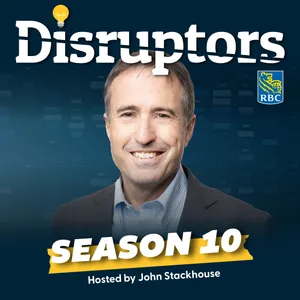
Free Daily Podcast Summary
Disruptors: Daily Summaries Delivered
by RBC Thought Leadership, John Stackhouse
Disruptors, now in its 11th season, has become your front-row seat to Canada’s innovation story—200+ episodes exploring the people, ideas, and technologies reshaping Canada’s future. Each episode, hosted by John Stackhouse, SVP, Office of the CEO at Royal Bank of Canada—and former Editor-in-Chief of The Globe and Mail—cuts through the hype and focuses on what you need to know.This season, we’re leaning into urgency: the global economy is shifting, geopolitics are noisy, and Canada needs to respond. You’ll hear from founders, investors, scientists, operators, and policy leaders at the forefront. Listen for a clearer understanding of the tech and innovation shaping Canada and the world—and practical insights to help you make sense of what’s coming next.
Latest Episodes
The most recent episodes — sign up to get AI-powered summaries of each one.
- 1 weeks ago20 min
Space Race: Getting Canada to Orbit
At SpaceBound in Gatineau, Quebec, across the river from Parliament Hill, John Stackhouse sat down with three people at the centre of Canada's push to reach orbit on its own terms.Dan Goldberg, President and CEO of Telesat, is building Telesat Lightspeed, a global low-Earth orbit broadband constellation conceived, built and operated in Canada, with MDA as prime contractor. Its satellites will reach orbit on American rockets. Goldberg explains why defence and sovereignty have moved from a niche to a central source of demand for satellite services since the war in Ukraine, and why Canada's head start matters to allies in Europe, Asia and the Middle East.He supports a domestic launch capability but is clear-eyed about the bar. An operator competing with SpaceX, Amazon and state-owned Chinese operators needs launch that is reliable, affordable and frequent.Hugh Kolias, co-founder and CEO of Canada Rocket Company, and Bachar Elzein, founder and CEO of Reaction Dynamics, are trying to meet that bar from different directions. Kolias is building a larger vehicle with proven technology and engineers who have built rockets before. Elzein is building containerized rockets that can be stored and launched from remote sites, with simpler propulsion to drive down cost.The conversation builds on RBC Thought Leadership's Mission Critical report on why Canada's race to space is a matter of national urgency.0:00 Live from SpaceBound 0:56 Telesat Lightspeed and Canada's place in low-Earth orbit 3:06 Defence, sovereignty and where demand is coming from 4:54 Why launch is a sovereign capability 9:28 Canada Rocket Company: speed, capital and talent 12:57 What a satellite operator needs from launch 15:22 Reaction Dynamics: cutting complexity to cut cost 19:16 Looking ahead to SpaceBound next yearRelevant Reports and Podcasts:From Ottawa to Orbit: Two Views on Canada's Big Day. Colonel Jeremy Hansen, whose name is on Canada Rocket Company's new engine test facility. (PODCAST)Atlantic Canada: Launching Sovereignty (The Canada Project). Stephen Matier of Maritime Launch Services and Rahul Goel of NordSpace, on the Canso spaceport Goldberg mentions. (PODCAST)Space: The Low Earth Orbit Movement. Dan Goldberg's earlier Disruptors appearance, with Mike Greenley of MDA Space and Dr. Margarita Marinova. (PODCAST)Mission Critical: Why Canada's race to space is of national urgency. The report Stackhouse references on air.A Higher Orbit: How Canada can build and finance a bolder space strategy. CONNECT & SUBSCRIBE:• Follow RBC Thought Leadership on LinkedIn• Follow John Stackhouse on LinkedIn• For more insights visit RBC Thought Leadership Hosted by Simplecast, an AdsWizz company. See pcm.adswizz.com for information about our collection and use of personal data for advertising.
- 2 weeks ago18 min
Clear Skies: Direct air capture and Canada's advantage
In the latest episode of Disruptors, host John Stackhouse travels to Innisfail, Alta., a little more than an hour north of Calgary. There he joins Alex Petre, the CEO of Deep Sky, a direct air capture company that finds itself in the middle of a geo-tech race. The two discuss whether direct air capture technology can scale, how to test competing systems side-by-side, and how Canada’s geology, labor force, fiscal regime and reputation as a trusted partner can turn carbon removal into a competitive advantage.0:00 Inside Deep Sky Alpha 0:48 Why carbon removal, and how direct air capture works 4:32 Multiple technologies on one site 7:26 Can direct air capture scale? 9:22 Building the first commercial facilities 11:49 The global race for carbon removal 15:01 What Canada needs to do next CONNECT & SUBSCRIBE:• Follow RBC Thought Leadership on LinkedIn• Follow John Stackhouse on LinkedIn• For more insights visit RBC Thought Leadership Hosted by Simplecast, an AdsWizz company. See pcm.adswizz.com for information about our collection and use of personal data for advertising.
- 3 weeks ago23 min
Permission to Fail: A case for youth entrepreneurship
Spin Master co-founder Ronnen Harary believes Canada needs more entrepreneurs—especially young ones. In this episode of Disruptors, he joins host John Stackhouse to explain why your 20s offer the perfect window to start a business: you’re close to emerging trends, you have permission to fail, and you possess the “power of not knowing” that lets you take risks mature companies won’t.Ronnen shares the story of building Spin Master from Earth Buddies to global brands like Air Hogs, Hatchimals, and Paw Patrol. He introduces the concept of “inverse risk”—the idea that not pursuing your entrepreneurial vision may be riskier than trying and failing. And he makes the case that despite economic uncertainty, AI disruption is creating unprecedented opportunities for young founders willing to move fast.Chapters:00:00 Why Canada needs more young entrepreneurs01:39 Why your 20s are the best decade to start a business03:49 The power of not knowing: the Air Hogs story05:28 Immigrant roots, dysgraphia and an early entrepreneur08:42 Earth Buddy and the birth of Spin Master10:30 Tracking down the Kmart buyer13:32 Inverse risk: from Earth Buddy to PAW Patrol16:30 Why doesn't Canada have more entrepreneurs?17:34 Futurpreneur and collateral-free loans18:27 AI, Stickerbox and the most exciting time to start21:23 Advice to his 23-year-old self CONNECT & SUBSCRIBE:• Follow RBC Thought Leadership on LinkedIn• Follow John Stackhouse on LinkedIn• For more insights visit RBC Thought Leadership Hosted by Simplecast, an AdsWizz company. See pcm.adswizz.com for information about our collection and use of personal data for advertising.
- Oct 7, 202625 min
Digital Refineries: Data centres as Alberta’s new resource
Alberta wants $100 billion of AI data centre investment within five years, without subsidies. Recorded live at Energy Disruptors: UNITE in Calgary, Alberta's Minister of Technology and Innovation, Nate Glubish, tells John Stackhouse why he sees data centres as "digital refineries" that turn natural gas into intelligence. He explains how bring-your-own-power rules protect the grid and ratepayers, why projects proposed for Sturgeon County and Olds ended so differently, and what a proposed second round of grid power could look like. A conversation about energy, AI and where Canada's computing power gets built. Chapters0:00 Live from Energy Disruptors: UNITE0:42 The mood shift on data centres4:42 Value-added economics8:33 The Alberta model: water, setbacks, Meta vs. Olds16:05 Exporting the intelligence17:55 The power queue and Phase 221:27 Sizing the opportunity22:36 Public opinion and responsible AIGuest: Nate Glubish, Minister of Technology and Innovation, Government of AlbertaHost: John Stackhouse, Senior Vice-President, Office of the CEO, RBCRecent RBC Thought Leadership Reports:License to build: Unlocking Canada's data centre potential CONNECT & SUBSCRIBE:• Follow RBC Thought Leadership on LinkedIn• Follow John Stackhouse on LinkedIn• For more insights visit RBC Thought Leadership Hosted by Simplecast, an AdsWizz company. See pcm.adswizz.com for information about our collection and use of personal data for advertising.
- Sep 29, 202626 min
Canada's Biotech Challenge
Canada has world-class biotech science. Too often, the companies built on it grow up somewhere else. Clarissa Desjardins, co-founder and CEO of Montreal’s Congruence Therapeutics, joins John Stackhouse on the state of biotech and what Canada must do to keep more of what it builds. In this episode: • How AI is changing the way new drugs are discovered • Why China’s rise is reshaping the global industry • Why biotech stays invisible in Canada, even to investors • What it would take to grow Canadian companies to global scale at home Chapters:0:00 Will Canada's medicines come from China? 0:28 Biotech's missing place in Canada's agenda 1:32 From scientist to entrepreneur 3:47 Great science, too little commercialization 6:03 How AI is changing drug discovery 9:54 Why biotech is invisible, and underfunded 13:15 Health sovereignty and the anchor-company gap 18:33 China's rise in drug discovery 21:31 What Canada needs to do next 24:17 Closing thoughts CONNECT & SUBSCRIBE:• Follow RBC Thought Leadership on LinkedIn• Follow John Stackhouse on LinkedIn• For more insights visit RBC Thought Leadership Hosted by Simplecast, an AdsWizz company. See pcm.adswizz.com for information about our collection and use of personal data for advertising.
- Sep 23, 202619 min
Two Middle Powers. One AI Bet
Live from ALL IN 2026 in Montreal, John Stackhouse and Nora Bieberstein sit down with three German business leaders — Yvonne Denz of the Canadian German Chamber of Industry and Commerce, Robert Jozic of Schwarz Digits, and Dr. Ralf Wintergerst of Giesecke+Devrient — as Germany serves as ALL IN's Country of Honour. Recorded the same week Canada and Germany backed Yoshua Bengio's AI safety lab LawZero and built on last year's Digital Alliance, they discuss why Schwarz backed the Cohere-Aleph Alpha merger and what a deeper Canada-Germany tech partnership could mean for both economies.Chapters:0:00 Intro — live from ALL IN Montreal0:41 Co-host Nora Bieberstein joins1:20 Yvonne Denz on Germany's delegation to Canada2:02 Inside the industrial AI panel with BSF3:29 Making the case for Canada-Germany business5:36 Robert Jozic on scaling sovereign AI at Schwarz Digits6:19 Middle powers vs. the tech hegemons8:54 The Cohere-Aleph Alpha deal, on the record10:12 What Germany offers Canada11:45 Dr. Ralf Wintergerst on Germany's AI ambitions13:19 Combining Canada's AI research with Germany's industrial base14:27 The "third moment" in global AI15:32 What Canada offers Germany16:38 Building the digital euro18:34 Reflections: the globalization of AI CONNECT & SUBSCRIBE:• Follow RBC Thought Leadership on LinkedIn• Follow John Stackhouse on LinkedIn• For more insights visit RBC Thought Leadership Hosted by Simplecast, an AdsWizz company. See pcm.adswizz.com for information about our collection and use of personal data for advertising.
- Sep 16, 202615 min
Canada's A.I. Potential
At the Milken Institute's Global Dialogues Toronto, held alongside Prime Minister MarkCarney's Canada Investment Summit, three Canadian leaders took up both questions on onestage. Aidan Gomez co-founded Cohere and was a co-author of the 2017 paper that introducedthe transformer architecture underpinning today's large language models. Dave McKay leadsRBC. Evan Solomon is Canada's first Minister of Artificial Intelligence and DigitalInnovation. Susan Li of Fox Business Network moderated.The conversation runs across three arguments. Gomez makes the case that regulation should beshaped by an independent third party rather than by the largest labs, and warns aboutincumbents using rules as a competitive moat. McKay describes a practical sovereigntyproblem: the most advanced security tooling is released selectively outside the UnitedStates, which he calls an unfair playing advantage with real cyber risk for institutionsoperating elsewhere. Solomon frames the government's position as a build right or build wrong option,and argues the test is whether society comes along.Gomez closes on the case for a democratic second rail in AI, with Cohere in Canada andMistral in France as the two candidates. It is a compact view of where Canada's AI debateactually sits.0:00 Canada's claim on the technology it built0:16 Two kinds of uncertainty, one week in Toronto1:11 Who should write the rules for frontier AI1:46 Uneven access to the most advanced tools3:38 Canada's position on AI safety4:47 Development cycles are compressing6:52 Will AI change more jobs than it creates?8:41 Build right or build wrong9:41 How modern AI was invented in Canada11:58 The case for a democratic second rail12:39 Final thoughts from the panel14:42 What's next: geotech CONNECT & SUBSCRIBE:• Follow RBC Thought Leadership on LinkedIn• Follow John Stackhouse on LinkedIn• For more insights visit RBC Thought Leadership Hosted by Simplecast, an AdsWizz company. See pcm.adswizz.com for information about our collection and use of personal data for advertising.
- Sep 9, 202625 min
David, Goliath, and Drones: The New Map of Geo-Technology
As global power dynamics shift, the intersection of technology and national strategy is defining a new Cold War race. In this season opener of Disruptors, host John Stackhouse sits down with economist and Noahpinion author Noah Smith to map out the new geopolitics of tech.Together, they unpack China’s dominance over the critical "electric tech stack" (batteries, magnets, and power electronics), why traditional military platforms are being upended by cheap drone warfare, and how middle powers like Canada, Japan, and Korea can build "Allied Scale" to compete. They also explore the true goal of modern industrial policy, the reality of AI labor disruption, and what a disabled rabbit named Giggles can teach us about resilience in a noisy world.CHAPTERS & TIMESTAMPS: 00:00 - Introduction: The Shift to Geo-Technology 01:58 - Lessons in Resilience from a Disabled Rabbit 03:07 - Great Power Competition & the New Global Tech Map 07:15 - The "Electric Tech Stack": Batteries, Magnets, and Electronics 10:03 - Rebuilding "Allied Scale" Without the U.S. 13:32 - Modern Industrial Policy: Wealth vs. Strategic Preservation 17:10 - AI, Labor Disruption, and Jevons Paradox 21:30 - Canada’s Next Move in the Geo-Tech RaceRESOURCES & LINKS MENTIONED:Substack Newsletter: Noahpinion by Noah SmithCommentary & Analysis: Bloomberg Opinion archives by Noah SmithConcepts Referenced: Rush Doshi’s "Allied Scale," Mark Carney’s commentary on global hegemons, and Jevons Paradox in economic theory. CONNECT & SUBSCRIBE:• Follow RBC Thought Leadership on LinkedIn• Follow John Stackhouse on LinkedIn• For more insights visit RBC Thought Leadership Hosted by Simplecast, an AdsWizz company. See pcm.adswizz.com for information about our collection and use of personal data for advertising.
Get Disruptors summaries in your inbox
Free AI-powered daily recaps. Key takeaways, quotes, and mentions — in a 5-minute read.
Get Free Summaries →Free forever for up to 3 podcasts. No credit card required.
You Might Also Like
Listeners also like.

Total Disruption Podcast
Discussions with entrepreneurs and thought leaders on how disruptions in life and business drive personal and professional transformation.
Digital Disruption with Geoff Nielson
Industry leaders and innovators discuss how to adapt to and leverage digital transformation in the evolving technological landscape.

The Restless Ones
Executives at the intersection of technology and business discuss innovation, leadership, and driving change in fast-evolving industries.
Smart Talks with IBM
Conversations with leaders leveraging AI, quantum computing, and emerging technologies to transform global businesses.
"The Cognitive Revolution"
Explores the transformative impact of artificial intelligence through interviews with innovators shaping its future.

HBR IdeaCast
Features leading thinkers in business and management discussing key ideas and trends.

Business Daily
A daily exploration of the world of money and work from the BBC.

Better Offline
Ed Zitron and guests explore how the tech industry’s power players shape society, for better or worse.

TED Tech
Experts examine how technology reshapes society, science, design, and business through TED Talks hosted by Sherrell Dorsey.

Right About Now - Legendary Business Advice
Raw business insights from founders and industry leaders, revealing real wins, failures, and actionable strategies without the fluff.

Intelligence Squared: Business
Discusses the future of capitalism and major economic trends with business leaders, authors, and economists.
Unbossing
Conversations with business and tech leaders about redefining leadership by unlearning outdated rules in times of change.
About Disruptors
Disruptors, now in its 11th season, has become your front-row seat to Canada’s innovation story—200+ episodes exploring the people, ideas, and technologies reshaping Canada’s future. Each episode, hosted by John Stackhouse, SVP, Office of the CEO at Royal Bank of Canada—and former Editor-in-Chief of The Globe and Mail—cuts through the hype and focuses on what you need to know.This season, we’re leaning into urgency: the global economy is shifting, geopolitics are noisy, and Canada needs to respond. You’ll hear from founders, investors, scientists, operators, and policy leaders at the forefront. Listen for a clearer understanding of the tech and innovation shaping Canada and the world—and practical insights to help you make sense of what’s coming next.
Customized Recaps
AI-powered recaps with compact key takeaways, quotes, and insights.
Straight to Your Inbox
Get key takeaways from Disruptors in a 5-minute read.
Save Hours Every Week
Stay current on your favorite podcasts without falling behind.
Frequently Asked Questions
What is Podzilla's Disruptors daily summary?
It's a free AI-powered email that summarizes new episodes of Disruptors as soon as they're published. You get the key takeaways, notable quotes, and links & mentions — all in a quick read.
How does the Disruptors podcast summary work?
When a new episode drops, our AI transcribes and analyzes it, then generates a personalized summary tailored to your interests and profession. It's delivered to your inbox every morning.
Is this an official Disruptors product?
No. Podzilla is an independent service that summarizes publicly available podcast content. We're not affiliated with or endorsed by RBC Thought Leadership, John Stackhouse.
Can I get summaries of other podcasts too?
Absolutely! The free plan covers up to 3 podcasts, any in the catalog. Basic raises that to 15, Pro to 40 and Max to 100. Browse our full catalog at /podcasts.
How often does Disruptors release new episodes?
Disruptors publishes weekly. Our AI generates a summary within hours of each new episode.
What topics does Disruptors cover?
Disruptors covers topics including Technology, Business, Entrepreneurship. Our AI identifies the specific themes in each episode and highlights what matters most to you.
Start getting Disruptors summaries tomorrow morning.
Free forever for up to 3 podcasts. No credit card required.
Free forever for up to 3 podcasts. No credit card required.