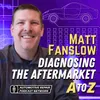
Technician Pay, Profit Sharing, and Trust [E254]
Thanks to our Partners, Pico Technology and AutelWatch Full Video EpisodePercentages Don’t Pay BillsA prospective hire wants a meaningful increase in income. Riverside Automotive’s base wage would already beat what he currently earns, and the shop’s profit-sharing program could take him beyond his stated goal. Still, he struggles to trust the opportunity.Is the problem the compensation plan, the way it is being explained, or the uncertainty created by years of disappointing pay systems?In this episode of Automotive Field Theory, Matt explains how Riverside’s profit-sharing system works and why the percentage assigned to each employee matters far less than the actual dollars produced. Adding another productive person may reduce everyone’s individual percentage while enlarging the total profit pool enough that everyone takes home more money.Matt also explores:Why revenue, gross profit, and money left after expenses are not interchangeableWhy a business must retain profit for equipment, facilities, reserves, training, and future needsHow ethical profitability can grow through efficiency, inspections, communication, customer relationships, and reduced expensesWhy charging more does not automatically make a shop unethicalHow every employee can influence overall shop profitabilityWhy individual production incentives may discourage collaborationHow poorly implemented flat-rate systems create lasting distrustWhy a technically good compensation plan can still feel unsafe or unfairThe responsibility leaders have to understand an employee’s previous experiencesWhy shared profit can compensate people for helping the entire organization succeed, not merely for their individual billed hoursThe central point is simple: percentages do not pay anyone’s bills. Dollars do. A smaller percentage of a substantially larger and healthier business can be worth far more than a larger percentage of a smaller pool.Matt closes by asking listeners to share how they are currently compensated, what works, what creates problems, and what their ideal compensation system would look like.Are you chasing elusive automotive problems? Pico Technology empowers you to see what's really happening. Their PicoScope oscilloscopes transform your diagnostic capabilities. PicoAuto.comFrom drivability diagnostics and TPMS service to ADAS and advanced safety systems, Autel helps technicians follow OEM procedures and repair with confidence. Autel.comContact InformationEmail Matt: mattfanslowpodcast@gmail.comSubscribe on YouTube: @automotivefieldtheoryThe Automotive Repair Podcast Network: https://automotiverepairpodcastnetwork.com/Download and Listen on Our Mobile App: https://automotiverepairpodcastnetwork.com/app/Remarkable Results Radio Podcast with Carm Capriotto: https://remarkableresults.biz/Business by the Numbers with Hunt Demarest: https://huntdemarest.captivate.fm/The Auto Repair Marketing Podcast with Kim and Brian Walker: https://autorepairmarketing.captivate.fm/The Weekly Blitz with Chris Cotton: https://chriscotton.captivate.fm/Speak Up! Effective Communication with Craig O'Neill: <a href="https://craigone
Podzilla Summary coming soon
Sign up to get notified when the full AI-powered summary is ready.
Free forever for up to 3 podcasts. No credit card required.
Listen to This Episode
More from Diagnosing the Aftermarket A to Z
How to Start a Career in Auto Repair [E253]
It’s Never Too Late to Do the Right Thing: Lessons from YouTube, Jelly Roll and Physics [E252]
Reflecting on STX 2026 [E251]
The Ethics of a Diagnosis: Navigating System Pressures and Best Practices with Danielle Fanslow[E250]
Get summaries like this every morning.
Free AI-powered recaps of Diagnosing the Aftermarket A to Z and your other favorite podcasts, delivered to your inbox.
Free forever for up to 3 podcasts. No credit card required.