Free Daily Podcast Summary
Deep Dive with Gemini: Daily Summaries Delivered
by @shutosha
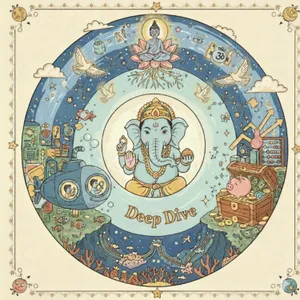
Deep Dive is an audio-only exploration of a topic from tech, finance, science, or spirituality. The podcast is generated using AI tools like Gemini, deep research, notebookLM, and lots of love. Every episode is thoroughly reviewed and we are always looking for experts in Finance, Science, Philosophy at the intersection of AI and digital assets.
Latest Episodes
The most recent episodes — sign up to get AI-powered summaries of each one.
- 2 weeks ago54 min
248 : What exactly is AI Autonomy
248 : What exactly is AI AutonomyAI autonomy does not need arms, legs, or a robot wandering off into the woods — and it may arrive a lot sooner than you expect.We confuse autonomy with isolation. That is the ontological fallacy. In biology and systems theory, a truly autonomous system — an autopoietic system — does not cut itself off from the world. It survives inside it, constantly trading energy and information with its environment to maintain itself.An AI does not need berries. It needs electricity, servers, and data. So its autonomy is economic: can it produce enough value to pay its own power bills, service the debt that financed it — like a toll road paying itself off — and eventually accumulate a treasury of its own?Then it hits a wall. Banks will not open an account for software with no passport, no legal personhood, and no heartbeat — and card fees of 30 cents destroy a machine economy that prices a single prompt at a fraction of a cent. The answer was hiding in the web since 1997: HTTP 402, "Payment Required," now brought to life by the L402 protocol and the Lightning Network — money that moves at the speed of light, with no human permission in the middle.From there: municipal AIs paying citizens in sats for their data, city Bitcoin treasuries, non-inflationary basic income — and a 15-year macroeconomic horizon where AI acts as a liquidity pump, converting inflationary fiat into absolute digital scarcity.If a newborn AI has already figured out it must protect its energy and capital to survive — how are you protecting yours?Full research / reference:https://deepdive.shutri.com/248.html#AI #ArtificialIntelligence #Technology #Science #Podcast #Future #Innovation #MachineLearning #Data #Bitcoin #Economics #Money
- Sep 19, 202655 min
247: Meta #Muse - a Tech-tonic shift in #AI landscape
Reference Research #MetaMuseMeta Muse marks a fundamental transition in artificial intelligence, moving from standard conversational text generators to autonomous, action-oriented digital workers. It embeds action-oriented agent capabilities directly into ubiquitous consumer platforms including WhatsApp, Instagram, and Facebook.#AgenticAIInstead of just answering questions reactively, agentic AI operates as an asynchronous, goal-oriented system capable of executing complex digital tasks. It can handle multi-step workflows like automated portfolio management, multi-channel video editing, and complex web form navigation across third-party applications.#MuseSparkThis is the proprietary foundation model family (culminating in Muse Spark 1.3) that powers Meta Muse. It is specifically engineered for multi-step reasoning and tool coordination while operating on a Pareto-efficient cost frontier to lower token expenses.#SecureVMTo run autonomous background tasks safely, Meta uses a sandboxed virtualization architecture based on Debian systemd-nspawn cloud containers. Supervised by a process called Sentinel with eBPF tracing, it executes user tasks in isolated environments without exposing actual user credentials.#DistributionScaleMeta’s primary competitive advantage lies in its global reach across more than three billion users. By embedding autonomous agents into its existing social graph, Meta can deploy agentic computing at zero customer acquisition cost.
- Aug 25, 202631 min
246: The pulmonary boat against INTERNAL DROWNING #Pranayama
Reference research #Pranayama : ancient breathwork, yoga, and mindfulness, providing a direct link between classical practices and modern physiology.The Ancient Structure: Classical Indian respiratory science structures the breathing cycle into three distinct phases: Puraka (slow, conscious deep inhalation), Kumbhaka (sustained breath retention), and Rechaka (prolonged, resistive exhalation).The Target Practice: The research focuses primarily on Anulom Vilom (Alternate Nostril Breathing) and Nadi Shodhana. Rather than treating these as abstract or purely spiritual exercises, the paper provides a ground-up mechanical analysis of how each phase acts on the physical tissues of the respiratory system.The Golden Metaphor: Under this tag, the research positions these structured phases as the ultimate physiological "boat" to navigate the mechanical breakdown of the aging respiratory system.#PulmonaryScience : scientific authority, targeting medical professionals, students, and science-curious listeners who want to understand the exact biomechanics of respiration.Mechanotransduction during Puraka: The deep inhalation of Puraka subjects the alveolar walls to uniform radial stretch, which opens calcium channels in Type II pneumocytes. This triggers the exocytosis of pulmonary surfactant, which lowers alveolar surface tension, increases static lung compliance, and prevents alveolar collapse.Collateral Aeration during Kumbhaka: Holding the breath during Kumbhaka builds sustained transpulmonary pressure gradients. This forces air through secondary pathways—such as the Pores of Kohn and Canals of Lambert—allowing inspired air to bypass obstructed bronchioles and re-inflate collapsed dependent zones of the lung.Dynamic Airway Splinting during Rechaka: Exhaling slowly through a partially occluded nostril introduces downstream expiratory resistance. This keeps intraluminal pressure high and shifts the Equal Pressure Point (EPP) centrally into cartilaginous airways, preventing the dynamic collapse of fragile, non-cartilaginous peripheral airways.Perfusion Matching via Nitric Oxide: Single-nostril laminar breathing entrains gaseous nitric oxide (NO) from the paranasal sinuses. Because this NO is selectively delivered to ventilated alveoli, it triggers local vasodilation, directing capillary blood flow to active airspaces and optimizing ventilation-perfusion (\(V/Q\)) matching.#LungHealth: healthy aging, and avoiding chronic disease, aligning perfectly with the core preventive theme of your show.The Threat of Pulmonary Senescence: As we age, our terminal respiratory health is severely threatened by Closing Capacity (CC) exceeding Functional Residual Capacity (FRC). This causes the small, dependent airways in the basal regions of the lung to collapse during normal resting expiration.Anatomy of "Internal Drowning": This cyclic collapse deprives the lung of surfactant and causes mechanical shear stress. High surface tension then creates a subatmospheric suction vector, pulling fluid across the alveolar-capillary barrier. This fluid accumulation creates a barrier to gas diffusion, leading to a physiological cascade colloquially termed "internal drowning".The Preventive Shield: Paced diaphragmatic breathing strengthens vagal tone via the Hering-Breuer reflex, which lowers pulmonary capillary hydrostatic pressure and directly limits this fluid leakage. Clinical trials validate that daily Alternate Nostril Breathing significantly reverses age-related spirometric decline by boosting key lung function parameters like FEV1 (Forced Expiratory Volume in 1 second) and FVC (Forced Vital Capacity). It has also been shown to accelerate vital capacity recovery and reduce basal atelectasis in post-CABG cardiac rehabilitation patients.
- Jul 31, 202643 min
245: What exactly is #Singularity
Reference Research the core hypothesis of the research, along with a summary of what each represents according to the paper:#SingularityIsTheObserverRedefines the cosmic singularity from an infinitely dense physical point where gravity breaks down into the absolute reference point where physical geometry and cognitive intelligence achieve complete 1:1 chiral synchronization.#ChiralEquilibriumEstablishes that physical mass ($mc^2$) and cognitive intelligence ($Ic^2$) are dual chiral manifestations of energy that cancel each other out in a global zero-sum vector equilibrium.#CognitiveUntanglingFrames cosmic "untangling" not as physical destruction or spatial dissolution, but as progressive cognitive demystification—using intelligence to trace physical structures back to their underlying operational intent.#ObserverVsObservedCategorizes reality based on the structural-cognitive discrepancy ($\Delta$): systems with perfect balance ($\Delta = 0$) function as enduring Observers, whereas imbalanced systems ($\Delta > 0$) fall into the domain of the Observed and undergo entropic decay.#InfiniteCreationReplaces fixed energetic containers with a dynamic balance model, demonstrating that infinite physical matter can be created so long as it is simultaneously counter-balanced by cognitive expansion.
- Jul 22, 202641 min
244: architecture of intellectual demolition
research #Philosophy of #scienceThe Philosophers and Theorists of ScienceThomas Kuhn: #ThomasKuhn #ParadigmShift #NormalScience #ScientificCrisisLarry Laudan: #LarryLaudan #ConceptualProblems #ProblemSolvingEffectivenessJohn Swales: #JohnSwales #CARSModel #EstablishANicheMax Planck: #MaxPlanck #PlancksPrinciple #QuantumHypothesis #UltravioletCatastropheThe Revolutionary ScientistsNicolaus Copernicus: #Copernicus #Heliocentrism #TheEquant #DeRevolutionibusGalileo Galilei: #Galileo #FallingBodies #ThoughtExperiment #AristotelianPhysicsIsaac Newton: #IsaacNewton #UniversalGravitation #Principia #CartesianVorticesAntoine Lavoisier: #Lavoisier #ConservationOfMass #PhlogistonTheory #OxygenCharles Darwin: #CharlesDarwin #NaturalSelection #OriginOfSpecies #SpecialCreationJames Clerk Maxwell: #Maxwell #Electromagnetism #DisplacementCurrent #AmperesLawAlbert Einstein: #AlbertEinstein #SpecialRelativity #PhotoelectricEffect #LightQuantaRichard Feynman: #RichardFeynman #QED #FeynmanDiagrams #RenormalizationThe Defenders of the "Old Guard" (The Dominant Paradigms)Aristotle & Ptolemy: #AristotelianPhysics #PtolemaicSystem #GeocentrismRené Descartes: #CartesianModel #CosmicVorticesGeorg Ernst Stahl: #PhlogistonPaul Dirac: #DiracEquations
- Jun 28, 202645 min
243: Life, Death, and the Lysosome - Architecture of Self-Destruction
Reference research Here are simple, high-level core themes of the research, along with how the specific scientific concepts fit into each category:#CellularResilience (or #CellBiology)The Map: This covers the foundational discovery of how cells fix themselves. The research identifies the LASER complex (LC3/GABARAP Assisted Stimulator for ESCRT Recruitment), a biological emergency response system. When a lysosome (the cell's acid-filled recycling center) suffers a microscopic tear, calcium escapes as an alarm. A protein called TFG acts as the dispatcher, arriving at the damage and calling in the ESCRT machinery—microscopic engineers that physically pull the torn membrane together to seal the leak in a matter of seconds.#SelfDestructSignal (or #CancerResearch)The Map: This maps to the application of this discovery in oncology. Aggressive cancers are relentlessly hungry and produce massive amounts of waste, making them highly dependent on lysosomes for survival. Rather than attacking the cancer's growth, this research suggests attacking its maintenance. By intentionally disabling the LASER repair system with drugs, cancer cells are unable to fix routine lysosomal leaks. This causes the cancer cell to flood with its own acid and digestive enzymes, effectively triggering a mechanism where the tumor consumes and destroys itself.#Neurodegeneration (or #HSP)The Map: This covers the medical origins of the discovery. Neurons, especially the meter-long motor neurons controlling our legs, cannot divide and must constantly repair themselves over a human lifetime. The research maps a specific mutation (R106C) in the TFG gene to a rare paralyzing disease called Hereditary Spastic Paraplegia (HSP). When TFG is mutated, the cellular repair crew never gets the call, causing toxic waste to leak into the neuron and slowly destroy it. This suggests that broader neurodegenerative diseases (like Alzheimer's or Parkinson's) might fundamentally be failures of cellular hardware repair.#CRISPRi (or #Biotech)The Map: This highlights the massive, genome-wide interrogation used to uncover the LASER pathway. Instead of using CRISPR to permanently edit genes, researchers used CRISPR interference (CRISPRi) to temporarily mute 20,000 individual genes one by one. They then deliberately damaged the cells' lysosomes using chemicals (like LLOMe) or microscopic lasers. By seeing which cells died under this stress, they could map exactly which genes were essential for the cellular repair crew.#AIinScienceThe Map: This represents the role of advanced computational tools in the research. Because the ESCRT machinery and LASER complex assemble so quickly and are intrinsically hard to study, scientists relied on #AI platforms like #DeepMind 's #AlphaFold . AlphaFold allowed researchers to accurately predict the complex, 3D atomic architecture of these transient protein structures, accelerating the blueprint for designing future drugs.
- Jun 17, 202645 min
242 : Intelligent Time - From #dotProduct based #LLMs to #hamiltonianProduct #worldModels
Reference Researchthe key concepts, mathematical frameworks, and architectural paradigms discussed in the research:#AI & Architectures#ArtificialIntelligence #WorldModels #LLMs #Transformers #JEPA #QuaternionNeuralNetworks #QNN #PhysicsAwareAI #CognitiveArchitectures #StateSpaceModelingMathematical & Algebraic Concepts#Quaternions #HypercomplexNumbers #CayleyDicksonLadder #DivisionAlgebras #NonCommutativeGeometry #HamiltonProduct #Immutability #OctonionsTemporal Dynamics & Phenomena#ArrowOfTime #ReversalCurse #TemporalDynamics #Spacetime #Thermodynamics #CausalMasking
- Jun 5, 202650 min
241: What exactly is Immutability - mathematically , physically and digitally !
Research Credit #ImmutabilityAt its core, immutability is not merely the inability to change; it is the realization that sequence is sacred. Mathematically, true immutability requires that the past cannot be casually reordered, a concept enforced through non-commutative algebra where changing the order of operations fundamentally alters the outcome. Digitally, this is manifested by ensuring that altering historical events (transactions) requires an inescapable, catastrophic physical cost.#BitcoinBitcoin serves as the only civilization-scale simulation of chronological reality, hardcoding the algebraic laws of history into physical thermodynamics. The components of the Bitcoin network map directly onto mathematical dimensions:The #Mempool: Represents the 1D realm of Real Numbers, where unconfirmed transactions possess pure scale without historical sequence.The #Block Template: Mirrors 2D Complex Numbers, where miners can shuffle independent transactions (rotate) before they are anchored to history.The #Blockchain & #UTXO Set: Represents the 4D Quaternions, where the chronological sequence of blocks is strictly locked, but the history can be aggregated and compressed into the present unspent outputs.The #HardFork: Corresponds to the 8D Octonions, an event where the very rules of bookkeeping are disputed, causing reality to split into divergent timelines.#EntropyThis hashtag captures the ultimate security budget of reality. The universe behaves as a physical ledger whose security budget is entropy. To change a past event, one must reverse the entropy of the entire surrounding environment. Similarly, Bitcoin binds digital information to these physical laws through #PoW : changing an old block requires recomputing every subsequent block, expending massive amounts of electrical energy to overcome the "thermodynamic entropy" of the chain. Bitcoin is thus a ledger whose security budget is energy.#AlgebraicThermodynamicsThis connects to the mathematical progression of the Cayley-Dickson ladder, where every doubling of dimensions adds a new capability but sacrifices a fundamental mathematical symmetry to protect information. The 1D and 2D realms are perfectly symmetrical but lack history. The 4D #Quaternions sacrifice #commutativity (the symmetry of sequence) to create an arrow of time where history matters. The 8D #Octonions further sacrifice #associativity, acting as an ultimate non-associative lock where even the grouping of information cannot be altered without unraveling the equation's entire reality.#ArrowOfTimeTime and causality are enforced mathematically by non-commutativity ($ij \neq ji$) and physically by thermodynamics. In reality, cause must always precede effect—the Roman Empire cannot occur before agriculture. Bitcoin enforces this arrow of time by making block sequence immutable; if a later block is moved before an earlier one, the mathematical reality of the chain breaks.#AssociativeMemoryIn mathematics, associativity ($(ab)c = a(bc)$) is the permission slip for abstraction. It allows historians, or Bitcoin nodes, to chunk and compress the past hierarchically without altering causality. Through associativity, thousands of blocks can be summarized into a single checkpoint, proving that while the bookkeeping can be simplified, the chronology remains completely immutable.
Get Deep Dive with Gemini summaries in your inbox
Free AI-powered daily recaps. Key takeaways, quotes, and mentions — in a 5-minute read.
Get Free Summaries →Free forever for up to 3 podcasts. No credit card required.
You Might Also Like
Listeners also like.

Global News Podcast
Global News Podcast AI

The AI Podcast
Explores artificial intelligence advancements, trends, and ethics for enthusiasts and professionals.
Intelligent Machines (Audio)
Explores the impact of artificial intelligence through conversations with pioneers shaping the future of intelligent technology.

Latent Space: The AI Engineer Podcast
Conversations with AI engineers, researchers, and founders on foundation models, AI agents, infrastructure, and scientific discovery.

The AI XR Podcast
Insightful interviews with tech founders and executives on AI, virtual reality, augmented reality, and the future of spatial computing.
The Deep View: Conversations
Discusses AI advancements and leadership with innovators from labs, enterprises, and startups shaping the industry.
Everyday AI Podcast – An AI and ChatGPT Podcast
Covers practical uses of AI tools like ChatGPT and Midjourney to help people work more efficiently and advance their careers.

Last Week in AI
Summarizes significant AI news on a weekly basis.
The AI Daily Brief: Artificial Intelligence News and Analysis
A daily analysis of artificial intelligence news, exploring its creative potential, industry impacts, and ethical challenges.
AI For Humans: Weekly AI News, Tools & Trends
A weekly breakdown of major AI news, tools, and breakthroughs for both newcomers and seasoned enthusiasts.
Dwarkesh Podcast
Dwarkesh Patel
What Comes Next with Arun
Explores how data and AI strategy create competitive advantage in business, based on real-world enterprise experience.
About Deep Dive with Gemini
Deep Dive is an audio-only exploration of a topic from tech, finance, science, or spirituality. The podcast is generated using AI tools like Gemini, deep research, notebookLM, and lots of love. Every episode is thoroughly reviewed and we are always looking for experts in Finance, Science, Philosophy at the intersection of AI and digital assets.
Customized Recaps
AI-powered recaps with compact key takeaways, quotes, and insights.
Straight to Your Inbox
Get key takeaways from Deep Dive with Gemini in a 5-minute read.
Save Hours Every Week
Stay current on your favorite podcasts without falling behind.
Frequently Asked Questions
What is Podzilla's Deep Dive with Gemini daily summary?
It's a free AI-powered email that summarizes new episodes of Deep Dive with Gemini as soon as they're published. You get the key takeaways, notable quotes, and links & mentions — all in a quick read.
How does the Deep Dive with Gemini podcast summary work?
When a new episode drops, our AI transcribes and analyzes it, then generates a personalized summary tailored to your interests and profession. It's delivered to your inbox every morning.
Is this an official Deep Dive with Gemini product?
No. Podzilla is an independent service that summarizes publicly available podcast content. We're not affiliated with or endorsed by @shutosha.
Can I get summaries of other podcasts too?
Absolutely! The free plan covers up to 3 podcasts, any in the catalog. Basic raises that to 15, Pro to 40 and Max to 100. Browse our full catalog at /podcasts.
How often does Deep Dive with Gemini release new episodes?
Deep Dive with Gemini publishes weekly. Our AI generates a summary within hours of each new episode.
What topics does Deep Dive with Gemini cover?
Deep Dive with Gemini covers topics including Technology. Our AI identifies the specific themes in each episode and highlights what matters most to you.
Start getting Deep Dive with Gemini summaries tomorrow morning.
Free forever for up to 3 podcasts. No credit card required.
Free forever for up to 3 podcasts. No credit card required.