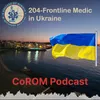
204-Frontline Medic in Ukraine
This week, Aebhric is joined by Fred, who has spent almost four and a half years working in military and military-adjacent medicine in Ukraine, primarily on the forward line of troops (FLOT), with additional experience at casualty collection points and stabilisation points. In this episode, he and Aebhric trace how combat casualty care has changed since 2022: evacuation timelines have stretched from minutes to weeks, wounding patterns have shifted as troop formations disperse to avoid drone strikes, and medics on the ground are being asked to deliver prolonged field care (PFC) far beyond their training. The conversation covers current combat wound pack medications, the phase-out of nalbuphine, tramadol's hepatotoxicity risk in dehydrated patients, the training gap between CLS/CMC-qualified providers, and the disease and non-battle injury (DNBI) burden from leptospirosis to Lyme disease to anthrax that frontline medics are managing largely on their own.Chapters00:00 – Introduction and guest welcome01:00 – Four years of medical experience on the Ukrainian front02:00 – How drone warfare has changed casualty patterns03:10 – Evolution of TCCC and prolonged evacuation04:20 – Changes to battlefield medications and analgesia06:00 – Ketamine, morphine and tramadol in prolonged casualty care08:00 – The challenge of prolonged pain management09:15 – Nerve blocks and expanding combat medic skills10:15 – Closing the knowledge gap for frontline medics12:00 – Self-directed learning and educational resources13:15 – Current medical training available in Ukraine15:00 – Could prolonged casualty care become a formal certification?16:00 – A day in the life of a frontline combat medic18:15 – Drone casualty evacuation: promise and limitations20:00 – What knowledge do combat medics really need?22:00 – Disease, dehydration and prolonged field medicine23:20 – Final advice for new austere medical providersEvolving battlefield medicine. Evacuation that once happened within minutes from positions near the front now can take weeks, driven by pervasive drone surveillance and strike capability. Mass casualty incidents near the front line have become less common as units disperse, changing the injury and casualty flow medics have to plan for.Training and knowledge gaps. There's a wide spread in provider background — from Ukrainian feldshers (registered-nurse equivalent) to personnel who completed a seven-day CMC course — all filling the same frontline medic role. Nerve blocks beyond digital blocks aren't commonly taught. Fred argues CMC training was never meant to stand alone; it assumes a prior EMT-level foundation that many providers don't have. Training availability is inconsistent and largely filled by NGOs of varying quality, with NAMT/CLS/CMC certification currently the closest thing to a standard.Evacuation reality on the ground. Getting to a casualty may take hours to days depending on drone "weather windows." Waits of 30–60 days for evacuation are not unheard of. As a result, stabilisation points are increasingly seeing patients who would survive regardless of intervention, rather than the critical mid-triage-category patients medics are most needed for. Ground evacuation drones (UGVs) are seeing real use but only for stable patients, since medics can't manage an airway or maintain a sedated patient during transit; aerial casualty evacuation is currently considered infeasible due to drone threats.Disease and non-battle injury (DNBI). Fred and Aebhric discuss the need for a Ukraine-specific DNBI framework and better environmental/threat updates reaching medics in the field.Closing advice. Fred's advice for new medics, nurses, and physicians entering austere medicine: keep learning and keep developing — people are counting on you to do your job well.
Podzilla Summary coming soon
Sign up to get notified when the full AI-powered summary is ready.
Free forever for up to 3 podcasts. No credit card required.
Listen to This Episode
More from CoROM cast. Wilderness, Austere, Remote and Resource-limited Medicine.
206-World Extreme Medicine Fund with Luca Alfatti
205-Good ALS starts with great BLS with David Stanton
203-Austere Primary Care Webinar
202-A Life in Medicine with Dr Winston de Mello
Get summaries like this every morning.
Free AI-powered recaps of CoROM cast. Wilderness, Austere, Remote and Resource-limited Medicine. and your other favorite podcasts, delivered to your inbox.
Free forever for up to 3 podcasts. No credit card required.