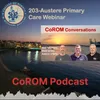
203-Austere Primary Care Webinar
This week, Aebhric O’Kelly is joined by Bill Vasios and Rhod Jordan for an interactive discussion on one of the most important and often overlooked areas of remote medicine: Austere Primary Care.Whilst trauma often dominates training, the reality is that most remote clinicians spend far more time managing diarrhoeal illness, skin infections, musculoskeletal injuries, respiratory complaints, fever, environmental illnesses, and preventative healthcare. The panel discusses the clinical mindset required to work in resource-limited environments, introduces CoROM's CHART patient assessment system, and explores practical approaches to diagnosis when advanced investigations are unavailable.Whether you work in expedition medicine, offshore healthcare, humanitarian operations, military medicine, or remote primary care, this episode provides practical insights into becoming a more capable austere clinician.Chapters 00:05 – Welcome to CoROM Conversations00:17 – Why primary care matters more than trauma in remote medicine01:10 – Defining austere and resource-limited environments02:00 – Developing the austere clinical mindset02:40 – Becoming comfortable with uncertainty and limited resources04:00 – Building confidence through deliberate practice05:00 – Wilderness medicine and learning outside the ambulance07:15 – Resilience and supporting expedition teams08:00 – Common primary care presentations in austere environments08:15 – Gastrointestinal illness, dehydration and traveller's diarrhoea08:45 – Skin disease, wound care and blister management09:30 – Environmental illness: hypothermia, frostbite and heat injury10:10 – Musculoskeletal injuries in expedition medicine11:55 – Learning orthopaedic assessment through repetition13:00 – ENT, eye and dental emergencies14:20 – Introducing the CoROM CHART assessment framework16:40 – Chief Complaint, Condition and the CPRO assessment17:20 – Recognising the critically ill patient20:15 – History taking using SAMPLER with additional risk assessment22:00 – Secondary assessment using the BEAST observations26:10 – Review of systems using CRANES27:30 – Treatment, disposition and clinical trending28:10 – Diagnostic tools for austere medicine30:30 – Essential point-of-care investigations31:00 – Why every diagnostic tool needs a backup plan33:00 – Altitude, pulse oximetry and interpreting observations34:00 – Fever assessment in austere environments34:45 – Measuring temperature correctly in older adults and children35:40 – Managing fever of unknown origin and malaria36:10 – Nursing care and prolonged patient management36:45 – Public health and preventative medicine37:30 – Recognising clinical red flags38:00 – Key learning points and deployment preparation39:00 – The importance of clinical examination over technology40:00 – Trusting your senses and treating the patient—not the monitor41:00 – Closing remarks and CoROM CPD opportunitiesKey Topics DiscussedAustere primary careClinical reasoning in resource-limited environmentsThe austere clinical mindsetPreventative medicineTravel medicineWilderness medicineExpedition healthcareRemote diagnosticsFever of unknown originMalaria diagnosisEnvironmental medicineMusculoskeletal injuriesSkin diseasePoint-of-care ultrasoundNursing care in prolonged field careThe CoROM CHART assessment systemCPRO and BEAST observationsDifferential diagnosisKey TakeawaysMost remote clinicians spend considerably more time managing primary care conditions than major trauma.Clinical confidence develops through experience, deliberate practice and mentorship.Every piece of diagnostic equipment should have a backup plan.Careful history taking remains one of the most valuable diagnostic tools available.Trend observations over time rather than relying on single measurements.In malaria-endemic regions, malaria should remain high on the differential diagnosis for every patient with fever.
Podzilla Summary coming soon
Sign up to get notified when the full AI-powered summary is ready.
Free forever for up to 3 podcasts. No credit card required.
Listen to This Episode
More from CoROM cast. Wilderness, Austere, Remote and Resource-limited Medicine.
206-World Extreme Medicine Fund with Luca Alfatti
205-Good ALS starts with great BLS with David Stanton
204-Frontline Medic in Ukraine
202-A Life in Medicine with Dr Winston de Mello
Get summaries like this every morning.
Free AI-powered recaps of CoROM cast. Wilderness, Austere, Remote and Resource-limited Medicine. and your other favorite podcasts, delivered to your inbox.
Free forever for up to 3 podcasts. No credit card required.