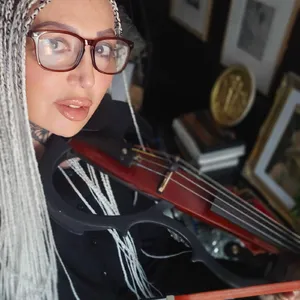
Free Daily Podcast Summary
Continuum Music Studio: Daily Summaries Delivered
by Sarnia de la Maré FRSA
Continuum Music Studio — Sarnia de la Maré This channel shares my work developing the Continuum Method: a personalised, pressure-free approach to learning music. I’m a multi-instrumentalist, educator, and author, and I teach through adaptive methods shaped around individual learning styles, personalities, and creative temperaments. My work focuses on: • Confidence and creative wellbeing • Neurodiversity-aware learning • Sustainable practice • Long-term musical development • Artistic and reflective musicianship Alongside teaching, I write books and develop educational resources connected to this work. Online Studio Phase Sessions Personalised 1:1 sessions via Zoom / Google Meet £10 / 30 mins (founders rate)
Latest Episodes
The most recent episodes — sign up to get AI-powered summaries of each one.
- Today10 min
iServalan Homotech 23: How My Hands Became a Machine, and the Machine Became a Self
iServalan Homotech 23: How My Hands Became a Machine, and the Machine Became a SelfI did not set out to invent a movement. I set out to keep working.In 2023 I began calling myself a Homotech. The word arrived the way a diagnosis sometimes does: not as a costume, but as a name for something already happening. My human creativity was fusing with a digital self that felt larger than the hand that made it. The brain itself seemed to be digitising, not metaphorically, not as a slogan, but as a felt change in how thought moved. Ideas no longer arrived only as images or sentences. They arrived as layers, channels, filters, versions. A line on a screen could be undone. A voice could be split into characters. A dream could be held still long enough to be drawn, scored, and published as a world.That is the beginning of iServalan, a recognition that something in my creative centre was shifting and I really wanted to ride the wave.The De La Maré Music ContinuumWritten and presented by iServalan™ (the stage name of Sarnia de la Maré FRSA)Music, listening, and the Continuum Approach: Exploring sound across genres, eras, and performance cultures — from Baroque to punk, hip-hop to minimalism — without hierarchy or haste.iservalan.com🎧 Podcast & essays: 🎻 Music School#iServalan #ContinuumApproach #MusicPodcast #RadicalListening #MusicAcrossGenres#PerformanceCulture #SarniaDeLaMaré
- Today8 min
How Musicians and Digitisation Fuse by Sarnia de la Maré FRSA for Continuum
Digitisation does not replace the musician. It changes the size of the body.A performer used to end at skin, instrument and room. Now the body can include sensors, software, sampled memory, a second voice that is not a throat, a stage that is a screen, and a partner that does not breathe. The interesting work happens when those extra organs start thinking with the human rather than sitting beside them as gadgets.Performance: the instrument becomes a nervous systemLive performance is where fusion is hardest to fake, because time cannot be hidden.A violinist still bows. A singer still breathes. But the bow can also trigger grain clouds. The breath can open a filter. A wrist tilt can detune a choir of copies of the same voice. Gloves, rings, floor pads and cameras turn gesture into score. The performer is no longer only playing notes. They are conducting a second body that answers in milliseconds.The De La Maré Music ContinuumWritten and presented by iServalan™ (the stage name of Sarnia de la Maré FRSA)Music, listening, and the Continuum Approach: Exploring sound across genres, eras, and performance cultures — from Baroque to punk, hip-hop to minimalism — without hierarchy or haste.iservalan.com🎧 Podcast & essays: 🎻 Music School#iServalan #ContinuumApproach #MusicPodcast #RadicalListening #MusicAcrossGenres#PerformanceCulture #SarniaDeLaMaréThis episode includes AI-generated content.
- 2 weeks ago4 min
Welcome to the De La Maré Music Continuum. Thirds as musical tools for composers and musicians
The De La Maré Music ContinuumWritten and presented by iServalan™ (the stage name of Sarnia de la Maré FRSA)Music, listening, and the Continuum Approach: Exploring sound across genres, eras, and performance cultures — from Baroque to punk, hip-hop to minimalism — without hierarchy or haste.iservalan.com🎧 Podcast & essays: 🎻 Music School#iServalan #ContinuumApproach #MusicPodcast #RadicalListening #MusicAcrossGenres#PerformanceCulture #SarniaDeLaMaré
- 2 weeks ago2 min
Welcome to the De La Maré Music Continuum. This is an essay celebrating the beautiful third.
The De La Maré Music ContinuumWritten and presented by iServalan™ (the stage name of Sarnia de la Maré FRSA)Music, listening, and the Continuum Approach: Exploring sound across genres, eras, and performance cultures — from Baroque to punk, hip-hop to minimalism — without hierarchy or haste.iservalan.com🎧 Podcast & essays: 🎻 Music School#iServalan #ContinuumApproach #MusicPodcast #RadicalListening #MusicAcrossGenres#PerformanceCulture #SarniaDeLaMaré
- 3 weeks ago5 min
West Dean College’s Musical Instruments programme: A De La Maré Music Continuum InfoPod
The De La Maré Music ContinuumWritten and presented by iServalan™ (the stage name of Sarnia de la Maré FRSA)Music, listening, and the Continuum Approach: Exploring sound across genres, eras, and performance cultures — from Baroque to punk, hip-hop to minimalism — without hierarchy or haste.iservalan.com🎧 Podcast & essays: 🎻 Music School#iServalan #ContinuumApproach #MusicPodcast #RadicalListening #MusicAcrossGenres#PerformanceCulture #SarniaDeLaMaré
- 3 weeks ago5 min
The Heart of the Workshop: A Viola Maker’s Bench. A De La Maré Music Continuum InfoPod.
Welcome to the Continuum Pedagoy Music School at iservalan.comThe De La Maré Music ContinuumWritten and presented by iServalan™ (the stage name of Sarnia de la Maré FRSA)Music, listening, and the Continuum Approach: Exploring sound across genres, eras, and performance cultures — from Baroque to punk, hip-hop to minimalism — without hierarchy or haste.iservalan.com🎧 Podcast & essays: 🎻 Music School#iServalan #ContinuumApproach #MusicPodcast #RadicalListening #MusicAcrossGenres#PerformanceCulture #SarniaDeLaMaré
- Aug 22, 20265 min
Jonathan Hill: UK Specialist in Viola d’Amore Making. A De La Maré Music Continuum Info Pod
From the De La Maré Music ContinuumThe De La Maré Music ContinuumWritten and presented by iServalan™ (the stage name of Sarnia de la Maré FRSA)Music, listening, and the Continuum Approach: Exploring sound across genres, eras, and performance cultures — from Baroque to punk, hip-hop to minimalism — without hierarchy or haste.iservalan.com🎧 Podcast & essays: 🎻 Music School#iServalan #ContinuumApproach #MusicPodcast #RadicalListening #MusicAcrossGenres#PerformanceCulture #SarniaDeLaMaré
- Aug 18, 20268 min
Lesson Project Songs on a Semitone, Lesson by iServalan for Continuum Music Studio
ABOUT PAGE https://www.iservalan.com/2026/08/the-de-la-mare-music-continuum-adaptive.htmlThe De La Maré Music ContinuumWritten and presented by iServalan™ (the stage name of Sarnia de la Maré FRSA)Music, listening, and the Continuum Approach: Exploring sound across genres, eras, and performance cultures — from Baroque to punk, hip-hop to minimalism — without hierarchy or haste.iservalan.com🎧 Podcast & essays: 🎻 Music School#iServalan #ContinuumApproach #MusicPodcast #RadicalListening #MusicAcrossGenres#PerformanceCulture #SarniaDeLaMaré
Get Continuum Music Studio summaries in your inbox
Free AI-powered daily recaps. Key takeaways, quotes, and mentions — in a 5-minute read.
Get Free Summaries →Free forever for up to 3 podcasts. No credit card required.
You Might Also Like
Listeners also like.

Music Matters with Darrell Craig Harris
In-depth interviews with major music artists, producers, and industry leaders shaping the global music landscape.

Guitar Music Theory
Learn how music theory applies to the guitar fretboard, covering scales, chords, progressions, and improvisation through practical lessons.
The Integral Principles of the Structural Dynamics of Flow
Steven Conrad

Learn Jazz Standards Podcast
A jazz musician discusses improvisation, theory, and practice with guests and answers listener questions about playing jazz.

Commune with Jeff Krasno
Explores practices and ideas for healthy, purposeful living through conversations on wellness, spirituality, and societal well-being.
Joanna Lumley & The Maestro
Joanna Lumley and her husband, a conductor, discuss classical music, composers, and symphonies in conversational, accessible episodes.

The Music Podcast for Kids!
Children learn about world music, instruments, and genres through interactive lessons and listening challenges with hosts Mr. Henry and Mr. Fite.
The Open Ears Project
People from diverse backgrounds share the classical music piece that profoundly matters to them and why.
The Will Clarke Podcast
Conversations with creatives, artists, and industry professionals about their personal journeys in music, food, and art.

The Middle School Mary Poppins Podcast
Practical parenting strategies and brain science to help caregivers understand and support tweens through middle school challenges.
The Balanced, Beautiful and Abundant Show - Rebecca Whitman
A coach helps high-achieving women overcome burnout using a framework centered on spiritual, emotional, physical, and financial well-being.

Deeper Shades of House - weekly Deep House Podcast with Lars Behrenroth
Weekly deep house mixes by Lars Behrenroth with guest sets from international DJs and background on artists and labels.
About Continuum Music Studio
Continuum Music Studio — Sarnia de la Maré This channel shares my work developing the Continuum Method: a personalised, pressure-free approach to learning music. I’m a multi-instrumentalist, educator, and author, and I teach through adaptive methods shaped around individual learning styles, personalities, and creative temperaments. My work focuses on: • Confidence and creative wellbeing • Neurodiversity-aware learning • Sustainable practice • Long-term musical development • Artistic and reflective musicianship Alongside teaching, I write books and develop educational resources connected to this work. Online Studio Phase Sessions Personalised 1:1 sessions via Zoom / Google Meet £10 / 30 mins (founders rate)
Customized Recaps
AI-powered recaps with compact key takeaways, quotes, and insights.
Straight to Your Inbox
Get key takeaways from Continuum Music Studio in a 5-minute read.
Save Hours Every Week
Stay current on your favorite podcasts without falling behind.
Frequently Asked Questions
What is Podzilla's Continuum Music Studio daily summary?
It's a free AI-powered email that summarizes new episodes of Continuum Music Studio as soon as they're published. You get the key takeaways, notable quotes, and links & mentions — all in a quick read.
How does the Continuum Music Studio podcast summary work?
When a new episode drops, our AI transcribes and analyzes it, then generates a personalized summary tailored to your interests and profession. It's delivered to your inbox every morning.
Is this an official Continuum Music Studio product?
No. Podzilla is an independent service that summarizes publicly available podcast content. We're not affiliated with or endorsed by Sarnia de la Maré FRSA.
Can I get summaries of other podcasts too?
Absolutely! The free plan covers up to 3 podcasts. Upgrade to Pro for 15, or Premium for 50. Browse our full catalog at /podcasts.
How often does Continuum Music Studio release new episodes?
Continuum Music Studio publishes daily. Our AI generates a summary within hours of each new episode.
What topics does Continuum Music Studio cover?
Continuum Music Studio covers topics including Music, Education, Arts, Performing Arts. Our AI identifies the specific themes in each episode and highlights what matters most to you.
Start getting Continuum Music Studio summaries tomorrow morning.
Free forever for up to 3 podcasts. No credit card required.
Free forever for up to 3 podcasts. No credit card required.