Free Daily Podcast Summary
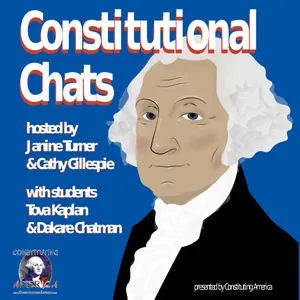
Constitutional Chats Presented By Constituting America: Daily Summaries Delivered
by Constituting America
Constitutional Chats are hosted by Janine Turner, Cathy Gillespie, student ambassadors, and experts who join us weekly to discuss hot-topic issues! The audience is not on camera, but you may ask questions!
Latest Episodes
The most recent episodes — sign up to get AI-powered summaries of each one.
- Yesterday53 min
Ep. 319 | Constitutional Chats Podcast | Timothy Sandefur | The Constitution vs. Socialism: America's Built-In Safeguards
Socialism isn't new. Plato's "The Republic" outlines an ideal state with elements of socialism. The Founding Fathers were well aware of the concept and purposefully wrote safeguards against it in our founding documents. Case in point: the Bill of Rights protects private property and Article 1 of the Constitution protects patents and intellectual property. Please join our special guest, Timothy Sandefur, Vice President for Legal Affairs at the Goldwater Institute's Scharf-Norton Center for Constitutional Litigation, and our student panel for this enlightening discussion.
- 1 weeks ago57 min
Ep. 318 | Constitutional Chats Podcast | Shruti Rajagopalan | What Happens When a Country Tries Socialism
Socialism sounds good in theory — but what does it look like in practice? From centralized economic policies to government control over markets and private enterprise, our guest today explores the real-world consequences of nations that have experimented with socialism — and the promises compared to the results. Dr. Shruti Rajagopalan is a Senior Research Fellow at the Mercatus Center and a Fellow at the Classical Liberal Institute at New York University School of Law and is our guest expert this week.
- 2 weeks ago57 min
Ep. 317 | Constitutional Chats Podcast | Lawrence W. Reed | What Is Socialism?
This week we kick off a new Constitutional Chats Podcast series on socialism. In our first episode this week we address the basic concept of socialism: what defines it, what is it not and how does it compare with capitalism? Young Americans are embracing socialism in record numbers. A recent survey by the Cato Institute and YouGov finds that 62% of Americans aged 18–29 say they hold a "favorable view" of socialism, while a recent Gallup poll shows that 39% of ALL Americans have a positive view of socialism. To help us understand this trend and the dangers of it, we are honored to welcome Lawrence W. Reed, president emeritus of the Foundation for Economic Education and founding president of the Mackinac Center for Public Policy.
- 3 weeks ago51 min
Ep. 316 | Constitutional Chats Podcast | Matthew Skic | The Declaration's Journey: 250 Years of America's Founding Document
It's no secret, we at Constituting America are big fans of the Declaration of Independence. What Thomas Jefferson so eloquently wrote quite literally changed the world. But have you stopped to think exactly how it changed the world? How did it influence other countries who were perhaps seeking independence? Did you know in the time since our Declaration of Independence was written, over 100 countries have adopted similar declarations, inspired by our Declaration? To discuss this global impact beyond just words on paper as well as their fantastic landmark exhibit celebrating America 250, we are honored to welcome Matthew Skic from the Museum of the American Revolution as our special guest this week.
- Aug 21, 202657 min
Ep. 315 | Constitutional Chats Podcast | Christopher Burkett | Breathing Life into the Law: How the People Ratified the Constitution
"Consent of the governed." It's such a powerful phrase in our Declaration of Independence and truly speaks to the heart of the American Experiment. But what does consent mean? To dive into this notion of consent and how it is derived and utilized in the creation of our founding documents, we are pleased to welcome long-time friend of Constituting America, Professor Christopher Burkett. Dr. Burkett is an associate professor of political science and director of the Ashbrook Scholar Program at Ashland University.
- Aug 14, 202657 min
Ep. 314 | Constitutional Chats Podcast | Luke Hopely | The History of Independence Hall
If we were to recognize one physical location as the birthplace of our great nation, it would undoubtedly be Independence Hall in Philadelphia, PA. Originally serving as the Pennsylvania State House, this is where both the Declaration of Independence and the Constitution were debated and adopted. To share more information on this magnificent and historic structure, Constituting America is honored to welcome National Park Service Ranger Luke Hopely to our chat this week. Luke serves as a park ranger at the National Park Service's Independence National Historical Park.
- Aug 7, 202656 min
Ep. 313 | Constitutional Chats Podcast | Gary Porter | America 250: The Signing of the Declaration of Independence August 2, 1776
We all know the Fourth of July is when we adopted the Declaration of Independence to formally sever ties with the British Crown. But the physical act of signing the Declaration, and thus affixing the signers' personal oath to that document happened nearly a month later on August 2, 1776. To discuss the events of that day, we are honored to have Gary Porter return for a second week. Gary Porter is the founder of former executive director of the Constitution Leadership Initiative and regular contributor to Constituting America.
- Jul 31, 202655 min
Ep. 312 | Constitutional Chats Podcast | Gary Porter | America 250: Going Viral in 1776—How the Press Spread Independence
In an era of instant global communication, it is hard to fathom a time when it took it took months to communication across the Atlantic or weeks to send letters across the colonies. But that's the world in which our country was founded. The role of newspapers is such a vital component to our founding as it's how word of the new Declaration of Independence was transmitted to gain public support for the American Revolution. To further expound on the role of newspapers and "viral" content for that era, we are pleased to welcome a close friend of Constituting America, Gary Porter to our show. Gary Porter is a prolific writer and is the founder of former executive director of the Constitution Leadership Initiative.
Get Constitutional Chats Presented By Constituting America summaries in your inbox
Free AI-powered daily recaps. Key takeaways, quotes, and mentions — in a 5-minute read.
Get Free Summaries →Free forever for up to 3 podcasts. No credit card required.
You Might Also Like
Listeners also like.

Civics 101
Explains how U.S. government institutions and constitutional rights function in everyday life.
Conversations with Coleman
Explores complex topics like politics, philosophy, and culture through candid, in-depth conversations with intellectuals and thinkers.

Stanford Legal
Experts analyze pressing legal issues, landmark cases, and constitutional questions shaping American democracy and society.

This Day (An America 250 History Show)
Historians explore pivotal U.S. political events from the past and connect them to today’s news.

Congressional Dish
Investigates U.S. congressional spending and legislation to inform the public about government actions.
Strict Scrutiny
Constitutional law professors analyze Supreme Court rulings, legal culture, and their impact on daily life.

The Atlantic Interview
A weekly exploration of democracy, society, and the American ideal through in-depth interviews and analysis.

The WallBuilders Show
Examines current issues through biblical, historical, and constitutional viewpoints with insights from experts and public figures.

The Signal Sitdown
Examines how Washington policymakers make decisions and why government often fails to serve public interests.
Americast
Weekly analysis of U.S. politics and social media’s impact on elections from BBC journalists and guests.

Slow Burn
Examines pivotal political and cultural moments in American history through archival audio and firsthand accounts.

Townhall Review | Full Interviews & Monologues
A conservative talk-radio show offering weekly political commentary and analysis from leading voices in U.S. and global news.
About Constitutional Chats Presented By Constituting America
Constitutional Chats are hosted by Janine Turner, Cathy Gillespie, student ambassadors, and experts who join us weekly to discuss hot-topic issues! The audience is not on camera, but you may ask questions!
Customized Recaps
AI-powered recaps with compact key takeaways, quotes, and insights.
Straight to Your Inbox
Get key takeaways from Constitutional Chats Presented By Constituting America in a 5-minute read.
Save Hours Every Week
Stay current on your favorite podcasts without falling behind.
Frequently Asked Questions
What is Podzilla's Constitutional Chats Presented By Constituting America daily summary?
It's a free AI-powered email that summarizes new episodes of Constitutional Chats Presented By Constituting America as soon as they're published. You get the key takeaways, notable quotes, and links & mentions — all in a quick read.
How does the Constitutional Chats Presented By Constituting America podcast summary work?
When a new episode drops, our AI transcribes and analyzes it, then generates a personalized summary tailored to your interests and profession. It's delivered to your inbox every morning.
Is this an official Constitutional Chats Presented By Constituting America product?
No. Podzilla is an independent service that summarizes publicly available podcast content. We're not affiliated with or endorsed by Constituting America.
Can I get summaries of other podcasts too?
Absolutely! The free plan covers up to 3 podcasts. Upgrade to Pro for 15, or Premium for 50. Browse our full catalog at /podcasts.
What topics does Constitutional Chats Presented By Constituting America cover?
Constitutional Chats Presented By Constituting America covers topics including Education, Government. Our AI identifies the specific themes in each episode and highlights what matters most to you.
Start getting Constitutional Chats Presented By Constituting America summaries tomorrow morning.
Free forever for up to 3 podcasts. No credit card required.
Free forever for up to 3 podcasts. No credit card required.