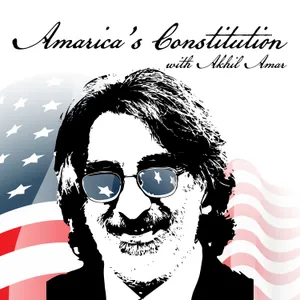
Free Daily Podcast Summary
Amarica's Constitution: Daily Summaries Delivered
by Akhil Reed Amar
Professor Akhil Reed Amar, Sterling Professor of Law and Political Science at Yale University and one of the nation’s leading authorities on the Constitution, offers weekly in-depth discussions on the most urgent and fascinating constitutional issues of our day. He is joined by host Andy Lipka and guests drawn from other top experts including Bob Woodward, Lawrence Lessig, Neal Katyal, Michael Gerhardt, and many more.
Latest Episodes
The most recent episodes — sign up to get AI-powered summaries of each one.
- 2 days ago1h 23m
The Constitution Goes to Princeton
It’s Constitution Day, or rather Constitution Eve as we record. Akhil is the invited speaker at Princeton University’s gala event, and ahead of the speech, we invited Princeton undergraduates to come and talk about the Constitution with us; to voice their questions, and to help us honor the mission of the day by engaging with American citizens on that thing that we all share and that hopefully embodies some set of shared values, history, and tradition. Akhil fielded, Cosell-style, the barrage of questions, and we came away reassured about the next generation and the likelihood of the document enduring. And Happy Constitution Day to all of you! CLE credit is available for lawyers and judges from podcast.njsba.com.
- 1 weeks ago1h 44m
More Statesmanship, and State Constitutions - Special Guests Steven B. Smith and Vikram D. Amar
The big issue in the news today is the Missouri legislature’s attempt to avoid the state constitution’s referendum provisions in order to impose a legislative map that would advantage Republicans to the tune of all but one of the state’s seats in the US House. The Supreme Court is asked to intervene, and Justice Kavanaugh - after we taped - declined to do so. This may not be end of the story, but our guest Vik Amar is on top of it together with Akhil. Listen to get the details, and check out Scotusblog.com to stay updated - Akhil and Vik have a new column there. Meanwhile, our interview with Professor Steven Smith discussing his new book, On Statesmanship, precedes this discussion this week - don’t miss that, either! CLE credit is available for lawyers and judges from podcast.njsba.com.
- 2 weeks ago1h 34m
The Statesman's Constitution - Special Guest Steven B. Smith
Originalists venerate the Founders, who were by most reckonings a group of remarkable statesmen. Today, many Americans look seemingly in vain for a statesman worthy of the moment and its challenges. But what is a statesman? Does the U.S. Constitution assume a statesman will be at the helm? Does it enable such a leader, or is it designed to thwart the designs of what Lincoln called the “towering genius?” Acclaimed author and scholar Steven B. Smith joins us from Yale on the occasion of publication of his new book, On Statesmanship, in the first of two fascinating segments on many aspects of this many-faceted concept. And, Andy and Akhil take a look at an important law emerging from the California legislature and awaiting the governor’s signature. CLE credit is available for lawyers and judges at podcast.njsba.com.
- 3 weeks ago1h 21m
An Amendment Like Some Others - Special Guest Vikram D. Amar
Voting rights are in the news. The state and federal governments have sought to weigh in and intervene on election laws, as we have seen in previous cycles. This time, a number of states have passed laws that address mail-in or absentee voting, but in doing so, what seems on its surface to be addressing some needs of seniors may in fact be more constitutionally questionable than first meets the eye. And in so doing, the states are implicating the 26th amendment. A circuit split has developed and as a result, the Supreme Court may get involved and this modern amendment may get its first case before the court. We bring in the expert on such things: Professor Vik Amar, who has already published a new article on these questions in recent days. The “brothers-in-law” are at it again, and we are all the beneficiaries. CLE credit is available for lawyers and judges from podcast.njsba.com.
- Aug 19, 20261h 14m
Preclearing the President
What happens when the president loses in court, even at the Supreme Court, but repeatedly attempts to fight the battle again? New tariffs are offered after the old ones are thrown out. Birthright citizenship, resoundingly affirmed, is challenged anew. To Americans who lived in the South after Brown v. Board, this might sound familiar. And indeed, as we wrap up our Roberts court constitutional survey, and we arrive at the cases we take great issue with, this theme echoes back to the Shelby County case. We therefore discuss a question that has rankled many Americans in recent years. CLE credit is available for lawyers and judges from podcast.njsba.com.
- Aug 12, 20261h 8m
There You Go Again
The President did not file for reconsideration of the Court’s decision in Trump v. Barbara, but the President nevertheless doesn’t let the Constitution rest, issuing two new executive orders that purport to extend the set of persons not receiving birthright citizenship upon their birth, among other things. We take a look. Meanwhile, our review of the Roberts Court’s important constitutional cases brings us back to the Affirmative Action cases, and we take a look at them three years in. Finally, another listener question takes us to yet another corner of the constitutional canon - and Akhil is ready even without advance notice. CLE is available for lawyers and judges from podcast.njsba.com.
- Aug 5, 20261h 19m
Dobbs and Bruen Plus Time
As we make our way through the 20 most constitutionally significant cases of the Roberts court, this episode takes us through two cases that have continued to have resonance with the American people and with the justices. Dobbs saw an infamous leak, a momentous decision, powerful electoral impact, and ongoing questions that echo back to an important limiting concurrence. Bruen brought a controversial methodology to questions of gun rights, caused mayhem at the lower courts, and spawned a number of subsequent cases that seek to clarify and perhaps recover from this sweeping opinion. We take you back - and forward - as we examine these cases on our way to an overall accounting of the Roberts Court. CLE credit is available for lawyers and judges from podcast.njsba.com.
- Jul 29, 20261h 23m
Faces of Intratextualism
We continue our survey of the Roberts Court’s oeuvre of constitutional cases, with particular emphasis on the series of cases that concerned making rules for voting and for voting districts. These cases make particular use of “intratextualism” - a term coined by Professor Amar that provides tools - and traps - for textual analysis of the Constitution. And as it turns out, it is also valuable on some of the most important themes and cases in the history of the nation, including Brown v. Board and its companion case, Bolling v. Sharpe. A listener’s question takes us down this road, which intersects with our own prior path in fascinating ways. These and more cases are explored as only Professor Amar can. CLE credit is available for lawyers and judges from podcast.njsba.com.
Get Amarica's Constitution summaries in your inbox
Free AI-powered daily recaps. Key takeaways, quotes, and mentions — in a 5-minute read.
Get Free Summaries →Free forever for up to 3 podcasts. No credit card required.
You Might Also Like
Listeners also like.
Stanford Legal
Experts analyze pressing legal issues, landmark cases, and constitutional questions shaping American democracy and society.

Amicus With Dahlia Lithwick | Law, justice, and the courts
A weekly exploration of the U.S. Supreme Court, its justices, and the legal issues shaping American law and society.

Civics 101
Explains how U.S. government institutions and constitutional rights function in everyday life.
Bound By Oath by IJ
Explores the U.S. Constitution’s text and history through judicial oaths, legal scholarship, and landmark cases.

The Atlantic Interview
A weekly exploration of democracy, society, and the American ideal through in-depth interviews and analysis.

Americast
Weekly analysis of U.S. politics and social media’s impact on elections from BBC journalists and guests.
What Trump Can Teach Us About Con Law
A constitutional law professor and a podcaster explore how Trump’s presidency tested U.S. constitutional norms and principles.

Conversations with Coleman
Explores complex topics like politics, philosophy, and culture through candid, in-depth conversations with intellectuals and thinkers.
Another Way, by Lawrence Lessig
Explores policies and movements aimed at restoring democratic power through interviews with activists, politicians, and reformers.
Assembly Required with Stacey Abrams
Assembly Required with Stacey Abrams

UNBIASED Politics
A lawyer-hosted recap of U.S. political news, elections, and legal developments explained clearly and without opinion.

The Al Franken Podcast
Al Franken discusses public policy and political comedy with notable guests, blending insight and satire.
About Amarica's Constitution
Professor Akhil Reed Amar, Sterling Professor of Law and Political Science at Yale University and one of the nation’s leading authorities on the Constitution, offers weekly in-depth discussions on the most urgent and fascinating constitutional issues of our day. He is joined by host Andy Lipka and guests drawn from other top experts including Bob Woodward, Lawrence Lessig, Neal Katyal, Michael Gerhardt, and many more.
Customized Recaps
AI-powered recaps with compact key takeaways, quotes, and insights.
Straight to Your Inbox
Get key takeaways from Amarica's Constitution in a 5-minute read.
Save Hours Every Week
Stay current on your favorite podcasts without falling behind.
Frequently Asked Questions
What is Podzilla's Amarica's Constitution daily summary?
It's a free AI-powered email that summarizes new episodes of Amarica's Constitution as soon as they're published. You get the key takeaways, notable quotes, and links & mentions — all in a quick read.
How does the Amarica's Constitution podcast summary work?
When a new episode drops, our AI transcribes and analyzes it, then generates a personalized summary tailored to your interests and profession. It's delivered to your inbox every morning.
Is this an official Amarica's Constitution product?
No. Podzilla is an independent service that summarizes publicly available podcast content. We're not affiliated with or endorsed by Akhil Reed Amar.
Can I get summaries of other podcasts too?
Absolutely! The free plan covers up to 3 podcasts. Upgrade to Pro for 15, or Premium for 50. Browse our full catalog at /podcasts.
How often does Amarica's Constitution release new episodes?
Amarica's Constitution publishes weekly. Our AI generates a summary within hours of each new episode.
What topics does Amarica's Constitution cover?
Amarica's Constitution covers topics including News, History, Education, Politics. Our AI identifies the specific themes in each episode and highlights what matters most to you.
Start getting Amarica's Constitution summaries tomorrow morning.
Free forever for up to 3 podcasts. No credit card required.
Free forever for up to 3 podcasts. No credit card required.