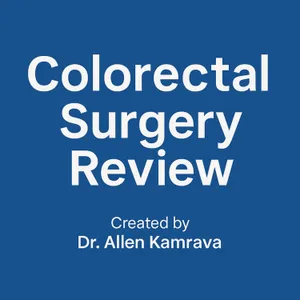
Free Daily Podcast Summary
Colorectal Surgery Review: Daily Summaries Delivered
by Allen Kamrava, MD MBA FACS FASCRS
An academic, sponsor-free audio review of core concepts in colon and rectal surgery. Using the power of A.I., created by Dr. Allen Kamrava, Associate Teaching Faculty at Cedars-Sinai Medical Center, this series is designed for residents, fellows, and practicing surgeons to stay current with concise, evidence-based updates. Covering textbook foundations, landmark trials, and evolving ASCRS guidelines, each episode delivers practical surgical education for the commute, workout, or even to wind down at night. Learn more at https://drkamrava.com/podcast
Latest Episodes
The most recent episodes — sign up to get AI-powered summaries of each one.
- 4 days ago41 min
ASCRS Guidelines: FAP, AP, and Rectal Polyposis Management
Welcome to Colorectal Surgery Review. In this episode, we deliver an evidence-based clinical breakdown of the 2023 American Society of Colon and Rectal Surgeons (ASCRS) Clinical Practice Guidelines for the Management of Familial Adenomatous Polyposis (FAP) and associated polyposis syndromes.Designed for practicing colon and rectal surgeons, surgical oncologists, and senior trainees preparing for board certification, this deep dive translates complex genetic data, anatomical considerations, and guideline algorithms into actionable surgical strategies.Key Clinical Topics Covered:Genetics & Pathophysiology: How APC gene mutations drive classical FAP, the concept of somatic mosaicism in attenuated FAP (AFAP), and the profound clinical implications of MUTYH-associated polyposis (MAP). We also discuss why 20-50% of patients presenting with an attenuated phenotype lack an identifiable pathogenic variant (the "genetic void"). Preoperative Staging & Extracolonic Disease: The critical shift to baseline upper endoscopy starting at age 20-25 to monitor for duodenal adenocarcinomas, which represent the leading cause of non-colorectal mortality in FAP. Surgical Timing & Prophylactic Colectomy: Why prophylactic surgery in classical FAP is typically delayed until the late teens or early 20s, balancing the 100% lifetime cancer risk against the psychosocial and functional burden of early intervention. The Surgical Triad: Detailed algorithmic decision-making between:Chemoprevention & Medical Management: The current (and often debated) role of NSAIDs (Sulindac) and COX-2 inhibitors (Celecoxib) in delaying polyp progression or managing retained rectal stump polyposis. Desmoid Tumors: The second leading cause of mortality in FAP patients. We explore why intra-abdominal surgical trauma often precipitates their aggressive growth and the modern shift toward non-operative, medical management of these challenging fibromatous lesions.
- 1 weeks ago45 min
ASCRS Guidelines: Hemorrhoids, Transanal Approaches & the Mucosectomy Debate
oin us for an evidence-based clinical review of the 2024 American Society of Colon and Rectal Surgeons (ASCRS) Clinical Practice Guidelines for the Management of Hemorrhoids.In this episode, we unpack the anatomical nuances, non-operative thresholds, and surgical algorithms needed to safely navigate one of the most common—yet frequently mismanaged—anorectal conditions. We delve into the shifting consensus around office-based therapies and examine the dramatic downgrade of stapled hemorrhoidopexy.(Please refer to the accompanying audio file: New_ASCRS_Colon_Cancer_Surgical_Guidelines.m4a for the full discussion.)Key Clinical Topics Covered:Anatomy & Pathophysiology: How the degradation of suspensory ligaments and vascular engorgement drive disease progression, and why the dentate line dictates symptom presentation.Non-Operative Foundations: The critical role of bulk-forming fiber and hydration. We discuss why topical steroids and topical anesthetics are actively discouraged for long-term use due to mucosal atrophy and allergic contact dermatitis.Office-Based Interventions (Grades I–II):Surgical Management (Grades III–IV):Special Populations & Emergencies:
- Sep 21, 202633 min
ASCRS Guidelines: Appendiceal Neoplasms & Anal Cancer
The newly published 2025 ASCRS guidelines for appendiceal neoplasms represent a total departure from traditional surgical dogma, revealing a 16% risk of concealed malignancy in patients presenting with periappendiceal abscesses. This mandates strict oncologic follow-up after initial antibiotic therapy and percutaneous drainage.Beyond the appendix, this episode explores the etiology, staging, and treatment algorithms for anal squamous cell carcinoma. Driven by HPV (specifically serotypes 16 and 18) within the anal transitional zone (ATZ), anal cancer requires a distinct management approach far different from colorectal adenocarcinoma.
- Sep 14, 202648 min
Colon Cancer Staging, Surgical Management & Molecular Profiling
Welcome to Colorectal Surgery Review. In this episode, we deliver a high-yield clinical breakdown of the American Society of Colon and Rectal Surgeons (ASCRS) Clinical Practice Guidelines for the Management of Colon Cancer.Designed for practicing colon and rectal surgeons, surgical oncologists, general surgeons, and senior trainees preparing for board certification or recertification exams, this deep dive translates complex trial data, molecular insights, and guideline recommendations into actionable clinical decision-making.
- Sep 7, 202649 min
ASCRS Guidelines: Anorectal Abscess, Fistula-in-Ano & RVF
Join us for an in-depth clinical review of the 2022 American Society of Colon and Rectal Surgeons (ASCRS) Clinical Practice Guidelines for the Management of Anorectal Abscess, Fistula-in-Ano, and Rectovaginal Fistula.In this episode, we break down the latest evidence-based algorithms, anatomical pearls, surgical techniques, and clinical pitfalls needed for surgical practice and board exam preparation.
- Aug 31, 202645 min
ASCRS Guidelines: Chronic Anal Fissure Management
Join us for a comprehensive clinical review of the American Society of Colon and Rectal Surgeons (ASCRS) Clinical Practice Guidelines for the Management of Anal Fissures.In this episode, we move beyond basic definitions to examine the vascular mechanics, randomized trial data, and surgical algorithms needed to break the cycle of internal sphincter hypertonia and ischemia. Whether you are updating your clinical practice or prepping for board exams, this evidence-based review delivers high-yield insights.
- Aug 25, 202641 min
ERAS in Colorectal Surgery: ASCRS & SAGES Guidelines
A clinical deep dive into the 2022 and 2023 ASCRS and SAGES guidelines for Enhanced Recovery After Surgery (ERAS). We cover carbohydrate loading, bowel prep, SSI bundles, fluid management, the NSAID leak debate, and early discharge.Join us for an evidence-based clinical review of the 2022 and 2023 American Society of Colon and Rectal Surgeons (ASCRS) and Society of American Gastrointestinal and Endoscopic Surgeons (SAGES) Clinical Practice Guidelines for Enhanced Recovery After Surgery (ERAS).In this episode, we move past basic ERAS concepts to explore the precise physiological mechanisms, statistical realities, and trial data driving modern perioperative care. Whether you are updating hospital protocols or prepping for your board exams, this review delivers the high-yield details you need.
- Aug 17, 202644 min
Enhanced Recovery After Colorectal Surgery (ERAS)
Join us for a detailed clinical dissection of the updated American Society of Colon and Rectal Surgeons (ASCRS) and Society of American Gastrointestinal and Endoscopic Surgeons (SAGES) Clinical Practice Guidelines for Enhanced Recovery After Surgery (ERAS).In this episode, we move past basic ERAS concepts to explore the precise physiological mechanisms, statistical realities, and trial data behind modern perioperative pathways. Whether you are updating hospital protocols, optimizing patient pathways, or prepping for recertification and board exams, this review delivers the evidence-based details you need.Preoperative Optimization & Stoma Education: Implementing structured ileostomies pathways to prevent dehydration and AKI—reducing readmission rates from 15.5% down to 0%.Fasting & Carbohydrate Loading: Ditching the "NPO after midnight" rule for clear liquids up to 2 hours pre-induction. Why complex carbohydrates (maltodextrin) prevent post-op insulin resistance and why simple sugars are avoided.Pre-op Nutrition vs. Immunonutrition: Weight-based protein supplementation (1.2–1.5 g/kg/day) for malnourished patients and why commercial immunonutrition shakes remain controversial in non-industry-funded trials.Bowel Prep & C. diff Reduction: The strong Grade 1B mandate for combining Mechanical Bowel Preparation (MBP) with oral antibiotics (Neomycin + Metronidazole/Erythromycin) to decimate mucosal biofilms and cut SSIs in half.Intraoperative SSI Bundles: Swiss-cheese risk management, including dedicated wound-closure trays, mandatory glove/gown changes before facial closure, normothermia, and tight glycemic control.Analgesia & The NSAID Leak Debate: Why Diclofenac dramatically increases anastomotic leak rates due to enterohepatic circulation, while Ketorolac and COX-2 inhibitors remain safe. Plus, why routine thoracic epidurals and gabapentinoids are falling out of favor in minimally invasive cases.Fluid Management & Hemodynamics: Moving away from "bone-dry" fluid restriction to preserve the endothelial glycocalyx. The chemistry of why Normal Saline causes hyperchloremic metabolic acidosis and renal vasoconstriction, and how Goal-Directed Hemodynamic Therapy (GDHT) prevents fluid overload.Hardware & Post-Op Care: Evidence against routine NG tubes and pelvic drains, accepting post-op oliguria down to 0.2 mL/kg/hr without fluid boluses, and accelerating bowel return with sham feeding (gum) and coffee.Early Discharge Pathways: Criteria from the RECOVER MI trial allowing selected low-risk patients to safely go home on Post-Op Day 1 before the return of bowel function.
Get Colorectal Surgery Review summaries in your inbox
Free AI-powered daily recaps. Key takeaways, quotes, and mentions — in a 5-minute read.
Get Free Summaries →Free forever for up to 3 podcasts. No credit card required.
You Might Also Like
Listeners also like.
The Curbsiders Internal Medicine Podcast
Expert-led internal medicine discussions with clinical insights and humor for primary care and hospital medicine providers.
Out of the Gray (Gy) - Standard Imaging
Conversations with experts in radiation oncology exploring advancements in technology, research, and clinical practice.

Red Pill Your Healthcast
Two healthcare providers discuss overlooked health issues and empower listeners to make informed decisions for their families.

Invictus Reviews
Emergency medicine board exam prep with Mel Herbert and team, covering core topics for all levels.

The Dr. Jeffrey Roth‘s Looking Good Feeling Great Podcast
Expert discussions on plastic surgery, cosmetic procedures, and wellness from a board-certified surgeon and his co-host.
ICU Ed and Todd-Cast
Eddie and Todd
The Internet Book of Critical Care Podcast
A podcast exploring critical care medicine through chapter discussions and evidence-based updates from The Internet Book of Critical Care.

Vet Rounds
Dr Sandy Karl CertAVP ECC

The Peter Attia Drive
Conversations with experts on health, longevity, performance, and critical thinking led by physician Peter Attia.

Extend Podcast with Darshan Shah, MD
Explores science-backed strategies and expert insights to extend healthspan and optimize longevity through actionable health protocols.

Be All You Can Be MSC
Podcast for Army Medical Service Corps officers focusing on career advancement, leadership, and professional development.

DR. GUNDRY PODCAST: GUT HEALTH, WEIGHT LOSS, AND NUTRITION
Explores gut health, nutrition, and chronic illness through the lens of plant-based diets, lectin avoidance, and microbiome science.
About Colorectal Surgery Review
An academic, sponsor-free audio review of core concepts in colon and rectal surgery. Using the power of A.I., created by Dr. Allen Kamrava, Associate Teaching Faculty at Cedars-Sinai Medical Center, this series is designed for residents, fellows, and practicing surgeons to stay current with concise, evidence-based updates. Covering textbook foundations, landmark trials, and evolving ASCRS guidelines, each episode delivers practical surgical education for the commute, workout, or even to wind down at night. Learn more at https://drkamrava.com/podcast
Customized Recaps
AI-powered recaps with compact key takeaways, quotes, and insights.
Straight to Your Inbox
Get key takeaways from Colorectal Surgery Review in a 5-minute read.
Save Hours Every Week
Stay current on your favorite podcasts without falling behind.
Frequently Asked Questions
What is Podzilla's Colorectal Surgery Review daily summary?
It's a free AI-powered email that summarizes new episodes of Colorectal Surgery Review as soon as they're published. You get the key takeaways, notable quotes, and links & mentions — all in a quick read.
How does the Colorectal Surgery Review podcast summary work?
When a new episode drops, our AI transcribes and analyzes it, then generates a personalized summary tailored to your interests and profession. It's delivered to your inbox every morning.
Is this an official Colorectal Surgery Review product?
No. Podzilla is an independent service that summarizes publicly available podcast content. We're not affiliated with or endorsed by Allen Kamrava, MD MBA FACS FASCRS.
Can I get summaries of other podcasts too?
Absolutely! The free plan covers up to 3 podcasts, any in the catalog. Basic raises that to 15, Pro to 40 and Max to 100. Browse our full catalog at /podcasts.
How often does Colorectal Surgery Review release new episodes?
Colorectal Surgery Review publishes 2x weekly. Our AI generates a summary within hours of each new episode.
What topics does Colorectal Surgery Review cover?
Colorectal Surgery Review covers topics including Education, Courses. Our AI identifies the specific themes in each episode and highlights what matters most to you.
Start getting Colorectal Surgery Review summaries tomorrow morning.
Free forever for up to 3 podcasts. No credit card required.
Free forever for up to 3 podcasts. No credit card required.