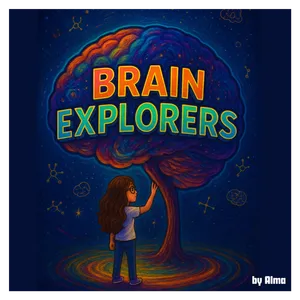
Free Daily Podcast Summary
Brain Explorers: Daily Summaries Delivered
by Alma Radulescu
Get key takeaways, quotes, and insights from Brain Explorers in a 5-minute read. Delivered straight to your inbox.
Latest Episodes
The most recent episodes — sign up to get AI-powered summaries of each one.
- Mar 1, 20263 min
Quantum weirdness and spooky patterns
Step into the strangest corner of reality, where particles ghost through walls, pop in and out of existence, and seem to communicate faster than light. In this episode, we dive into the quantum “spooky patterns” that made Einstein nervous and still keep physicists awake at night. We’ll unpack how experiments with single particles paint interference patterns, why observation appears to change reality itself, and what this all might mean for our everyday world. If you’ve ever wondered whether the universe is secretly rolling dice behind the scenes, this is your invitation to peek behind the curtain.
- Feb 19, 20268 min
Your brain is constantly changing
In this episode, we're talking about the continuous evolution of the brain, or, the so-called neuroplasticity. Learn how everyday actions and new skills cause neurons to form and strengthen pathways, emphasizes that this rewiring happens continuously across the lifespan and how simple actions can help cognitive flexibility.
- Feb 1, 20260 min
Call for ideas
Hello, Brain Explorers! I’m Alma, and today’s episode is a little different — because this time, I need your help.So far on Brain Explorers, we’ve explored electric brain waves, dreams, imagination, memory, and the incredible ways our brains help us think, feel, and explore the world. But the brain is full of mysteries — and I know you have questions about it too.Maybe you’ve wondered: Why do we dream strange dreams? How does the brain make decisions? Why do we forget things… and then suddenly remember them? What happens in your brain when you feel scared, happy, or excited?Or maybe you’ve noticed something curious about your own brain — something that made you stop and think, “How does that work?”That’s where you come in.I’d love to hear your ideas for future Brain Explorers episodes. You can send me:Questions about the brainTopics you’re curious aboutStrange brain facts you want explainedOr even ideas for experiments, stories, or brain mysteriesNo question is too small. No idea is too strange. And you don’t need to be a scientist — curiosity is all you need.Brain Explorers is all about discovering how amazing your brain really is — and the best explorers ask the best questions.So start thinking… What do you want to explore next?Thank you for being part of this journey, Brain Explorers. I can’t wait to hear your ideas.Until next time — keep exploring your brain!
- Jan 25, 20264 min
The quantum brain
In this episode of Brain Explorers, we take a fun journey inside your brain and discover that it’s not quiet at all - it’s buzzing like a tiny lightning storm. Billions of brain cells send speedy electric messages to each other, helping you think, feel, dream, move, and even have those sudden “aha!” moments.We learn how different brain waves act like music, changing when you sleep, relax, get excited, or focus really hard. We also explore how emotions like joy, fear, and love are powered by these electric signals, and how things like music, breathing, and imagination can help your brain stay in tune. By the end, you’ll see that your brain is like an amazing orchestra of sparks — and you are the conductor of the music inside your head.
- Jan 18, 20264 min
The brain that bends time
In this episode of Brain Explorers, we uncover the brain as a powerful electrical universe. Inside neurons, tiny electrical impulses race through billions of cells, forming vast networks that create thought, emotion, memory, and consciousness itself. We explore how brainwaves shape everything from sleep and calm to excitement and inspiration, and how even a blink or a sudden “aha” moment is powered by precise bursts of electrical activity.The episode also reveals how feelings like love, fear, and joy are not just chemical reactions, but electrical patterns guided by brain rhythms - patterns that can be influenced by music, breathing, focus, and even new technologies. From invisible electromagnetic fields to future brain–computer interfaces, the key idea is clear: you are a living storm of electricity. And learning to “conduct” that inner energy may be one of the greatest discoveries of the human mind.
- Jan 11, 20265 min
The brain's electric symphany - how electricity creates thought, emotion and life itself
Today we’re diving into the electric heart of your mind. Your brain isn’t quiet or still - it’s a living storm of lightning, where tiny sparks of electricity create every thought, emotion, memory, and movement you’ve ever had.From neurons firing faster than a racing car, to brainwaves that shape your mood, focus, and dreams, this episode explores how electricity becomes you. We’ll uncover how inspiration flashes, how feelings are tuned by neural rhythms, and why your brain may be more like an orchestra — or even a constellation — than a machine. So get ready to explore the science of the sparks inside your skull. Let’s begin.
- Jan 3, 20265 min
The brain’s hidden worlds - dreams, hallucinations, and alternate realities
When you sleep, daydream, or drift between being awake and asleep, your brain can build entire realities - images, sounds, and emotions that feel real, even when they aren’t. And here’s the mystery: this isn’t a glitch. It’s how your brain works.Some people can even become aware inside their dreams. Others use these strange brain states to spark creativity and new ideas. So here’s the question for today: If your brain can create worlds on its own… how does it decide what’s real?Let’s find out.
- Dec 30, 20253 min
The brain on time travel - how your mind skips across past, present, and future
Today we’re discovering something incredible: your brain can travel through time.Even though time feels linear, your brain doesn’t experience it that way. Deep inside your brain, the hippocampus works like a time machine. It lets you relive the past, imagine the future, and understand the present - all at the same time.What’s amazing is that the same brain circuits activate when you remember something and when you imagine something that hasn’t happened yet. That means your imagination is like a realistic rehearsal for the future. But it also explains why our memories aren’t always perfect—sometimes the brain mixes real memories with imagined ones.So here’s the takeaway, Brain Explorers: when you daydream or remember, you’re not wasting time. You’re using one of your brain’s most powerful tools—its ability to travel through time.
Get Brain Explorers summaries in your inbox
Free AI-powered daily recaps. Key takeaways, quotes, and mentions — in a 5-minute read.
Get Free Summaries →Free forever for up to 3 podcasts. No credit card required.
You Might Also Like
Listeners also like.
Brains On! Science podcast for kids
Brains On Universe
ExperienceCuriosity
ExperienceCuriosity - Podcast
Brain Fit with Robert Love
Robert Love
Brain Science: Neuroscience, Behavior
Changelog Media
Brain Science with Ginger Campbell, MD: Neuroscience for Everyone
Ginger Campbell, MD
Neurosapiens
Neurosapiens
Kids Learning Lab - Science, History, and Technology for Kids and Family
Eshaan Buddhisagar, young podcaster
BrainStuff
iHeartPodcasts
Neuroscience of Everything
Dr Nand Muley, Ph.D.
Brain Collective Podcast - A Revolution In Neurofeedback
The BrainCollective
Brainjo Bites: The Art & Science of Molding a Musical Mind
Josh Turknett, MD
Brain Inspired
Paul Middlebrooks
About Brain Explorers
Welcome to Brain Explorers, the first neuroscience podcast for kids, ran by a kid! I'm Alma, I'm 13 years old, a pianist in the making, a neuroscience enthusiast with dreams of becoming a neurosurgeon.Each episode of Brain Explorers is packed with fun facts, cool experiments, and interviews with real scientists, musicians, researchers to help kids explore how our brains work and what makes them tick (or tickle). Perfect for curious young minds who want to learn more about the most fascinating part in our bodies!Let me know your thoughts about this podcast at brainexplorers15@gmail.com.
Customized Recaps
AI-powered recaps with compact key takeaways, quotes, and insights.
Straight to Your Inbox
Get key takeaways from Brain Explorers in a 5-minute read.
Save Hours Every Week
Stay current on your favorite podcasts without falling behind.
Frequently Asked Questions
What is Podzilla's Brain Explorers daily summary?
It's a free AI-powered email that summarizes new episodes of Brain Explorers as soon as they're published. You get the key takeaways, notable quotes, and links & mentions — all in a quick read.
How does the Brain Explorers podcast summary work?
When a new episode drops, our AI transcribes and analyzes it, then generates a personalized summary tailored to your interests and profession. It's delivered to your inbox every morning.
Is this an official Brain Explorers product?
No. Podzilla is an independent service that summarizes publicly available podcast content. We're not affiliated with or endorsed by Alma Radulescu.
Can I get summaries of other podcasts too?
Absolutely! The free plan covers up to 3 podcasts. Upgrade to Pro for 15, or Premium for 50. Browse our full catalog at /podcasts.
How often does Brain Explorers release new episodes?
Brain Explorers publishes weekly. Our AI generates a summary within hours of each new episode.
What topics does Brain Explorers cover?
Brain Explorers covers topics including Science, Education, Kids & Family, Family, Social Sciences. Our AI identifies the specific themes in each episode and highlights what matters most to you.
Start getting Brain Explorers summaries tomorrow morning.
Free forever for up to 3 podcasts. No credit card required.
Free forever for up to 3 podcasts. No credit card required.