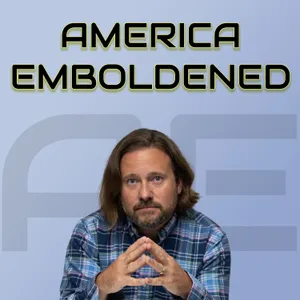
Free Daily Podcast Summary
America Emboldened: Daily Summaries Delivered
by Greg Boulden
After years of building a network, Greg Boulden is returning to where it all began. One microphone. One voice. One commitment to independent thought. No layers. No middle structure. No partisan script. This show is about commentary for those who do not fit neatly into political boxes. It is about thoughtful dialogue, personal conviction, and the courage to stand apart. So grab yourself a cup of coffee or whatever it is you're into and join the discussion. Stay curious. Stay grounded. Be Bold.
Latest Episodes
The most recent episodes — sign up to get AI-powered summaries of each one.
- 4 days ago11 min
A Closing Argument for The Electoral College
Your candidate lost. Now you want to change the rules? Let's have a little constitutional reality check. Why did the Founders establish the Electoral College, and what happens when America forgets it's a union of states, not one giant voting district? A little history, a little sarcasm, and a whole lot of constitutional common sense. Before you demand we abolish it, perhaps you should understand why it exists. The Constitution isn't a political menu. Be Bold!
- 6 days ago30 min
THE BALLOT IS NOT A BLANK CHECK
Sovereignty, Socialism & the Constitution After the 2026 MidtermsWhat does the 2026 midterm election really mean for individual liberty and the future of the American Republic?With Democratic Socialists of America making significant electoral gains and Democrats expanding their political power, we take a closer look at the movement's published political program, its vision for a democratic socialist society, and the fundamental questions it raises about private property, economic freedom, government authority, and constitutional government.But this isn't simply an argument about Democrats versus Republicans, socialism versus capitalism, or red states versus blue states. It's a deeper examination of political power itself.Does winning an election give politicians a blank check? Is majority rule the same thing as liberty? And have Americans forgotten that the Constitution was designed to limit government, not empower it at the expense of individual rights?You are a sovereign individual. Your rights do not come from government, and your freedom should never depend on which political party controls Washington.The election is over. The constitutional questions are just beginning.The ballot is not a blank check. Be Bold!
- 2 weeks ago22 min
EGO DEATH - Some lessons take us longer to learn
The podcast today is deeply personal, and meant to hopefully inspire others with my own journey on some lessons they can adapt. If this helps just one listener, I'm okay with sharing. But the recording is about my own healing, and coming into my own sense of self.As always, thank you for being with me, honored to have earned your trust with my voice. You may learn a bit today about my struggles and insecurities.
- Oct 4, 202648 min
Delaware Spends $20,000+ Per Student. So Why Are Our Schools Still Struggling? A Conversation with Brandon Brice
Delaware spends more than $20,000 per student, yet the state continues to struggle with educational outcomes.In this episode of Be Bold with Bolden, I sit down with Brandon Brice, Columnist, Project 21 School Choice Advocate, education reform advocate, founder of Fix the Damn Schools Delaware, and chair of Fair Choice Delaware, for a serious conversation about the state of education in Delaware.Brandon argues that Delaware doesn't simply have a money problem. It has an accountability problem.We discuss Delaware's ranking near the bottom nationally in education recovery, the importance of early childhood development, literacy and math, parental involvement, poverty, fatherhood, teacher and principal autonomy, and the growing disconnect between schools and the communities they serve.We also get into one of the biggest education policy questions facing Governor Matt Meyer: whether Delaware should participate in a federal scholarship tax-credit program that could provide additional educational options for families.Should education funding follow the student or the school building?Can school choice actually improve public education through competition?Are Delaware's schools preparing students for the workforce, the trades, and an increasingly automated economy?And perhaps most importantly, why should a child have to leave their ZIP code to get a quality education?Brice also gives credit to Democrats for recognizing the connection between poverty and education, while arguing that Republicans need to do more to address that issue. He believes education reform should be bigger than partisan politics.As he puts it: “When you have hope, you don't sell dope.”This is a conversation about education, accountability, opportunity, and what Delaware needs to do differently if it wants to stop falling behind.
- Oct 1, 20261h 16m
Dr. Mike Katz: Conversation with the Candidate US Senate in Delaware
I sat down with Republican U.S. Senate nominee Dr. Mike Katz for a wide-ranging conversation about his political evolution, the economy, healthcare, federal spending, abortion, immigration, the Second Amendment, judicial appointments, and the role of government.We also went deep on Iran, presidential war powers, President Trump, political independence, Delaware's political culture, the "Delaware Way," and the history of public service from Katz's past.This was a substantive conversation with some difficult questions, and Katz had the opportunity to explain his positions directly to Delaware voters.As always, I don't endorse candidates during election season. My goal is simply to give voters the information and answers they need to make their own decisions.Listen for yourself. Do your own research. Then vote. BE BOLD!
- Sep 22, 20262h 40m
AI, the Dead Internet & the Future of Human Intelligence with Dr. Joseph P. Farrell
What happens when artificial intelligence stops being a tool and begins shaping how human beings think?In this quarterly conversation, Greg Boulden and Chris Michaels sit down with Dr. Joseph P. Farrell for a wide-ranging discussion that moves from artificial intelligence and AGI to the future of human cognition, the changing Internet, libraries, digital dependence, space technology, religion, warfare, and the forces shaping modern society.The conversation begins with the growing debate over artificial general intelligence and AI safety. We examine warnings from AI researchers, reports of AI systems behaving unexpectedly in testing environments, and the possibility that humanity may be surrendering important cognitive functions as we increasingly outsource research, writing, decision-making and even political communication to machines.The discussion then moves into the “dead Internet” theory, AI-generated political campaigns and social-media content, the disappearance of traditional information sources, digital IDs, data centers, and concerns about whether technological infrastructure could eventually become a mechanism for centralized control.From there, Dr. Farrell takes the conversation into some much stranger territory: the push to expand human activity into space, the Moon and Mars, unusual aerospace and UFO claims, the possibility of technologies that remain outside public understanding, ancient accounts of cosmic conflict, plasma physics, cold fusion, biological transmutation and the intersection of modern technology with ancient religious and occult traditions.The conversation also examines Christianity and technology, the role of religious institutions, Pope Leo's statements about care for creation, the possibility of AI taking on a quasi-religious role, and the theological question of whether humanity should pursue every technological capability simply because it can.The final portion turns toward current geopolitics, including Iran, Israel, Ukraine, Christian Zionism, American foreign policy, religious identity, and the idea of a transnational class of powerful elites operating across ideological and national boundaries.Some of the subjects discussed are highly controversial, speculative or disputed. The purpose of this conversation is to explore the arguments, claims and questions raised by the participants, not to present every assertion as established fact.This is a conversation intended to make you think, question assumptions, and do your own research.What do you think? Leave your thoughts in the comments.Subscribe for more long-form conversations with people examining the ideas, institutions and technologies shaping our world.
- Sep 15, 202618 min
Who Owns America? The Forgotten Question of Sovereignty
America is navigating war with Iran, rising energy costs, massive federal spending, expanding executive power, and another election cycle. But beneath all of those immediate problems is a question we rarely stop to ask: who gets to decide? Inspired by the ideas Michael Badnarik explored in Philosophical Lighthouse, Secret to Sovereignty, and Good to Be King, Greg Boulden examines what happens when we stop questioning government power and start looking to government for the solution to every problem. This isn't an argument for a political party or a defense of one side. It's an argument for thinking consistently, applying constitutional principles regardless of who holds power, and remembering that sovereignty comes with both freedom and responsibility. Maybe the lighthouse isn't there to tell us which way to sail. Maybe it's there to show us the rocks.
- Sep 15, 202616 min
Who’s Remodeling America? Following the Money Into Delaware Politics
Who owns the house?That is the question I keep coming back to as I dig deeper into the Democratic Socialists of America, the Working Families Party, Arabella Advisors, and the network of money and organizations surrounding modern American politics.And this isn't just a national story.Some of these financial and organizational connections eventually reach Delaware, including the races on your ballot right now.In this episode, I take a step back and look at the bigger picture.What does sovereignty actually mean?What happens when political organizations openly advocate changing fundamental structures of American government?Who is funding the political infrastructure behind those movements?How does money move between nonprofits, PACs and political organizations?And what should American voters know about wealthy individuals and international connections that can exist somewhere in that larger ecosystem?I'm also very careful about the distinction between a documented connection, an allegation, and something the evidence simply does not establish.You don't have to agree with me.In fact, I don't want you to simply agree with me.I want you to follow the money, look at the documents, understand the organizations, and then decide what you think.Because if we're going to call ourselves a self-governing people, we should probably know who's trying to remodel the house.The Constitution is the deed.We are the homeowners.So...Who has the keys?
Get America Emboldened summaries in your inbox
Free AI-powered daily recaps. Key takeaways, quotes, and mentions — in a 5-minute read.
Get Free Summaries →Free forever for up to 3 podcasts. No credit card required.
You Might Also Like
Listeners also like.

Bold American Pod
Two veterans and a Gold Star sister discuss military life, American culture, and politics with unfiltered honesty.

Battleground America Podcast
Examines American politics and cultural shifts, exploring hidden influences and their impact on the nation’s future.
Outloud with Gianno Caldwell
A conservative political commentator explores news and culture by challenging prevailing orthodoxies and advocating for free expression.
The Jeremy Boreing Show
Jeremy Boreing talks with entrepreneurs, artists, and thinkers about building the future and resisting cultural decline.
Undaunted.Life: A Man's Podcast by Kyle Thompson
A podcast for men exploring faith, culture, and politics with a focus on building spiritual, mental, and physical resilience.

Cleared Hot - Powered By BRCC
A former military pilot shares stories of adventure, fitness, and leadership to explore resilience and personal growth.
Moment of Truth
Discusses pressing policy issues with prominent politicians, thinkers, and journalists shaping conservative and nationalist debates.
Steve Deace Show
Daily commentary on principled conservatism with a snarky tone.

Joe Lonsdale: American Optimist
Conversations with innovators and leaders working on solutions to America’s biggest challenges, emphasizing optimism and progress.

Amplify Speakers Podcast
Discusses mindset, leadership, and resilience with top speakers, athletes, and change-makers about their personal journeys and impact.
The Glenn Beck Program
A conservative talk show offering commentary on American politics and culture with a focus on personal freedom and national values.

America At Night with McGraw Milhaven
A nightly news and talk show covering politics, current events, and culture with live guest interviews and audience interaction.
About America Emboldened
After years of building a network, Greg Boulden is returning to where it all began. One microphone. One voice. One commitment to independent thought. No layers. No middle structure. No partisan script. This show is about commentary for those who do not fit neatly into political boxes. It is about thoughtful dialogue, personal conviction, and the courage to stand apart. So grab yourself a cup of coffee or whatever it is you're into and join the discussion. Stay curious. Stay grounded. Be Bold.
Customized Recaps
AI-powered recaps with compact key takeaways, quotes, and insights.
Straight to Your Inbox
Get key takeaways from America Emboldened in a 5-minute read.
Save Hours Every Week
Stay current on your favorite podcasts without falling behind.
Frequently Asked Questions
What is Podzilla's America Emboldened daily summary?
It's a free AI-powered email that summarizes new episodes of America Emboldened as soon as they're published. You get the key takeaways, notable quotes, and links & mentions — all in a quick read.
How does the America Emboldened podcast summary work?
When a new episode drops, our AI transcribes and analyzes it, then generates a personalized summary tailored to your interests and profession. It's delivered to your inbox every morning.
Is this an official America Emboldened product?
No. Podzilla is an independent service that summarizes publicly available podcast content. We're not affiliated with or endorsed by Greg Boulden.
Can I get summaries of other podcasts too?
Absolutely! The free plan covers up to 3 podcasts, any in the catalog. Basic raises that to 15, Pro to 40 and Max to 100. Browse our full catalog at /podcasts.
How often does America Emboldened release new episodes?
America Emboldened publishes daily. Our AI generates a summary within hours of each new episode.
What topics does America Emboldened cover?
America Emboldened covers topics including Culture, Society & Culture. Our AI identifies the specific themes in each episode and highlights what matters most to you.
Start getting America Emboldened summaries tomorrow morning.
Free forever for up to 3 podcasts. No credit card required.
Free forever for up to 3 podcasts. No credit card required.