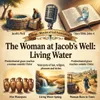
Moga - Mercies of God Association, October 4, 2026
Moga with Dr Peter Nortier The Woman of Samaria 1 The Woman at Jacob's Well: Predestinated Grace and Living Water Dr. Peter Nortier opens his Moga broadcast with a sermon on John chapter four, the story of Jesus meeting a Samaritan woman at Jacob's well. He uses her life to describe every person outside Christ, and he presses listeners to ask whether they know the Lord personally and to share what Christ has done for them. Opening Reading, Prayer, and the Subject Dr. Peter Nortier opens the broadcast by asking the congregation to take their Bibles and stand as he reads John chapter four, verses one through fourteen. He announces the subject as the woman of Samaria and says the passage will occupy several weeks, asking listeners to read the whole chapter at least three or four times before the next study. After a brief prayer asking God to open hearts and understandings, he invites the congregation to be seated and sketches the geography of the land in Jesus's day. Judea lay to the south around Bethlehem and Jerusalem, Galilee to the north, and Samaria between them, and Jews travelling from Galilee to Judea would not pass through it. Nortier explains that the Samaritans were a mixed people, half Jewish, whom the Jews looked down upon, and that the two groups had no dealings with one another. Outside Christ as a Gentile Stranger Nortier argues that the woman of Samaria stands for every person outside the Lord Jesus Christ. He reads Ephesians chapter two, verses eleven through thirteen, on being Gentiles without Christ, aliens from the commonwealth of Israel, strangers from the covenants of promise, having no hope and without God in the world. He rejects the idea that everyone is already under grace, saying only those who know Christ personally are, and he cites Galatians on all being children of God by faith in Christ Jesus. He points to a religious leader featured on a national television program that day, arguing that religion alone does not save. Then he pauses the message with a direct question to the listener: do you know Christ, and are you depending on him alone to take you to heaven? If not, he says, you stand in the same category as the woman at the well. A Vagabond With Six Husbands Nortier turns to the woman's life and calls her a vagabond who would fit easily into modern society. He explains that the Old Testament Hebrew word for harlot carries the sense of a sturdy, idle beggar who flits from place to place. Quoting verses sixteen through eighteen, he notes that Jesus told her to call her husband, that she had five husbands, and that the man she now lived with was not her husband, which he counts as the sixth. He reads Ephesians chapter four on walking as other Gentiles walk, and he states that about half of modern marriages end in divorce, with couples entering vows already planning an exit. He also warns against church-hoppers who blame every congregation for their problems, saying churches split when too many such vagabonds refuse sound doctrine. He closes the point by saying the woman's deepest need was that nobody could please her, and that she did not find the right person until the seventh, the Lord Jesus Christ. Prejudice in Religion and Salvation of the Jews Nortier moves to verse nineteen, where the woman tells Jesus that her fathers worshipped on the mountain while the Jews said Jerusalem was the place to worship. He hears in her words a prejudice that her religion was as good as true worship, and he applies it to the present day. Quoting First Corinthians chapter eight, verse four, he insists there is only one God, the triune God of Father, Son, and Holy Spirit, and that every person must have a personal encounter with Christ. He names several movements and figures, among them Christian Science, Ellen White, the Baha'i faith, Confucianism, Islam, and Roman Catholic teaching on Mary, arguing that each falls short of the Lord Jesus. He rejects the claim that England and the United States are the lost tribes of Israel, and he stresses Jesus's words that salvation is of the Jews. He says he opposes not religion in general but any system that does not uphold the Lord Jesus Christ. Waterpots of Lust, Religion, and Riches Nortier draws on verse seven, where the woman comes to draw water at the sixth hour, to describe the waterpots people carry today. The first is the waterpot of fleshly lust, which must be refilled again and again because it never satisfies. The second is the waterpot of religion and pleasure, illustrated by Second Timothy chapter three on people having a form of godliness while denying its power, and by his observation that many church members do not attend Sunday night services or prayer meetings. He then names the waterpots of education and riches, saying he holds several degrees himself but that learning without Christ is not worth having, and he criticizes a college professor who, he says, taught that the Bible is fables. He warns that people who strive only for
Podzilla Summary coming soon
Sign up to get notified when the full AI-powered summary is ready.
Free forever for up to 3 podcasts. No credit card required.
Listen to This Episode
More from BBS Radio TV Station Streams

Shadow Politics, October 4, 2026

Health Talk America, October 4, 2026

Financial Fitness with The Money Doctor, October 4, 2026
Bible News Prophecy, October 4, 2026
Get summaries like this every morning.
Free AI-powered recaps of BBS Radio TV Station Streams and your other favorite podcasts, delivered to your inbox.
Free forever for up to 3 podcasts. No credit card required.