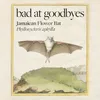
Jamaican Flower Bat :: Phyllonycteris aphyllaBad at Goodbyes :: Episode 087On today’s show we learn about the Jamaican Flower Bat, a critically endangered flying mammal native to the Caribbean island nation of Jamaica. Its scientific name is Phyllonycteris aphylla and it was first described in 1898.For more information about Jamaica Flower Bat conservation and bat conservation in general please see Bat Conservation International at https://www.batcon.org.(00:05) Intro(02:05) Species Information(27:22) Citations(29:29) Music(36:42) PledgeResearch for today’s show was compiled from:Baker, R. J., Groen, J. A., & Owen, R. D. (1984). Field key to Antillean bats (Occasional Papers, No. 94). Museum of Texas Tech University. – https://ttu-ir.tdl.org/server/api/core/bitstreams/d15e93d9-80de-45dc-95b8-3af88073278b/contentBat Conservation International. (2022, May 20). Globally significant Jamaican cave permanently protected to save critically endangered bats [Press release]. https://www.batcon.org/press/globally-significant-jamaican-cave-permanently-protected-to-save-critically-endangered-bats/Carstens, B. C. (2001). Phylogeny of the neotropical nectar-feeding bats (Chiroptera: Phyllostomidae) (Publication No. 1403850) Master's thesis, Michigan State University. ProQuest Dissertations & Theses Global. https://www.proquest.com/openview/5e2c8907b5a92b9a86606531d3c6b86b/1Genoways, Hugh H., Baker, Robert J., Bickham, John W., & Phillips, Carleton J. (2005). Bats of Jamaica. Bats of Jamaica, 48, 1--155. – https://www.biodiversitylibrary.org/part/249897iNaturalist – near Rock Spring Caverns, St. Mary, JamaicaKoenig, S. & Davalos, L. 2015. Phyllonycteris aphylla. The IUCN Red List of Threatened Species 2015: e.T17173A22133396. – https://dx.doi.org/10.2305/IUCN.UK.2015-4.RLTS.T17173A22133396.enMcFarlane, D. A. (1986). Cave bats in Jamaica. Oryx, 20(1), 27-30. – https://doi.org/10.1017/S0030605300025874Miller, G. S., Jr. (1898). Descriptions of five new phyllostome bats. Proceedings of the Academy of Natural Sciences of Philadelphia, 50, 326–337. – https://www.biodiversitylibrary.org/page/1647828Oelbaum, P. J., Hall, R. P., Whyte, D. L., Stewart, R. S., Pauel, J., Kouwenberg, S., … Welch, K. C. (2024). Reproductive populations of the Critically Endangered bat Phyllonycteris aphylla at two new locations in Jamaica. Oryx, 58(5), 650–654. – https://doi.org/10.1017/S0030605323001643National Environment and Planning Agency. (2011). 2012 - 2017 bat management plan for Jamaica. – https://www.cockpitcountry.com/pdfs/NEPA%20Bat%20Mgt%20Plan_2012-2017.pdfPallardy, R. (2024, August 27). "We found 20 pairs of wings in an hour.” Culprit of Jamaica's dismembered bats caught on camera. Discover Wildlife. – https://www.discoverwildlife.com/animal-facts/feral-cats-catching-bats-jamaicaSears, K. E., Behringer, R. R., Rasweiler, J. J., & Niswander, L. A. (2006). Development of bat flight: Morphologic and molecular evolution of bat wing
Podzilla Summary coming soon
Sign up to get notified when the full AI-powered summary is ready.
Free forever for up to 3 podcasts. No credit card required.
Listen to This Episode
Get summaries like this every morning.
Free AI-powered recaps of Bad at Goodbyes and your other favorite podcasts, delivered to your inbox.
Free forever for up to 3 podcasts. No credit card required.