Free Daily Podcast Summary
Art Happens: The Divine Mess of Art History: Daily Summaries Delivered
by James William Moore
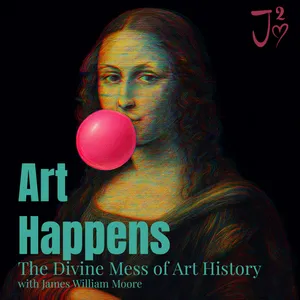
Art Happens: The Divine Mess of Art History is where masterpieces meet mayhem. Join artist and educator James William Moore for bite-sized episodes exploring the scandals, strokes of genius, and happy accidents that shaped art history. Witty, insightful, and a little irreverent — it’s art history served with sass, smarts, and a splash of chaos. Because perfection’s overrated… and art happens.
Latest Episodes
The most recent episodes — sign up to get AI-powered summaries of each one.
- 1 weeks ago12 min
Cindy Sherman's Untitled Film Stills: The Movies That Don't Exist
A nervous woman glances over her shoulder. A lonely figure stares through a window. A young ingénue arrives in the city with a suitcase—and somehow, you already think you know what happens next. Between 1977 and 1980, Cindy Sherman created 69 black-and-white photographs inspired by the visual language of classic cinema. But these aren’t stills from real movies, and Sherman isn’t playing actual characters. She gives us costumes, poses, and familiar stereotypes—then lets our own cultural progra...
- 2 weeks ago11 min
Constructivism: Art Builds a New World (Movement in about Ten Minutes)
A revolution has overturned the government, the economy, and nearly every reliable plan for next Tuesday. The old world is gone. Now someone has to design the new one. In this episode of Art Happens: The Divine Mess of Art History, James explores Russian Constructivism—the radical movement that wanted art to leave the museum, enter everyday life, and get a job. Its artists traded precious masterpieces for industrial materials, photography, posters, clothing, theater sets, furniture, and the a...
- 3 weeks ago12 min
Marcel Duchamp: The Man Who Broke Art (Artist Spotlight)
Marcel Duchamp could paint. He understood perspective, composition, Cubism, and the rules of art history—and then he decided those rules were optional. Inspired by MoMA’s sweeping Duchamp retrospective, James explores nearly six decades of work by one of modern art’s most disruptive figures. The exhibition moves from Duchamp’s early paintings and drawings through readymades, mechanical contraptions, optical experiments, wordplay, alter egos, and the mysterious installation he constructed in s...
- 4 weeks ago11 min
The Gardner Museum Heist: Cops, Canvases, and a Very Bad Night (Art History Mystery)
In the early hours of March 18, 1990, two men dressed as police officers walked into Boston’s Isabella Stewart Gardner Museum—and walked out with thirteen works of art worth an estimated $500 million. The haul included a Vermeer, three Rembrandts, five works by Degas, a Manet, and, because apparently priceless masterpieces weren’t enough, the decorative top of a Napoleonic flagpole. More than three decades later, the art is still missing. No one has been charged. And the empty frames still ha...
- Aug 17, 202610 min
Ana Mendieta: Earth, Body, Exile, and Absence (Artist Spotlight)
Ana Mendieta didn’t simply place the body in nature—she let it disappear into it. In this episode of Art Happens: The Divine Mess of Art History, James William Moore explores how Ana Mendieta transformed earth, fire, water, blood, flowers, photography, and film into a deeply personal language of exile, memory, ritual, and belonging. From her childhood departure from Cuba and years in Iowa to the haunting Silueta works that fused body and landscape, we trace the experiences that shaped one of ...
- Aug 10, 202610 min
The Night Watch - The Rembrandt That Got "Trimmed" (Masterpiece Moment)
In 1715, Amsterdam officials faced a decorating dilemma: Rembrandt’s monumental masterpiece The Night Watch didn’t fit between two doors. Their solution? Cut it down to size. In this episode of Art Happens: The Divine Mess of Art History, James explores how Rembrandt transformed a conventional militia portrait into a scene bursting with light, movement, muskets, and one mysteriously glowing girl—only for later generations to trim away figures, architecture, and nearly two feet of canvas. Disc...
- Aug 3, 202612 min
Movement in about Ten Minutes: Futurism - Speed, Machines, Violence, and Very Bad Decisions
Futurism wanted art to move at the speed of modern life—and it wasn’t interested in asking permission. In this episode, James follows Filippo Tommaso Marinetti and the Italian Futurists as they transform speeding cars, factories, electric lights, experimental typography, and industrial noise into a new artistic language. Along the way, paintings learn to move, words escape their sentences, orchestras become factories, and performances erupt into confrontations. But Futurism’s obsession with y...
- Jul 27, 202610 min
Artist Spotlight: Alexander Calder - The Art That Learned to Dance
Alexander Calder didn’t just make sculpture move—he taught it how to dance. In this episode of Art Happens: The Divine Mess of Art History, James William Moore explores how a mechanically minded artist transformed gravity, air, balance, and motion into artistic materials. From Calder’s miniature, five-suitcase circus and his wire “drawings in space” to the encounter with Piet Mondrian that helped set abstraction in motion, we follow the experiments that led to his revolutionary mobiles and st...
About Art Happens: The Divine Mess of Art History
Art Happens: The Divine Mess of Art History is where masterpieces meet mayhem. Join artist and educator James William Moore for bite-sized episodes exploring the scandals, strokes of genius, and happy accidents that shaped art history. Witty, insightful, and a little irreverent — it’s art history served with sass, smarts, and a splash of chaos. Because perfection’s overrated… and art happens.
Customized Recaps
AI-powered recaps with compact key takeaways, quotes, and insights.
Straight to Your Inbox
Get key takeaways from Art Happens: The Divine Mess of Art History in a 5-minute read.
Save Hours Every Week
Stay current on your favorite podcasts without falling behind.
Frequently Asked Questions
What is Podzilla's Art Happens: The Divine Mess of Art History daily summary?
It's a free AI-powered email that summarizes new episodes of Art Happens: The Divine Mess of Art History as soon as they're published. You get the key takeaways, notable quotes, and links & mentions — all in a quick read.
How does the Art Happens: The Divine Mess of Art History podcast summary work?
When a new episode drops, our AI transcribes and analyzes it, then generates a personalized summary tailored to your interests and profession. It's delivered to your inbox every morning.
Is this an official Art Happens: The Divine Mess of Art History product?
No. Podzilla is an independent service that summarizes publicly available podcast content. We're not affiliated with or endorsed by James William Moore.
Can I get summaries of other podcasts too?
Absolutely! The free plan covers up to 3 podcasts. Upgrade to Pro for 15, or Premium for 50. Browse our full catalog at /podcasts.
How often does Art Happens: The Divine Mess of Art History release new episodes?
Art Happens: The Divine Mess of Art History publishes weekly. Our AI generates a summary within hours of each new episode.
What topics does Art Happens: The Divine Mess of Art History cover?
Art Happens: The Divine Mess of Art History covers topics including Arts, Culture, Society & Culture, Visual Arts. Our AI identifies the specific themes in each episode and highlights what matters most to you.
Start getting Art Happens: The Divine Mess of Art History summaries tomorrow morning.
Free forever for up to 3 podcasts. No credit card required.
Free forever for up to 3 podcasts. No credit card required.