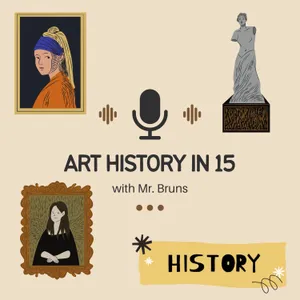
Free Daily Podcast Summary
AP Art History in 15: Daily Summaries Delivered
by Robert Bruns
This podcast series is designed to help Advanced Placement (AP) Art History students gain an understanding of the "250" works of art and art history. The series will try to connect works of art and architecture to help students succeed in the AP Exam.
Latest Episodes
The most recent episodes — sign up to get AI-powered summaries of each one.
- 1 weeks ago16 min
From Republic to Empire: How Roman Art Sold Power
Why would a Roman politician want a face full of wrinkles, while an emperor wanted to look forever young? Join Mr. Bruns as we compare the Head of a Roman Patrician and Augustus of Prima Porta to discover how Roman art reflected changing ideas about leadership, status, and political power.Explore Republican verism, imperial idealization, Greek artistic influence, and the use of sculpture as political propaganda. Learn how the patrician’s weathered face communicated experience and gravitas, while Augustus’s youthful body, decorated armor, and mythological symbolism promoted military success, divine ancestry, and stability.We’ll break down Form, Function, Content, and Context and finish with an AP-ready comparison thesis you can use in your own writing.Remember: Art is another document!
- 3 weeks ago17 min
The Grave Stele Hegeso and Nike of Samothrace - Remembrance and Victory
What can a grave marker reveal about ancient Greek society, and how can a winged goddess turn a marble sculpture into a symbol of unstoppable victory? Join Mr. Bruns on AP Art History in 15 as we explore two unforgettable masterpieces of ancient Greece: #36, Grave Stele of Hegeso, and #37, Winged Victory (Nike) of Samothrace.First, discover how Hegeso's quiet domestic scene reveals Athenian funerary customs, gender expectations, family identity, and social hierarchy. Then, prepare for takeoff as we examine the dramatic movement, flowing drapery, and monumental power of Winged Victory, a Hellenistic masterpiece celebrating triumph and divine favor.But there's more! Mr. Bruns tackles two essential AP Art History questions: How does Hegeso help us understand Greek cultural practices? And why do archaeological discoveries, missing pieces, and uncertain historical evidence lead to multiple interpretations of Winged Victory?Using Form, Function, Content, and Context (FFCC), we'll connect artistic choices to the beliefs, values, and historical circumstances of ancient Greece.Whether you're preparing for the AP Art History exam or simply love discovering the stories behind great works of art, this episode will help you look closer, think critically, and turn visual observations into strong historical analysis.
- Oct 16, 202618 min
The Acropolis: Gods, Glory & Athenian Power
What can marble tell us about the gods, politics, and power of ancient Athens? Join Mr. Bruns on AP Art History in 15 as we explore the Acropolis and four essential works from AP Art History Work #35! In this episode, we explore:Helios, Horses, and Dionysus: Discover how the Parthenon's sculptors used mythology, naturalism, and architectural space to celebrate Athena.Temple of Athena Nike: Examine how religious devotion and military victory became powerful symbols of Athenian identity.Victory Adjusting Her Sandal: Unpack the elegance of wet drapery, naturalistic movement, and the personification of victory.Plaque of the Ergastines: Explore the Panathenaic Festival and how religious rituals reinforced Athenian civic identity.🎯 AP Exam Focus: We go beyond identifying and describing works of art to examine how purpose, intended audience, and patronage influenced artistic choices. Learn how the Athenian state used monumental architecture and sculpture to honor its patron goddess, celebrate civic traditions, and communicate political power.Whether you're preparing for the AP Art History exam or simply fascinated by the art and culture of ancient Greece, this episode connects Form, Function, Content, and Context (FFCC) in a sharp, engaging, student-friendly format.
- Oct 12, 202618 min
Feasting with the Dead & Facing the Gods | Etruscan Tomb of the Triclinium & Greek Niobides Krater
Welcome back to AP Art History in 15 with Mr. Bruns! This episode takes us on a Mediterranean journey to explore two fascinating works of art and the societies that created them.🏛️ First Stop: Etruscan Tomb of the Triclinium (c. 470 BCE)Step inside an underground burial chamber where banquets, musicians, and dancers transform a tomb into a celebration of life. Discover how Etruscan social hierarchies, funerary customs, and beliefs about death influenced the creation of this lively painted environment.🏺 Second Stop: Greek Niobides Krater (c. 460–450 BCE)Meet Niobe, the mortal mother whose pride provokes the wrath of Apollo and Artemis. Explore how Greek mythology, religious beliefs, and symposium culture shaped this remarkable red-figure mixing vessel. We'll also examine how the Niobid Painter experimented with spatial depth and figure placement to bring a dramatic myth to life.
- Oct 2, 202616 min
Democracy, Gods & Death: How Culture Shapes Art
In this episode of AP Art History in 15, Mr. Bruns—your 29-year AP teaching veteran—takes us into the ancient Mediterranean to explore three important AP Art History works:🏛️ #26 — Athenian Agora👗 #28 — Peplos Kore💀 #29 — Sarcophagus of the SpousesWe'll break down Form, Function, Purpose, and Historical Context while answering one of College Board's biggest questions:How do cultural practices, belief systems, and physical settings affect art and art making?You'll discover how the Athenian Agora reflects the civic and political culture of Athens, how the Peplos Kore connects sculpture to Greek religious practices and sacred space, and how the Sarcophagus of the Spouses reveals Etruscan ideas about marriage, social life, death, and the afterlife.Along the way, we'll uncover some Golden Nuggets—the kind of strange, surprising, and memorable historical facts that can help these works stick in your brain when you're sitting in front of the AP exam.
- Sep 25, 202615 min
Ancient Egypt: Purpose, Audience & Patron | Hatshepsut & King Tut
Why did the ancient Egyptians create such elaborate temples,tombs, coffins, and funerary objects? In this episode of AP Art History in 15, Mr. Bruns explores how purpose, intended audience, and patronage shaped Ancient Egyptian art and art making.We’ll examine two essential AP Art History works:#21. Mortuary Temple ofHatshepsut — Discover how architecture, religious imagery, and royal representation helped Hatshepsut communicate her authority, divine connections, and role as pharaoh.#23. Tutankhamun’s Tomb,Innermost Coffin — Explore why gold, idealized royal imagery, and traditional symbols of kingship were so important in Egyptian funerary art and beliefs about the afterlife.Along the way, we’ll explore the ka, Egyptianfunerary beliefs, royal patronage, divine kingship, the purpose of mortuary complexes, and why materials and imagery matter.AP Art History TakeawayWhen studying Egyptian art, remember:PURPOSE — Why was it made?AUDIENCE — Who was it made for?PATRON — Who commissioned it?Then ask the most important AP question:How did those factors affect the way the artwork wasmade?
- Sep 21, 202616 min
Ancient Egypt, Part 1: Pharaohs, Pyramids & the Power of Images
In Part 1 of our Ancient Egypt series, Mr. Bruns explores how cultural practices, belief systems, political power, and the Egyptian environment shaped the art and architecture of one of history's most fascinating civilizations.We'll examine three essential AP Art History works: #13 Palette of King Narmer — Discover how hierarchical scale, symbolism, and visual conventions communicate the power of the pharaoh and the organization of Egyptian society. #15 Seated Scribe — Explore the importance of literacy, bureaucracy, and funerary practices—and why this sculpture looks so different from idealized images of Egyptian rulers. #17 Great Pyramids of Giza — Go beyond "they're giant tombs" and examine how religion, engineering, social organization, geography, and royal power came together to create some of the most famous architecture in the world.Along the way, we'll tackle a key AP Art History question:How do culture, belief, and physical setting influence what artists create—and how they create it?Remember: Don't just identify the artwork. Explain WHY it looks the way it does.
- Sep 11, 202615 min
Ancient Mesopotamia Art - Impact of the Environment, Beliefs, and Politics on art
Travel back to ancient Mesopotamia—the “land between the rivers”— as we begin a new AP Art History unit and explore how physical setting, belief systems, cultural practices, and political power shaped the art of the ancient world.In this episode, Mr. Bruns examines four important AP Art History works:🏛️ #12 White Temple and its Ziggurat — Discover how Mesopotamia’s flat landscape and religious beliefs influenced the creation of monumental ziggurats and elevated sacred spaces.🙏 #13 Statue of a Votive Figure — Learn why these figures were created as perpetual worshippers and why those enormous eyes are so important to understanding Mesopotamian beliefs.⚔️ #16 Standard of Ur — Explore the connections between warfare, peace, social hierarchy, kingship, trade, and artistic representation—including the famous hierarchy of scale.🪽 #25 Lamassu from the Citadel of Sargon II — Meet the human-headed, winged bull that protected Assyrian royal spaces and communicated the power of the empire. And yes… we'll explain the five legs!Throughout the episode, we’ll use an important AP Art History formula:CONTEXT → ARTISTIC CHOICE → MEANINGWe’ll also tackle the big question:How do cultural practices, belief systems, and physical setting impact art and art making?
Get AP Art History in 15 summaries in your inbox
Free AI-powered daily recaps. Key takeaways, quotes, and mentions — in a 5-minute read.
Get Free Summaries →Free forever for up to 3 podcasts. No credit card required.
You Might Also Like
Listeners also like.

Art History for All
Explores individual artworks and their broader significance, making art history accessible and meaningful to all audiences.
New Books in Ancient History
New Books Network
Stories of Art
Art historians explore pivotal moments, artists, and hidden narratives that shaped the history of art.
The Ancients
Explores ancient history through expert interviews, covering topics from Neolithic Britain to the fall of Rome.

The Jealous Curator : ART FOR YOUR EAR
The Jealous Curator

History Snacks
Quick, engaging history lessons for kids covering empires, heists, lost explorers, and royal rivalries.

The Art World: What If...?!
Leading art figures explore radical ideas about culture, patronage, and the future of the art world with insight and humor.

The Great Women Artists
Explores the lives and work of women artists through interviews with artists, curators, and writers.
HistoryExtra podcast
Historical conversations with leading experts explore gripping stories from the past.

Immaterial: 5,000 Years of Art, One Material at a Time
Explores the history and meaning of art through the lens of individual materials, from clay to jade to paper.
New Books in Medieval History
New Books Network

HISTORY This Week
A weekly look at pivotal historical events and the people behind them, from famous figures to unknown influencers.
About AP Art History in 15
This podcast series is designed to help Advanced Placement (AP) Art History students gain an understanding of the "250" works of art and art history. The series will try to connect works of art and architecture to help students succeed in the AP Exam.
Customized Recaps
AI-powered recaps with compact key takeaways, quotes, and insights.
Straight to Your Inbox
Get key takeaways from AP Art History in 15 in a 5-minute read.
Save Hours Every Week
Stay current on your favorite podcasts without falling behind.
Frequently Asked Questions
What is Podzilla's AP Art History in 15 daily summary?
It's a free AI-powered email that summarizes new episodes of AP Art History in 15 as soon as they're published. You get the key takeaways, notable quotes, and links & mentions — all in a quick read.
How does the AP Art History in 15 podcast summary work?
When a new episode drops, our AI transcribes and analyzes it, then generates a personalized summary tailored to your interests and profession. It's delivered to your inbox every morning.
Is this an official AP Art History in 15 product?
No. Podzilla is an independent service that summarizes publicly available podcast content. We're not affiliated with or endorsed by Robert Bruns.
Can I get summaries of other podcasts too?
Absolutely! The free plan covers up to 3 podcasts, any in the catalog. Basic raises that to 15, Pro to 40 and Max to 100. Browse our full catalog at /podcasts.
How often does AP Art History in 15 release new episodes?
AP Art History in 15 publishes weekly. Our AI generates a summary within hours of each new episode.
What topics does AP Art History in 15 cover?
AP Art History in 15 covers topics including Education, Courses. Our AI identifies the specific themes in each episode and highlights what matters most to you.
Start getting AP Art History in 15 summaries tomorrow morning.
Free forever for up to 3 podcasts. No credit card required.
Free forever for up to 3 podcasts. No credit card required.