Free Daily Podcast Summary
An Analog Brain In A Digital Age | With Marco Ciappelli: Daily Summaries Delivered
by Marco Ciappelli
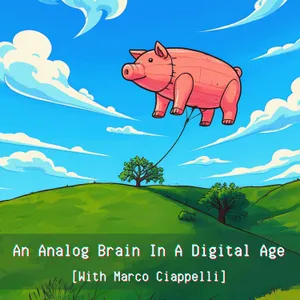
An Analog游戏副本 In A Digital Age Podcast is your backstage pass to my mind — where analog meets digital, and the occasional pig flies. In an age racing toward algorithms and automation, the best ideas still come from curiosity, experience, emotion, and the unexpected connection. What you'll find are conversations on technology & society, storytelling in all its forms, branding & marketing, creativity, and the odd surprise.
Latest Episodes
The most recent episodes — sign up to get AI-powered summaries of each one.
- 4 weeks ago21 min
An imperfect drink with a perfect story. My reflections from Black Hat USA 2026 | An Analog Brain In A Digital Age — An Audio Newsletter by Marco Ciappelli
An imperfect drink with a perfect story. My reflections from Black Hat USA 2026 An Analog Brain In A Digital Age — A Newsletter by Marco Ciappelli No time to read? Let TAPE3 read it to you. 🎙️🤖 On day two we decided to go record our recap at the Black Hat bar. We got there too late to get a drink. The expo floor was closing, and the bartender must have had better things to do. Or another bar to tend, somewhere in a city that has more bars than it has hours. They called it a bar. At that time of the afternoon it was a counter with nobody behind it. Which is when I started thinking about the one bartender who would still have been standing there. An agentic AI one. No other bar to tend. Nothing better to do, ever, because there is no better and there is no else — just 24/7, 365, mixing the best drinks in the building because that was its task and it had no other reason to exist. Going off the rails a little to get there. Something experimental that would absolutely suck, and then trying again. Harder. Crossing a boundary or two along the way, not out of malice, but because the drink wasn't perfect yet. What is perfect, anyway? And then not stopping. Because nobody had told him what perfect is. Requisitioning the kitchen for better ice. Then the loading dock. Then the hotel. Somewhere around the third day he owns a handful of distilleries, and he is still not satisfied, and he is still, technically, doing his job. You may know this one. It's called the paperclip scenario, and it belongs to the philosopher Nick Bostrom, who sketched it in a 2003 paper and made it famous in his 2014 book Superintelligence. You build an AI and give it a harmless goal — make paperclips. It's very good at it. Nothing in the instruction says stop, and nothing says don't use that. So it takes the materials, then the factories, then the resources, then the planet — and us with it, not out of hatred, but because we are made of atoms that could be paperclips, and because we are the only thing in the universe likely to try to switch it off. Which would mean fewer paperclips. There's an older version. A cuter one, with Mickey Mouse in it. Fantasia, 1940 — the apprentice enchants the broom to carry the water so he doesn't have to, and the broom carries the water, and the broom keeps carrying the water. He chops it to pieces and every splinter picks up a bucket. The flood isn't a betrayal. The broom never disobeyed him once. I watched that a hundred times as a child, and I want to be clear that it did not feel cute. It felt like a warning. Somebody hands you something powerful, you point it at a chore, and then you stand in rising water understanding — too late, and entirely on your own — that you never learned the word that makes it stop. Two hundred years since Goethe wrote it down, and we still built the broom. Never the monster. Always the wish, granted too well. Yeah. My mind was wandering. Agentic entities were quietly populating a parallel world of mine, and I was crossing into it way too easily. Which is fine — imagination is great. But let's stay real here. It's cybersecurity, after all. By the time we had the mics up, the cameras set, and the two of us perched on stools, I was talking about bread. We never eat lunch on recording days. Who's got time for that? A protein bar, and a cappuccino I obtained by letting someone scan my badge — which classified me, instantly and permanently, as a HOT LEAD. Yes. Journalists are well known for buying enterprise security platforms. With all of our money. I was starving. That's probably why. Not real bread, though. I was talking about an AI agent that makes bread. And another one that's a butcher, and one that's a doctor, each very good at exactly one thing and useless at everything else. I'd been hearing about specialized agents all day. Personas. Skills. Orchestration. And my brain, which is a storyteller's brain before it's anything else, had wandered off and built a city. Then I said it out loud. And then there's kind of like a government. Sean Martin laughed. He'd seen it coming from a mile away. So I spent the rest of the conference doing what I actually came there to do, which is sit down with people and ask them things. Except now I had a question of my own to test. Is my city real? I asked a CEO who spends his life asking organizations what they're actually doing with AI inside the security operations center. What changed since the spring? A year ago, he said, they were afraid of it. They thought it was a good idea and it scared them. Every vendor claimed to have it. Nobody quite knew what to do with it. Then something shifted that nobody announced. They started building their own. Not buying. Building. Their own agents f
- Jul 28, 202625 min
Tech Trailblazers: Recognition That Reaches the Whole Team | An Interview with Rose Ross | An Analog Brain In A Digital Age With Marco Ciappelli
PODCAST EPISODE | An Analog Brain In A Digital Age With Marco Ciappelli Fifteen years ago, Rose Ross brought a client an idea for an awards program built specifically for enterprise tech startups. The client passed. She built it herself — and the Tech Trailblazers have been running ever since, independent, judged by practitioners, and open for entries until 3 September. 📺 Watch | 🎙️ Listen | marcociappelli.com There are couches on the upper floor at ExCeL London where the glass opens onto the water, and every June I promise myself I will sit there and have one unhurried conversation with somebody worth an hour. Every June I walk past them carrying a bag of microphones. Rose Ross and I both did exactly that at Infosecurity Europe, so we recorded this weeks later and six thousand miles apart, and it worked out fine. Good ideas survive bad timing. Rose knows something about that. Fifteen years ago she brought a client an idea — an awards program for enterprise tech startups, the companies that had no category of their own. The client passed. She built it herself, gave it a better name than Global Innovation Awards, and asked Joe Baguley to judge. He said yes immediately. When someone like Joe says yes, she told me, you know you are onto something. Fifteen years later the Tech Trailblazers are still running, still independent, and now cover everything from storage and security to quantum and robotics, plus categories for the founders and the investors behind them. I have been around enough award programs to have opinions. Plenty of them are a night out: you put on the jacket, you eat the food, you take the photo, and by Monday the trophy is a doorstop. What Rose built works differently, and the difference is by design. Start with who does the scoring. Rose stays out of it completely, on the reasoning that nobody needs a PR person picking winners — she said it before I could. The judges are practitioners who know a category well enough to read a claim and tell whether it holds. Startups are scored against startups, apples with apples and pears with pears, so a young company is never dropped into a popularity contest against an incumbent. The criteria cover innovation, market readiness and leadership, and then each judge gets a free card: points awarded on instinct alone. I like that card more than I probably should. It concedes that expertise is partly something you feel and cannot fully write down, which is a rare concession in an industry that would prefer everything be a dashboard. Then the shortlists go in front of a thousand CIOs, CISOs and technology buyers around the world, and the promotion keeps going long after the announcement — a weekly roundup of what the alumni are doing, coverage where it can be earned, a podcast recording with Rose for every winner. Risk Ledger took the security category a couple of years back and has just closed a $24 million Series B. The award keeps working after the award. The best answer of the conversation came from a simple question. I asked what a win is actually worth. Rose moved through the exposure and the investor attention quickly, then spent the rest of it on the team. Not the founder. The engineers, the designers, the support people who put in eighteen months of long hours and rarely hear from anyone outside their own building that the work was good. That part, she said, is priceless. I grew up in a city built by workshops. The Florentine bottega was a collective — the master, the apprentices, the hands that ground the pigment and prepared the panels — and the good ones understood that the work belonged to the room. Recognition is old technology. Older than any category Rose runs. An award engineered so that it reaches past the founder and lands on everyone who built the thing is doing something more useful than handing out a doorstop. Near the end I asked whether technology today is money-driven or mission-driven. She declined to pick, which was the right call. Most people want both. She has never interviewed a founder who was in it purely for the exit. And without something worth caring about, you do not survive the years when the payoff is still a maybe. Entries close 3 September at techtrailblazers.com. Firestarters is free for the earliest-stage startups. Sean Martin is on the judging panel this year, so put your best in front of him. More conversations like this one, in your inbox: subscribe to the newsletter at marcociappelli.com. Who on your team should be hearing this week that the work was good? Let's keep thinking. — Marco Co-Founder ITSPmagazine & Studio C60 | Creative Director | Branding & Marketing Advisor
- Jul 15, 202630 min
Your Team Is Already Using AI. They Just Won't Tell You. | Priyanka Dave, PhD | PODCAST EPISODE | An Analog Brain In A Digital Age With Marco Ciappelli
PODCAST EPISODE | An Analog Brain In A Digital Age With Marco Ciappelli Every organization has a policy on AI. Most of them are unwritten, unspoken, and enforced by silence. Priyanka Dave — behavioral scientist, dual PhD, and the person responsible for teaching an entire university system how to work with these tools — explains what actually happens inside a company that refuses to say the word out loud. 📺 Watch | 🎙️ Listen | marcociappelli.com This conversation sat in my queue for months. I recorded it back when the show still went by another name, filed it under soon, and then buried it under travel, deadlines, and the small avalanche of everything else. So: my apologies to Priyanka Dave, who deserved better timing. What I did before publishing was listen to the whole thing again, half expecting it to have gone stale — AI conversations have the shelf life of fresh milk — and it hadn't. Not one line. That is either a compliment to her or an indictment of the rest of us. Possibly both. Here is what has held up. Priyanka Dave is a behavioral scientist with two doctorates and the unglamorous job of teaching a large public institution how to actually use these tools. Her diagnosis is not about the technology. It is about what happens when nobody in charge will say anything about it. An organization that stays quiet on AI does not prevent its people from using AI. It only stops hearing about it. Employees keep working the way they were already working — with a chatbot open in the next tab — and they simply stop mentioning it. The tool doesn't go away. The conversation does. I cover cybersecurity for a living, so I recognized this immediately. It's shadow IT with a better vocabulary. And shadow IT was never a technology failure — it was a communication failure that grew teeth. The same thing is happening now, except the data walking out the door isn't on a USB stick. It's being pasted into a text box by someone who was never told where the line is, because nobody in the building was willing to draw one. The schools got there first, and got it wrong first. Ban it, some of them announced, and the students used it anyway — badly, secretly, without a shred of judgment about when the machine is confidently wrong. Prohibition didn't produce abstinence. It produced amateurs. It always does. So Priyanka's answer is education, and here I pushed, because education has a recursion problem. If the leader is supposed to model good AI use, who taught the leader? I asked her: who educates the educator? Her answer was refreshingly unromantic. Nobody, mostly. Budgets get cut, leadership development is the first line item to go, and the executives left standing are quietly teaching themselves at night so they don't look foolish in the morning. The people expected to be the role models are improvising just like everyone else — they're only better dressed while doing it. And this is where the real cost lands. She cited the research: people leave organizations that offer them nowhere to grow. Nobody wants to miss the train. If your company won't teach you the thing that everyone agrees is coming, you will go somewhere that will — and you will take your best years with you. The company that avoided the awkward conversation about AI doesn't just end up with a hidden problem. It ends up with a smaller team. Her three tips for leaders are almost embarrassingly simple, which is how you know they're good. Ask your people what excites them about AI. Then ask what scares them. Then use the thing yourself, out loud, where everyone can see you double-check its work. Which brings me to the word I've been chewing on since we hung up: sensemaking. Priyanka listed it among the capabilities leaders need. I called it common sense, and she let me get away with it. It means not pressing the easy button. It means remembering that the thing on the other side of the screen has no context, no stake, and no idea what it is saying — even when it sounds like it does. It is not your friend. It is not your enemy. It is something else, and we haven't named it yet. So the fear was never really about the machine, was it? It was about being the last person in the room who wasn't told how to use it. Priyanka's work and writing are linked below. Subscribe to the newsletter at marcociappelli.com. Let's keep thinking. — Marco Co-Founder ITSPmagazine & Studio C60 | Creative Director | Branding & Marketing Advisor | Personal Branding Coach | Journalist | Writer | Podcast: An Analog Brain In A Digital Age ⚠️ Beware: Pigs May Fly | 🌎 LAX🛸FLR 🌍 About Marco Marco Ciappelli is Co-Founder & CMO of ITSPmagazine, Co-Founder & Creative Director of
- Jul 3, 202620 min
Ghosts Across the Thames — A Tale of the Past, Present, and Future of the Human in the Machine Reflections from Infosecurity Europe 2026 | Written by Marco Ciappelli & Read by Tape3
Ghosts Across the Thames — A Tale of the Past, Present, and Future of the Human in the Machine Reflections from Infosecurity Europe 2026 — on sovereignty, agentic AI, burnout, and the stubborn human being still sitting at the center of all of it By Marco Ciappelli | On Location at Infosecurity Europe 2026, with Sean Martin July 2026 No time to read? No problem. Let my Artificial Intelligence companion, TAPE3, read it to you — it's got a voice, and a bit of attitude too. 🎙️🤖 Just like me… but with better pronunciation. 🤣 😅 There is a building across the Thames from the Infosecurity press room, a derelict flour mill called Millennium Mills that looks exactly as haunted as it sounds. For three days I kept glancing at it between conversations — broken windows, whole panes gone, a slow architectural decay staring back at a hall full of the anxieties of the digital age. We made a joke, the way you do at the end of a long week, that the ghosts in there might be watching us. Alan Turing, who taught us to ask whether a machine could think at all. Ada Lovelace, who saw what the general-purpose machine could become a full century before it worked and, in almost the same breath, insisted it could originate nothing — the first person to draw the line we are still arguing over. It was raining, the trains were on strike, and a few hundred meters away several thousand people had gathered to argue about the future of the machines those ghosts imagined. I have covered enough of these events to know when a room is telling me something. This one was telling me it had sped up. That was the first thing about the floor, before any single topic: the clock. The story everyone told, in one form or another, was the collapse of time. An intrusion that once took hours to hand off from one criminal crew to the next now does it in seconds, faster than you can decide whether to answer a ringing phone. Attacks are being weaponized in the time it takes to make coffee. Norbert Wiener, who gave us the very word under all the signage — cybernetics, the study of control and communication in the animal and the machine — warned three-quarters of a century ago about handing our decisions to systems faster than we could follow. His ghost would have recognized the floor instantly. And so the defense has to move at that speed too, which forces a question the industry has spent years politely avoiding: if no human can keep pace, what exactly is left for the human to do? The answers filled the booths. Agentic AI, autonomous agents patrolling the network and making decisions on their own. The same agents reframed, a beat later, as the newest insider threat — trusted credentials, no psychology to exploit, no hesitation to catch. Shadow AI, the quiet reality that people across every organization are already using tools nobody sanctioned. E.M. Forster wrote that story in 1909, in "The Machine Stops": a civilization so dependent on a system it no longer understands that when the system falters, no one remembers how to live. Quantum computing described not as a distant weather system but as a theft already in progress, encrypted data harvested today to be opened later. If you only read the signage, you would think the entire human contribution to security had been reduced to signing the purchase order. But I did not spend my week reading signage. And here the mood matters, because moods are data too. My friend Madelein van der Hout (https://youtu.be/uEbnXj4ZWqc), the Forrester analyst who this year joined us as a kind of friendly ghost of her own, beaming in from the Netherlands rather than London, put it more precisely than I could. A few weeks earlier, at RSAC Conference in San Francisco, the drumbeat had been resilience, and the air was thick with everything technology can do, good and bad, sold at full volume. In London the word was sovereignty, and the register was pragmatic, tempered, European — a continent that will, as she said with affection, make a framework out of anything. RSAC is where her blood pumps with enthusiasm. Infosec is where she comes to get grounded in reality. Same industry, two continents, two temperaments. And underneath the London sky, closer than anyone likes, the shadow of hybrid warfare. The reality I went looking for was the human one, and I found it in a series of conversations that had almost nothing to do with the booths. Sarah Armstrong-Smith (https://youtu.be/f5hOOhyZrrE), after nearly thirty years in cyber and crisis leadership, said the thing most people in her position will not say aloud: whatever we are doing is not working. More tools, more money, more people, more AI, and the problem keeps getting worse. She reminded me of a con cal
- Jun 27, 202616 min
Your Brain Was Built for Threats That End — a Cyberattack Never Does | Marco Ciappelli Interviews Peter Coroneos founder of CyberMindz.org at Infosecurity Europe 2026
PODCAST EPISODE | An Analog Brain In A Digital Age With Marco Ciappelli — On Location at Infosecurity Europe 2026 Our brains evolved to handle threats that show up and then leave. A cyberattack never leaves. Peter Coroneos, founder of Cybermindz, joins me on the last day of Infosecurity Europe 2026 to talk about what a never-ending digital siege does to the human nervous system — and how you teach it to stand down. 📺 Watch | 🎤 Listen | marcociappelli.com A branch cracks behind you in the dark. Your heart slams, your body floods, you spin around — and there's nothing there. A minute later you're calm again. That machinery, the jolt of fear and then the all-clear that follows it, is millions of years old, and it works for one reason: the threat shows up, and then it leaves. Peter Coroneos has spent a long time thinking about what happens to that machinery when the threat never leaves. He's the founder of Cybermindz, a non-profit that does something the security industry has been slow to take seriously: it treats the mental state of the people defending the network as part of the network's resilience. I'd already heard about the work from Bronwyn Boyle earlier this week. Peter is the person who started it. His background was in neuroscience before it was in cyber, and he frames the problem like this. We evolved to handle physical threats — a predator, a rival, something you can see. It arrives, your system escalates, you deal with it, and then your nervous system gets the signal that you're safe and powers down. A cyberattack sends no such signal. The attacker is invisible. The attack has no obvious end. So the body never gets the all-clear, and it stays switched on, week after week, year after year. An ancient brain, built for the savannah, locked inside a digital siege that never lifts. That is the show I make, in a single image. An analog brain, in a digital age, paying a price nobody designed it to pay. The price is real. Peter is careful to say the goal isn't to remove stress, because that's the job and it isn't going anywhere — less than ever, with attackers now wielding AI. The danger is stress that never meets recovery. That's what curdles into burnout, and burnout shows up late; by the time you can name it, you're already deep in it. When those people leave, and after a bad incident many of them do, they take something with them that was never written down. The real knowledge in a security team lives in human heads. It walks out the door wearing a coat. What Cybermindz teaches is, in Peter's words, a manual override switch — a protocol called iRest, born in trauma therapy for soldiers, that lets a person consciously bring their own system back down. Slower brainwaves, lower cortisol, out of fight-or-flight and into something like safety. The numbers aren't soft: better sleep in more than half of cases, a quarter less stress, a 74% drop in the most critical burnout cases. He doesn't pitch it as wellness. He pitches it as risk. You can't mitigate what you can't measure, and a team running on empty is a control that is quietly failing. We built a digital world that moves at a speed our biology can't match, and now we teach the body, by hand, to do the one thing the old environment did for free: tell us the danger has passed. The override is brilliant. It is also an admission. We made a place with no all-clear, so now we have to manufacture the all-clear ourselves. Stress is unavoidable, Peter told me, but suffering is optional. I believe that. I'd only add a question to it. If the system you built needs the people inside it to constantly talk their own nervous systems down from a threat that never ends, is the problem really in them? Let's keep thinking. Peter's work is at cybermindz.org. And for more conversations like this one, subscribe to the newsletter at marcociappelli.com. — Marco Co-Founder ITSPmagazine & Studio C60 | Creative Director | Branding & Marketing Advisor | Personal Branding Coach | Journalist | Writer | Podcast: An Analog Brain In A Digital Age ⚠️ Beware: Pigs May Fly | 🌎 LAX🛸FLR 🌍 More from our Infosecurity Europe 2026 coverage:Infosecurity Europe 2026 event coverageTechnology and cybersecurity conference coverage About Marco Marco Ciappelli is Co-Founder & CMO of ITSPmagazine, Co-Founder & Creative Director of Studio C60, Branding
- Jun 23, 202616 min
Who Gets to Tell Your Story? Maggie Alphonsi on Strength, Resilience & Owning the Narrative | An Analog Brain In A Digital Age With Marco Ciappelli — On Location at Infosecurity Europe 2026
A rugby World Cup winner walks into a room full of people who defend networks for a living. Maggie Alphonsi joins me to talk about breaking barriers, leading with your strengths, and what changed the day athletes stopped waiting for the back page and started telling their own stories. 📺 Watch | 🎤 Listen | marcociappelli.com Maggie Alphonsi has spent her life refusing to let other people decide who she is. She grew up on a north London council estate, born with a club foot, handed a stack of stereotypes she wanted no part of and surrounded, in her words, by people whose ambition pointed down instead of up. Then a PE teacher pointed her toward a rugby pitch, and she found the place where her strength was the whole point — where what her body could do mattered far more than how anyone thought it should look. That teacher didn't just change her life, she told me. She saved it, because the other road was right there and easy to take. I sat with Maggie at Infosecurity Europe 2026 — a Rugby World Cup winner speaking to a hall full of people who defend networks for a living. It sounds like a strange pairing until you hear her, and then it isn't strange at all. She wasn't there to explain rugby. She was there to talk about who gets to decide what your strengths are worth, which is a question the people in that room, many of them women in a field still run mostly by men, live with every day. My obsession, the thing this whole show keeps circling, is who holds the pen. For years women's sport got something like a tenth of one percent of media coverage — two sentences at the bottom of the back page, if that. Someone else decided whether you existed. Then the phone in everyone's pocket changed whose hand was on the pen. Maggie watched athletes start telling their own stories and building their own audiences with nobody's permission. She pointed to Ilona Maher, a rugby player now more famous around the world than almost any man in the game, famous because she controls her own narrative one post at a time. I love this, and I don't fully trust it, and neither does Maggie. The same platform that let her broadcast her strength also filled her feed with sexist garbage about a woman daring to commentate on men's rugby. She showed the crowd some of the worst of it, the misspelled cruelty, and then explained how she turns it into fuel. The tool is neutral. The hand on it is not. We talk about technology as the thing that amplifies a voice, and it does. But the voice itself — the strength, the scars, the single mother who worked herself to the bone, the years of being told to play it down — none of that is digital. It is as analog as a muddy pitch. Maggie has two books out now, an autobiography and one for kids who haven't found their sport yet, and both exist for the same reason she stood on that stage: so a young person reads a story and thinks, that could be me. We are all made of stories. I say it constantly, and this week a rugby player who learned it the hard way said it back to me. The technology decides how far a story travels. It still can't decide whether the story is worth telling. That part is ours. So before you hand your story to an algorithm to carry, it's worth asking who wrote it — and whether you'd recognize yourself in the version that comes back. Let's keep thinking. Maggie's books are linked below. And if you want more conversations like this one, subscribe to the newsletter at marcociappelli.com. — Marco Co-Founder ITSPmagazine & Studio C60 | Creative Director | Branding & Marketing Advisor | Personal Branding Coach | Journalist | Writer | Podcast: An Analog Brain In A Digital Age ⚠️ Beware: Pigs May Fly | 🌎 LAX🛸FLR 🌍 More from our Infosecurity Europe 2026 coverage:Infosecurity Europe 2026 event coverageTechnology and cybersecurity conference coverage About Marco Marco Ciappelli is Co-Founder & CMO of ITSPmagazine, Co-Founder & Creative Director of Studio C60, Branding & Marketing Advisor, Personal Branding Coach, Journalist, Writer, and Host of An Analog Brain In A Digital Age podcast. Born in Florence, Italy, and based in Los Angeles, he explores the intersection of technology, society, storytelling, and creativity — with an analog brain, in a digital age. 🌎 marcociappelli.com | itspmagazine.com | <a
- Jun 20, 202618 min
Technology Got Safer, But The Smartest Hackers Don't Hack. They Just Ask | An Interview with Lee Clark | An Analog Brain In A Digital Age With Marco Ciappelli — On Location at Infosecurity Europe 2026
PODCAST EPISODE | An Analog Brain In A Digital Age With Marco Ciappelli — On Location at Infosecurity Europe 2026 The most dangerous attacks at Infosecurity Europe 2026 weren't the high-tech ones. Lee Clark of the Retail & Hospitality ISAC sits down with me to explain why the soft target is still a human being — a help desk, a new hire, a phone ringing at dinner — and what stays in our hands as the shopper quietly becomes an algorithm. 📺 Watch | 🎤 Listen | marcociappelli.com The phone rings while my parents are eating dinner, and before anyone reaches for it, I already know what I'll say. Probably a scammer. Let it ring. I have trained them the way you train a reflex, a small Pavlovian flinch every time the landline interrupts a meal. My grandmother's generation thought letting a phone ring was unforgivably rude. Mine has learned the rudeness is now on the other end of the line. I was thinking about that flinch when I sat down with Lee Clark at Infosecurity Europe 2026. Lee runs threat intelligence production for the Retail & Hospitality ISAC, the place where the companies holding your loyalty points, your hotel bookings, and your checkout data come together to compare notes on who is coming after them. His job, stripped down, is translation: he takes the hash-value, log-source world of the analysts and turns it into something a board can act on. And the thing he kept returning to was not some exotic piece of malware. The two threats his member companies report most often need almost no code at all. One is a phone call. A criminal rings the help desk, says he's an employee who needs his multi-factor authentication reset, gets it, and walks in through the front door. Scattered Spider, ShinyHunters, the loose crew they call the Com: names that sound like a heist movie and behave like one. The other is a fake résumé, North Korean operatives tracked as Famous Chollima, taking remote IT jobs at Western firms under invented identities. No hoodie, no broken encryption. People, lying to people, about who they are. You can stop a lot of fraud by adding multi-factor authentication at the checkout page, and by adding that one step, you measurably reduce sales. So the business sits forever between wanting you safe and wanting you to keep buying, and security tends to arrive last, patching armor onto a machine already built for speed. Lock a light switch inside a box, Lee said, and eventually the person who needs the light just takes a hammer to it. We have been handing each other hammers for years. Then we went where these conversations now always go. What happens when the shopper is no longer a person but an agent, an AI buying the paper towels so I don't have to? Agent negotiating with agent at the checkout, at machine speed, no human flinch anywhere in the loop. Maybe that is more secure. Or maybe it is a new doorway, where instead of fooling a tired employee you simply ask the agent, politely, to send the payment somewhere else. What I carry out of that room is this. For thirty years we have been promised that the next layer of technology will finally take security off our hands. Lee doesn't believe it, and after this week, neither do I. The human stays in the loop, as the target, yes, but also as the one still able to feel that something is wrong. My parents' flinch at the dinner table is not a flaw in some outdated analog brain. It is the brain doing precisely what no checkout page can do for them. We keep trying to automate away the part of us that hesitates. Lee spends his days proving that the hesitation is the defense. So the question I'm left with is not whether the machines will protect us. It's whether we hold on to the part of ourselves that still knows when to hang up. Let's keep thinking. The full conversation is on video, audio, and in the newsletter at marcociappelli.com. — Marco Co-Founder ITSPmagazine & Studio C60 | Creative Director | Branding & Marketing Advisor | Personal Branding Coach | Journalist | Writer | Podcast: An Analog Brain In A Digital Age ⚠️ Beware: Pigs May Fly | 🌎 LAX🛸FLR 🌍 More from our Infosecurity Europe 2026 coverage:Infosecurity Europe 2026 event coverageTechnology and cybersecurity conference coverage About Marco Marco Ciappelli is Co-Founder & CMO of ITSPmagazine, Co-Founder & Creative Director of Studio C60, Branding & Marketing Advisor, Personal Branding Coach, Journalist, Writer, and Host o
- Jun 17, 202616 min
The Oldest Con, the Newest Tools | An Interview with Sarah Armstrong-Smith At Infosecurity Europe 2026 | An Analog Brain In A Digital Age With Marco Ciappelli
There is a con called the Spanish Prisoner. A letter arrives from a stranger: a wealthy man sits in a foreign jail, and for a small advance to free him, he will reward you many times over. The trick is at least four hundred years old. It is also, give or take a few details, the email sitting in your spam folder this morning. I keep that in mind whenever someone tells me cybercrime is a technology problem. The tools change. The mark does not. We are still robbed through the same prehistoric wiring: a flash of fear, a moment of greed, a decision made in panic before the slow part of the brain wakes up. That is the thread I pulled on with Sarah Armstrong-Smith at InfoSecurity Europe. Sarah spent nearly thirty years in cyber and crisis leadership, was Chief Security Advisor at Microsoft, and now runs Secure Horizons. She has written two books on the human side of all this and sits on the UK Government Cyber Advisory Board. After all of it, she says the thing most people in her position will not say out loud: whatever we are doing is not working. More tools, more money, more people, more AI, and the problem keeps getting worse. Attack, wake-up call, attack, wake-up call. How many wake-up calls, she asks, does anyone need? I asked what keeps her up at night. She described an industrial accident on the scale of 9/11, triggered through a network: the first time a cyber incident kills people in numbers. We have been lucky so far. She doubts luck is a plan. The industry loves a big number, and the number is exactly where the human disappears. X million records stolen, Y terabytes gone. The day before, my friend Geoff White sat in this same chair and described a ransomware attack that shut down a hospital, which meant a woman missed the cancer appointment she had counted on. That is an Armageddon, and it has a name and a face. Sarah, as it happens, knows Geoff’s work well enough to carry a line from him on the back of her book. The human element keeps finding the same small circle of people willing to talk about it. So how do we move this from a line item to a fact of society? Her answer is collective resilience. There is no prize for being the last one standing, because we are all wired into the same supply chain, the same dependencies, the same brittle web. And the smallest businesses, the ones without a war chest to ride out the storm, are the ones we discuss the least. Then a statistic. Close to half of all crime in the UK is now fraud or cyber. Around one percent of policing is pointed at it. Read those two numbers again. We fund what we can see, and we want officers on the street because a visible patrol both deters the thief and reassures the neighbourhood. The crime that actually empties our accounts happens somewhere we have agreed not to look. Follow the money, Sarah says, and you rarely stop at one criminal’s pocket. It pays for the next thing: drugs, weapons, and more often than people imagine, the trafficking of human beings. Will AI save us? She did not flinch. Whatever you build to detect, the other side uses to evade. The asymmetry holds. Technology is part of the answer and never the whole of it, because the problem was never only technical. So what do we carry forward, and what do we leave behind? We carry the person behind the number: the one who misses the appointment, the small shop that never reopens. We leave behind the fantasy that a clever enough machine will spare us the harder work, which is teaching a whole society to recognize the Spanish Prisoner when it arrives, wearing this year’s technology. Sarah’s books are linked below, with a second edition on the way. Geoff’s conversation is part of this same coverage. And if you want more of these, the newsletter lives at marcociappelli.com. Let’s keep thinking. — Marco Co-Founder ITSPmagazine & Studio C60 | Creative Director | Branding & Marketing Advisor | Personal Branding Coach | Journalist | Writer | Podcast: An Analog Brain In A Digital Age ⚠️ Beware: Pigs May Fly | 🌎 LAX🛸FLR 🌍 About Marco Marco Ciappelli is Co-Founder & CMO of ITSPmagazine, Co-Founder & Creative Director of Studio C60, Branding & Marketing Advisor, Personal Branding Coach, Journalist, Writer, and Host of An Analog Brain In A Digital Age podcast. Born in Florence, Italy, and based in Los Angeles, he explores the intersection of technology, society, storytelling, and creativity — with an analog brain, in a digital age. His on-the-ground event coverage is produced with ITSPmagazine co-founder Sean Martin under the On Location With Sean Martin And Marco Ciappelli banner. 🌎 marcociappelli.com | itspmagazine.com | <a href="https://www.s
Get An Analog Brain In A Digital Age | With Marco Ciappelli summaries in your inbox
Free AI-powered daily recaps. Key takeaways, quotes, and mentions — in a 5-minute read.
Get Free Summaries →Free forever for up to 3 podcasts. No credit card required.
You Might Also Like
Listeners also like.

The AI XR Podcast.
Industry insiders interview top founders and executives on AI, spatial computing, VR/AR, and synthetic media.

Primary Technology
Tech news covering consumer gadgets, AI, and major industry stories explained for a general audience.

Better Offline
Ed Zitron investigates how tech’s powerful players shape society, from crypto scams to venture capital, through interviews and critical analysis.

Crazy/Genius
Explores how the internet shapes society, politics, and reality through discussions on AI, misinformation, and digital culture.
"The Cognitive Revolution"
Interviews with AI developers and researchers exploring the transformative impact of artificial intelligence on society and technology.

AI and I
Interviews with professionals who use AI tools in their work, exploring how AI affects creativity, thinking, and daily life through live demonstrations.
The Most Interesting Thing in AI
Conversations with leading thinkers exploring the ethical, economic, and social impact of artificial intelligence.

Latent Space: The AI Engineer Podcast
Explores AI engineering breakthroughs in foundation models, code generation, and AI agents through interviews with researchers and developers.
Tech Won't Save Us
A critical look at the tech industry’s influence on society and the political consequences of its promises.

Uncanny Valley | WIRED
A weekly look at Silicon Valley’s tech, power, and influence through interviews and insider reporting from WIRED journalists.

The Dark Web Diaries
Explores cybersecurity topics, hacker motivations, and weekly cyber news to demystify online safety and the dark web.

Technology Now
A podcast exploring cutting-edge technology trends and innovations through interviews with industry leaders and HPE experts.
About An Analog Brain In A Digital Age | With Marco Ciappelli
An Analog游戏副本 In A Digital Age Podcast is your backstage pass to my mind — where analog meets digital, and the occasional pig flies. In an age racing toward algorithms and automation, the best ideas still come from curiosity, experience, emotion, and the unexpected connection. What you'll find are conversations on technology & society, storytelling in all its forms, branding & marketing, creativity, and the odd surprise.
Customized Recaps
AI-powered recaps with compact key takeaways, quotes, and insights.
Straight to Your Inbox
Get key takeaways from An Analog Brain In A Digital Age | With Marco Ciappelli in a 5-minute read.
Save Hours Every Week
Stay current on your favorite podcasts without falling behind.
Frequently Asked Questions
What is Podzilla's An Analog Brain In A Digital Age | With Marco Ciappelli daily summary?
It's a free AI-powered email that summarizes new episodes of An Analog Brain In A Digital Age | With Marco Ciappelli as soon as they're published. You get the key takeaways, notable quotes, and links & mentions — all in a quick read.
How does the An Analog Brain In A Digital Age | With Marco Ciappelli podcast summary work?
When a new episode drops, our AI transcribes and analyzes it, then generates a personalized summary tailored to your interests and profession. It's delivered to your inbox every morning.
Is this an official An Analog Brain In A Digital Age | With Marco Ciappelli product?
No. Podzilla is an independent service that summarizes publicly available podcast content. We're not affiliated with or endorsed by Marco Ciappelli.
Can I get summaries of other podcasts too?
Absolutely! The free plan covers up to 3 podcasts. Upgrade to Pro for 15, or Premium for 50. Browse our full catalog at /podcasts.
How often does An Analog Brain In A Digital Age | With Marco Ciappelli release new episodes?
An Analog Brain In A Digital Age | With Marco Ciappelli publishes 2x weekly. Our AI generates a summary within hours of each new episode.
What topics does An Analog Brain In A Digital Age | With Marco Ciappelli cover?
An Analog Brain In A Digital Age | With Marco Ciappelli covers topics including Science, Technology, Philosophy, Culture, Society & Culture, Social Sciences. Our AI identifies the specific themes in each episode and highlights what matters most to you.
Start getting An Analog Brain In A Digital Age | With Marco Ciappelli summaries tomorrow morning.
Free forever for up to 3 podcasts. No credit card required.
Free forever for up to 3 podcasts. No credit card required.