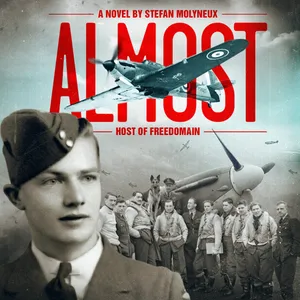
Free Daily Podcast Summary
"Almost" - A Novel by Stefan Molyneux: Daily Summaries Delivered
by Stefan Molyneux, MA
Get key takeaways, quotes, and insights from "Almost" - A Novel by Stefan Molyneux in a 5-minute read. Delivered straight to your inbox.
Latest Episodes
The most recent episodes — sign up to get AI-powered summaries of each one.
- Dec 1, 20201h 2m
"Almost" Part 33: Book 3, Part 4
Chapter 99The siren jolted Tom from sleep. His body twisted on his little cot. His brain was scalded with exhaustion. He flew ten, twelve, fourteen hours a day. He closed his eyes at night, and saw his trembling windshield, felt the shaking of his seat as he opened fire, jerked his head involuntarily as his bullets chewed bits of metal off Nazi aeroplanes. When he slept, he dreamt of flying. It felt as if he had closed his eyes for only a few minutes when the siren started up again. Sometimes, he dreamt of the siren, and even in his sleep, he was afraid that the siren was really going off, and he was losing precious minutes of altitude and interception.Tom was one of three thousand fighter pilots. Modern warfare had come down to such tiny numbers. Three thousand knights of the air who threw themselves into the sky as a shield against the oncoming German air force, the Luftwaffe.For the first time in his life, Tom knew complete rage. He had been afraid for so many years that it was a blessed relief to have something tangible and evil to shoot at. He had joined the Royal Air Force in November, 1938, the day after his conversation with Gunther about radar. He met a few of his former students, who wondered what had taken him so long. He contacted a secret tribe he had always dreamed of; men his own age who knew that there was going to be war, and ignored or found amusing the endless antics of the appeasers. Tom was utterly humbled by their courage. They had all read reports about the hopelessness and doom of modern aerial combat. They knew nothing of the existence of radar, but they were unafraid. Tom met two young men who had been present at his great debate at Oxford in 1933, who had voted for the resolution to refrain from fighting for King and Country. One of them was abashed and shamefaced. The other just laughed and said: “Oh, but I’m still not fighting for King and Country. At the time, King and Country were appeasers. Still are. And I still refuse to fight for them. Now, I fight for myself. I am just sad that I shall be saving them as well.”They were mostly children of the lower middle classes – very few came from England’s elite schools.There were some refugees from the Continent. By far the most skilled pilots were the Poles. They had a careless sort of courage which allowed them to perform maneuvers which took Tom’s breath away. They did ‘victory rolls’ when returning from combat – one roll for each German plane shot down, which none of the British pilots had the stomach for. To do a victory roll when you didn’t know what sort of structural damage your aeroplane had sustained in combat..? Ugh!But they were the highest-scoring pilots. Some of the British were good – Lock, Bader, Lacey, Lane – but more than eighty percent of the pilots had never even shot at an enemy plane. This was partly luck – finding enemy planes in the endless blue was very, very hard. And even if you found them, they were so easy to lose again. It happened all the time. One moment, the sky was full of planes; the next, it was empty, and you had to go home alone.The battle was hard. Very hard. You flew far more than you fought. But the RAF had some significant tactical advantages. They had more fuel for fighting – the Messerschmidt BF109 fighters could only spend half an hour over England before having to turn back to France. The Spitfires had a tighter turning radius than the 109s, and so could get into a kind of ‘spiral’ turning war with the German fighters, inching closer to a good firing position with every loop...
- Nov 28, 20202h 27m
"Almost" Part 32: Book 3, Part 3
Chapter 92Ruth was not by nature a confrontational person, and she agonized over her decision to confront her husband for over a week. It was, for her – and quite literally – the worst thing in the world. Something about demanding something from him – enforcing her will – made her feel as if she were hanging from a frayed rope over an endless chasm.And what was worse, the events at Munich – which she followed daily in the newspaper – were forcing her to act, and act now. The endless excuses of procrastination were being overshadowed by the need to do something now, immediately, before the time was lost. It’s now or never, she kept thinking, and ruminated for a long time on the last word… Because the ‘never’ has already been happening for twenty years. The ‘never’ is not in the future, but was in the past…Every time she made a decision, or fixed a time, she shied away. The confrontation and herself were like opposing magnets. The more effort she put into bringing them together, the more they seemed to fly apart.Her attitude wasn’t helping. After enough time, even badly-married couples can hide very little from each other. She was nervous, and prone to outbursts, headaches, and speaking out of turn. It seemed impossible to confront him. She must confront him.It had a lot to do with Tom. Ruth knew, in her heart, that she would not see him unless she acted. Oh, she might see him at family functions – or even have the odd, stiff lunch – but it would never be the same again. Never be as it once was. When he was her secret, lovely heart. But it was more than that. It was about much more than Tom. I want to exist before I die, she thought.But Quentin was always busy, and Ruth didn’t want to warn him of what was coming. If she went to him and said: I need to speak with you about something of great importance tomorrow at seven p.m., he would be tipped off, and all would be lost. He would be busy, or distracted, or would have time to think up some sort of counter-scheme…And – and he would need time to think. This was the worst part, the part that caused her to bite her nails to the bone. But I cannot give him time to think! It will all be over then! I must force him! I must force him!To do what? was her first thought. But that was quickly resolved by the newspaper. To oppose Munich. To change sides. To join Churchill and – and Gunther…
- Nov 24, 20201h 51m
"Almost" Part 31: Book 3, Part 2
Chapter 84 Ruth vomited, the precious scrap of paper clutched in her fist. She did not keep quiet. She did not hold her hair back. Her customary terror of germs was gone. She was an animal trying to purge a poison. When she had returned with Catherine from Uxbridge’s little room, she had been struck down by a terrible suspicion. She was no stranger to avoiding her own thoughts, but this one smashed through her defenses like a thundering locomotive through an opening-day ribbon. When did my brothers die? They died in 1915. In the summer. Quentin signed for the grenades in the summer of 1915. They were not terribly far from each other. The middle of France. None of her three brothers were in the same outfit; the Army didn’t want to risk wiping out entire bloodlines. And, strangely enough, the thought had struck Ruth with a grim certainty. She did not imagine that it would be anything other than what it turned out to be. It would be one of them, or… Or… The thought was striking, insistent. Or there was never any reason for you to have stayed in bed… But that made no sense. How could she have known? My guilt was entirely about my father, she thought blindly, vomiting once more. My betrayal of my husband, my love for and hatred of Gunther, my complicity in the coming of war… I knew nothing about Quentin’s guilt. I knew nothing about what he had done during the war. I could not stand to ask – and now, I know, he could not stand to tell me… But all lost lives are lived in the shadows of silence. Active silence. Silence that is a turning away. When you cover your eyes, you cover your mouth. And your heart. Your soul.
- Nov 22, 20201h 15m
"Almost" Part 30: Book 3, Part 1
BOOK THREEChapter 81Runciman was almost too much for Reginald to bear.Cuthbert had had his faults, but had been able to rouse himself to some sort of passion about British interests and international affairs. Runciman was almost to urbane to draw breath. He smoked endlessly, through a long black cigarette holder. He had lazy eyes, a long nose and a tiny moustache. He was imperturbable. He yawned when their aeroplane had hit a chilly downdraft over some mountains. Reginald was used to yawns from Cuthbert, but this was quite another matter. Cuthbert’s indifference had been an affectation. Runciman’s was innate.On the aeroplane, Runciman had made things very clear to Reginald.“You see, my boy, it’s quite simple. All our negotiation will be a show. We’ve already talked to the German Foreign Office and asked them to give us a list of their demands. We’ve assured them that we are going to press Benes into two dimensions to accept them. Classic diplomacy. We go, we lie, we return. We hint to Hitler what we might do – fight. We hint to Benes what we might not do.” Another yawn. “Fi-ight.”As Runciman dozed, Reginald’s hands kept wandering over the armrests of his humming seat. The image of his tiny little brother, in a garden shed, turning blue, kept coming back to him. It was accompanied by a question, which he tried to bat away with all the mental hands he could summon, which was enough for a hall-full of riotous applause.But the question made it through anyway:What am I doing here?He glanced over at Runciman’s dozing profile. He saw that the older man had fallen asleep holding a cigarette, still burning in its holder, between two fingers. Reginald reached out and took it, to put it out.“I say, old fellow,” murmured Runciman, not opening his eyes. “You want one, just ask.”“Sorry,” said Reginald. “I thought you were done.”Runciman grunted, turning to the window. Reginald stabbed out the cigarette. He remembered a time, as an undergraduate, when he had tried to smoke for a week, and had been driving when his cigarette fell from his lips into his groin, scalding his testicles, and he had felt trapped panic at his need to keep his eyes on the road, as well as to stop the burning…Reginald sighed, closing his eyes. If I ever figure out the point of these random little visions…
- Nov 16, 20201h 24m
"Almost" Part 29: Book 2, Part 19
Chapter 75Tom had never seen such joy, and it was a terrible thing to behold.Even the German troops were taken aback. Crowds of men, women and children lined the streets, screaming themselves hoarse. Shimmering clouds of flower petals rained down on the armed columns, like unicoloured butterflies.He was watching the parade from the balcony of the British Embassy, with Sir Palairet. The Ambassador was in silent tears. Tom was not far behind.“The strangest thing,” murmured Sir Palairet, “is that they genuinely believe that they are being liberated.”“No Jews,” said Tom, looking for yarmulkes in the crowd.“No, but they haven’t left. They think that… Oh, I don’t know what they think.”“Where in Europe would they go? Can’t go East. Can’t go West.” Tom sighed. “I don’t know why they’re so happy.”“Race…”“Why do they care about race?”“It’s what failures cling to. So they don’t have to do anything to be special.”“This is more than the work of failures,” said Tom with a shudder. “This is something far darker. Deeper. Older.”“Well, we handed it to them, didn’t we?” asked Sir Palairet sadly. He could not tear his eyes away from the procession.“How?”“We told them that a country was defined by culture. By race. By history. By… language.” He almost seemed to spit out the last word.“What do you think a country is defined by?”“The good,” said Sir Palairet softly.The word was almost lost among the clatter of boots and the clashing of arms, but it hit Tom solidly, in the solar plexus. The good…
- Nov 12, 20201h 37m
"Almost" Part 28: Book 2, Part 18
Chapter 70 A child can go down, into the depths of parental numbness. It doesn’t matter how old the child is, or the parent. The umbilical is sometimes a lifeline, thrown to the future, with which a mother can hope to haul herself up the well of her own dying. And children can so rarely tear themselves from around that well. A parent present, but absent, can be the bottomless quicksand of an entire lifetime. Tom thought about his mother’s revelation long and hard. It consumed him. Invaded him. He thought about it before going to sleep. He dreamt about it. It greeted him on awakening, during the instant evolution of abandoning sleep. I am a carbon-based life form. I am human. I am Tom. I am not my father’s son. He briefly considered writing to Gunther, but got stuck on the salutation. Dear… And it really should be something they talked about face-to-face. It became more and more important, because in the weeks after the Rhineland crisis, Ruth seemed to go down even further. Something was gnawing at the root of her soul, and Tom knew that it wouldn’t be long until that root would give way, and she would fall further, into the numb, floating center of the earth. The lengths of his responsibilities gnawed at him as well. Tom began to truly hate Quentin. It was not a resentful hatred. It was not just reactive. He hated both Quentin and Reginald, because they provoked suffering and then stood by with slight smiles as it writhed at their feet. They weakened people with scorn and indifference, then turned them over with their toes to mock their weakness. It’s like knocking someone down, then calling them lazy for lying around… He felt some frustration with his mother as well, but much, much less. It is always harder to pin responsibility on the feminine. Ruth was not free; not politically, not economically, not socially. She had been forced to make a choice – by society, biology, it didn’t matter which – in the full blindness of youth, when her future was almost completely unconscious, and so inevitable. Tom wept on waking one morning, thinking of his mother’s potential, and felt that he had come as close as he ever had to the root of her depression. She is a wonderful political wife. She is very intelligent. She is moral, quite moral, in her own way. She chose her husband for all the shallow, impractical reasons of youth. She was passionate – imagine her having an affair, then covering it up, then being so full of anger that she denounced her lover at every step. The will to keep such secrets..! For they were kept, and magnificently too! To have Gunther in our house, during the war… My God – I wonder if they made love that rainy day, when Reginald refused to put the destroyer away, when Gunther locked him away… She had a headache, and he ordered her back to bed. And Quentin let it all happen. Quentin had no idea – unless, of course, Quentin did have an idea, but felt that it assuaged something. Took responsibility away from him. To make her happy. And, of course, Quentin has secrets of his own. You can almost smell his secrets; they waft from his pores like spices left damp and underground…
- Nov 7, 20201h 9m
"Almost" Part 27: Book 2, Part 17
Chapter 68Klaus was astounded at the amount of human energy that can be released by pushing all conflicts into the unconscious.He was an educated man; he knew that the Nazis represented a radical break with European traditions – but then, Germany had never really been a part of Europe anyway. That Europe. The Europe he had studied in England. The Europe of reason and compromise and all the natural difficulties of different viewpoints. In Germany, there were no different viewpoints. There was one note; you could play it loud, or soft.Klaus had been out of Germany for six years. When he had returned, he had mostly stayed at his father’s house. He had spent a little time in the larger cities – mostly Berlin and Hamburg, but they became depressing as the Depression worsened. His city friends had scattered with the onset of Nazism; a few had fled, most had joined. His local friends – the rural idiots, he called them – were largely indifferent to politics. They were happy that the Nazis were in power, because they got to keep their farms, which had been mortgaged to the hilt during the Depression, when it was impossible to make a living from honest crops. But such city matters as freedom of the press didn’t trouble them much.In his new ‘Nazi experiment,’ Klaus had tried talking to them about Hitler, but it didn’t do any good. It was quite fascinating, and he found it hard to avoid the alienating contempt of the intellectual. They could only see politics in the most local, tangible and practical of terms. They cared nothing for freedom, the Reichstag or the death of the Republic. They wanted good rains and dependable insurance. They wanted their sons to work and their daughters to get married. They wanted to go to church and sit with a pipe. They wanted to know the words to every song that could be sung. They were the rhythm of the land, of the seasons, of the decades between birth, marriage and re-birth. When he was younger, Klaus thought that they might be wise, in their own slow, stolid way. But now, he knew that it was not so. Extend that principle, he thought, and trees become sages.The Nazis were a curious bunch. Klaus could never quite decide if they believed their own propaganda or not. They would seem to – some at the salon evenings at Count Orsky’s were most passionate on this point – but in their very next breath, they could as easily say that all these lies were only designed for the masses, and that whoever swallowed such idiotic bait was utterly unsophisticated. Klaus could not follow their transitions.Another curious item was the Nazi’s ability to combine a hatred of authority with an absolute allegiance to the Fuhrer. When Klaus, early on, began to point out some of the contradictions inherent in the Nazi theory of life and history, he was reviled. Any attempt to bring the authority of logic or experience on their beliefs was considered more insulting than a physical attack. They hated external authorities, but crawled before the image of Hitler without a thought. Most odd...
- Nov 5, 20201h 26m
"Almost" Part 26: Book 2, Part 16
Chapter 63In October 1935, Mussolini’s Grand Army crossed the border into Abyssinia. This land had been independent since the days of King Solomon. It was the only African country to successfully resist European invasion in the nineteenth century.The Italians had modern aeroplanes, tanks and flame-throwers. The Abyssinians had war-drums, camels and twelve obsolete biplanes. The Italians used poison gas and bombed Red Cross hospitals. The League of Nations applied some sanctions, but not enough to stop the war. The British let oil and coal sail through the British-controlled Suez canal. The French sold oil to the Italians. The League forbade arms sales to either side.The Abyssinians were slaughtered.Cuthbert was outraged.It was the first time any of his employees had seen him anything other than bored and distemperate. It made them all panic. Each of them ran around, feeling the weight of the Abyssinian crisis as he had been directly responsible for it. Cuthbert acted as if he had been against the League of Nations from the start, but had been overruled by his underlings – and now had the full magisterial right of a man who had given good but unheeded advice.The truth was that the FO was in quite a bind, and Cuthbert felt it most keenly. Throughout his career, he had been in the position of unequalled expert. His detailed knowledge was consulted, deferred to, sought after and never questioned. His position was a kind of weapon; his heavy, bludgeoning personality saw that it never went unused.But now, things were crawling out into the open. The British public – largely due to propaganda coming out of the FO – were almost fetishistically enamoured of the League of Nations. The League of Nations served Cuthbert perfectly, because he could blame the other members if a British initiative failed, and take personal credit if something succeeded. The greatest engine of the mortal world is the drive to avoid responsibility and fuel vanity. The League of Nations was popular with the people because it served the vanities of the leaders.Cuthbert was in a very privileged position, and this position was directly threatened by Mussolini. He was the chief civil servant under Samuel Hoare, the Secretary of State for Foreign Affairs. Cuthbert had seen quite a few ministers stumble through the FO – it did not tend to attract the best and brightest – and had loved them all. They had the microphones and interviews, but spoke little but what Cuthbert wanted them to say. The word ‘democracy’ always made him smile. Ministers who went against the policy of the civil service – surely a more permanent and skilled layer – found unpleasant information leaked to the newspapers, or were given poor advice which got them kicked out. In the palaces of power, the civil service were neither king, queen or courtier, but oxygen. An invisible, unfelt substance on which all pomp and power depended.Being a great civil servant required two things, according to Cuthbert. One had to be very certain, and very patient. “The great virtue of the civil service,” he would say, “is that we are not subject to the vagaries of public opinion. We are the ballast of the ship of state.”He was not a great fan of democracy, except insofar as the illusion of participation created the moral requirement of obedience. “They vote in the figureheads,” he smiled, “and we tell them what to do. If they succeed, they preen. If not, they leave. But we remain. We always remain.”
Get "Almost" - A Novel by Stefan Molyneux summaries in your inbox
Free AI-powered daily recaps. Key takeaways, quotes, and mentions — in a 5-minute read.
Get Free Summaries →Free forever for up to 3 podcasts. No credit card required.
You Might Also Like
Listeners also like.

Almost False
Almost False

Freedomain with Stefan Molyneux
Stefan Molyneux

Almost Serious
Elijah Schaffer
The Partially Examined Life Philosophy Podcast
Mark Linsenmayer, Wes Alwan, Seth Paskin, Dylan Casey

Almost Forty
Kylie Lately
The Partially Examined Life
Mark Linsenmayer

Almost Awakened – Almost Awakened
Brittney Hartley & Bill Reel

Modern Meditations - Stoicism For The Real World
Justin Stohlton & Bruce Peck
Philosophize This!
Stephen West

Forum Borealis
Al Borealis

Freedomain Premium: History of Philosophers!
Stefan Molyneux, MA

Not Quite Christlike
James Kennison
About "Almost" - A Novel by Stefan Molyneux
A powerful novel by philosopher Stefan Molyneux, the host of Freedomain, the largest and most popular philosophy show on the internet, with over 700 million views and downloads.Two families - one German, and one English - find love, friendship and combat from the trenches of World War One to the skies of World War Two.
Customized Recaps
AI-powered recaps with compact key takeaways, quotes, and insights.
Straight to Your Inbox
Get key takeaways from "Almost" - A Novel by Stefan Molyneux in a 5-minute read.
Save Hours Every Week
Stay current on your favorite podcasts without falling behind.
Frequently Asked Questions
What is Podzilla's "Almost" - A Novel by Stefan Molyneux daily summary?
It's a free AI-powered email that summarizes new episodes of "Almost" - A Novel by Stefan Molyneux as soon as they're published. You get the key takeaways, notable quotes, and links & mentions — all in a quick read.
How does the "Almost" - A Novel by Stefan Molyneux podcast summary work?
When a new episode drops, our AI transcribes and analyzes it, then generates a personalized summary tailored to your interests and profession. It's delivered to your inbox every morning.
Is this an official "Almost" - A Novel by Stefan Molyneux product?
No. Podzilla is an independent service that summarizes publicly available podcast content. We're not affiliated with or endorsed by Stefan Molyneux, MA.
Can I get summaries of other podcasts too?
Absolutely! The free plan covers up to 3 podcasts. Upgrade to Pro for 15, or Premium for 50. Browse our full catalog at /podcasts.
What topics does "Almost" - A Novel by Stefan Molyneux cover?
"Almost" - A Novel by Stefan Molyneux covers topics including Fiction, Arts, Books, Drama. Our AI identifies the specific themes in each episode and highlights what matters most to you.
Start getting "Almost" - A Novel by Stefan Molyneux summaries tomorrow morning.
Free forever for up to 3 podcasts. No credit card required.
Free forever for up to 3 podcasts. No credit card required.