Free Daily Podcast Summary
The Partially Examined Life Philosophy Podcast: Daily Summaries Delivered
by Mark Linsenmayer, Wes Alwan, Seth Paskin, Dylan Casey
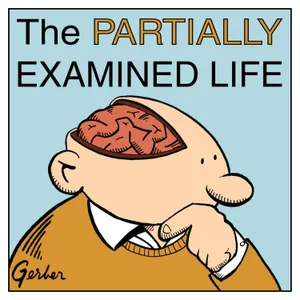
The Partially Examined Life is a podcast by some guys who were at one point set on doing philosophy for a living but then thought better of it. Each episode, we pick a short text and chat about it with some balance between insight and flippancy. You don't have to know any philosophy, or even to have read the text we're talking about to (mostly) follow and (hopefully) enjoy the discussion. We also feature episodes from other podcasts by our hosts to round out your partially examined life, including Pretty Much Pop (covering all media), Nakedly Examined Music (deconstructing songs), Philosophy vs. Improv (fun with performance skills and philosophical ideas), and (sub)Text (looking deeply at lit and film).
Latest Episodes
The most recent episodes — sign up to get AI-powered summaries of each one.
- Today51 min
Ep. 400: Dennett Rejects Qualia (Part Two)
Continuing on Consciousness Explained, ch. 12-14, especially responding to Dennett's discussion of Nagel's "What Is It Like to Be a Bat?" which which gets us in a whole conversation about animal consciousness. What is it like to be any languageless creature? How is the debate relevant to ethical issues? Get more at partiallyexaminedlife.com. Visit partiallyexaminedlife.com/support to get ad-free episodes and tons of bonus discussion.
- Today55 min
PEL Presents Closereads: Late Dennett on Consciousness (Part One)
On "Are We Explaining Consciousness Yet" (2001), an article published with and commenting on papers by psychologists, neurologists, etc. on the state of consciousness studies at the time, featuring his newer metaphor for consciousness, "fame in the brain." Follow along with us. You can choose to watch this on video. Subscribe to Closereads at patreon.com/closereadsphilosophy; follow us there via the free tier to get many other episodes like this one ad free, or pay us to get part 2 and everything else we've recorded. (Alternatively, support both PEL and Closereads at patreon.com/partiallyexaminedlife for a nice combo deal.)
- 2 days ago49 min
PEL Presents PMP#230: Gettin' Furious
To begin our new season, we're up to the moment covering the first season of Elizabeth Meriwether's Hulu crime drama Furious, about an abused detective pursuing, and ultimately relating to, an abused revenge killer. The first half is spoiler free! How does this relate to other revenge fantasy films (e.g. Kill Bill) or other shows where we're supposed to be attracted to a female killer (Killing Eve)? It it good in the manner of The Wire? We talk a lot about casting, the showrunner, and especially decisions made in ending the season. Would this have been much better as a mini-series than as something that will now have a second season that may well jump the shark? Get more at prettymuchpop.com. Get an ad-free experience, plus bonus talking for nearly every episode at patreon.com/prettymuchpop.
- 1 weeks ago52 min
Ep. 400: Dennett Rejects Qualia (Part One)
We focus on the final chapters of Dan Dennett's Consciousness Explained, where he confronts various views, figures, and thought experiments that contend that he's failed to explain the essence of consciousness: the "what it's like" element of any conscious experience that is distinct from a mere judgment or processing of information. One could imagine a being that organizationally matches Dennett's multiple drafts model, acts just like an intelligent person, and yet lacks consciousness. Dennett denies this. Get more at partiallyexaminedlife.com. Visit partiallyexaminedlife.com/support to get ad-free episodes and tons of bonus discussion. Sponsor: Visit functionhealth.com/PEL to get the data you need to take action for your health.
- 1 weeks ago53 min
PEL Presents PvI#124: Navel Evaluation (Our Season 5 Finale)
We wrap up Mary's first year with the podcast, and changes are afoot for our upcoming season, but why? Let's explore to the point of physical discomfort! We act out an odd annual employee review, a dramatic pitch for a new play, and the navel-gazing club. Hear more at philosophyimprov.com. Support the podcast and listen ad-free at patreon.com/philosophyimprov.
- 1 weeks ago1h 4m
PEL Presents NEM#260: Jacqui Hunt (Single Gun Theory) Now Master of Her Synth Domain
Jacqui rose to fame with the Australian electronic dance band Single Gun Theory (three albums '87-'94), did some one-off collaborations, and released her first solo album in 2008. After an album as CiiVE and some solo singles, she's now released her second solo album, Desiderium. We discuss "Planet" and listen at the end to "Cycles" from that new album, plus "Myriad" from Auraphonic (2008), and "The Sea of Core Experience" by Single Gun Theory from Flow, River of My Soul (1994). Intro: "Take Me Back" by Single Gun Theory from Millions, Like Stars in My Hands, The Daggers in My Heart Wage War (1991). More at jacquihunt.net. Hear more Nakedly Examined Music at nakedlyexaminedmusic.com. Support us at patreon.com/nakedlyexaminedmusic.
- 2 weeks ago51 min
Ep. 399: Dan Dennett's Model of Mind (Part Two)
Continuing on Consciousness Explained (Ch. 5, 12). We talk about appearance vs. judgment and whether Dennett's denial of this distinction makes sense or just holds for very short time-scales, as in the phi-phenomenon experiment. Does the rejection of appearances and rejection of the concept of qualia undermine the very thing Dennett is trying to describe? Get more at partiallyexaminedlife.com. Visit partiallyexaminedlife.com/support to get ad-free episodes and tons of bonus discussion. Sponsor: Get your free trial at shopify.com/pel.
- 2 weeks ago54 min
PEL Presents Closereads: Donald Davidson on Self-Knowledge (Part One)
On "First Person Authority" (1984). What warrants our superior knowledge of our own mental states, as oppose to those of others? Why is this not obvious? Read along with us. You can choose to watch this on video. Subscribe to Closereads at patreon.com/closereadsphilosophy; follow us there via the free tier to get many other episodes like this one ad free, or pay us to get part 2 and everything else we've recorded. (Alternatively, support both PEL and Closereads at patreon.com/partiallyexaminedlife for a nice combo deal.)
Get The Partially Examined Life Philosophy Podcast summaries in your inbox
Free AI-powered daily recaps. Key takeaways, quotes, and mentions — in a 5-minute read.
Get Free Summaries →Free forever for up to 3 podcasts. No credit card required.
You Might Also Like
Listeners also like.
Philosophize This!
Explores the history of philosophy by breaking down key thinkers and ideas in chronological order for a general audience.

The UnMute Podcast
Philosophers discuss current social and political issues with insight, humor, and a drive for change.

Psychiatry & Psychotherapy Podcast
Explores psychiatry and psychotherapy through interviews with experts, trainees, and individuals sharing lived mental health experiences.

Theories of Everything with Curt Jaimungal
Analyzes theoretical physics, consciousness, AI, and metaphysics with rigorous, unconventional depth.
Stanford Psychology Podcast
Students interview psychologists about recent research and its real-world applications in mental health, behavior, and cognition.

Weird Studies
Conversations on art and philosophy that explore unsettling ideas and works challenging the boundaries of reality.
The Psychology Podcast
Explores human potential and possibility through conversations with scientists, thinkers, and self-actualized individuals.
In Our Time: Philosophy
Discusses philosophers, theories, and key themes in philosophy, from altruism to Wittgenstein.

Forum Borealis
In-depth interviews with authors and thinkers on unconventional topics in history, science, philosophy, and politics.
Good Life Project
Explores meaningful living through conversations with experts in science, culture, and the arts.
Stuff To Blow Your Mind
Explores the strange edges of science, consciousness, and reality through neuroscience, cosmology, evolution, and emerging technology.
Inner Cosmos with David Eagleman
Neuroscientist David Eagleman examines how the brain interprets reality through science, stories, and interviews.
About The Partially Examined Life Philosophy Podcast
The Partially Examined Life is a podcast by some guys who were at one point set on doing philosophy for a living but then thought better of it. Each episode, we pick a short text and chat about it with some balance between insight and flippancy. You don't have to know any philosophy, or even to have read the text we're talking about to (mostly) follow and (hopefully) enjoy the discussion. We also feature episodes from other podcasts by our hosts to round out your partially examined life, including Pretty Much Pop (covering all media), Nakedly Examined Music (deconstructing songs), Philosophy vs. Improv (fun with performance skills and philosophical ideas), and (sub)Text (looking deeply at lit and film).
Customized Recaps
AI-powered recaps with compact key takeaways, quotes, and insights.
Straight to Your Inbox
Get key takeaways from The Partially Examined Life Philosophy Podcast in a 5-minute read.
Save Hours Every Week
Stay current on your favorite podcasts without falling behind.
Frequently Asked Questions
What is Podzilla's The Partially Examined Life Philosophy Podcast daily summary?
It's a free AI-powered email that summarizes new episodes of The Partially Examined Life Philosophy Podcast as soon as they're published. You get the key takeaways, notable quotes, and links & mentions — all in a quick read.
How does the The Partially Examined Life Philosophy Podcast podcast summary work?
When a new episode drops, our AI transcribes and analyzes it, then generates a personalized summary tailored to your interests and profession. It's delivered to your inbox every morning.
Is this an official The Partially Examined Life Philosophy Podcast product?
No. Podzilla is an independent service that summarizes publicly available podcast content. We're not affiliated with or endorsed by Mark Linsenmayer, Wes Alwan, Seth Paskin, Dylan Casey.
Can I get summaries of other podcasts too?
Absolutely! The free plan covers up to 3 podcasts. Upgrade to Pro for 15, or Premium for 50. Browse our full catalog at /podcasts.
How often does The Partially Examined Life Philosophy Podcast release new episodes?
The Partially Examined Life Philosophy Podcast publishes every few days. Our AI generates a summary within hours of each new episode.
What topics does The Partially Examined Life Philosophy Podcast cover?
The Partially Examined Life Philosophy Podcast covers topics including Philosophy, Culture, Society & Culture. Our AI identifies the specific themes in each episode and highlights what matters most to you.
Start getting The Partially Examined Life Philosophy Podcast summaries tomorrow morning.
Free forever for up to 3 podcasts. No credit card required.
Free forever for up to 3 podcasts. No credit card required.