Free Daily Podcast Summary
AI Literacy for Entrepreneurs: Daily Summaries Delivered
by Northlight AI
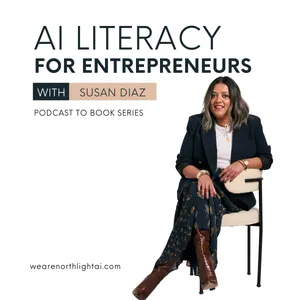
"AI Literacy for Entrepreneurs", with host Susan Diaz, helps you integrate artificial intelligence into your business operations. We'll help you understand and apply AI generative in a way that is accessible and actionable for entrepreneurs at all levels. With each episode, you'll gain practical insights into effective AI strategies and tools, hear from leading practitioners with deep expertise and diverse use cases, and learn from the successes and challenges of fellow business owners in their AI adoption journey. Join us for the simplified knowledge and inspiration you need to leverage AI effectively to level up your business.
Latest Episodes
The most recent episodes — sign up to get AI-powered summaries of each one.
- 1 weeks ago43 min
EP278 AI Governance in Higher Ed with Dr. Eugene Chan
Most organizations govern AI the same way cities govern speeding. They set a rule, then punish people who break it. Dr. Eugene Chan thinks that's the least interesting tool available. He's a behavioural scientist - founder of the consultancy Behavieural and Professor of Business at Tyndale University - and his argument is that punishment is a lagging response to a problem you could have designed out. His analogy is a speed camera versus a speed bump. Both reduce speeding. The camera does it by fining you after the fact, and it needs maintenance forever. The speed bump does it by making the behaviour physically inconvenient, and you install it once. One punishes. The other just makes the wrong thing harder to do. Apply that to shadow AI, or to the human-in-the-loop review that everyone claims to have and nobody actually does, and the conversation changes shape entirely. Host Susan Diaz and Eugene also get into why universities are harder to govern than corporations, why a single institution-wide AI rule can't work when the philosophy faculty and the accounting faculty need opposite things, why the white-font trick some professors are using is a symptom rather than a solution, and what a provost should map before writing a single line of policy. Susan and Eugene are building a governance mapping engagement for higher education institutions together. If that's you, get in touch. About Dr. Eugene Chan Dr. Eugene Chan wears two hats. He's the founder of Behavieural, a consultancy that uses behavioural science to help organizations solve trust challenges - AI adoption, customer loyalty, brand and PR. He's also Professor of Business and Marketing at Tyndale University, and has taught at TMU as well as in Australia and the United States. His PhD in management is from the Rotman School. What we get into Two hats: behavioural science consultancy and the business school Policy versus governance, and why even the consultants can't define it clearly Susan's working definition: policy is the best practice, governance is the daily behaviour Confusing access with literacy - why handing out licences isn't adoption AI as the internet 25 years ago, and why there's no chief internet officer Who actually owns AI governance? "Talk to IT" isn't an answer The case for the CTO, the case for legal, the case for HR Why universities are structurally harder than corporations Three groups, three different toolsets, one institution Why "use AI and you fail" is a more rational position than it sounds But banning it is not enforceable. It's like banning the calculator. The better question: under what circumstances should it be used? Why this can't be one rule for a whole university Susan's classroom approach - use it, then defend it Why that teaches a skill most working professionals don't have Susan on delegation, and what "senior human in the loop" means The white-font trick professors are embedding in assignment briefs Turnitin, AI detectors, and what a 30% match actually tells you Governing by consequence, and where that runs out Speed cameras, speed bumps, and a Toronto argument Friction instead of punishment Applying it directly to shadow AI Cameras need maintenance. Speed bumps don't. Susan's reframe: leading indicators and lagging indicators Why human-in-the-loop fails when everything's on one screen Five screens instead of one The student problem - personal devices, personal subscriptions What higher ed leaders should be thinking about beyond cheating Map it, survey it, treat it as a situation analysis Silos, and why this has to come from the provost level Why an honest map is cathartic rather than damning The questions to answer before you write any governance If AI frees up staff time, where does that time go? The flywheel, and why the first turn is the hardest Quotes "You cannot ban the use of AI. At least you cannot enforce it. I
- 3 weeks ago37 min
EP277 Is AI Going to Take the Gift of Failure Away? asks Julie Cole
Episode description Julie Cole and her co-founders started Mabel's Labels in a Hamilton basement 23 years ago, back when customers were still nervous about typing a credit card number into a computer. They figured out early that they weren't really running a label company - they were running a tech company that happened to make labels. Nothing off the shelf did what they needed, so they built it themselves. Which is why her read on this moment carries some weight. She's watched every technology wave since. She's not a skeptic and she's not a cheerleader. She uses AI, has a clear personal rule for when she will and won't, and is clear about where companies are getting it wrong with customers. But she circles one worry: young entrepreneurs are now building in a day what took her team six months in that basement, and she isn't certain the lessons survive the shortcut. She's worried AI is going to take the gift of failure away. Also in this one: the LinkedIn post that made her furious, why she has two full-time people whose entire job is email, what her funeral-director son has to do with AI-proof careers, the Air Canada chatbot case, and why turning up in person has become a strong marketing strategy. About Julie Cole Julie Cole is co-founder and Senior Director of Mabel's Labels, the Hamilton-born company she and three co-founders launched from a basement in 2003 and grew into a household name. She's a recovered lawyer, a mom of six, an award-winning entrepreneur, and the best-selling author of Like a Mother: Birthing Businesses, Babies, and a Life Beyond Labels. She's a regular on Canadian television and a fixture at women's entrepreneurship events across the country - which, as this episode argues, is not incidental to how she's built the brand. What we get into Why a label company is actually a tech company Hamilton, 2003, and the fact that there wasn't a nerd among them Susan's shoe labels, and a core memory involving a three-year-old choosing fonts Watching kids grow up through the icons they pick Twenty-three years of technology waves - what's different this time Six months in a basement versus one day now. What gets lost? You can't put your head in the sand about this "I didn't know you could write like that" - the LinkedIn post that stung What fresh hell is this Where companies are getting AI badly wrong with customers Julie's litmus test for when she'll use AI and when she won't Six kids, generational skepticism, and hiding the tab when they walk in Susan's podcast platform story: how a 30-minute task became 24 hours The Air Canada chatbot case, and who's responsible for what your bot says Founder-forward PR, and the CEO as the next influencer The fake expert problem, and how people will start telling the difference Lower your production quality. Let the dog in. Turning up in person is having a moment "Don't tell me you're authentic. Show me." LinkedIn's report-AI-slop button, and the problem LinkedIn built for itself "If I rest, I rust" <p dir="ltr" role="presenta
- Aug 12, 202632 min
EP276 Your AI Strategy Is a Hammer. Where's the Nail? - with David Cohen
"We need AI" is the most common brief in business right now. David Cohen's read on what it means: usually nothing in particular. David is the founder of Superposition, a consultancy for data and AI consultancies - a meta consultancy, as he calls it. He's spent his career inside both big and boutique consulting shops, which makes him refreshingly blunt about what's actually happening in the services world right now. His diagnosis is that we're still in the solution-in-search-of-a-problem stage. Everybody's curious. Everybody's excited. There's enormous movement, enormous hype, and very few real outcomes. And most organizations hiring AI help have not identified the problem they're hiring it to solve. Susan pushes on the bigger question underneath: if we're in the knowledge era and knowledge just got cheap, what happens to everyone who sells expertise for a living? David's answer is that knowledge didn't lose value - access did. What's scarce now is contextualized knowledge. The kind that accounts for internal politics, history, and the things no system can pick up from the outside. Also in this one: why consulting content is so relentlessly boring, what surprised Susan when she asked clients why they hired her, and the two words that should precede any AI purchase. About David Cohen David Cohen is the founder of Superposition, a consultancy built for data and AI consultancies. He's a lifelong consultant with both big-firm and boutique experience, and over a decade of delivering data and AI transformation work at F500 scale. He now advises boutique founders on the existential problems of running a firm - go-to-market, positioning, pricing models, and hiring. He builds his workshops and content to be collaborative and genuinely fun, on the theory that the consulting world has more than enough beige. He's based in Dallas. What we get into Schrödinger's data consultants - where the name Superposition comes from Why he serves other consultants, and the personal story behind it What clients actually mean when they say "we need AI" (spoiler: FOMO) The scale check - the average person does not care about AI tools Automation has existed for decades. Generative AI is not the origin story The two things every consultant is really selling - expertise and risk mitigation Why clients now assume they shouldn't have to pay for intelligence The consulting growth model, explained at a fifth-grade level - and why it's breaking Is the knowledge era ending? David's answer: knowledge didn't change, access did In the age of infinite information, the right information is the value Contextualized knowledge - internal politics, feelings, history, and what AI can't pick up The hype cycle, honestly assessed. Blockchain, Metaverse, VR, social What AI becomes after the hype dies - the Google test Asking rather than deploying first Why consulting content is bland, boring, and forgettable Susan's client research, and the two answers she never expected The clarity problem: consultancies that don't know what they're selling Ann Handley's joke about world hunger and 500-word LinkedIn posts "A hammer in search of nails" - why real outcomes are still rare The problem-first test, and when you should not be solving anything</
- Jul 29, 202634 min
EP 275 "Do I Trust Myself?" Grace Gravestock on the Real Reason AI Adoption Stalls
Episode description Everyone's arguing about whether AI can be trusted. Almost nobody's asking the harder question underneath it. Grace Gravestock has spent more than twenty years leading change management on some of the highest-profile technology projects around - including the team that set the stage for the $67B Dell EMC integration. Her verdict on why AI pilots stall is unsentimental: it's the same reason ERP stalled, and CRM before that. People aren't using the technology the way it was intended. You can have the best tools in the world, and if people don't use them, it doesn't matter. But the conversation turns when Susan brings up the trust deficit - the LinkedIn feeds full of complaints about AI slop, the comment sections litigating whether a video is real. Grace flips the question entirely: the crisis isn't whether we trust the machine. It's whether we still trust our own judgment. Along the way: the Mac Mini that sat unused for months, why the longest-tenured experts are your real bottleneck, why young people are hitting the brakes hardest, and the one change that rescued a technology rollout that had already failed. About Grace Gravestock Grace Gravestock is a change management leader with more than twenty years on large-scale technology projects. She was part of the team that set the stage for the $67B Dell EMC integration, one of the largest tech mergers in history. Her work spans Deloitte, Dell, and Warner Brothers, plus years consulting inside the utility sector. She got her start in the UK on a government services rollout that touched every citizen in the country, at the front edge of the eGov boom. She's now turning that expertise toward AI adoption, and is writing Three Secrets to Making Change Fun and Easy. What we get into From a UK-wide government rollout to AI adoption - Grace's twenty-year arc Why AI pilots are failing, and why the answer is boringly familiar Why training isn't the root - and what has to happen before it The surprise: young people are putting the brakes on hardest and fastest Secret one - we get to choose. Why agency is the whole ballgame Why your longest-tenured experts are the real bottleneck (and why you need them anyway) The Mac Mini that sat there for months Susan on being a ChatGPT person who barely opened Claude "Am I training my own replacement?" - the fear leadership keeps answering wrong Choosing to become more human rather than less Monday morning heart attacks, and the work people don't want to go back to The people who keep their jobs will be the ones who know how to orchestrate How leaders should communicate when they don't have all the answers - WIIFM radio The single change that rescued a failed rollout: executive bonuses Two utilities, same state, wildly different outcomes "We are not planning on cutting jobs. We're planning to 10x our results." The trust deficit, LinkedIn, and the inauthenticity problem The question that reframes everything: do I trust myself? What leaders can actually do this week Quotes "You can have the best technology, and if people don't use it, it really doesn't matter." - Grace Gravestock "The biggest reason people hate change and fear cha
- Jan 1, 202642 min
EP 274 The Human OS - AI Adoption With Curiosity, Safety, and Monday Ease ft. Melissa Penton
In the final episode of the Podcast-to-Book series, host Susan Diaz sits down with change leader and AI education lead Melissa Penton (Sun Life) for a human-first conversation about what actually makes AI adoption work. They talk productivity vs room-for-life, why one-prompt culture is snake oil, the shift from prompt engineering to context engineering, and the simplest enterprise question that changes everything: "What would make Monday easier for employees?" Episode summary Susan closes out the Podcast-to-Book sprint with a conversation that feels like the point of the whole series: AI isn't a tool problem. It's a people problem disguised as a tool problem. Melissa Penton shares her lens as a long-time change manager working in AI readiness and education inside a large organisation. Her focus isn't faster work. It's making room for what matters - and designing adoption in a way that's safe, honest, and grounded in real human tension points. Together, Susan and Melissa unpack why generic prompting courses aren't enough, why people get hives when they hear words like "workflow" and "agentic," and how leaders can create real change by starting with everyday pain. They also go deep on psychological safety, the fear of "training your robot replacement," and what it looks like to lead with humility in the biggest transformation most of us will live through. Key takeaways Productivity is the doorway. Room-for-life is the goal. Saving time is nice. The real win is using that time to live in your "zone of genius" and have space for the things you care about. One-prompt culture is snake oil. Useful AI work is iterative, messy, and conversational. The magic isn't the prompt. It's the human steering, correcting, and refining. Prompt engineering is evolving into context engineering. The skill isn't "write a clever prompt." It's learning to give the right context, ask better questions, and build on responses. Enterprise adoption should start with one simple question: "What would make Monday easier for my employees?" That question forces leaders to solve real friction instead of buying shiny tools. The biggest people problem masquerading as an AI problem is readiness. AI is being thrown at people who don't know where to start, how it fits their real lives, or how it changes their work without threatening them. Training should be experiential, not theoretical. Courses can help. But capability sticks when people learn by doing, inside real workflows, with real tasks, and real feedback loops. Psychological safety is non-negotiable. People won't share pain points if they fear automation will erase their job. Leaders shouldn't make promises they can't keep. They should make learning safe and transferable. Workflows don't have to be scary. A workflow is just the steps you already take. "Ask a question → make notes → read notes → act." That's a workflow. Low-risk experiments lead to higher-risk breakthroughs. The "AI coffee warmer" might feel silly. But it's part of the lab. Small experiments teach the muscles needed for bigger transformations. Leadership in the AI era requires humility. Admit you're learning. Model curiosity. Use AI to explore recurring organisational stuck points, mediate perspectives, and surface patterns in conversations. Timestamps 00:03 — Susan sets the scene: the final stretch of the 30-day podcast-to-book sprint 01:12 — Meet Melissa: change management, training, and leading AI education/readiness 02:31 — Productivity vs "making room for what matters" (crochet, hikes, real life) 03:29 — Time saved is table stakes… what are we doing with the time? 03:58 — Zone of Genius living and why AI should move you toward it 06:44 — Snake-oil prompts, "one prompt fixes your life," and why it makes Susan grumpy 08:02 — "I am the prompt": AI as an iterative, human conversation 09:21 — Prompting → context engineering (asking better questions is the skill) 09:50 — The enterprise question: "What will make Monday easier for employees?" 11:02 — Voice mode and why it changes tone, cadence, and output quality 14:27 — The biggest "AI problem" is actually a people/readiness problem 16:20 — Start with real tension points, not an abstract AI adoption plan 18:23 — Why "prompting courses" can repel people (language matters) 20:39 — Courses aren't bad… they're just not sufficient 21:49 — Cleaning workflows as the gateway
- Dec 29, 202517 min
273 - Future-proofing your organization through continuing AI literacy
Most companies do a few AI trainings, run some pilots, and then stall. In this episode, host Susan Diaz argues the only real future-proofing strategy is continuous AI literacy. She breaks down what "continuous literacy" actually includes (skill, judgment, workflow, norms), the predictable failure modes of the AI literacy divide, and a simple flywheel you can run monthly so capability keeps compounding. Episode summary Susan opens with a familiar pattern: a burst of AI excitement, a deck called "AI Strategy 2025" a few clever workflows… and then reality hits. Tools change. Policies shift. Vendors overpromise. Early adopters keep learning. Everyone else stalls. Her reframe is blunt: AI is not a project or a software rollout. It behaves like a language. Best practices change fast. What was smart six months ago can become a bad habit in the next six months. So future-proofing isn't about predicting what AI will do next. It's about building an organization that can keep learning without burning people out or gambling with risk. That's what continuous AI literacy is. Key takeaways Continuous AI literacy has four parts: Skill: how to use AI. Judgment: whether you should use AI. Workflow: where AI fits into the process. Norms: what's safe, allowed, expected (guardrails + governance). If training only focuses on skill, you get chaos. If it covers all four, you get adoption velocity without panic. The AI literacy divide is already here. A few people sprint. Most people watch. Leadership tries to govern what they don't fully understand. HR is stuck between "train everyone" and "we have no time". That divide creates three predictable outcomes: Shadow AI (people use tools quietly because they fear bans). Innovation theatre (lots of activity, little operational change). Champion burnout (early adopters carry the organisation and get exhausted). To future-proof, you need a continuous literacy flywheel. Not a one-off workshop. A system. Susan's flywheel starter kit (run it monthly/quarterly): Build the floor: minimum viable competence for everyone (basics of prompting, privacy, verification). Role-based lifts: train people to do their jobs better with AI (sales, HR, marketing, ops), not "AI training" in the abstract. Protect and pay champions: office hours, workflow library, recognition, and compensation so they don't become unpaid internal consultants. Package workflows: move beyond prompting into templates, SOPs, and personalized tools (repeatable cognitive automation). Measure better metrics: stop obsessing only over time saved. Track quality, speed to opportunity, risk reduction, and learning. Refresh the loop: update what changed in tools/policy, what workflows are now standard, and what failure modes to avoid. Repeat. How you know it's working: You'll hear the language change. Less "AI is scary." More "Is this a good use case?" "What's the risk?" "What's the verification step?" AI becomes boring in the best way. Standardized quality improves. Handoffs improve. Fewer heroics. A simple rubric for "good AI use": Is it safe (data + context)? Is the output verifiable? Is a human accountable? Is it repeatable enough to operationalise? Timestamps 00:02 — The pattern: training + excitement + pilots… then stall 00:28 — Vendor "agents" promises and why reality disappoints 01:09 — The only real future-proofing strategy: continuous literacy 02:06 — Reframe: AI is a language, not a project 03:50 — What continuous literacy means in practice 04:11 — The four parts: skill, judgment, workflow, norms 05:40 — Why skill-only training creates chaos 06:05 — Culture as the OS: why literacy won't stick without safety 06:35 — The literacy divide: power users sprint, others stall 07:36 — The three outcomes: shadow AI, innovation theatre, champion burnout 08:24 — Continuous literacy as a flywheel (system, not workshop) 09:02 — Step 1: build the floor (minimum viable competence) 09:58 — Step 2: role-based lifts (train jobs, not "AI") 10:47 — Step
- Dec 26, 202544 min
EP 272 - Mindset, Sales, and AI That Actually Helps with Gazzy Amin
Host Susan Diaz sits down with sales strategist Gazzy Amin, founder of Sales Beyond Scripts, to talk about the real ways AI is changing revenue, planning, and scale. They cover AI as a thinking partner, how to use it across departments in a small business, why audits matter more than hype, and how mindset quietly determines whether you treat AI as a threat or an advantage. Episode summary This episode is part of Susan's 30-episodes-in-30-days "podcast to book" sprint for Swan Dive Backwards. Susan and Gazzy zoom in on the selling process first. Then they zoom out to the whole business. They talk about three camps of AI users (anti, curious, invested), and why the curious group has a huge edge right now. Gazzy shares how she uses AI as a co-pilot across marketing, sales, and operations. Not just for captions. For thinking, planning, campaign creation, and building repeatable systems. They also go into mindset. Gazzy's approach is clear: protect your mental real estate. Don't let recession talk, doom narratives, or fear-based chatter shape your decisions. Use AI to help you widen perspective, challenge limiting beliefs, and plan like a CEO. Key takeaways AI is more than a copywriting tool. It's a strategic brainstorming partner that reduces burnout and speeds up decision-making. If you want to scale, map your departments and ask AI how it can support each one. Marketing, sales, finance, operations, hiring, delivery, and client experience. Do a year-end audit before you set new goals. Feed AI your revenue data, launches, offers, and calendar patterns. Then let it ask you smart questions you wouldn't think to ask yourself. AI doesn't erase experts. It raises your baseline. You show up to expert conversations more informed, so you can go deeper faster. Documentation and playbooks become an unfair advantage. When knowledge lives only in your head, your business is fragile. AI helps you turn what's in your brain into systems other people can run. Scale is doing more with less. AI can increase output without needing to triple headcount, if you're intentional about workflows and training your team. Women have a big opportunity here. AI can reduce the invisible workload, expand access to expert-level thinking, and help women-led businesses grow faster - if women stay in the conversation and keep learning. Timestamps 00:00 — Susan introduces the 30-day podcast-to-book sprint and today's guest, Gazzy Amin 01:10 — The three types of entrepreneurs using AI (anti / curious / invested) 02:10 — AI as a thinking partner vs a task-doer 03:50 — Why most people don't yet grasp AI's full capability (and why curiosity matters) 05:00 — Using AI for personal life tasks as a low-pressure entry point 06:46 — Recession narratives, standing out, and using AI to challenge limiting beliefs 07:40 — "Create an AI per department" and train it for specific use cases 09:10 — The opportunity window: access to expertise that used to cost tens of thousands 10:10 — The 2025 audit: asking AI to interview you and pull out patterns 12:55 — Will AI devalue experts? Why the human layer still matters 16:45 — How AI changes your conversations with experts (you go deeper, faster) 18:20 — Mindset tools: music, movement, and protecting your "mental real estate" 21:00 — Documentation, playbooks, and why small teams need systems 24:00 — Training AI on your real sales process to improve onboarding + client experience 27:20 — Do AI-enabled businesses become more valuable? Scale, output, and leverage 30:00 — Why people default to content (and how to make AI content actually sound like you) 34:15 — Women, AI, the wage gap, and why this moment is non-negotiable 40:00 — Gazzy shares her CEO Growth Plan Intensives and how she uses AI in sessions 42:55 — Where to connect with Gaz
- Dec 25, 202511 min
EP 271 - How to Quantify AI ROI Beyond 'Time Saved'
If you're measuring AI success by "hours saved" you're playing the easiest game in the room. In this episode, Host Susan Diaz explains why time saved is weak and sometimes harmful, then shares a better "AI ROI stack" with five metrics that map to real business value and help you build dashboards that actually persuade leadership. Episode summary Time saved is fine. It's also table stakes. Susan breaks down why "we saved 200 hours" is the least persuasive AI metric, and why it can backfire by punishing your early adopters with more work. She then introduces a smarter approach: a set of five metrics that connect AI usage to quality, risk, growth, decision-making, and compounding capability. If you want your AI work funded, supported, and taken seriously, you need to move the conversation from cost to investment. This episode shows you how. Key takeaways Time saved doesn't automatically convert to value. If no one reinvests the saved time, you just made busy work faster. Hours saved can punish high performers. Early adopters save time first. They often get "rewarded" with more work. Time saved misses the second-order benefits. AI's biggest wins often show up as fewer mistakes, better decisions, faster learning, and faster response to opportunity. Susan's "AI ROI stack" has five stronger metrics: Quality lift Is the output better? Track error rate, revision cycles, internal stakeholder satisfaction, customer satisfaction, and fewer rounds of revisions (e.g., proposals going from four rounds to two). Risk reduction AI can reduce risk, not only create it. Track compliance exceptions, security incidents tied to content/data handling, legal escalations/load, and "near misses" caught before becoming problems. Speed to opportunity Measure time from idea → first draft → customer touch. Track sales cycle speed, launch time, time to assemble POV/brief/competitive responses, and responsiveness to RFPs (the "game-changing" kind of speed). Decision velocity AI can reduce drag by improving clarity. Track time-to-decision in recurring meetings, stuck work/aging reports, decisions per cycle, and decision confidence. Learning velocity This is the compounding one. Track adoption curves, playbooks/workflows created per month, time from new capability introduced → used in production, and how many documented workflows are adopted by 10+ people. Dashboards should show three layers: Leading indicators (adoption, workflow usage, learning velocity). Operational indicators (cycle time). Business outcomes (pipeline influence, time to market, cost of service). You're not investing in AI to save hours. You're building a system that produces better work, faster, with lower risk, and gets smarter every month. Timestamps 00:01 — "If you're measuring AI success by hours saved… that's table stakes." 00:51 — Why time saved doesn't translate cleanly into value 01:12 — Time saved doesn't become value unless reinvested 01:29 — Hours saved can punish high performers (they get more work) 02:10 — Time saved misses second-order benefits (mistakes, decisions, learning) 02:45 — Introducing the "AI ROI stack" (five better metrics) 02:59 — Metric 1: Quality lift (error rate, revision cycles, satisfaction) 03:31 — Example: proposal revisions drop from four rounds to two 04:14 — Metric 2: Risk reduction (compliance, incidents, legal load, near misses) 05:19 — Metric 3: Speed to opportunity (idea to customer touch, sales cycle, launches) 06:11 — Example: RFP response in 24 hours vs five days 06:34 — Metric 4: Decision velocity (time to decision, stuck work, confidence) 07:30 — Metric 5: Learning velocity (adoption curve, workflows, time to production) 08:57 — Dashboards: leading indicators vs lagging indicators 09:15 — Dashboards should include business outcomes (pipeline, time to market, cost) 09:32 — Reframe: AI as a system that improves monthly 10:08 — "Time saved is the doorway. Quality/risk/speed/decisions/learning is the house." 10:36 — Closing + review request <p d
About AI Literacy for Entrepreneurs
"AI Literacy for Entrepreneurs", with host Susan Diaz, helps you integrate artificial intelligence into your business operations. We'll help you understand and apply AI generative in a way that is accessible and actionable for entrepreneurs at all levels. With each episode, you'll gain practical insights into effective AI strategies and tools, hear from leading practitioners with deep expertise and diverse use cases, and learn from the successes and challenges of fellow business owners in their AI adoption journey. Join us for the simplified knowledge and inspiration you need to leverage AI effectively to level up your business.
Customized Recaps
AI-powered recaps with compact key takeaways, quotes, and insights.
Straight to Your Inbox
Get key takeaways from AI Literacy for Entrepreneurs in a 5-minute read.
Save Hours Every Week
Stay current on your favorite podcasts without falling behind.
Frequently Asked Questions
What is Podzilla's AI Literacy for Entrepreneurs daily summary?
It's a free AI-powered email that summarizes new episodes of AI Literacy for Entrepreneurs as soon as they're published. You get the key takeaways, notable quotes, and links & mentions — all in a quick read.
How does the AI Literacy for Entrepreneurs podcast summary work?
When a new episode drops, our AI transcribes and analyzes it, then generates a personalized summary tailored to your interests and profession. It's delivered to your inbox every morning.
Is this an official AI Literacy for Entrepreneurs product?
No. Podzilla is an independent service that summarizes publicly available podcast content. We're not affiliated with or endorsed by Northlight AI.
Can I get summaries of other podcasts too?
Absolutely! The free plan covers up to 3 podcasts. Upgrade to Pro for 15, or Premium for 50. Browse our full catalog at /podcasts.
What topics does AI Literacy for Entrepreneurs cover?
AI Literacy for Entrepreneurs covers topics including Technology, Business, Marketing. Our AI identifies the specific themes in each episode and highlights what matters most to you.
Start getting AI Literacy for Entrepreneurs summaries tomorrow morning.
Free forever for up to 3 podcasts. No credit card required.
Free forever for up to 3 podcasts. No credit card required.