Free Daily Podcast Summary
ACEP Frontline: Daily Summaries Delivered
by Ryan A. Stanton MD, FACEP
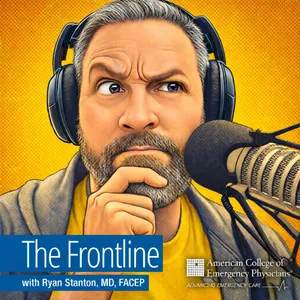
ACEP Frontline, hosted by Dr. Ryan Stanton, features in-depth conversations on the hottest topics in emergency medicine and critical care.
Latest Episodes
The most recent episodes — sign up to get AI-powered summaries of each one.
- 1 weeks ago29 min
Treating Opioid Use Disorder with Dr. Evan Schwarz
Recorded live at Michigan ACEP at Mackinac, Dr. Ryan Stanton talks with Dr. Evan Schwarz, a UCLA emergency physician, medical toxicologist, and addiction medicine specialist, about the evolving landscape of substance use disorder in the ED. Dr. Schwarz explains why opioid overdose deaths are trending down despite what emergency physicians see day to day, and how the drug supply has shifted from prescription opioids and heroin to fentanyl, kratom, xylazine, and medetomidine adulterants. The conversation covers practical buprenorphine dosing, including why higher doses are often needed and safe, how to use the COW score to assess readiness, microdosing for patients not yet ready to start, and the role of harm reduction and peer recovery coaches in getting patients into treatment. Dr. Schwarz will present this topic again at ACEP26 in Chicago.
- 1 weeks ago25 min
Managing LVAD Emergencies with Dr. Marianne Wallis
In this Frontline Weekend Playlist episode, hear Dr. Marianne Wallis, Assistant Professor at the University of Colorado School of Medicine, present on LVAD emergencies from the Fourth Annual Leadership Symposium & EM: High Risk – Do Not Miss Conference in Beaver Creek, Colorado. Using a case-based approach, she covers how LVADs work, how to read the controller and alarms, and how to recognize and manage the most common emergencies — pump thrombus, suction events, arrhythmias, infection, and bleeding. The throughline: these patients can largely be managed like any other, with key exceptions — defibrillation and cardioversion are safe, and chest compressions are reserved for cases where the device itself is failing.
- 2 weeks ago17 min
Investing in Emergency Medicine Research with Dr. Christopher Baugh
Recorded in Dallas at the Partner Collaborative, Dr. Ryan Stanton welcomes back Dr. Christopher Baugh, MD, MBA, FACEP, chair-elect of the Emergency Medicine Foundation (EMF), for a conversation on the role of specialty-specific research in emergency medicine. Dr. Baugh discusses EMF's 50-plus year history funding over 700 investigators, how the foundation's scientific review committee and volunteer board evaluate grant applications, and why supporting early-career researchers, including students and residents, is a key priority. The two also discuss how AI and large datasets are lowering barriers to high-quality research, how EMF structures industry-sponsored grants at arm's length to protect research integrity, and how the foundation is funded primarily through donations.
- 2 weeks ago25 min
Joint Reduction Techniques with Dr. Gannon Sungar
In this Frontline Weekend Playlist episode, hear Dr. Gannon Sungar, DO, present "Syringes, Rocket Launchers, and Rum: Common Reduction Techniques in the Emergency Department" from the Fourth Annual Leadership Symposium & EM: High Risk – Do Not Miss Conference in Beaver Creek, Colorado. Rather than a comprehensive review, Dr. Sungar highlights a handful of practical, often-overlooked techniques for three of the ED's most common dislocations. For the mandible, he compares the syringe and extraoral techniques as gentler alternatives to the traditional intraoral approach. For the shoulder, he covers scapular manipulation as a universal adjunct along with the no-sedation Cunningham and Fares techniques, plus the shoulder-elbow method as a sedated rescue. For the hip, he walks through the Captain Morgan and rocket launcher techniques as safer alternatives to the classic Bigelow maneuver, along with the hip-foot fulcrum for tougher cases. The throughline: patience, positioning, and mechanical advantage can often beat brute force — a useful addition to any emergency physician's toolkit.
- 3 weeks ago28 min
EM Guideline Updates: Practical Take-Home Changes with Dr. Michael McCrea
In this episode of ACEP Frontline, Dr. Ryan Stanton is joined by Dr. Michael McCrea to discuss his Michigan Emergency Medicine Assembly lecture, “2 AM Guideline Updates,” a practical review of recent evidence and guideline changes affecting emergency medicine practice. He highlights key updates in ACLS and PALS, pulmonary embolism risk stratification and disposition, ischemic stroke management, and ACEP’s updated aortic dissection clinical policy, focusing on take-home changes clinicians can apply at the bedside.
- 3 weeks ago31 min
Post-Pandemic EM Job Market with Dr. Leon Adelman
In this Frontline Weekend Playlist episode, hear Dr. Leon Adelman present “The Post-Pandemic Emergency Physician Job Market: Disasters, Disruptions, and Dynamism” from the Fourth Annual Leadership Symposium & EM: High Risk – Do Not Miss Conference in Beaver Creek, Colorado. He examines the evolving business landscape of emergency medicine, discussing consolidation, private equity, the No Surprises Act, reimbursement trends, and the forces shaping the emergency physician job market after the COVID-19 pandemic.
- 4 weeks ago24 min
ACEP Advocacy Priorities with Ryan McBride
In this episode of ACEP Frontline, Dr. Ryan Stanton is joined by Ryan McBride, ACEP’s Senior Director of Federal Government Affairs, to discuss ACEP’s federal advocacy priorities and the College’s efforts on behalf of emergency physicians and their patients. They explore the challenges of advancing policy in Congress, provide an update on the No Surprises Act and independent dispute resolution process, and highlight ways members can stay engaged with ACEP’s advocacy work.
- Aug 21, 202625 min
Immune Therapy Considerations with Dr. Abigail Leibowitz
In this first installment of the Frontline Weekend Playlist, hear Dr. Abigail Leibowitz present an update on immune-based cancer therapies from the Annual Leadership Symposium & EM: High Risk – Do Not Miss Conference in Beaver Creek, Colorado. She reviews immune checkpoint inhibitors and CAR T-cell therapy, focusing on the recognition and management of immune-related complications encountered in the ED and highlighting why emergency physicians must understand today’s rapidly evolving oncology treatments.
Get ACEP Frontline summaries in your inbox
Free AI-powered daily recaps. Key takeaways, quotes, and mentions — in a 5-minute read.
Get Free Summaries →Free forever for up to 3 podcasts. No credit card required.
You Might Also Like
Listeners also like.

The Peter Attia Drive
Conversations with experts on health, longevity, performance, and critical thinking led by physician Peter Attia.
The Internet Book of Critical Care Podcast
A podcast exploring critical care medicine through chapter discussions and evidence-based updates from The Internet Book of Critical Care.
This Week in Cardiology
A weekly summary and analysis of key developments in cardiology for healthcare professionals.
The Curbsiders Internal Medicine Podcast
Expert-led internal medicine discussions with clinical insights and humor for primary care and hospital medicine providers.
Peak Performance Life Podcast
Covers health, energy, and mental performance optimization through biohacking, nutrition, and lifestyle strategies.
Out of the Gray (Gy) - Standard Imaging
Conversations with experts in radiation oncology exploring advancements in technology, research, and clinical practice.
Plenary Session
A medical oncologist discusses cancer care, health policy, and evidence-based medicine.
Water Rescue with Dr. Michael Kachmar, DPM
Conversations with water rescue professionals about their real-world experiences, training, and operations in saving lives on the water.

Epic Spotlight Podcast
Examines personal growth, financial stability, and life balance through practical lessons on health, wealth, love, and happiness.
Paul Saladino MD podcast
A physician explores the root causes of chronic disease and optimal health through science and personal experimentation.
Red Pill Your Healthcast
Two healthcare providers discuss overlooked health issues and empower listeners to make informed decisions for their families.
» Divine Intervention Podcasts
Teaches medical concepts to help listeners solve patient problems and succeed on exams.
About ACEP Frontline
ACEP Frontline, hosted by Dr. Ryan Stanton, features in-depth conversations on the hottest topics in emergency medicine and critical care.
Customized Recaps
AI-powered recaps with compact key takeaways, quotes, and insights.
Straight to Your Inbox
Get key takeaways from ACEP Frontline in a 5-minute read.
Save Hours Every Week
Stay current on your favorite podcasts without falling behind.
Frequently Asked Questions
What is Podzilla's ACEP Frontline daily summary?
It's a free AI-powered email that summarizes new episodes of ACEP Frontline as soon as they're published. You get the key takeaways, notable quotes, and links & mentions — all in a quick read.
How does the ACEP Frontline podcast summary work?
When a new episode drops, our AI transcribes and analyzes it, then generates a personalized summary tailored to your interests and profession. It's delivered to your inbox every morning.
Is this an official ACEP Frontline product?
No. Podzilla is an independent service that summarizes publicly available podcast content. We're not affiliated with or endorsed by Ryan A. Stanton MD, FACEP.
Can I get summaries of other podcasts too?
Absolutely! The free plan covers up to 3 podcasts. Upgrade to Pro for 15, or Premium for 50. Browse our full catalog at /podcasts.
How often does ACEP Frontline release new episodes?
ACEP Frontline publishes 2x weekly. Our AI generates a summary within hours of each new episode.
What topics does ACEP Frontline cover?
ACEP Frontline covers topics including Science. Our AI identifies the specific themes in each episode and highlights what matters most to you.
Start getting ACEP Frontline summaries tomorrow morning.
Free forever for up to 3 podcasts. No credit card required.
Free forever for up to 3 podcasts. No credit card required.