Free Daily Podcast Summary
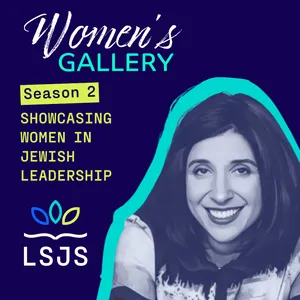
Women's Gallery: Showcasing Women in Jewish Leadership: Daily Summaries Delivered
by Joanne Greenaway
"I've seen the difference it makes when women's voices and talents are included at all levels," says Joanne Greenaway, CEO at the London School of Jewish Studies, who as well as being a communal leader and educator is also an international lawyer who spent 10 years developing expertise in resolving Jewish divorce cases individually and systemically.For this reason, Women's Gallery Podcast will spotlight incredible female leaders making a mark in the Jewish community. Interviewing a different woman leader in each episode, Women's Gallery will explore different models of leadership in the context of schools, shuls, universities, batei din and every place where we can find incredible female leaders, showcasing the women defining Jewish leadership today.Visit www.lsjs.ac.uk to continue learning with Joanne Greenaway and other LSJS educators.
Latest Episodes
The most recent episodes — sign up to get AI-powered summaries of each one.
- 6 days ago52 min
(56) Why Don't We Talk About Mikvah? With Dr. Naomi Marmon Grumet
For generations, mikvah has been one of the most central institutions of Jewish life. But for many women, it has also remained deeply private, rarely discussed openly and often understood primarily in terms of obligation. What might change if we thought about mikvah not only as a halachic practice, but as a source of spirituality, self-awareness, connection, and renewal? In this episode of Women's Gallery, Joanne Greenaway speaks with Dr. Naomi Marmon Grumet, founder and director of the Eden Center in Jerusalem, about reimagining the place of mikvah in the lives of Jewish women. Beginning with the centuries-old custom of women immersing before Yom Kippur, they explore mikvah as an embodied form of spiritual preparation and a powerful opportunity to think about who we are and who we hope to become in the year ahead. Their conversation moves into some of the most sensitive questions surrounding mikvah today: the role of mikvah attendants, autonomy and trauma, sexuality and relationships, women's halachic knowledge and authority, and whether our emphasis on privacy has sometimes created unnecessary secrecy and shame. It's a wide-ranging conversation about tradition, women's bodies, spiritual renewal, and what it might mean for women to take greater ownership of one of Judaism's most intimate rituals. Partake in the ancient custom of women's immersion on erev Yom Kippur. This helpful infographic from The Eden Center can guide you. It's also a wonderful time to introduce girls to mikveh in a spiritual context, without the overtones of relationship.
- 1 weeks ago49 min
(55) Beyond the Labels: Tamar Elad-Appelbaum on Jewish Unity, Tradition, and Healing
What does it mean to build a Jewish community where secular and religious, Sephardi and Ashkenazi, right and left can all find a place? In this deeply moving conversation, Joanne Greenaway speaks with Tamar Elad-Appelbaum, founder of Kehilat Zion in Jerusalem and a leading voice for Jewish spiritual and communal renewal. Drawing on the faith of her Moroccan and Ashkenazi grandparents, Tamar describes a vision of Judaism that reaches beyond denominational labels and asks Jews to rediscover one another as a people. Together, Jo and Tamar explore the challenge of creating new Jewish ritual after October 7, the spiritual needs of a younger generation, the tension between pluralism and extremism, and what Rosh Hashanah can teach us about judgment, happiness, responsibility, and hope. Tamar also reflects on her path as a female religious leader and her dream of a future in which women no longer need to justify why their voices belong in Jewish leadership. At a moment of profound pain and division, this is a conversation about tradition that remains alive, leadership rooted in responsibility, and the possibility of rebuilding a Jewish people capable of seeing, hearing, and healing one another.
- 4 weeks ago55 min
(54) Women Holding the Keys: Sarah Segal-Katz on Torah, Authority, and Changing Orthodoxy
For years, women in Israel could study halakha at the highest levels, teach Torah, and answer complex religious questions, yet they were barred from taking the state rabbinical examinations open to men. Rabbi Sarah Segal-Katz helped lead the landmark legal battle that finally changed that. In this episode of Women's Gallery, Joanne Greenaway speaks with Sarah about her journey into Torah scholarship, the long struggle to open Israel's rabbinical exams to women, and why access to religious knowledge and authority matters far beyond titles or recognition. They also explore the evolving place of women in Orthodox leadership, the relationship between feminism, halakha, and the State of Israel, Sarah's work creating religious language in response to October 7, and her hope for a future in which women serving as rabbis and religious authorities is no longer remarkable, but simply normal.
- Aug 11, 202650 min
(53) Welcoming the Convert: Rethinking Jewish Conversion Today
Conversion to Judaism is often misunderstood, both by those considering it and by the communities that receive them. In this episode, Netta Asner-Minster shares what she has learned from guiding hundreds of prospective converts, explains the realities of the Orthodox conversion process, and challenges common assumptions about "pushing converts away." Together with Joanne Greenaway, she explores how greater openness, education, and compassion can strengthen the Jewish future.
- Jul 28, 202651 min
(52) Creating Safer Communities: Dr. Guila Benchimol on Abuse, Accountability, and Jewish Leadership
Dr. Guila Benchimol never expected to leave Jewish education for a career in criminology. Yet her journey led her to become one of the Jewish world's leading voices on abuse prevention, safeguarding, restorative justice, and institutional accountability. In this thoughtful and often challenging conversation, she reflects on what first drew her to this work, why abuse is never simply the result of one individual, and how communities can create cultures that are both safer and more compassionate. Joanne and Guila explore the lasting impact of the MeToo movement, the responsibilities of faith communities, the promise of restorative justice, and why genuine leadership requires the courage to confront uncomfortable truths while never losing love for the community itself.
- Jul 14, 202646 min
(51) Work, Purpose, and Torah: Gvira Milworm's Vision for Haredi Women
Gvira Milworm has spent years helping transform economic opportunities for Haredi women in Israel, all while remaining firmly rooted in Torah values. As CEO of Temech, she has helped thousands of women build careers, launch businesses, and achieve financial stability without asking them to compromise their religious commitments. In this episode of Women's Gallery, Joanne Greenaway speaks with Gvira about her own journey from the world of technology to nonprofit leadership, the remarkable economic transformation taking place within the Haredi community, and how meaningful work, entrepreneurship, family, and faith can reinforce rather than compete with one another. Their conversation explores leadership, self-care, the future of Haredi women in Israel's workforce, and the powerful question Gvira believes everyone should ask: What does Hashem want from me now?
- Jun 30, 202641 min
(50) From Consumers to Producers of Torah: Raising the Next Generation of Women Torah Scholars, with Dr. Raizi Chechik
What does the future of women's Torah scholarship look like? Dr. Raizi Chechik, the inaugural director of the Pava Center for Women's Torah Scholarship at Yeshiva University, joins Joanne Greenaway to discuss an inspiring new vision for cultivating women as Torah scholars, educators, and teachers of Torah. Drawing on decades of experience as an educator, mentor, and head of school, she reflects on the mentors who shaped her, the philosophy that has guided her work, and why authentic Torah learning is resonating so deeply with today's young women. Together, Joanne and Dr. Chechik explore how rigorous Torah scholarship, mentorship, and community engagement can prepare women to make meaningful contributions to Orthodox Jewish life while remaining deeply rooted in tradition. They discuss the remarkable response to the new program, the challenge of balancing innovation with continuity, and the importance of helping women see themselves not only as consumers of Torah, but also as producers and teachers of Torah. The conversation concludes with a moving reflection on hope, resilience, and the enduring wisdom of Torah in times of uncertainty.
- Jun 16, 202651 min
(49) Leading with Laughter: Rachel Creeger on Comedy, Courage, and Jewish Visibility
For most Orthodox women, leadership does not begin with a microphone in a comedy club. But for award-winning comedian Rachel Creeger, humor has become a powerful way to represent Jewish life, challenge stereotypes, and create connection across communities. In this episode of Women's Gallery, Joanne Greenaway speaks with Rachel about forging a path where no roadmap existed, navigating life as an Orthodox woman in the performing arts, confronting antisemitism after October 7, and discovering that comedy can be a form of leadership. Rachel also reflects on being targeted and effectively canceled by venues because she is openly Jewish, and on her determination to respond not by retreating, but by speaking more boldly. Their conversation explores authenticity, resilience, public voice, and what happens when Jewish women refuse to be defined by other people's expectations.
About Women's Gallery: Showcasing Women in Jewish Leadership
"I've seen the difference it makes when women's voices and talents are included at all levels," says Joanne Greenaway, CEO at the London School of Jewish Studies, who as well as being a communal leader and educator is also an international lawyer who spent 10 years developing expertise in resolving Jewish divorce cases individually and systemically.For this reason, Women's Gallery Podcast will spotlight incredible female leaders making a mark in the Jewish community. Interviewing a different woman leader in each episode, Women's Gallery will explore different models of leadership in the context of schools, shuls, universities, batei din and every place where we can find incredible female leaders, showcasing the women defining Jewish leadership today.Visit www.lsjs.ac.uk to continue learning with Joanne Greenaway and other LSJS educators.
Customized Recaps
AI-powered recaps with compact key takeaways, quotes, and insights.
Straight to Your Inbox
Get key takeaways from Women's Gallery: Showcasing Women in Jewish Leadership in a 5-minute read.
Save Hours Every Week
Stay current on your favorite podcasts without falling behind.
Frequently Asked Questions
What is Podzilla's Women's Gallery: Showcasing Women in Jewish Leadership daily summary?
It's a free AI-powered email that summarizes new episodes of Women's Gallery: Showcasing Women in Jewish Leadership as soon as they're published. You get the key takeaways, notable quotes, and links & mentions — all in a quick read.
How does the Women's Gallery: Showcasing Women in Jewish Leadership podcast summary work?
When a new episode drops, our AI transcribes and analyzes it, then generates a personalized summary tailored to your interests and profession. It's delivered to your inbox every morning.
Is this an official Women's Gallery: Showcasing Women in Jewish Leadership product?
No. Podzilla is an independent service that summarizes publicly available podcast content. We're not affiliated with or endorsed by Joanne Greenaway.
Can I get summaries of other podcasts too?
Absolutely! The free plan covers up to 3 podcasts. Upgrade to Pro for 15, or Premium for 50. Browse our full catalog at /podcasts.
What topics does Women's Gallery: Showcasing Women in Jewish Leadership cover?
Women's Gallery: Showcasing Women in Jewish Leadership covers topics including Religion & Spirituality, Spirituality, Judaism. Our AI identifies the specific themes in each episode and highlights what matters most to you.
Start getting Women's Gallery: Showcasing Women in Jewish Leadership summaries tomorrow morning.
Free forever for up to 3 podcasts. No credit card required.
Free forever for up to 3 podcasts. No credit card required.