Free Daily Podcast Summary
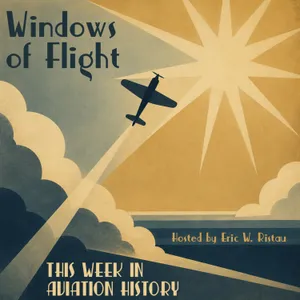
Windows of Flight: Weekly Aviation History: Daily Summaries Delivered
by Eric W. Ristau
Every week in aviation history holds a story worth telling. Windows of Flight explores the moments that shaped human flight — from the first machines to leave the ground, to the pilots and dreamers who pushed every boundary they found. Aviation thriller author Eric W. Ristau brings you weekly episodes covering the milestones, the firsts, the record-breakers, and the remarkable people behind them. Made for pilots, aviation history enthusiasts, and anyone who loves a great story. From the earliest aviators, the World War I and World War II to the jet age. New episodes every week.
Latest Episodes
The most recent episodes — sign up to get AI-powered summaries of each one.
- Jul 20, 202612 min
July 19, 2026 - This Week in Aviation History Through the Windows of Flight
The history of aviation contains every kind of story there is — triumph, institution-building, and hard-won tragedy that changed engineering forever. The fourth week of July gives us all three, spanning forty-five years.We start on July 25th, 1909, on the cliffs above Calais, where a thirty-seven-year-old Frenchman named Louis Blériot, flying with a foot still bandaged from an in-flight exhaust pipe accident, took off without a compass and followed a torpedo boat across the English Channel until he overtook it — leaving him alone over open water, navigating by instinct, until the white cliffs of Dover appeared through the haze. Twenty-two miles. Thirty-six and a half minutes. And a Daily Mail editorial that captured the moment precisely: "Great Britain is no longer an island."Then July 26th, 1947, aboard a presidential aircraft on a Washington tarmac, where Harry Truman signed the National Security Act and created, for the first time in American history, an Air Force entirely independent from the Army. It inherited 300,000 personnel and instantly became one of the largest air forces on earth — less than two years after the most destructive war in human history had ended.And finally, July 27th, 1949 — on test pilot John Cunningham's 33rd birthday, and designer Sir Geoffrey de Havilland's 67th — when the Comet lifted off from Hatfield and made Britain the leader of commercial jet aviation. What followed in the next five years was one of the most consequential investigations in aviation history, whose findings are visible every time you look out the rounded window of any commercial jet flying today.Three stories. Forty-five years. Achievement, institution, and the hardest kind of lesson aviation has ever had to learn.Windows of Flight is brought to you by the Border Series — aviation thriller novels by host Eric Ristau. Old bold pilots, vintage aircraft, and plots ripped straight from today's headlines. Find the Border Series wherever books are sold, and learn more at www.ericristau.com.
- Jul 14, 202611 min
July 12, 2026 - This Week in Aviation History Through the Windows of Flight
Every so often, the calendar plays a trick on aviation history — and this week, we're letting it. The third week of July centers on a single date, July 15th, which somehow hosted three of the biggest moments in the entire story of flight, in three completely different decades.We start on July 15th, 1916, in Seattle, where a timber merchant named William Boeing filed paperwork to incorporate a small company building seaplanes out of a converted boathouse. Nothing about that afternoon suggested it would eventually lead to the 747. It just did.Then July 15th, 1933 — seventeen years later, same date — when a one-eyed Oklahoma pilot named Wiley Post climbed into a Lockheed Vega before dawn at Floyd Bennett Field to attempt something no one had ever done: fly solo around the entire world. He used an early autopilot to grab short naps over Siberia. He landed seven days later having completed the journey more than twenty hours faster than his own previous record, set with a navigator two years before.And finally, July 15th, 1954 — twenty-one years after that, same date again — when a brown-and-yellow jet prototype called the Dash Eighty lifted off from Boeing Field in Seattle, carrying the company's entire financial future on its wings. A year later, a test pilot would barrel-roll that same aircraft twice over Lake Washington in front of the executives who needed convincing, tell them he had simply been "selling airplanes" — and the jet age for ordinary travelers began.Three stories. One date. Thirty-eight years apart, and somehow all connected by the same square on the calendar.Windows of Flight is brought to you by the Border Series — aviation thriller novels by host Eric Ristau. Old bold pilots, vintage aircraft, and plots ripped straight from today's headlines. Find the Border Series wherever books are sold, and learn more at www.ericristau.com.
- Jul 6, 202610 min
July 5, 2026 - This Week in Aviation History Through the Windows of Flight
The history of aviation is full of doors quietly opening — moments that didn't make front-page headlines at the time but changed everything that came after. The second week of July gives us three of them, spanning exactly forty years.We start on July 8th, 1908, in Milan, Italy, where a French sculptor named Thérèse Peltier watched an exhibition flight and simply asked if she could go up. She became the first woman in recorded history to leave the ground in a powered airplane — thirty-four years old, a passenger for less than a minute, in a Voisin biplane over an Italian airfield. Three years before Harriet Quimby earned the first American woman's pilot license. Thirteen years before Bessie Coleman earned hers in France. The door had already been opened.Then July 10th, 1938, when Howard Hughes took off from Floyd Bennett Field with a crew of four, determined to fly around the world faster than anyone in history. Four days later, he landed back in New York having covered 14,791 miles and bested Wiley Post's existing record by nearly four full days — through a flight of genuine engineering rigor that pointed directly toward the future of transoceanic aviation.And finally, July 14th, 1948 — exactly ten years after Hughes landed — when six Royal Air Force Vampire jet fighters completed the first Atlantic crossing by jet aircraft, staging their way from England through Scotland, Iceland, and Greenland to Labrador. It happened quietly, within a military context, with three Mosquito navigators flying alongside because the jets lacked adequate instruments for overwater flight. But it proved the ocean could be crossed by jet. Everything that followed was built on that proof.Forty years. Three doors. The whole shape of modern aviation on the other side of them.Windows of Flight is brought to you by the Border Series — aviation thriller novels by host Eric Ristau. Old bold pilots, vintage aircraft, and plots ripped straight from today's headlines. Find the Border Series wherever books are sold, and learn more at www.ericristau.com.
- Jun 29, 202610 min
June 28, 2026 - This Week in Aviation History Through the Windows of Flight
The history of aviation is written in moments of brilliant achievement and sudden silence. The first week of July gives us both — two milestones on Independence Day twenty years apart, and one disappearance that the world has never stopped trying to explain.We start on July 4th, 1908, in a grape-growing town in upstate New York, where a motorcycle racer named Glenn Curtiss flew a fragile biplane called the June Bug 1,550 meters in front of witnesses who certified every foot of it. The Scientific American Trophy. The fury of the Wright brothers. And the beginning of a career that would shape American military aviation for the next decade.Then July 4th, 1927 — nineteen years later to the day — when a sleek wooden aircraft called the Lockheed Vega lifted off from Burbank, California for the first time. No struts, no bracing wires, smooth as an egg and fifty miles per hour faster than anything else carrying passengers. Over the next decade, that aircraft and its sisters would carry Wiley Post around the world, carry Hubert Wilkins over the poles, and carry Amelia Earhart solo across the Atlantic in 1932. The Vega didn't just set records. It made records possible.And finally, July 2nd, 1937 — when Earhart and her navigator Fred Noonan, flying a newer Lockheed design on an around-the-world attempt, made their last radio transmissions to a Coast Guard cutter that could hear them but couldn't respond. The search covered 250,000 square miles of Pacific Ocean and found nothing. The ocean has kept its secret for nearly ninety years.Two Independence Days. One disappearance. All of aviation between them.Windows of Flight is brought to you by the Border Series — aviation thriller novels by host Eric Ristau. Old bold pilots, vintage aircraft, and plots ripped straight from today's headlines. Find the Border Series wherever books are sold, and learn more at www.ericristau.com.
- Jun 22, 202610 min
June 21, 2026 - This Week in Aviation History Through The Windows of Flight
WINDOWS OF FLIGHTEpisode Summary: The Fourth Week of JuneThe history of aviation is full of moments when human beings looked at something that had never been done and decided to do it anyway. The fourth week of June gives us three of them — a floating hotel with mahogany paneling that became the world's first airline, two Army lieutenants who threaded a needle across the Pacific by sextant and radio, and the pilots who kept an entire city of two and a half million people alive through the longest winter of the Cold War.We start on June 19th, 1910, in Frankfurt, Germany, where the world's first scheduled passenger airline service began — not with an airplane, but with a zeppelin. DELAG, the German Airship Travel Corporation, offered its passengers wicker chairs, mahogany paneling, large windows, and a promenade deck from which to watch the countryside slide past at forty miles an hour. Between 1910 and the outbreak of the First World War, they carried more than 37,000 passengers without a single fatality. It was the future — until it wasn't.Then June 28th, 1927, and a Fokker trimotor called the Bird of Paradise lifting off from Oakland, California with two Army lieutenants at the controls. Lester Maitland and Albert Hegenberger were pointing their aircraft at Hawaii — 2,407 miles of open Pacific with no landmarks, no alternates, and no margin for error. Hegenberger had spent two years building the radio navigation system that would guide them there. What happened when the signal faded is the kind of story that makes you appreciate every instrument approach you've ever flown.And finally, June 26th, 1948, at Tempelhof Airport in West Berlin, where a C-47 touched down with sacks of flour and the Berlin Airlift began. The Soviet Union had closed every road, rail line, and canal into the city two days earlier. Two and a half million people needed 4,500 tons of supplies every single day just to survive. The math said it couldn't be done by air. The men who flew it anyway — including a pilot named Gail Halvorsen who started dropping chocolate bars on handkerchief parachutes to the children at the fence — proved the math wrong for fifteen months straight.Three stories. Three different ways the airplane changed what the world believed was possible.Windows of Flight is brought to you by the Border Series — aviation thriller novels by host Eric Ristau. Old bold pilots, vintage aircraft, and plots ripped straight from today's headlines. Find the Border Series wherever books are sold, and learn more at www.ericristau.com.
- Jun 14, 202610 min
June 14, 2026 - This Week in Aviation History Through The Windows of Flight
The history of aviation is not just the history of aircraft. It is the history of the people who fought their way into the sky against every obstacle that stood between them and the horizon. The third week of June belongs entirely to three women who were told, in one way or another, that aviation wasn't for them — and who went anyway.We start on June 15th, 1921, in a small coastal town in northern France, where a twenty-nine-year-old woman from Waxahachie, Texas walked out of a flight school and into history. Bessie Coleman had been turned away by every American flight school she applied to — because she was a woman, because she was Black, or both. So she learned French, crossed an ocean, and earned her international pilot's license in France. She came home a barnstormer, used her visibility to fight segregation, and spent the rest of her short life saving money to build a flight school for Black Americans. The school she never got to build cast a long shadow — one that reaches all the way to the Tuskegee Airmen.Then June 17th, 1928, and a red-and-gold Fokker trimotor called Friendship lifting off from Newfoundland with Amelia Earhart aboard. She wasn't flying the airplane that day — and she knew it. Her own word for her role on the crossing was "cargo." The discomfort she felt about the glory that followed drove her for the next four years, until she climbed into a Lockheed Vega alone and crossed the Atlantic on her own terms. The 1928 flight matters not for what she did, but for what she refused to let herself get away with not doing afterward.And finally, June 21st, 1913, at Griffith Park in Los Angeles, where a four-foot-eight carnival performer named Tiny Broadwick became one of the first people ever to parachute from a powered aircraft. The following year, demonstrating for the Army in San Diego, she made a split-second decision that detached her from her static line and sent her into free fall — and the improvised hand-pull that brought her parachute open became the foundation for every ripcord that has ever saved a pilot's life.Three women. One week. All of aviation changed.Windows of Flight is brought to you by the Border Series — aviation thriller novels by host Eric Ristau. Old bold pilots, vintage aircraft, and plots ripped straight from today's headlines. Find the Border Series wherever books are sold, and learn more at www.ericristau.com.
- Jun 7, 20269 min
June 7, 2026 - This Week in Aviation History Through The Windows of Flight
The history of aviation is built on two things in equal measure: the courage to attempt the impossible, and the determination to make the impossible ordinary. The second week of June gives us both — a flying washboard that convinced a nation to trust the airplane, and two men who crossed the North Atlantic in an open cockpit, nearly died several times, and landed nose-first in an Irish bog.We start on June 11th, 1926, at Ford Airport in Dearborn, Michigan, where a blocky, corrugated, gloriously unglamorous aircraft lifted off for the first time. The Ford Trimotor — the Tin Goose — wasn't fast, wasn't quiet, and wasn't particularly comfortable. What it was, was trustworthy. Henry Ford put his name and his marketing machine behind it, and a generation of Americans who had never considered setting foot on an airplane gradually changed their minds. You can still ride in one at EAA AirVenture in Oshkosh every summer. It's loud. It's slow. It's magnificent.Then we go back seven years to June 14th, 1919, and a makeshift grass runway in St. John's, Newfoundland, where a Vickers Vimy loaded to its limits with fuel climbed into the sky and turned east. Captain John Alcock and Lieutenant Arthur Whitten Brown were attempting the first nonstop transatlantic crossing in history. What followed was sixteen hours of fog, ice, a spiral dive to sixty feet above the waves, and a navigator who climbed out of the cockpit six times in the dark to clear ice from the engines by hand. The Irish bog they landed in was not the ending anyone planned. It was the only ending that mattered.Two stories. Seven years apart. One about making aviation safe enough for ordinary people, and one about two men who were anything but ordinary doing something that had never been done.Windows of Flight is brought to you by the Border Series — aviation thriller novels by host Eric Ristau. Old bold pilots, vintage aircraft, and plots ripped straight from today's headlines. Find the Border Series wherever books are sold, and learn more at www.ericristau.com.
- May 31, 20269 min
May 31, 2026 - This Week in Aviation History through the Windows of Flight
The history of aviation didn't begin with the Wright brothers. It began in a smoky marketplace in southern France, on a June morning in 1783, when two brothers who made paper for a living let go of some ropes and changed the world's understanding of what was possible. This week we go back to that morning — and then follow the thread forward through 129 years of human beings finding new and increasingly audacious things to do with the sky.We start on June 5th, 1783, with Joseph and Étienne Montgolfier, whose backyard experiments with hot air and linen fabric gave the world its first glimpse of something rising freely into the sky. It would be 120 years before the Wright brothers flew at Kitty Hawk — but in some meaningful sense, it all started here.Then we jump to June 2nd, 1910, and a slender man in a fur-lined flight suit standing on the white cliffs of Dover at dawn. Charles Rolls — yes, the Rolls of Rolls-Royce — had a goal nobody had yet attempted: cross the English Channel and come back without landing. What he did that morning was remarkable. What happened to him five weeks later is the kind of story that reminds you how thin the margin was in those early years.And we close on June 7th, 1912, at College Park, Maryland — still operating today as the oldest continuously operating airport in the world — where two Army officers loaded a Lewis gun into the nose of a Wright biplane and asked a simple, consequential question: can you fire a machine gun from a moving airplane? Just nine years after Kitty Hawk, the answer they found that morning set aviation on a course that would shape the next century of warfare.Three stories. One hundred and twenty-nine years. From the first thing that ever rose into the sky, to the first weapon fired from one.Windows of Flight is brought to you by the Border Series — aviation thriller novels by host Eric Ristau. Old bold pilots, vintage aircraft, and plots ripped straight from today's headlines. Find the Border Series wherever books are sold, and learn more at www.ericristau.com.
Get Windows of Flight: Weekly Aviation History summaries in your inbox
Free AI-powered daily recaps. Key takeaways, quotes, and mentions — in a 5-minute read.
Get Free Summaries →Free forever for up to 3 podcasts. No credit card required.
You Might Also Like
Listeners also like.

Pilot Briefing - Aviation Podcast
Weekly aviation news updates for pilots and aviation enthusiasts.
Why We Fly
Mike Harris

Hangar Flying with Smokehouse Pilots Club
Smokehouse Pilots

AvTalk - Aviation Podcast
A podcast about aviation from Flightradar24, the world’s most popular flight tracking service.

Aviation Week's Check 6 Podcast
Aerospace and defense industry analysis from Aviation Week & Space Technology editors.
Aviation News Talk – Pilot Stories, Safety Tips & General Aviation News
Pilot stories, safety advice, and technical guidance for general aviation pilots, from a flight instructor with decades of experience.
AIN's Tales from the Flight Deck
Aviation International News

HISTORY This Week
Every week, a deep dive into a pivotal historical event using archival audio, historian insights, and firsthand accounts.

The Student Pilot Cast
A podcast exploring aviation and ongoing pilot training through the journey of a student pilot learning to fly.

The VIP Seat: Private Aviation News
A weekly breakdown of private aviation news, from jet charter trends and safety issues to industry analysis and insider interviews.

NTSB News Talk – Aviation Accidents, Safety Investigations & Pilot Lessons
A podcast that analyzes aviation accidents and NTSB investigations to teach pilots and enthusiasts critical safety lessons.

This Week in Tech (Audio)
A weekly roundtable of tech insiders discusses the latest developments in AI, robotics, computing, and digital privacy.
About Windows of Flight: Weekly Aviation History
Every week in aviation history holds a story worth telling. Windows of Flight explores the moments that shaped human flight — from the first machines to leave the ground, to the pilots and dreamers who pushed every boundary they found. Aviation thriller author Eric W. Ristau brings you weekly episodes covering the milestones, the firsts, the record-breakers, and the remarkable people behind them. Made for pilots, aviation history enthusiasts, and anyone who loves a great story. From the earliest aviators, the World War I and World War II to the jet age. New episodes every week.
Customized Recaps
AI-powered recaps with compact key takeaways, quotes, and insights.
Straight to Your Inbox
Get key takeaways from Windows of Flight: Weekly Aviation History in a 5-minute read.
Save Hours Every Week
Stay current on your favorite podcasts without falling behind.
Frequently Asked Questions
What is Podzilla's Windows of Flight: Weekly Aviation History daily summary?
It's a free AI-powered email that summarizes new episodes of Windows of Flight: Weekly Aviation History as soon as they're published. You get the key takeaways, notable quotes, and links & mentions — all in a quick read.
How does the Windows of Flight: Weekly Aviation History podcast summary work?
When a new episode drops, our AI transcribes and analyzes it, then generates a personalized summary tailored to your interests and profession. It's delivered to your inbox every morning.
Is this an official Windows of Flight: Weekly Aviation History product?
No. Podzilla is an independent service that summarizes publicly available podcast content. We're not affiliated with or endorsed by Eric W. Ristau.
Can I get summaries of other podcasts too?
Absolutely! The free plan covers up to 3 podcasts, any in the catalog. Basic raises that to 15, Pro to 40 and Max to 100. Browse our full catalog at /podcasts.
What topics does Windows of Flight: Weekly Aviation History cover?
Windows of Flight: Weekly Aviation History covers topics including Leisure, Aviation. Our AI identifies the specific themes in each episode and highlights what matters most to you.
Start getting Windows of Flight: Weekly Aviation History summaries tomorrow morning.
Free forever for up to 3 podcasts. No credit card required.
Free forever for up to 3 podcasts. No credit card required.