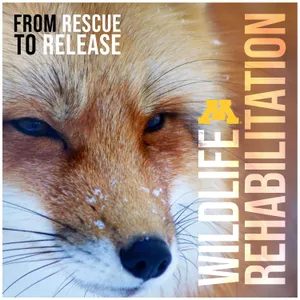
Free Daily Podcast Summary
Wildlife Rehabilitation: From Rescue to Release: Daily Summaries Delivered
by Gail Buhl
Get key takeaways, quotes, and insights from Wildlife Rehabilitation: From Rescue to Release in a 5-minute read. Delivered straight to your inbox.
Latest Episodes
The most recent episodes — sign up to get AI-powered summaries of each one.
- 3 weeks ago44 min
S5E13 Preventive Medicine with Scott Diehl
In this episode, we’re joined by Scott Diehl, Director Emeritus at the Wildlife Rehabilitation Center with the Wisconsin Humane Society. We discuss methods and programs implemented at the Wildlife Center to keep wildlife in our communities safe, helping to prevent unnecessary fear, injuries, illness, and even death, so that fewer animals end up needing rehabilitation. Special thanks to our guests, Partners For Wildlife, and The Raptor Center at the University of Minnesota College of Veterinary Medicine.Resources mentioned:Wildlife Rehabilitation Center - Wisconsin Humane Society
- Mar 27, 202650 min
S5E12 Partners For Wildlife and PACE with Chad Caruthers
We continue our series on what’s going on behind the scenes at Partners For Wildlife with Chad Caruthers, the Partnership and Community Engagement Coordinator. In this episode, we learn about P4W’s public outreach initiatives, what is currently in the works, and plans for the future. Special thanks to our guest, Partners For Wildlife, and The Raptor Center at the University of Minnesota College of Veterinary Medicine.Resources mentioned:Partners for WildlifeSubscribe to PACE's Substack here
- Mar 13, 202648 min
S5E11 Partners For Wildlife and WRKE with Rob Kulhanek
We discuss what’s going on behind the scenes at Partners For Wildlife with Program Manager Rob Kulhanek—diving into the collaboratively designed Wildlife Rehabilitation Knowledge Exchange (WRKE), a peer-to-peer message board platform for wildlife rehabilitators, veterinarians, and other wildlife care professionals hosted by the Veterinary Information Network (VIN), a long-standing networking site for veterinarians.Special thanks to our guest, Partners For Wildlife, and The Raptor Center at the University of Minnesota College of Veterinary Medicine.Resources mentioned:About WRKEWRKE sign-up formFrom a logged-in VIN account to WRKE
- Feb 27, 202639 min
S5E10 Wild Alert with Rachel Avilla, Pranav Pandit, and Terra Kelly, co-hosted with Julia Ponder Part 2
In the second part of this conversation, Gail and this episode’s co-host, Julia Ponder, a clinical wildlife veterinarian with a background in public health, continue speaking with members of the Wild Alert team: Rachel Avilla, President, Co-Founder, and Executive Director of The Wild Neighbors Database Project; Terra Kelly, an epidemiologist and wildlife health specialist; and Pranav Pandit, a One Health epidemiologist. They discuss how Wild Alert functions at the state level, describe the individual user experience, and outline their future goals for the system.Special thanks to our guests, Partners For Wildlife, and The Raptor Center at the University of Minnesota College of Veterinary Medicine.Resources mentioned:https://wildalert.org/www.wildneighborsdp.orghttps://www.usgs.gov/centers/nwhc/science/whispersInterested in learning more about WRMD?
- Feb 14, 202652 min
S5E9 Wild Alert with Rachel Avilla, Pranav Pandit, and Terra Kelly, co-hosted with Julia Ponder Part 1
“Every single wildlife rehabilitator is important, big or small…” - Rachel AvillaIn this conversation, Gail and her first co-host, Julia Ponder, a clinical wildlife veterinarian with a background in public health, speak with members of the Wild Alert team: Rachel Avilla, President, Co-Founder, and Executive Director of The Wild Neighbors Database Project; Terra Kelly, an epidemiologist and wildlife health specialist; and Pranav Pandit, a One Health epidemiologist. They discuss what Wild Alert is, what it does, and the projects they are currently working on. In the next episode, they take a deeper dive into how the system is used.Special thanks to our guests, Partners For Wildlife, and The Raptor Center at the University of Minnesota College of Veterinary Medicine.Resources mentioned:https://wildalert.org/www.wildneighborsdp.org
- Jan 30, 202650 min
S5E8 Austin Bat Refuge with Dianne Odegard and Lee Mackenzie Part 2
In the second part of this conversation, we speak with Dianne Odegard and Lee Mackenzie, the founders of Austin Bat Refuge. We add to our previous episode by doing a deep dive on the Eastern Red Bat, specifically, orphan babies.Special thanks to our guests, Partners For Wildlife, and The Raptor Center at the University of Minnesota College of Veterinary Medicine.Resources mentioned:Austin Bat RefugeThe Rehabilitation and Captive Care of Insectivorous Bats
- Jan 16, 202652 min
S5E7 Austin Bat Refuge with Dianne Odegard and Lee Mackenzie Part 1
In the first part of this two-parter, we speak with Dianne Odegard and Lee Mackenzie, the founders of Austin Bat Refuge. We hear recent rescue stories, and learn about radar projects, Free-tailed bats, and how Austin became known as “bat city”. Special thanks to our guests, Partners For Wildlife, and The Raptor Center at the University of Minnesota College of Veterinary Medicine.Resources mentioned:Austin Bat Refuge
- Jan 9, 202650 min
S5E6 National Wildlife Rehabilitators Association (NWRA) with Amanda Nicholson and Dr. Karra Pierce Part 2
In the second part of our conversation with Amanda Nicholson, Senior Vice President of the Wildlife Center of Virginia, and Dr. Karra Pierce, Director of Veterinary Services at the Wildlife Center of Virginia, we discuss the offerings (books, courses, and beyond) through the National Wildlife Rehabilitators Association (NWRA) and how you can get involved from becoming a member to joining a committee and even the board. NWRA’s 2026 Symposium takes place February 24–28 in Baton Rouge, Louisiana. To learn more about the symposium, please see the links below. Special thanks to our guests, Partners For Wildlife, and The Raptor Center at the University of Minnesota College of Veterinary Medicine.Resources mentioned:NWRA's 2026 SymposiumNWRA website
Get Wildlife Rehabilitation: From Rescue to Release summaries in your inbox
Free AI-powered daily recaps. Key takeaways, quotes, and mentions — in a 5-minute read.
Get Free Summaries →Free forever for up to 3 podcasts. No credit card required.
You Might Also Like
Listeners also like.
Our Wild Lives
The Wildlife Society
Keep it Humane
Keep it Humane
The Wilderness and Wellness Podcast
Ron Waline
Animal Posse
Unwanted Feline Organization
Let's Talk Wildlife
Courttney Monique
The Wildlife Experience
Andrew Austin
Nature's Secret Service
Ed Newcomer

All Things Wise and Wonderful (an animal welfare podcast)
Jody Gordon & Dr Henrietta Linnemann
All Creatures Podcast
All Creatures Podcast
Wildlife Photography
Rob Read and Josh Galicki
ReWild Yourself
Daniel Vitalis
In Tune to Nature Podcast
cpfreeman
About Wildlife Rehabilitation: From Rescue to Release
This podcast is dedicated to licensed wildlife rehabilitators and the veterinarians who support them.Each episode tackles topics about the rescue, care, management, reconditioning and release of wildlife found in North America - diving deep into each topic. Our aim is to give rehabilitators practical information they can use, because they’re already going to great lengths to rescue and nurse animals back to health.An injured or orphaned wild animal’s journey to restored health and independence in their natural habitat is delicate and complex: We draw techniques and expertise from many disciplines. We'll get into the three possible outcomes for wildlife in rehabilitation: Release, Euthanasia and Placement.
Customized Recaps
AI-powered recaps with compact key takeaways, quotes, and insights.
Straight to Your Inbox
Get key takeaways from Wildlife Rehabilitation: From Rescue to Release in a 5-minute read.
Save Hours Every Week
Stay current on your favorite podcasts without falling behind.
Frequently Asked Questions
What is Podzilla's Wildlife Rehabilitation: From Rescue to Release daily summary?
It's a free AI-powered email that summarizes new episodes of Wildlife Rehabilitation: From Rescue to Release as soon as they're published. You get the key takeaways, notable quotes, and links & mentions — all in a quick read.
How does the Wildlife Rehabilitation: From Rescue to Release podcast summary work?
When a new episode drops, our AI transcribes and analyzes it, then generates a personalized summary tailored to your interests and profession. It's delivered to your inbox every morning.
Is this an official Wildlife Rehabilitation: From Rescue to Release product?
No. Podzilla is an independent service that summarizes publicly available podcast content. We're not affiliated with or endorsed by Gail Buhl.
Can I get summaries of other podcasts too?
Absolutely! The free plan covers up to 3 podcasts. Upgrade to Pro for 15, or Premium for 50. Browse our full catalog at /podcasts.
How often does Wildlife Rehabilitation: From Rescue to Release release new episodes?
Wildlife Rehabilitation: From Rescue to Release publishes biweekly. Our AI generates a summary within hours of each new episode.
What topics does Wildlife Rehabilitation: From Rescue to Release cover?
Wildlife Rehabilitation: From Rescue to Release covers topics including Science, Nature. Our AI identifies the specific themes in each episode and highlights what matters most to you.
Start getting Wildlife Rehabilitation: From Rescue to Release summaries tomorrow morning.
Free forever for up to 3 podcasts. No credit card required.
Free forever for up to 3 podcasts. No credit card required.