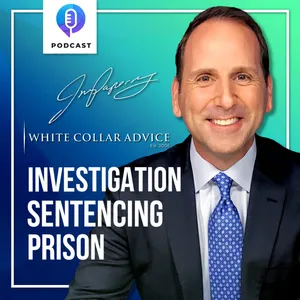
Free Daily Podcast Summary
White Collar Advice: Daily Summaries Delivered
by Justin Paperny
Whether you're a defense attorney, a criminal defendant, or someone eager to learn about sentencing, federal prison, and white-collar crime, our podcast is an excellent resource. It's never too soon or too late to begin preparing for a government investigation, and here's why: Statistics demonstrate the potentially life-altering consequences of encountering the criminal justice system. Beyond the initial indignity of an arrest or the notification of a criminal investigation, those targeted by law enforcement face additional challenges: How will this situation impact my career and earning capacity? What changes will my life undergo if I receive a federal prison sentence? How will my family members be affected by my term of confinement? In the face of such complex challenges, consulting with a competent defense attorney is crucial (please note we are not lawyers and do not offer legal advice). A skilled attorney will guide the criminal justice process and help individuals navigate these issues.
Latest Episodes
The most recent episodes — sign up to get AI-powered summaries of each one.
- 5 days ago8 min
Going to Prison Does Not Qualify You to Give Advice
A journalist writing about white collar crime sent me about 50 questions before our call. We cut it to 25, and I answered the first three here. Who I am and why anyone should listen to me: going to prison does not qualify you to give advice, and neither does failing. What matters is what you did with the experience and whether you built a record someone can look at. How I went from USC and Bear Stearns to federal prison: not one decision, but pressure, opportunity, and rationalization, convincing myself I was the good guy while I took commissions I was not entitled to. And whether I deserved prison: I know I deserved consequences. I broke the law, I hurt people, and even though the victims got their money back, it did not replace the shame and pain they went through.
- 1 weeks ago1 min
Why I Told This Lawyer Not to Ask for Probation
I got a call from someone new to our community, asking me to speak with his lawyer, a guy with more MVP awards than Michael Jordan, Kobe Bryant, and Magic Johnson combined. Two things stood out. The defendant didn't know his own guidelines were more than seven years, even after signing a plea agreement with points and restitution; how do you sign that and not know your number? And of course, he didn't want to go to prison. We got into what the government wants versus what the defense should ask for, and the lawyer told me, I'll do whatever you want me to do. I told him if the government wants more than seven years and you ask for probation, that gap is too wide; the judge will want to know what you're doing about making amends, accepting responsibility, and the victims who want punishment. You don't hire a lawyer with that resume so he can hand the decision back to you. You hire him to lead, research the judge, and not make a request that angers the judge and gets your client more time.
- 1 weeks ago1 min
USC vs North Carolina and the Ghost of 1995
I look back on playing baseball at USC, where making the travel roster to Stanford felt like a big deal. I remember grounding out weakly against Cal State Fullerton reliever Mark Kotsay, who went on to a 17 year career in the majors, and the years I spent punishing myself over that at bat, a regret that followed me into federal prison. Today USC plays North Carolina for a shot at returning to the College World Series for the first time since 2001; back in 1995, my own USC team lost the national championship game to Cal State Fullerton. I tell this year's team to embrace it, win or lose, because the stage itself shapes the rest of your life. I'm proud to be a Trojan and I'll be watching, pulling for the win.
- 1 weeks ago1 min
Her Father's Money Came With Two Conditions
On my way back from Santa Barbara, I stopped near Ojai and met with a woman whose husband had just surrendered to federal prison for ten years. I write about this meeting in my new book, After the Fall, chapter 14. She knew he was under investigation but not how severe; he kept her in the dark, and she expected two or three years, so everyone was stunned when they heard a decade. Every time he calls from prison he tells her he's sorry, but that doesn't help her manage the kids, the bills, the fallout, and the shame. She finally reached out to her father for money. He said yes, but not as a loan: he wanted her to immediately divorce her husband and go back to her maiden name.
- 1 weeks ago1 min
Just Get Him Home, She Said For Years
Every time we spoke, she'd say just get him home from federal prison. Before he went in, her husband blamed the court, the lawyers, the judge, and the co-defendant who cooperated against him. In prison he complained about his bunkie, the food, the commissary, his job, and asked why he was in a camp with no fences when he owed restitution. After he came home he complained about his probation officer, the restitution amount, how she was parenting their kids, and the dinner she cooked. About nine months after his release, she quietly told him: my life was much easier when you were in prison.
- 2 weeks ago1 min
He Called Me Before the FBI Did. He Still Got 6 Years
Nearly three years ago I spoke with a man who told me he was embezzling money. He was not the target of an investigation. I told him to stop the bleeding and not make it worse, and I referred him to five lawyers. He didn't call one. He had convinced himself, the way I once did, that another wire and another quarter would fix it and no one would know. He didn't fix it. The losses doubled. More victims, an indictment, a guilty plea, a conviction, and more than six years in federal prison. When we spoke again, he told me he wished he had taken my advice three years ago.
- 2 weeks ago1 min
Ippei Blamed Shohei in His Letter to the Judge
Someone new to our community asked how Ippei got 57 months while his co-defendant, Matthew Boyer, got a year and a day. I told him it's not the right comparison. Ippei stole $16 or $17 million, and even if Shohei is the greatest athlete in the world and a billionaire, he's still a victim, and the case did real damage to his brand. But look at how the two men responded. Ippei blamed Shohei in his letter to Judge Holcomb; I read that letter and made a long YouTube video about it. Matthew treated it as an evidence challenge instead of a legal one. He built a narrative about what he would do going forward, volunteered with Prison Professors, and spoke at business schools including USC about the consequences of cheating. I attended both sentencing hearings and filmed a video right after Matt's, reciting what Judge Holcomb said. Judge Holcomb is cynical. He expects defendants to say one thing and do another.
- 2 weeks ago1 min
The SEC Didn't Get Through to Me. Prison Did.
When I went to federal prison I got the severity of my conduct. Standing for count, the 2 a.m. fire drills, visiting with crying parents. You realize maybe you can do better. When I settled with the Securities and Exchange Commission, really a toothless agency, I didn't get it. I had to go inside. I think that's the case for a lot of people serving time for very small frauds, $10,000 to $50,000 in PPP fraud, and for the many who go to prison for obstruction with no financial loss at all. If you reward bad behavior, if you go to prison and get clemency you didn't earn, you come home and keep breaking the law, like George Santos did. He bet on Kalshi, the prediction market, got caught, they took $17,000, and he's banned from those markets. People go to prison for $17,000. There's no consequence for him, so he's going to continue. Prison worked for me because I understood the severity of it. Santos went to prison and got clemency, so he can keep breaking the law knowing he will never go back. It is indeed a two-tiered system of justice, them and us.
Get White Collar Advice summaries in your inbox
Free AI-powered daily recaps. Key takeaways, quotes, and mentions — in a 5-minute read.
Get Free Summaries →Free forever for up to 3 podcasts. No credit card required.
You Might Also Like
Listeners also like.

Public Defenseless
A deep look at flaws in the criminal legal system through interviews with defense attorneys and justice reform advocates.

Locked In with Ian Bick
Former inmates, law enforcement, and legal professionals share stories of hardship and resilience within the criminal justice system.

Court Junkie
Covers wrongful convictions and unsolved crimes by analyzing court documents, attending trials, and interviewing affected individuals.

Doing Justice
A former U.S. attorney examines high-stakes legal cases and the moral dilemmas behind prosecuting powerful figures.

The Counsel
A former prosecutor analyzes high-profile legal cases and the intersection of law, politics, and current events.

Swindled
Explores white-collar crime and corporate misconduct through immersive storytelling and archival audio.

Main Justice
Veteran prosecutors analyze how the Department of Justice operates under Trump’s administration and its impact on U.S. law and democracy.

Stay Tuned with Preet
A former U.S. attorney analyzes legal issues and interviews experts on power, policy, and justice.

Brief Recess: A Legal Podcast with Michael Foote & Mélissa Malebranche
Two lawyers dissect viral legal stories, answer listener questions, and explain how to use the law for social change.

The Prosecutors
Two prosecutors analyze infamous cold cases, offering insider perspectives on true crime mysteries.

The Trial: USA
Analyzes major criminal trials through court transcripts, interviews with investigators and experts, and detailed courtroom evidence breakdowns.

Law and Chaos
Legal journalists analyze pivotal courtroom cases and their impact on American democracy.
About White Collar Advice
Whether you're a defense attorney, a criminal defendant, or someone eager to learn about sentencing, federal prison, and white-collar crime, our podcast is an excellent resource. It's never too soon or too late to begin preparing for a government investigation, and here's why: Statistics demonstrate the potentially life-altering consequences of encountering the criminal justice system. Beyond the initial indignity of an arrest or the notification of a criminal investigation, those targeted by law enforcement face additional challenges: How will this situation impact my career and earning capacity? What changes will my life undergo if I receive a federal prison sentence? How will my family members be affected by my term of confinement? In the face of such complex challenges, consulting with a competent defense attorney is crucial (please note we are not lawyers and do not offer legal advice). A skilled attorney will guide the criminal justice process and help individuals navigate these issues.
Customized Recaps
AI-powered recaps with compact key takeaways, quotes, and insights.
Straight to Your Inbox
Get key takeaways from White Collar Advice in a 5-minute read.
Save Hours Every Week
Stay current on your favorite podcasts without falling behind.
Frequently Asked Questions
What is Podzilla's White Collar Advice daily summary?
It's a free AI-powered email that summarizes new episodes of White Collar Advice as soon as they're published. You get the key takeaways, notable quotes, and links & mentions — all in a quick read.
How does the White Collar Advice podcast summary work?
When a new episode drops, our AI transcribes and analyzes it, then generates a personalized summary tailored to your interests and profession. It's delivered to your inbox every morning.
Is this an official White Collar Advice product?
No. Podzilla is an independent service that summarizes publicly available podcast content. We're not affiliated with or endorsed by Justin Paperny.
Can I get summaries of other podcasts too?
Absolutely! The free plan covers up to 3 podcasts. Upgrade to Pro for 15, or Premium for 50. Browse our full catalog at /podcasts.
How often does White Collar Advice release new episodes?
White Collar Advice publishes every few days. Our AI generates a summary within hours of each new episode.
What topics does White Collar Advice cover?
White Collar Advice covers topics including Education, Business, Careers. Our AI identifies the specific themes in each episode and highlights what matters most to you.
Start getting White Collar Advice summaries tomorrow morning.
Free forever for up to 3 podcasts. No credit card required.
Free forever for up to 3 podcasts. No credit card required.