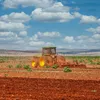
A tractor can plough an acre of Kenyan maize land in about an hour and a half. By hand, it takes a farmer nearly a week. Few smallholders can afford to buy a tractor, so they rent one. The tractor’s owner often lives in town, and employs an operator to drive the tractor to the fields and do business. To minimise risk, the owner keeps their tractor close to home, even when the best work is far away.Sophie Nottmeyer studied what changed when owners could observe exactly where the tractor was. She used GPS records from about 1,200 tractors fitted with a tracking app from the start-up Hello Tractor, covering close to a million fields, and satellite images of the land they worked. As owners learned to use the app, their tractors travelled further, finding better business opportunities. A year after adoption, they worked about 55 km further from home than in their first month.Nottmeyer presented the research at STEG's sixth Annual Conference in Nairobi in January 2026. She tells Tim Phillips what satellites reveal about the fields the tractors reached, and why a fuel subsidy that did the same job would cost hundreds of times more.The research behind this episodeNottmeyer, Sophie. 2025. "Trac(k)tors of Change: Monitoring, Tractor Mobility and Agricultural Mechanization in Kenya." Working paper, November 2025. A summary is available as a STEG policy brief: "Following the tracks: how digital monitoring expands access to agricultural mechanisation across space" (2026).To cite this episodePhillips, Tim, and Sophie Nottmeyer. 2026. "Tracking Kenya's tractors." Conversations on Transformation (podcast).About the guestSophie Nottmeyer is a Research Economist in the Directorate General of Economic Research at Banco de Mexico. She was previously a Postdoctoral Researcher at Universitat Pompeu Fabra in Barcelona, and holds a PhD in Economics from CEMFI in Madrid. Her research spans market access, organisational frictions and informal institutions, and how they interact with geography and climate. She has also worked with remote-sensing scientists to estimate maize yields in Kenya from satellite data.Research cited in this episodeHello Tractor is an agricultural technology company based in Nairobi. In 2018 it introduced a GPS tracking device for tractors, fitted by a mechanic, with a mobile and web app that shows owners where their tractor is in real time. The app reports how many jobs the tractor did, how many acres it worked, how long it ran and how far it drove, and it can replay the tractor's exact path across a field. In 2023 owners paid US$125 to install the device and US$60 a year to use the app. Nottmeyer's data cover every job done by tractors that adopted it between 2018 and 2025, about 917,000 in total.Moral hazard arises when one party cannot observe what another does on its behalf. Kenyan tractor owners hire operators, who are often paid from the revenue they collect. Because the owner cannot see how many acres were ploughed, an operator can under-report jobs, take unauthorised work or use fuel for other purposes. Owners respond with surprise visits, fuel checks and rules that the tractor must come home every night. All of these work only if the tractor stays nearby. The problem is sharper because many owners are not farmers at all; according to Kenya's 2019 census, 33% of tractor owners live in cities.Misallocation describes an economy in which capital or labour does not go where it would produce the most. Chang-Tai Hsieh and Peter Klenow showed in "Misallocation and Manufacturing TFP in China and India" (Quarterly Journal of Economics, 2009) how large the cost of such gaps can be. Nottmeyer measures misallocation as the spread in the returns that tractors earn in different places. If a tractor would earn more in a distant district than near home, but never goes there, the economy loses output.Counting Kenya's tractors is harder than it sounds. No official source records tractor ownership or use, Kenya's last nationwide agricultural census was in 1979, and the Food and Agriculture Organization stopped publishing its global series on agricultural machinery in 2009. The roughly 1,225 tractors in Nottmeyer's data represent between 1.73% of the tractors counted by the 2019 census and 8.75% of the last FAO figure, from 2008.Comparing each tractor with itself is how Nottmeyer deals with the lack of a control group. The data begin only when a tractor adopts the app, so she uses each tractor'
Podzilla Summary coming soon
Sign up to get notified when the full AI-powered summary is ready.
Free forever for up to 3 podcasts. No credit card required.
Listen to This Episode
More from VoxDev Development Economics
S7 Ep57: Skipping the factory

S7 Ep56: Why democracy alone does not build effective states

Ideas in Development: Ken Opalo on the research Africa needs

S7 Ep55: Armed groups as states: Taxation, security, and civilian support
Get summaries like this every morning.
Free AI-powered recaps of VoxDev Development Economics and your other favorite podcasts, delivered to your inbox.
Free forever for up to 3 podcasts. No credit card required.